“Bobby” Isn’t Calamitous

The local Toronto word on Emilio Estevez‘s Bobby (Weinstein Co., 11.17) has been pretty bad for the last two or three days, and so I went into this morning’s screening pumped and ready to scoff. But the old reverse-negative effect kicked in and I wound up not hating it too much.
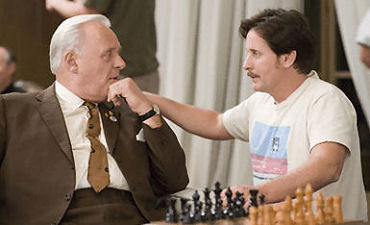

Bobby Anthony Hopkins, director-writer-costar Emilio Estevez .

Much of Bobby is treacly and mediocre and some of it might make you shudder, but it’s not altogether grotesque. It’s reasonaby well-shot and cut, it has a few smallish moments that work, and there are some saving grace moments near the very end.
Archival footage of the late Senator Robert F. Kennedy is basically what saves it, along with a recording of an eloquent and very moving speech that Kennedy gave about the persistent presence of violence in American life. Despite the best of intentions and the worst of consequences, Bobby fails to undermine the actual Kennedy mystique. There’s a lingering potency to the RFK legend — who he was, what he said, the metaphor of his life and how it ended.
Otherwise It’s true what people gave been saying about Bobby — it is Love Boat ’68 at the Ambassador Hotel, and that in itself makes it pretty gruesome to sit through, but if you can get past that…
Let’s try again: if you can sit back and go with the fact that Estvez is going to try and make you feel the allure of Kennedy’s Presidential primary campaign as well as the terrible shock of his murder on the night of June 4, 1968, by making you feel how it was to be an average person muddling through in ’68, and that Estevez will try for this immersion by showing you a series of Love Boat relationship stories — and I mean stories and situations that do nothing to illuminate or inform anyone about Kennedy or his ideals…if you can kick back and say, “Okay, I can roll with this…I’m ready to accept the banality of this approach,” then Bobby isn’t half bad.
I had been prepared, see, so I was ready for the worst. I first read the phrase “Love Boat ’68” in that John Ridley-authored Esquire piece that ran earlier this year. So when Bobby turned out to be tolerably pedestrian — not awful or atrocious, but mediocre in a familiar, TV-drama sort of way — it was like, “Whoa…!”
What’s especially funny in the Ridley piece is his description of the disputes over finance and script-trimming between Estevez and Bold Films owner Michel Litvak, who not only made sure that his wife, the Russian-born Svetlana Metkina, was given a part in the film but managed to arrange for her to appear in “more scenes” just as principal photography was about to begin.
Sure enough, Metkina is in the film and to be honest, she’s not half bad as a Czechoslovakian journalist looking to wangle an interview with RFK.
It isn’t the performances that are terrible — it’s the 1980s Aaron Spelling-level material. Anthony Hopkins exudes a certain courtly dignity as a longtime Ambassador Hotel employee coasting on memories. Christian Slater isn’t too bad as a racist kitchen-employee supervisor. Laurence Fishburne actually does pretty well with a couple of decently written scenes about racial politics. Elijah Wood is tolerable as a draft-dodger. Freddy Rodriguez does a decent job as the Latino bus boy who cradled Kennedy’s head as he lay on the kitchen hallway floor with a 22 calibre bullet in his brain.
Demi Moore is…well, not bad as a drunken lounge singer. William H. Macy plays a randy but fair-minded hotel manager with a certain sensitivity. Sharon Stone overacts as a hairdresser with false eyelashes and loads of mascara. Helen Hunt is a pampered wife of an older rich guy, played by Martin Sheen. Lindsay Lohan and Heather Graham give passable performances also.
Ashton Kutcher‘s hippy-dippy drug dealer gives the only really bad performance, although “silliest” or “most embarassing” is a more accurate way to put it.

“Fire” at the Elgin

Screen a film about a real-life character who endures some kind of prolonged, life-threatening hell only to emerge alive and healthy at the end of the trail, and you’re almost certainly going to move people. Show this very same film at a public screening at the Toronto Film Festival, and when the lights come up people are going to rise to their feet and cheer with lumps in their throats and eyes rimmed with tears.


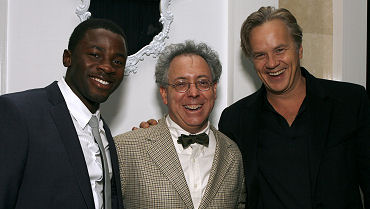
(l. to r.) Catch a Fire star Derek Luke, Focus Features honcho James Schamus, costar Tim Robbins at Lobby four days ago.

This is what happened at last Sunday’s (good God…four days ago) screening of Phillip Noyce‘s Catch a Fire (Focus Features, 10.27). I heard about it at the after-party at Lobby, and it sounded right because I’d had a similar reaction myself when I saw a longer version of Noyce’s film a few months ago.
Fire is the real-deal tale of Patrick Chamusso (Derek Luke), a South African factory worker and family man who was essentially goaded into becoming an anti-apartheid radical after he was falsely accused of being a domestic terrorist, and thereafter bullied and terrorized, by a South African secret policeman (Tim Robbins) and his goon squad.
The story concludes with Chamusso blowing up an oil refinery and then getting popped and sent to prison, only to be set free after the white-run South African government is voted out of power.
The emotional payoff happens at the very end when Noyce stages a real-life, happy-ending greeting between Chamusso, Luke and himself — everyone relieved and hugging each other and looking forward to a fair and just future. And then Chamusso addresses the camera and tells what his life has been like (generally happy, running an orphanage) since he got out of prison.
I wasn’t at the Elgin to witness the lights coming up and a spotlight finding a certain gentleman in an upper balcony and a loud voice announcing, “Ladies and gentlemen, Mr. Patrick Chamusso!”…but The Envelope columnist Tom O’Neill was, and he described it pretty well the other day so here it is.


Luke, Breaking and Entering director Anthony Minghella.

I tried to run photos of the Catch a Fire after-party the next morning, but it took two days to finally get them sent to me free and clear withut any password mucky-muck,and by that time my focus and momentum were elsewhere. Whenever I take my own photos the process is always cool and easy and fast — whenever I ask publicists or staff photographers to send me photos it’s always tedious and time-consuming…no offense.
I’ll get into Catch a Fire at greater length in two or three weeks. It’s a significant accomplishment to just get this much posted. Everything it taking three our four times longer to write than it usually does. I’m so whipped and fried that I’m starting to get angry about it.

Consideration Blahs

Christopher Guest‘s For Your Consideration (Warner Independent, 11.17), which I saw two or three days ago, is a low-budget ensemble satire about how Oscar-nomination fever belittles and humiliates would-be nominees (and actors in particular). I chuckled here and there (just like I chuckled at A Mighty Wind and Best in Show — Guest’s comedies never really make me quake with laughter), but Consideration feels lazy and second-tier-ish at every turn. Everything feels whimsical, smug, underdeveloped.
To laugh at satire you have to half-believe in the reality of the piece in order to suspend disbelief. But everything about this film feels strained, hokey, small-timey. A single internet rumor about a middle-aged actress’s (Catherine O’Hara) supposedly quality-level performance in a flat-footed period drama triggers a torrent of interest, traction and hype — and not just about O’Hara but her costars (Parker Posey, Harry Shearer), the sum of which stirs dreams of greater glory and re-energized careers.
I get the notion that Guest’s humor is always framed in mock-ironic quotes. What I don’t understand and find frustrating is why it’s so hard for him to create semi-believable plot lines, textures and details that help sourpusses like myself to get into the mood.
At best For Your Consideration is sporadically amusing — I’m amazed that people are calling it “hilarious,” “inventive,” “on-target”, etc. It’s really not any of these things, or at least not consistently. Guest’s The Big Picture, his other Hollywood-expose film that opened 17 years ago, was much more incisive.
It seems as if Guest has gotten caught up in making movies for the Chris Guest players — Ed Begley, Jr., Eugene Levy, Michael McKean, O’Hara, Posey, Shearer, Fred Willard , et. al. — and is so enjoying the making of these films and is sufficiently content with the amount of money they’re making that he’s just not trying all that hard.
I realize there are a lot of viewers and readers who think Guest’s material is drop-dead hilarious. (A lot of them went after me when I shrugged at A Mighty Wind.) I don’t want to see the Guest juggernaut go bust — I’m glad there’s a significant-sized audience that likes his films. I just wish he’d sweat a bit more when he writes and shoots them.

Script reviews

I don’t see what’s so heinous about the L.A. Times launching a column — “Scriptland” by Jay Fernandez — about script reviews.
Various online columnists (Stax, Drew McWeeny, myself) have done the same thing for many years, and the Times is just looking to jump on the same boxcar. It’s mildly flattering in this sense. I think that Variety was the last major print publication to take a stab at script-reviewing — editor Peter Bart riffed about two or three back in the mid ’90s, if memory serves.
My only rule is not to review a script that disappoints or otherwise doesn’t seem that exceptional.
I’ll never stop wanting to read (or read about) the hot new scripts, but I’ve begun to appreciate more fully over the last couple of years how reading them can lead, almost more often than not, to disappointment with the finished films. The unavoidable tendency, of course, is to cast and direct the film as you’re reading the script, and a lot of times the movies I’ve “directed” have seemed, in restrospect, better than the actual ones. (This syndrome had a something to do with my initial reaction to Wes Anderson‘s The Royal Tenenbaums.)
The other side of the coin, sometimes, is a script seeming moderately okay or pretty good, and then the movie turjing out much better. This, for me, was the case with the script of Anderson and Owen Wilson‘s Rushmore — enjoyable as the script was, the movie was twice as good. There are also instances in which scripts read fairly well with a need for some polishing, as was the case with Cameron Crowe ‘s Elizabethtown…and then the movie comes along and very little of the script’s charm has survived, much less been built upon.

Toronto pics #5


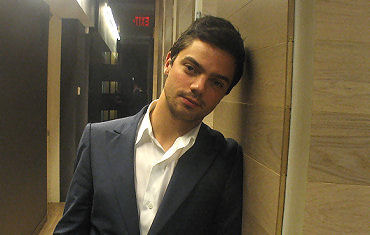
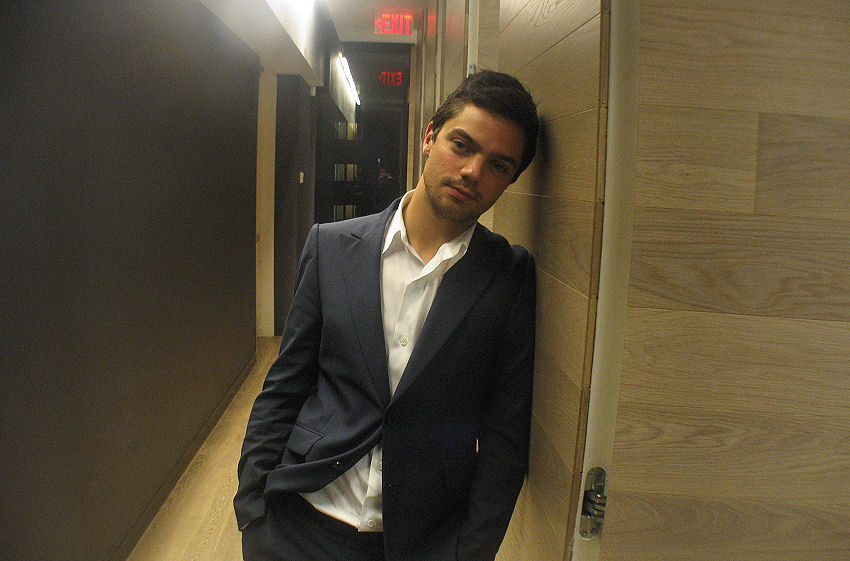
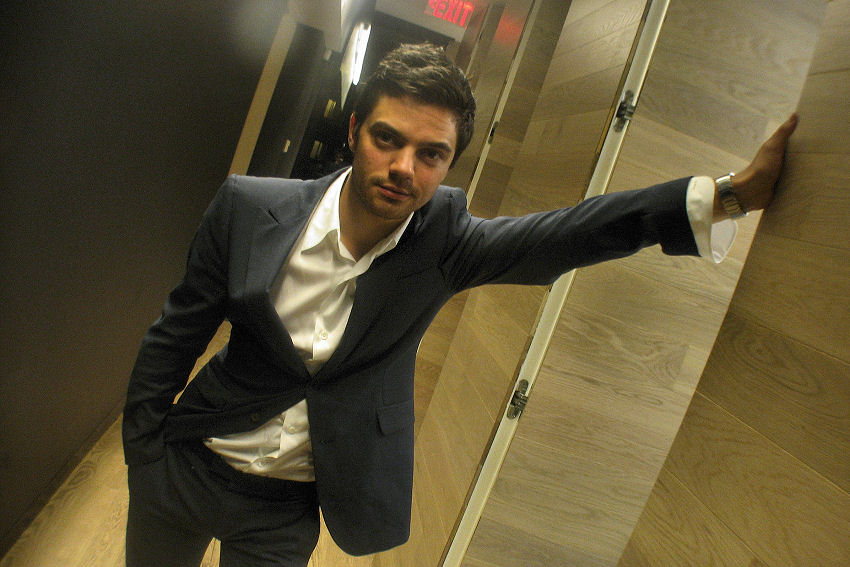
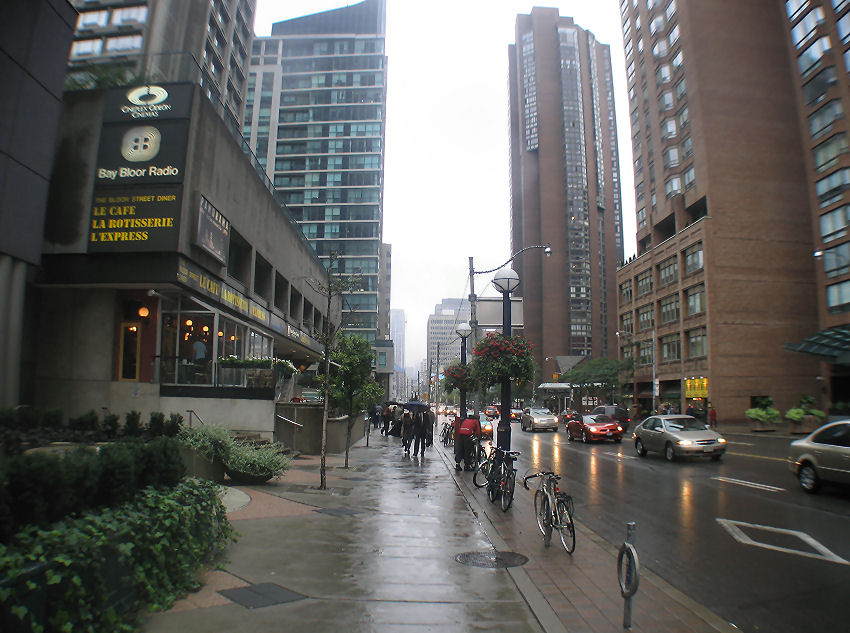
British actor Dominic Cooper at a Picturehouse/HBO dinner party last night (i.e., Wednesday) for a mezzo-mezzo, ’80s-soundtrack-driven release called Starter for Ten — more importantly Cooper is one of the key players in the film version of Nicholas Hytner’s The History Boys (Fox Searchlight, 11.24)…I saw him perform in the play on Broadway last May, and he’s definitely one of the two or three standouts; Bay Street just south of Bloor during Wednesday’s rainstorm; Bay Street facing south; the Vanity Fair Cruise, Katie and Suri issue was getting all kinds of attention at the beginning of the month, and here it is almost two weeks later and one of Toronto’s best book stores still has the Kate Moss issue.

Lohan Blues

Jane Fonda told an Access Hollywood interviewer that Morgan Creek honcho James Robinson was right to chastise Lindsay Lohan several weeks ago for missing work on Georgia Rule due to nocturnal running around. “It’s hard after a while to party very hard and work very hard,” Fonda reportedly said. Same thing goes for Toronto Film Festival journalists like myself doing the 17-hour per day frazzle. I’m sitting here in the TIFF press room trying to catch up on all the stuff I should have written on Tuesday and Wednesday but didn’t due to too many screenings, an inability to write faster, insufficent hours, one or two exquisite dinners too many and all that. I have been, in a sense, Lindsay Lohan, and I feel a need to plead guilty to this before moving on.