Glorious Jacks Pops in Cannes, But It Didn’t Look Like 1.85

The first-anywhere unveiling of the restored version of Marlon Brando‘s One-Eyed Jacks happened late last night, and it looked truly wonderful in every respect.  Yes, that includes the aspect ratio. I’ve been arguing that the restorers, Universal Home Video and The Film Foundation, should have gone with a somewhat more liberal 1.75 or 1.78 a.r. instead of an announced cropping of 1.85. My tried-and-true “why needlessly slice off that luscious head room?” argument was posted time and again.

Well, guess what? The Jacks a.r. didn’t look like 1.85 to me — it definitely looked more like 1.75. Speaking as an ex-projectionist and an a.r. fanatic second to none I know exactly and precisely what 1.85 vs. 1.75 are shaped like, and I’m telling you there’s an ample amount of headroom in every shot. To my enormous relief Jacks didn’t feel cut off or cramped in the slightest. And that, to me, spells 1.75.

My guess is that the film was indeed shown at 1.75. I was sitting right there in the second row, repeatedly calibrating the a.r. with my eye and my gut, tilting my head 90 degrees to the right and assessing the geometry, and I can’t accept that what I saw last night was cropped at 1.85. My guess is that the film was screened at 1.75 (the French have their own ways) but that the Bluray will pop at 1.85, or with a tiny bit less height. I’ve got an email out to Universal’s Peter Schade and The Film Foundation’s Margaret Bodde (both of whom delivered opening remarks) to suss this out.

Read more

The Big Chill

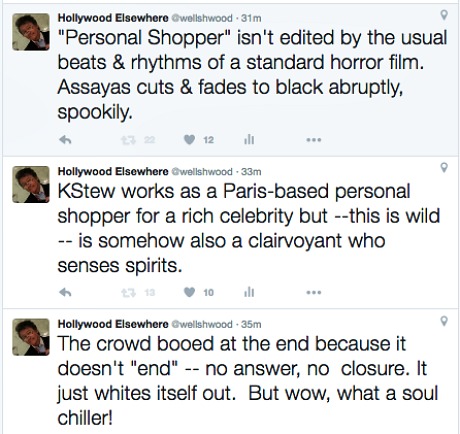
I have to leave for the Salle Bunuel for the 10:30 pm One-Eyed Jacks screening but first I have to at least post my tweets about Olivier AssayasPersonal Shopper, which broke around 40 minutes ago. The mostly Paris-based ghost story starring Kristen Stewart as (I know this sounds strange) a combination personal shopper and clairvoyant. which broke around 90 minutes go. More of a spooker than a “horror film,” but absolutely fresh and world-class in that realm. On par with Robert Wise‘s The Haunting, and I don’t care if every Tom, Dick and Harry agrees with me or not. (My flat-mate didn’t care for it.) This is a knockout, trust me.

Paterson-Residing Guy Named Paterson Drives a Bus, Writes Poetry, Accepts The Spirit Within The Mundane

I’m presuming there are hundreds of thousands of youngish or middle-aged people out there who are more or less content to live modest lives of regularity and security in minor, out-of-the-way burghs. There are, of course, many more who dream of The Life Kardashian — fame, stardom, super-wealth. So in this era of grotesque values you have to chuckle if not guffaw about Jim Jarmusch having made a film that basically says (a) “fuck all that,” (b) “turn it down and plant spiritual growth seeds” and (c) “dare to be dull in the ironic sense of that term.”

Paterson is about a lanky young bus driver (Adam Driver) and his Iranian wife Laura (Golshifteh Farahani) who live with a subversive prick dog named Marvin in a small dumpy house in Paterson, New Jersey and generally follow routines of almost astounding modesty — not hanging with friends, not partying, not doing Manhattan clubs on weekends…none of that.

Well, maybe Laura would like a little fun and frolic but Driver’s guy, who of course is also named Paterson, doesn’t even own a smart phone. All he wants is to write poetry in a little composing book. During work breaks, evenings in the cellar. Not to become “famous” but to one day write one-half or even one-third as well as famed Paterson poet William Carlos Williams. The quiet writing life and a general reverence for poetry becomes more and more of a thing as the film develops. Paterson itself is trying to be a kind of small, minimalist poem.

Read more

If Mike Nichols Could Protest

A curious claim about the late Mike Nichols is made in a 5.15.16 L.A. Review of Books piece by Manuel Betancourt (“Mike Nichols’s Disappearing Act”). He writes that “Nichols’s aesthetic (or lack thereof) denied him access to the most enduring of film studies labels, that of auteur. [Because] if there was a signature to be found in his films, it was perhaps that he had none.”

Betancourt mentions that Bruce Weber‘s N.Y. Times obit stated that Nichols “did not create a recognizable visual style or a distinct artistic signature.” He also writes that “Nichols’s direction is often seen as one that merely gets out of the actors’ ways,” and that his films are known “for [a] lack of obvious visual flourishes (no dolly zooms, no distracting jump cuts) that suggest a transparent style that attempts to mimic the mere observation of reality.”

In fact Nichols was known for an unmissable auteurist signature that he relied on for about eight years (’67 to ’75) — the static, ultra-carefully composed, long-take visual scheme that defined The Graduate, Catch 22, The Fortune and particularly Carnal Knowledge.

I explained it in my 11.20.14 Nichols obit. The long-take observation was passed along years ago by longtime Nichols collaborator Richard Sylbert. This signature, Sylbert believed, was what elevated Nichols into the Movie God realm.

Read more

Top Gun Is 30 Years Old, Man

“On a thematic level, Top Gun is all about machismo (a major theme in all of Tony Scott’s work), and how men deal with expectations, loss, tragedy, acceptance and success. Those classic scenes in the shower (or during a particular game of beach volleyball) seem homoerotic in hindsight, but what they’re really about is men trying to one up each other, trying to figure out how to best your opponent, and always remembering that there are no points for second place.

“To say that Top Gun is one of the most macho movies ever made would be understatement; you can practically smell the testosterone on the set. I’ve often wondered if PA’s were kept solely for the purpose of spraying down the actors with water in order to simulate excessive sweat, because everyone is glistening in this film.” — from an essay by HE’s own Nick Clement about the 30th anniversary of Top Gun.

Loving Gets A Pass

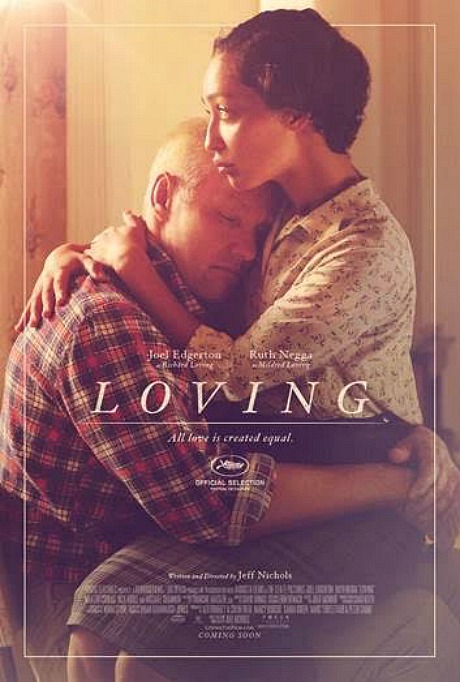
I had slight forebodings about Jeff NicholsLoving, which screened this morning at the Cannes Film Festival. Mainly whether a dramatization of the once-controversial interracial marriage between Mildred and Richard Loving would amount to anything more than a rote retelling. And I worried that the combination of Southern drawls (particularly Joel Edgerton‘s) combined with the notoriously bassy sound system in the Grand Lumiere would make for difficult listening.


Joel Edgerton, Ruth Negga in “teaser” poster for Jeff Nichols’ Loving.

Well, the film is slightly better than I expected. A warm, measured, adult-level thing. I wasn’t doing handstands in the lobby but I was telling myself “hmmm, okay, not bad.”

It’s less fact-specific than I would have preferred, and there’s the usual emphasis on emotional rapport and interplay and fine, nicely underplayed performances, my favorite being Ruth Negga‘s as Mildred. And at 123 minutes it feels maybe 20 minutes too long. And if you’re at all familiar with the facts or if you happened to catch Nancy Buirski‘s The Loving Story, a 2012 HBO doc, it’ll be hard to avoid a feeling of being narratively tied down.

But Loving is a compassionate, plain-spoken, better-than-decent film that will amost certainly pick up some award-season acclaim, particularly some Best Actress talk for Ms. Negga’s kindly, sad-eyed wife and mom. I suspect she’s the hottest contender right now for the festival’s Best Actress prize.

Read more