
Open Letter to Personal Shopper Loyalists

HE to Guy Lodge, Richard Lawson, Eric Kohn, Stephanie Zacharek, Peter Bradshaw, Robbie Collin, Tim Grierson, Jake Howell and others who were hugely impressed by Olivier AssayasPersonal Shopper: We were all knocked back when it played in Cannes five weeks ago, but a few too many critic friends have since told me “nope, not for me, didn’t care for it,” etc. And yet some of these same naysayers liked or even loved The Conjuring 2, which operates way, way below the level of Assayas’ film. And that, to me, is appalling.
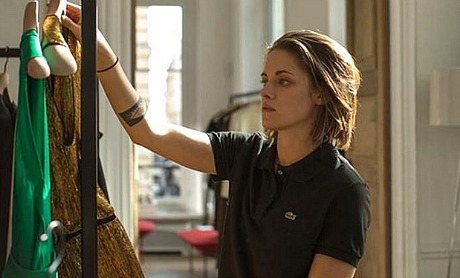
All I can figure is that Personal Shopper is too antsy and schizo for some people. It’s too teasing and darting and inconclusive. It doesn’t behave like other ghost stories, and some just don’t know what to do with it. So they toss it and wash their hands.

Have any of you thought about the schism between admirers and dissers? What are your thoughts? What’s going on here?

There’s not the slightest doubt in my mind about how uniquely chilling and riveting this film is — it’s my second favorite film of the year after Manchester by the Sea — and how stunningly good Stewart’s performance is. And yet two or three days ago Tom Luddy and Julie Huntsinger of the Telluride Film Festival were both telling me how they didn’t care for it. C’mon!

I posted a short “Friends of Personal Shopper” piece in Cannes on 5.17, but here’s a more comprehensive rundown of the best raves:

Personal Shopper is strange, frightening, and possessed of a dark ribbon of sadness that no champagne gulped down at a post-screening beach party could drown out. There are certain scenes — scored by ominous thuds and whispering wind — that are so frightening that they were, for this wimp, extraordinarily hard to watch. A horror movie with a matte, flat-faced demeanor [and] a grief drama with a shiver of sylphic humor, Personal Shopper is as cathartic as it is terrifying, as knowing and wise about the weirder mechanics of the grieving process as it is utterly confusing.” — Richard Lawson, Vanity Fair.
Read more

If You Say So

Executive produced by Brian Grazer and directed by Ron Howard, Eight Days A Week is a doc about the four years of stage performances (’62 to August ’66) given by the Beatles. How special can this be? What don’t we already know? If the quality of the footage meets a certain restoration standard and the stories are good…maybe. A brief theatrical booking with a day-and-date Hulu debut on 9.15.

Certain Persons Need To Suffer

What kind of malevolent engineer would design an automobile gear shift that allows drivers to mistakenly presume they’ve shifted into park when in fact the car is in neutral? What kind of perverse organization would approve a gear shift design that would allow for this possibility? The mind reels.

This design flaw, implemented by the geniuses at Fiat Chrysler, is apparently what killed Anton Yelchin early Sunday morning. He thought he’d put his 2015 Jeep Grand Cherokee into park, but it wasn’t. And it rolled down his driveway and crushed him.

A N.Y. Times story says the flaw, which resulted in a recall earlier this year, is not just in Jeep Grand Cherokees but also Chrysler 300s and 2014-14 Dodge Chargers. When the recall was announced Fiat Chrysler said it was aware of 41 injuries related to the gear shift problem.

The story says that the affected vehicles “use an unconventional lever to shift the automatic transmission. Instead of moving to a different position with each gear, the lever returns to a center position. The driver must look at the shifter to make sure the proper gear is selected. ‘Drivers erroneously concluding that their vehicle transmission is in the park position may be struck by the vehicle and injured,’ Fiat Chrysler said in a May report to federal regulators about the problem.

Read more

Bicker Bicker

Earlier this afternoon I got into an email argument with a guy who’s heavily into predicting award-season favorites. Yes, this again. He hasn’t seen The Birth of a Nation or Manchester by the Sea, but he was saying that my views about these two films (both of which I saw at last January’s Sundance Film Festival) are overly passionate and biased in terms of foreseeing how they’ll be received when they open in the fall.

Me: People are going to think what they think, but there’s really nothing lower in the universe than people who turn away from obviously well written, superbly acted, reality-reflecting, fully-rooted films by muttering that they’re not feel-goody enough.

Awards guy: Not being able to see that a group can’t, won’t or doesn’t appreciate a film that you admire is exactly what I’m talking about. You have an inability to check your own bias. Plus you don’t respond well when people disagree with you and so instead of trying to convince them to your side, you get aggressive and insulting.

Me: It’s not “an inability to check my own bias.” It’s an absolute refusal to show respect for the opinions of people who want a certain kind of drug when they go to a film. Good stuff is good stuff, and I know the properties. I always have. It’s not an opinion — I know the difference between pyrite (fool’s gold) and the real material. And I couldn’t care less about predicting what the middle-of-the-road crowd is going to like or not like.

Awards guy: Oscar predicting is always a combination of zeitgeist, politics and good reviews vs. good press. Since the last two years of #OscarsSoWhite have generated some really bad press for the Academy there’s a strong chance that we’ll see an anomaly of black-centered films nominated next year. That would affect something like Manchester by the Sea vs. The Birth of a Nation.

Read more

In Case This Didn’t Sink in Earlier…

I ducked a few slings and arrows the other day when I declared I would never again sit through an animated feature made by corporate formula peddlers. I said that films like Finding Dory were basically “corporate-branded heroin for the family audience.” One guy called me an asshat for dismissing quality-level animation. But it’s not the craft I’m addressing but the underlying corporate sedative that runs through the veins of (most) animated features. I explained my feelings a little better about three months ago, to wit:

“On a certain level I believe that family-friendly corporate animation is almost demonic in that it has a subversive agenda. It delivers family narcotic highs when your kids are young, but it acts as a kind of childhood sedative that leads to placated thinking and zombie lifestyles. Corporate animation is mainly about injecting and reenforcing blandly positive, middle-class consumerist attitudes and values. Watch corporate animation as a kid, live your tweener and teenaged life in malls, sign a college loan that will keep you in a kind of jail for half your life, and eternally invest and submit to American McMansionism — an Orwellian system if there ever was one.

“Childhood was a huge gulag existence when I was a kid, and Disney mythology was a key aspect of that. Comforting but phony emotion dreams do you no good as a 7 year-old — you’ll just have to unlearn them when you get older. And my parents played right along. Everything they did and said to shelter me from things they felt I was too young for constituted a huge minus in the end. It took me years to unlearn the lessons and impressions they passed along in the name of parental compassion.

Read more

It’s Not Whether You’ve Been Dealt A Shitty Hand Or Not, But How You Respond To It…Right?

“That’s what dads do…they pass the best of themselves to their kids.” — Steve Gleason, the ALS-afflicted former football player, speaking in Clay Tweel‘s Gleason.

Actually, not quite. Good or well-meaning fathers try to pass along the best of themselves to their children, of course, but dads mainly influence their kids by example (hugs, gifts, scoldings and advice don’t count nearly as much as what the kid notices about your day-to-day behavior and particularly your responses to this or that challenge) and through their genes. The origin of Gleason’s condition, for example, may have come from his parents as roughly 5% to 10% of ALS cases are genetically inherited.

You can be completely loved with the wind at your back as you begin to make your way in life, and you can still get swatted like a fly. God routinely hands out random, tough-shit fates to the nicest people. Life is a crap shoot. The best people sometimes buy it by accident (poor Anton Yelchin) and other good ones live long, mostly happy lives, and some not-so-good ones live happily and high on the hog until well into old age. It’s a garden out there but also a slaughterhouse, depending on the breaks.

Read more

Live By Night Opening Limited In December

On 3.22 Variety‘s Dave McNary reported that Ben Affleck‘s Live By Night, a 1930s crime drama based on a Dennis Lahane novel, would open on 10.20.17, or roughly two years after it began shooting in Georgia. Sasha Stone and I visited the set, remember, during the Savannah Film Festival.

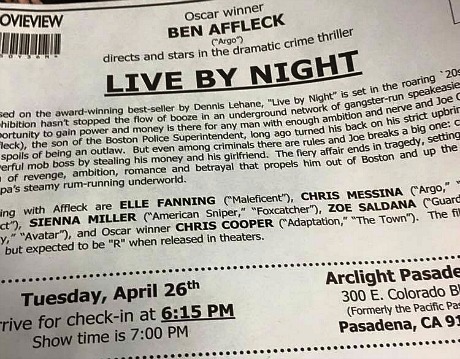
A little more than a month later (i.e., on 4.26) the film was research screened at the Pasadena Arclight. (Obviously the Warner Bros. person who told McNary about the October 2017 release date gave him a bum steer.) Live By Night was research-screened again on Tuesday, 5.24 at the AMC Burbank 16. A couple of days ago it was learned that the new release date is 1.13.17.

Which means, of course, that Live By Night will get an awards-qualifying run sometime in December. But it’s a period genre film, and you know how Lahane adaptations tend to go (i.e., respectable craft, strong genre materials, contained in their own realm).

Read more