Stormy Payoff Was Standard Procedure

Three days ago Newsweek reported that Common Cause has filed a complaint about the $130K paid to porn star Stormy Daniels (aka Stephanie Clifford) by Donald Trump‘s personal attorney Michael Cohen. The motive was to ensure Daniels’ silence about having had an affair with Trump in 2006.

The complaint alleges that the payment was an illegal campaign contribution or, according to a 1.22 Newsweek story, “an in-kind contribution, which would violate several campaign finance laws.”
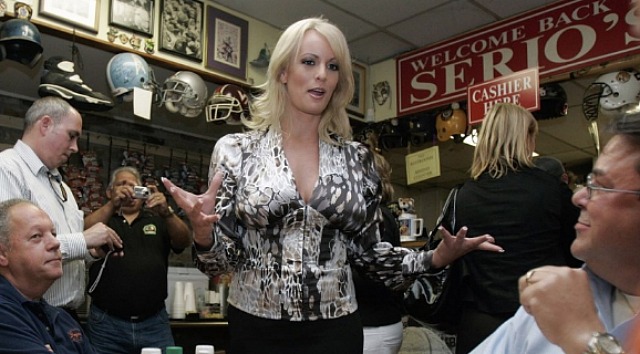
But think about this. Every presidential candidate’s staff has two main purposes — increase his/her chances of being elected and decrease his/her chances of being defeated. Squelching a story about Trump having indulged in a sexual affair with Daniels obviously decreased and increased. How could the $130K be anything other than a legit campaign expense?

Campaign funds weren’t spent for Daniels’ sexual services or some other sundry purpose — they were spent to prevent damaging information getting out about Trump. This is what campaigns do — spin or highlight positive information and obscure or suppress negative information about a candidate.
Read more

James Franco, Invisible Man

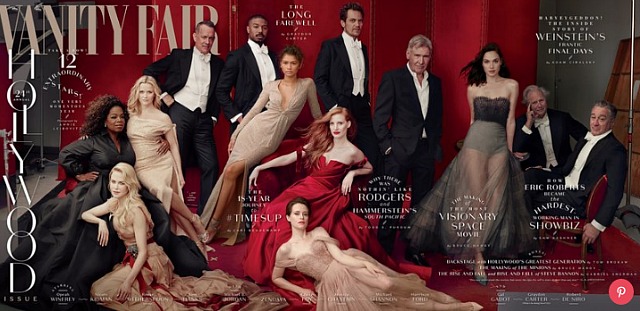
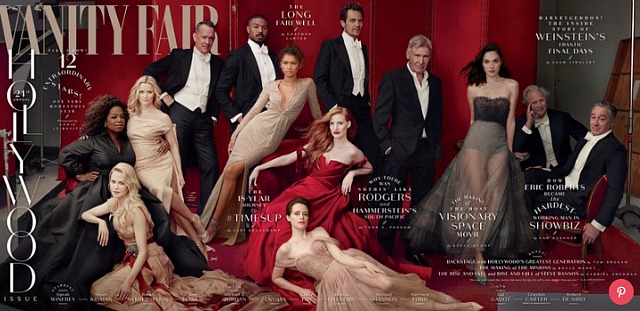
James Franco‘s un-person status in the Hollywood realm, a result of five allegations of sexual misconduct that broke on 1.11.18, led to his being digitally removed from Vanity Fair‘s special Hollywood issue cover, according to a story by The Hollywood Reporter‘s Chris Gardner.

“According to multiple sources familiar with the shoot, Franco sat for [the] photo shoot and interview and was to be featured in the magazine’s Annie Leibovitz-shot portfolio,” Gardner writes. “He was removed from the cover digitally, however, due to allegations of sexual misconduct that surfaced in the wake of his Golden Globe win for The Disaster Artist.

“Subjects for the Vanity Fair cover are often photographed separately in small groups and combined via digital imaging — Franco’s removal, then, did not require a reshoot. That said, it’s highly unusual for a star to be removed from an elaborate photo layout, especially so close to publication.”

What, Me Worry?

In a 1.25 Sundance Film Festival sum-up, N.Y. Times critic Manohla Dargis acknowledges that the festival “has been widely and rather a little too conclusively declared a disappointment before it was even over.”

I don’t want to assess things in a facile or simplistic way, but I haven’t spoken to a single person in Park City who doesn’t feel that Sundance ’18 has been, at the very least, didactic and a tad underwhelming. Actually, forget the “tad.”

For her own, Dargis thinks the festival has been pretty good if not perfectly fine. She acknowledges that “the tumult of both #MeToo and Black Lives Matter reverberated throughout the festival much as it has throughout the industry.” The “woke” thing doesn’t bother her because Sundance has “been pushing and advocating for filmmakers who are not white men for much of [its] history,” and because it has long been “committed to character-driven tales about lost, besieged, oppressed, searching and triumphant outsiders of one type or another.”

If Dargis truly believes that the aggressively instructive, agenda-driven climate at this year’s festival is no different than the Sundance vibe 10, 15 or 20 years ago, then I don’t know what to say.

Farewell to Oppressively “Woke” Sundance

I just paid $94 so I can get the hell out of here a day early. If I’d stuck to the original plan of leaving Saturday afternoon I could’ve caught three or four p&i screenings tomorrow, but I’m so sick of this place I can’t stand it any more. I always burn out on festivals after seven or eight days; today is the ninth.

The last big hoo-hah screening — Jason Reitman‘s Tully — happens tonight at 6:30 pm. My Salt Lake City to Burbank flight leaves tomorrow afternoon at 1:55 pm, and good riddance.

At best this was a mezzo-mezzo Sundance. If you ask me it was a fairly weak one.

Lynne Ramsay‘s You Were Never Really Here was the only home run, but it was more of a Cannes replay than a bona fide Sundance film. Ethan Hawke‘s Blaze and Jeremiah Zagar‘s We, The Animals were triples. Jesse Peretz‘s Juliet, Naked, Brad Anderson and Tony Gilroy‘s Beirut, Tamara JenkinsPrivate Life and Gus Van Sant‘s Don’t Worry, He Won’t Get Far On Foot were doubles. Plus those four conventional docs that I really loved — Studio 54, Hal, Jane Fonda in Five Acts and Robin Williams: Come Inside My Mind.

Sundance festivals can be fun and exciting and all the rest, but the programming this year was so heavily tilted toward the agendas of socially progressive “woke” zombies that my spirit began to wilt and I began to dream about the joys of edging away from this goose-stepping community and embracing contrarianism for the sake of my own sanity and independence.

I’ll be missing two or three films that I really wanted to see (Hereditary, Madeleine’s Madeleine, Assassination Nation), but if they’re any good they’ll find some form of distribution and will screen down the road. Maybe some of them aren’t good enough. I can tell you this much: I just don’t care any more.

More Wackjob Cage

The general presumption these days is that if a movie is starring Nic Cage, it’s going to be egregiously B-level — over-the-top scuzzy, low-rent creepy or just bad. Cage plays guys who are so oozy, self-tormenting and over-the-waterfall nuts that they have no road back to sanity. He’s not allowed to play mild-mannered or relatively sane any more. For Cage has more or less become a 21st Century version of Vincent Price. What was the last time that Price portrayed a half-reasonable character? Baca the master builder in The Ten Commandments? Once he began making those horror films for Roger Corman in the early ’60s, his bed was made. Incidentally: The director of this motley motel melodrama is Tim Hunter. I remember Hunter’s River’s Edge. I will always remember that film.

Wounded Aging Warrior Trudges On

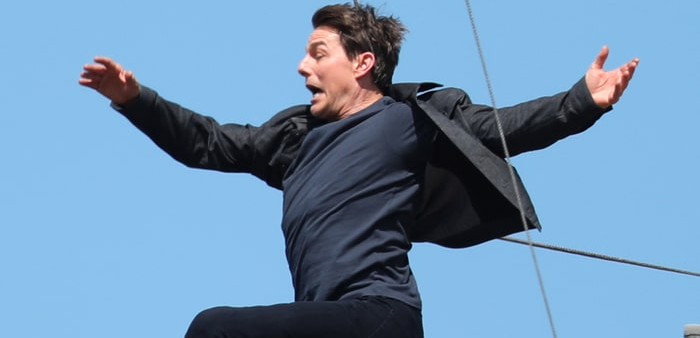
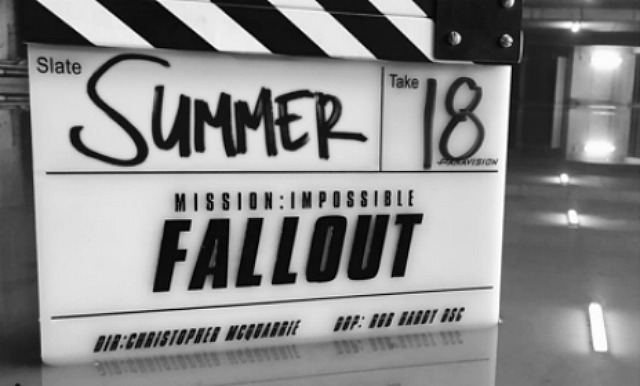
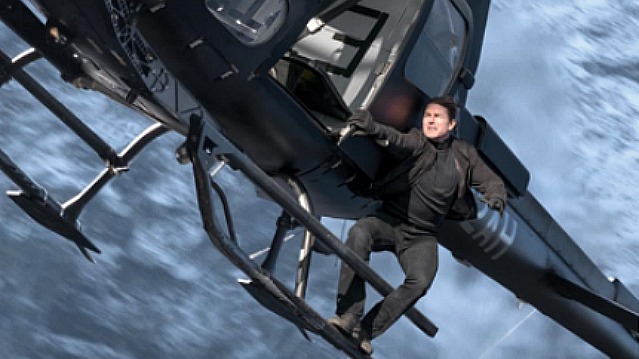
Christopher McQuarrie and Tom Cruise‘s Mission Impossible — Fallout (Paramount, 7.27) has to try and top the last MI film and the one before that and before that and yaddah yaddah. And yet stunt-wise, the bell tolled twice for Cruise during the shooting of this latest installment. He was seriously injured last August and — according to TMZ — got hurt again a few days ago. The man is 55 — he’ll be 56 in July. Tragic as this may seem, Cruise is being told by God, biology and fate to steer his energies away from energizer-bunny action flicks.

Read more

Why Metcalf Is Losing to Janney

Oscar-wise, it appears as if Laurie Metcalf‘s neurotic, tour de force Lady Bird performance is going to lose to Allison Janney‘s cigarette-smoking monster mom in I, Tonya. I wish it were otherwise, but the writing is clearly on the wall.

And the reason has just hit me. People don’t just vote for performances but for the characters, and most Academy members like largeness and intensity. They’ll vote for characters who are lovable or emotionally vulnerable on some level, and also for ones who’ve delivered a certain eccentric theatricality or campy trippiness. But they won’t vote for characters who make them feel badly or remind them of unpleasant frictions.

I suspect that Metcalf’s caring but high-strung and badgering mom hits too close to the bone for a lot of voters out there, particularly women who had contentious relationships with their own mothers when they were younger. They’re sensing emotional reality in her performance, of course, but also the guilt-tripping, shade-throwing and high-strung agitation, and they can’t quite “like” her character because it stirs unpleasant memories.

Janney’s character is a fiend — an awful mother and far more dislikable than Metcalf but also safely broad and evil and grand guignol-ish. In this sense she’s less real and relatable and less disturbing than Metcalf, and at the same time offering more of a show — “Look at how detestable I can be! Am I a hoot or what?”

Reconsidering Lady Bird

I don’t know who wrote this ScreenPrism essay about what makes Lady Bird so rich, layered and praiseworthy, but it’s perceptive, precise and well-ordered. The essay, I mean. Especially (a) the visual scheme stuff and (b) the thought about “attention being equal to love, and if you deny a significant someone your attention you’re denying them love.” Just ignore the first 54 seconds and scroll forward to 55.