

Uncut, Infuriating

Almost everyone hated David Robert Mitchell‘s Under The Silver Lake when it played at last year’s Cannes Film Festival. It was soon after reported that A24’s original 6.22 release date had been scuttled in favor of a 12.7.18 opening. That too was abandoned. Mitchell’s meandering noir is finally opening today, but without any cuts at all to the original 139-minute length. The thinking last summer was that A24 had almost certainly asked Mitchell to go back to the editing room and tighten things up, and perhaps even do a little re-shooting. Nope.

Original HE review, titled “Mitchell’s Wandering Fartscape“, posted on 5.16.18:

I’m sorry but David Robert Mitchell‘s Under The Silver Lake (A24, 6.22) is mostly a floundering, incoherent mess. Yeah, I know — Mitchell wanted it to feel this way, right? Ironically, I mean. Confusion and mental haziness are part of the impressionistic thrust.

It’s pretty much a textbook example of what happens when a gifted, financially successful director without much on his mind…this is what happens when such a fellow comes to believe that he’s a version of Federico Fellini in the wake of La Dolce Vita or 8 1/2 and thereby obtains the funds to make whatever the hell he wants, and so he decides to create…uhm, well let’s try an impressionistic fantasia dreamtrip about L.A. hipster weirdness and…you know, dreamy fantasy women with nice breasts and impressionistic effluvia and whatever-the-fuck-else.

Two hours and 15 minutes of infuriating slacker nothingness…everyone’s vaguely confused, nobody really knows anything, all kinds of clues and hints about seemingly impenetrable conspiracies involving general L.A. space-case culture, bodies of dead dogs, cults, riddles and obsessions of the super-rich.

It’s basically about Andrew Garfield absolutely refusing to deal with paying his overdue rent, and neighbor Riley Keough, whom he tries to find throughout the film after she disappears early on, doing a late-career Marilyn Monroe with maybe a touch of Gloria Grahame in In A Lonely Place.

Under The Silver Lake is Mulholland Drive meets Fellini Satyricon meets Inherent Vice meets The Big Lebowski, except Lebowski, bleary-eyed stoner comedy that it was, was far more logical and witty and tied together, and with an actual through-line you could more or less follow.

I felt the same kind of where-the-fuck-is-this-movie-going? confusion that I got from Paul Thomas Anderson‘s adaptation of Thomas Pynchon‘s novel of the late ’60s.
Read more

Just Around The Corner

Three observations about Ava Duvernay‘s When They See Us (Netflix, 5.31).

One, the biggest dramatic problem in this five-part dramatic reenactment of the 1989 Central Park Jogger case, which I wrote about when it was first announced 19 months ago, is the bizarre police confessions by the five alleged (and later exonerated) assailants despite being with parents and/or guardians. How do you dramatize this without the audience saying “what the fuck is wrong with these guys…have they ever heard of ‘you can hassle me all you want but I didn’t do it’ or, better yet, ‘I’m not saying anything until I talk to an attorney’?”

Two, one of the ogres behind these “forced” confessions was Linda Fairstein, head of the Manhattan district attorney’s sex-crimes unit from ’76 to ’02, and whose office supervised the 1990 prosecution of the Central Park Jogger case. Wiki excerpt: In a settlement lawsuit it was claimed that Fairstein, with the assistance of the detectives at the 20th precinct, coerced false confessions from the five arrested teenagers following 30 straight hours of interrogation and intimidation.”

Three, who plays Fairstein in DuVernay’s re-telling? None other than Felicity Huffman, fresh off her involvement in the recent college entrance-exam cheating scandal.

Read more

Life Can Be Harsh, Cruel

Last night I dreamt I was a salaried magazine columnist, and at the end of the dream I was laid off and given a lousy $5K severance package. As in real life, a horrible feeling descended — so horrible that I woke up. It reminded me, naturally, that life can be unfair and even brutal at times, and how organizations never say why you’re being let go. They just announce the bad news, Up in The Air-style, and ask you to collect your things and be out by the end of the day. All you can say to yourself is “why me? What brought this on?” As always, office politics and attitudes are often to blame.

I realized late this morning that my shitty-severance-package dream may have been inspired by a very gloomy Vanity Fair article I read yesterday — a piece called “‘You Will Lose Everything’: Inside The Media’s #MeToo Blacklist.”

Written by Diana Falzone, the piece basically reports that women who’ve filed sexual harassment lawsuits aren’t getting hired because they’ve been more or less blacklisted — branded as prickly and/or troublesome and too risky to bring aboard. The subhead reads, “Former television hosts and network personalities say they are persona non grata after settling high-profile lawsuits against serial sexual harassers. Is blacklisting the next legal battleground?”

This is really, really wrong. Women who were hassled or assaulted in a job environment obviously didn’t instigate the difficulty — they just wanted it to stop, and presumably sued to make a general point or get some justified payback or to possibly make things better for other sexual harassment victims. But now they’re being doubly victimized.

“There is no official blacklist,” Falzone writes. “And yet, multiple women, all of whom have settled high-profile lawsuits against serial sexual harassers, told me they struggled to continue their careers in media after defending themselves.”

Read more

RoPo Pushback

Legendary director and #MeToo ogre Roman Polanski, 85, is suing the Academy of Motion Picture Arts and Sciences over for having taken away his membership last May without following proper protocol — i.e., doing it too quickly and suddenly, not giving him a chance to defend himself.

In the same motivational vein of Amazon’s refusal to distribute Woody Allen‘s A Rainy Day in New York (a decision which is also being litigated), the Academy’s board of governors booted Polanski and Bill Cosby on the same day as a sympatico gesture to the #MeToo movement. Months earlier the Academy ejected Harvey Weinstein.

RoPo attorney Harland Braun to Variety: “We are litigating the fairness of their procedure. They threw him out without warning and without giving him a chance to respond. There was not even any notice of why. After 40 years, on the same day as [Bill] Cosby. Give me a break.”

Academy to Variety: “The procedures taken to expel Mr. Polanski were fair and reasonable. The Academy stands behind its decision as appropriate,” a spokesperson said.

Read more

Cliff Is The Guy

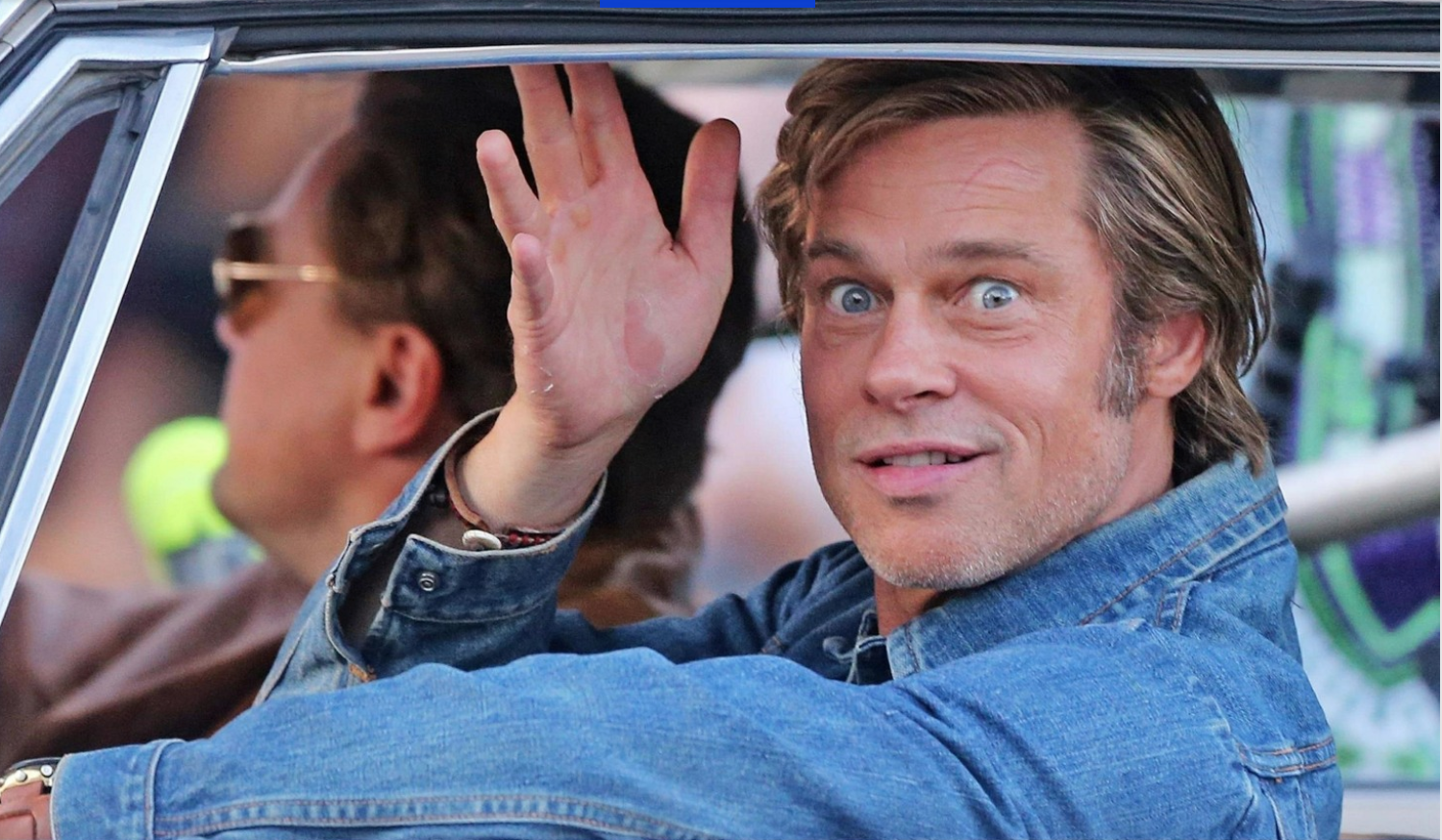
In a brief interview with USA Today‘s Brian Truitt, Quentin Tarantino riffs on Rick Dalton (Leonardo DiCaprio) and Cliff Booth (Brad Pitt), the lead characters in Once Upon A Time in Hollywood (Sony, 7.26).

In so doing Tarantino (a) gives props to HE’s theory that Dalton is largely based upon Burt Reynolds circa 1969 (and not so much Clint Eastwood) and (b) hints that the “deadly” Booth will violently settle some business, most likely during the third act.

According to Tarantino, Dalton is “a man full of inner turmoil and self-pity for not being in a better position, career-wise. But as is Rick’s way, he blames everybody but himself.”

That’s Reynolds, all right. He belly-ached a lot in the late ’60s about how he couldn’t break into A-level features, and then, when he was a big shot, about how he couldn’t land leads in prestige-level, Oscar-calibre films. Eastwood sure as hell wasn’t complaining in the late ’60s. In ’68 and ’69 he was building his brand with Hang ‘Em High, Coogan’s Bluff, Where Eagles Dare and Paint Your Wagon.

Somewhat curiously, Tarantino describes Booth as an “indestructible World War II hero” and one of the “deadliest guys alive” who “could kill you with a spoon, a piece of paper, or a business card. Consequently, he is a rather Zen dude who is troubled by very little.”

Okay, but how and why would an indestructible killing machine figure into a film that’s allegedly focused on hippy-dippy, head-in-the-clouds, peace-and-love-beads Hollywood? Why bring up killing at all when the 1969 Hollywood milieu was all about getting high and flashing the peace sign and reading passages from the Bhagavad Gita? Exactly — at a crucial moment Cliff will somehow go up against some folks who need to be corrected or otherwise interfered with — i.e., the Manson family.

Conway Op-Ed vs. Lizard Chronicles, Part II

“Poor Richard M. Nixon was almost certain to be impeached, and removed from office, after the infamous ‘smoking gun’ tape came out. On that tape, the president is heard directing his chief of staff to get the CIA director, Richard Helms, to tell the FBI ‘don’t go any further into this case’ — Watergate — for national security reasons. That order never went anywhere, because Helms ignored it.

“Other than that, Nixon was mostly passive — at least compared with Trump. For the most part, the Watergate tapes showed that Nixon had ‘acquiesced in the cover-up’ after the fact. Nixon had no advance knowledge of the break-in. His aides were the driving force behind the obstruction.

“Trump, on the other hand, was a one-man show. His aides tried to stop him, according to Mueller: ‘The President’s efforts to influence the investigation were mostly unsuccessful, but that is largely because the persons who surrounded the President declined to carry out orders or accede to his requests.’

“The investigation that Trump tried to interfere with here, to protect his own personal interests, was in significant part an investigation of how a hostile foreign power interfered with our democracy. If that’s not putting personal interests above a presidential duty to the nation, nothing is.

“White House counsel John Dean famously told Nixon that there was a cancer within the presidency and that it was growing. What the Mueller report disturbingly shows, with crystal clarity, is that today there is a cancer in the presidency: President Donald J. Trump.

“Congress now bears the solemn constitutional duty to excise that cancer without delay.” — from “Trump is a cancer on the presidency. Congress should remove him,” a 4.18 Washington Post op-ed by George Conway.

J.C. Penney Done Him Wrong

Shorter Halston: 35 years ago, haute couture fashion designer Roy Halston Frowick self-destructed when he cut a billion-dollar deal with J.C. Penney to sell a downmarket line — Halston III. Upscale retailers were appalled; Bergdorf Goodman dropped Halston like a bad habit. And yet other designers eventually followed suit and didn’t suffer the same consequences.

Real-Life Lesson: Don’t be too much of a nervy pathfinder. Wait for someone else to do the revolutionary thing, wait for the results, assess the odds and then rush in when the coast is clear.

Read more