And She Drinks A Little

Having dealt with an alcoholic dad and coped with my own boozing issues until I embraced sobriety on 3.20.12, I’m not especially interested in films about alcoholics. Even without that history movies about drunks have always seemed more or less the same to me.

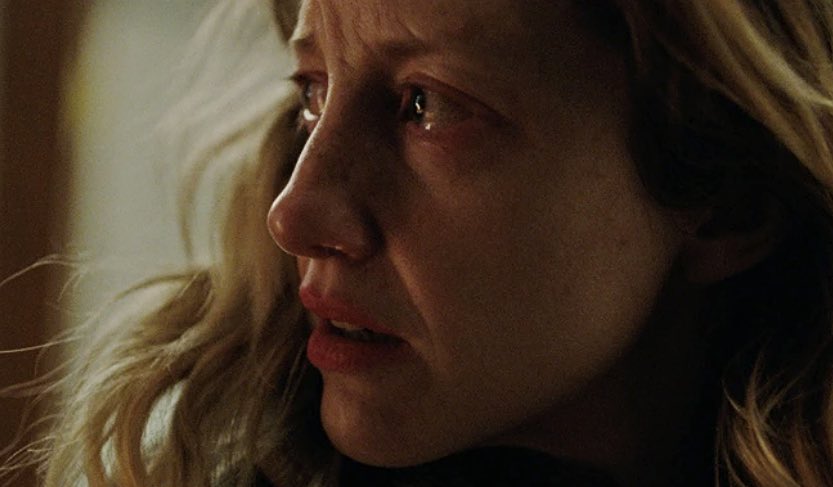
In Michael Morris‘s To Leslie, which recently screened at South by Southwest, Andrea Riseborough plays the 40ish Leslie, an all-but-hopeless drunk who’s nothing but rat poison to everyone she’s ever known or been close to, including her son.

The first 50 minutes or so are pure hell to get through, and then Leslie finally falls in with a couple of low-rent guys who run a 2nd-class motel. One of them, an amiable, low-key dude named Sweeney, is played by Marc Maron, and right away you’re asking yourself “is Sweeney a fucking idiot? Why has he offered Leslie a job as the motel’s maid? Why did he give her a chance? She’s obviously a lost cause and nothing but trouble.”

But he gives her a chance anyway, and after another relapse or two Leslie finally pulls out of the long downward spiral. But there’s so much ugliness in this film. I mean it’s really and truly awful.

Remember the opening scene in Bruce Beresford‘s Tender Mercies (’83), when Robert Duvall‘s Mac Sledge, a semi-retired country singer, is shouting and slugging someone and generally behaving like an abusive drunk? The ugly happens in one brief scene, and then Mac is on the mend for the rest of the film. But in To Leslie, Riseborough does the ugly for a whole damn hour before she starts to self-reflect and turn a corner. It struck me as too much to bear.

Riseborough’s performance is raw and scalding and frankly dispiriting. I believed her in every scene, but I also wanted to see her get hit by a truck. I didn’t believe Maron — I thought he was just laying on the charm with a shitkicker accent. But high marks for the other costars — Allison Janney, Andre Royo, Stephen Root, Owen Teague, etc.
“Lost City” Thoughts of My Tranquil Hours

The Lost City (Paramount, 3.25) is a lightweight, 100% synthetic “adventure” comedy in the vein of Romancing The Stone (’84). I didn’t hate it but there was no way to engage with or get lost in it. Not a chance. It’s pure jizz-whizz, and I just sat there in the fourth row like an overripe canteloupe or, you know, a half-eaten watermelon.

It did strike me as being primarily aimed at women and gay guys. No straight male could possibly give this film a thumbs-up or even a “whatev”. Because it’s emptiness incarnate. Harmless vapor.

When the show broke at the Century City AMC plex I was walking behind a youngish hetero couple, and as we hit the lobby the woman waved at a friend and gave her a thumbs-down gesture.

Right now the Rotten Tomatoes rating is 95%; Team Metacritic has given it a 67%. Most critics are shameless whores.

Based on the trailers I expected Brad Pitt to be some kind of supporting player. The promos made it clear that the leads are Sandra Bullock and Channing Tatum, but the expectation was that within the film’s helium-balloon, wank-off scheme Pitt would be a steady secondary principal. Early in the Dominican Republic section (i.e., 85% to 90% of the film) Pitt and Tatum make a good team. I was saying to myself “this is good…I like Pitt’s energy and scruffy dominance…if he hangs in there I might be okay with this.”

And then he’s suddenly gone. Right away I muttered to myself “to hell with this…no Pitt, no fun…eff this movie.”

None of the action scenes pass muster; none of the running-around-and-climbing-mountains stuff is even faintly credible. Half of the insert shots look like sound-stage sets, and a lot of the images look CG-enhanced. Most of the jungle photography was shot with a drone.

Daniel Radcliffe plays the yuppie bad guy — no killer lines, no funny scenes, doesn’t hold his own, boring to hang with.

One earmark of a sucky movie is that the bad guys have no personalities — no wit or flavor or stand-out attitude of any kind. The Lost City bad guys are the same exact stooges you’ve seen in a hundred other action films. Remember Richard Masur, Ray Sharkey and Anthony Zerbe‘s bad guys in Who’ll Stop The Rain (’78)? It never got any better than that. They were darkly funny, eccentric, deranged, vulnerable, and they never once winked.

All through the film Tatum is wearing a standard flat-top haircut (i.e., a little length on top). Near the end he suddenly adopts a butch cut (i.e., just this side of a shaved-head thing). It makes no sense that he would change his hair at the very end — he just does.

Poor Da’Vine Joy Randolph, whose affecting performance as Lady Reed in Dolomite Is My Name put her on the map, plays a spunky book publicist. She’s amusing from time to time, but I couldn’t get past one of the apparent ideas behind her casting in this film — i.e., to normalize her appearance.

Repeating: I didn’t hate this film. If some ticket-buyers have a good time with it, fine. I just kept saying to myself “who could give a shit about this?”

Zegler Deserves An Orchestra Seat! Of Course She Does!

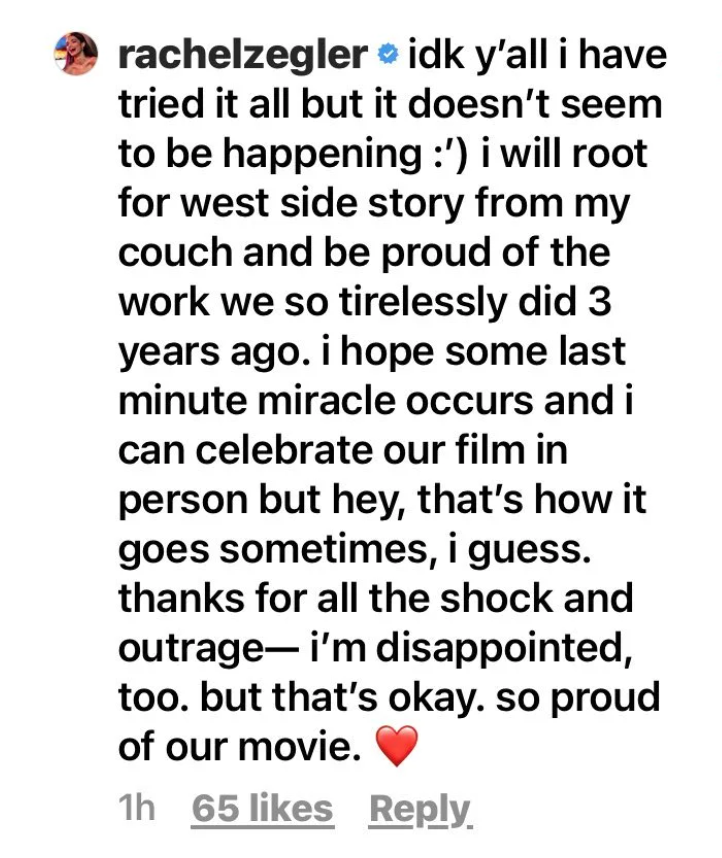
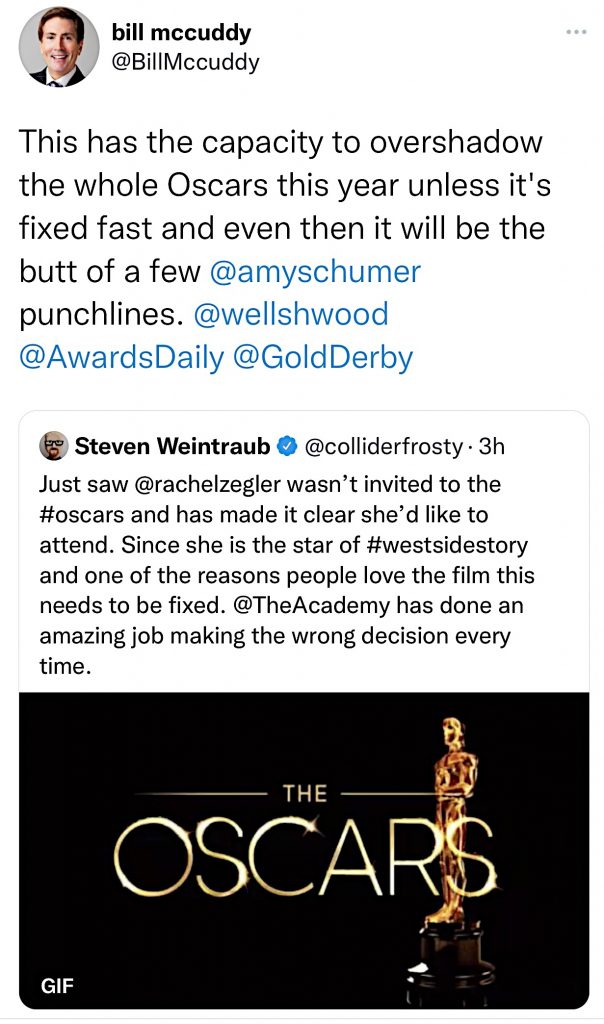
West Side Story star Rachel Zegler has been denied a seat at the Oscars. She spilled the beans earlier today on Instagram. It was Team Disney’s call, of course — God, do they look like assholes or what? If the Oscar producers were smart, they would turn this situation into a running gag. Arrange for Zegler to watch the show from a seat placed at extreme stage left, say, and then invite her to participate in a few random jokes as the show progresses.

“Shampoo” Is Now

A certain friendo re-watched Shampoo last night, and re-loved it. And he passed along an interesting political perception.

We all understand that the Democrats are going to get killed in November, in large part because they’re seen as being in the grip of progressive wokesters and in favor of teaching four-year-olds about gender fluidity and gender reassignment — average people HATE that. Plus Asian parents and Anglo parents with really smart kids hate the equity thing (i.e., show favoritism to POC students re university admissions and grades as a kind of cultural make-up exercise). They also reject the idea that European-descended Anglos are inherently evil and racist to the core, and therefore have to sit in the back of the bus for a generation or two in order to make up for past sins against POCs.

With all that said, here’s what friendo said about Shampoo….

Shampoo was made as kind of a nod to Jean Renoir’s Rules of the Game (’39), which was about a frivolous society right before Hitler invaded. Shampoo has Nixon humming in the background to make the point that after the politically tumultuous 1960s the Me Generation of the 1970s became silly and frivolous in their own way, and thus lost the country to conservatives (politically).

“It could also have been a nod to Charles Manson killing Jay Sebring (one of the inspirations for Beatty’s “George Roundy” character, the other being Jon Peters) and taking away Sharon Tate (Julie Christie).

“But I guess I see us in that movie: narcissistic, self-involved, not seeing the bigger picture. Focused on woke movies and tinkering with our utopian dioramas and not thinking about what is coming next. Which could be really really, really bad.”

2270 Bowmont Drive, by the way, is the address of the Beverly Hills home resided in by Christie’s “Jackie” character and paid for by Jack Warden‘s “Lester” character.

Sunday Morning Aftermath

My first post-PGA awards thought: “The emotional bounty aside, the competently-made CODA isn’t winning on its own cinematic merits. It’s winning because it’s the anti-Power of the Dog.”

Awards Daily‘s Sasha Stone agrees that last night’s CODA win “is about Power of the Dog in as much as people didn’t want to feel obligated to vote for a movie they didn’t like.”

But mainly, she says, the CODA win is about the same Oscar default impulse that’s been running the table for the last five or six years — virtue-signaling coupled with the word “first.”

First movie about a black gay man (Moonlight), first movie by a woman of color (Nomadland), first international movie by director of color (Parasite), first movie with a predominantly deaf cast (CODA), first sexually-informed, #MeToo-ish romantic drama between a mousey woman and a fishman (The Shape of Water).

Posted many months ago…last August and in early February ’21…

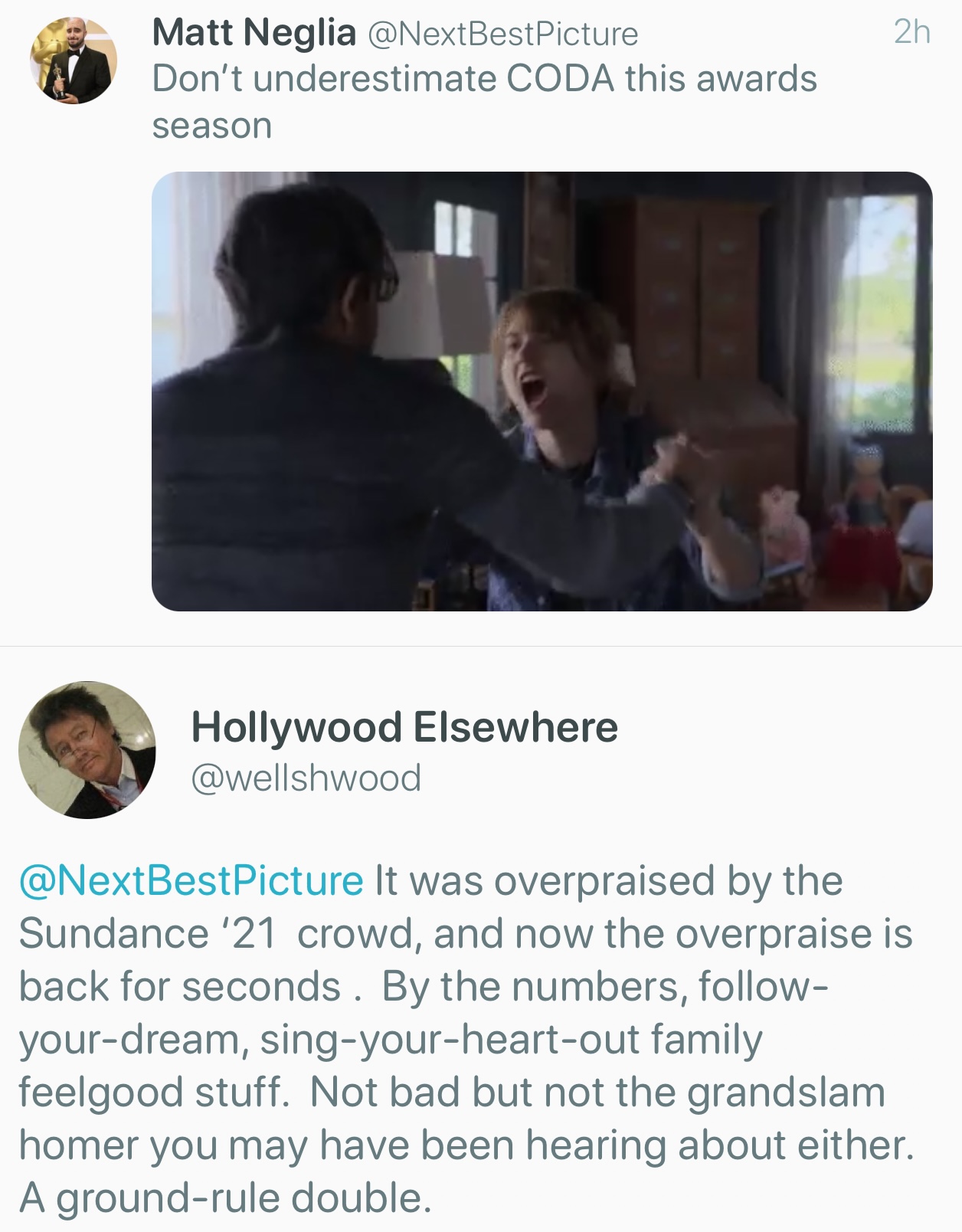
Posted on 2.3.21: Sian Heder ‘s much-adored, Sundance award-showered CODA (Apple +, 8.13) is moderately appealing and nicely made for the most part. Understand, however, that it’s an “audience movie” — aimed at folks who like feel-good stories with heart, humor, romance and charm.

It’s about a shy Gloucester high-school girl named Ruby (Emilia Jones) with a decent if less than phenomenal singing voice. She’d rather attend Boston’s Berklee College of Music than work for her deaf family’s fishing business, we’re told. The film is about the hurdles and complications that she has to deal with in order to realize this dream.

CODA is one of those “real people struggling with life’s changes and challenges” flicks, but given the fishing-off-the-Massachusetts-coast aspect it’s fair to say it’s no Manchester By The Sea — trust me. It’s a wee bit simplistic and schticky and formulaic -— okay, more than a bit — and contains a fair amount of “acting.”

Read more

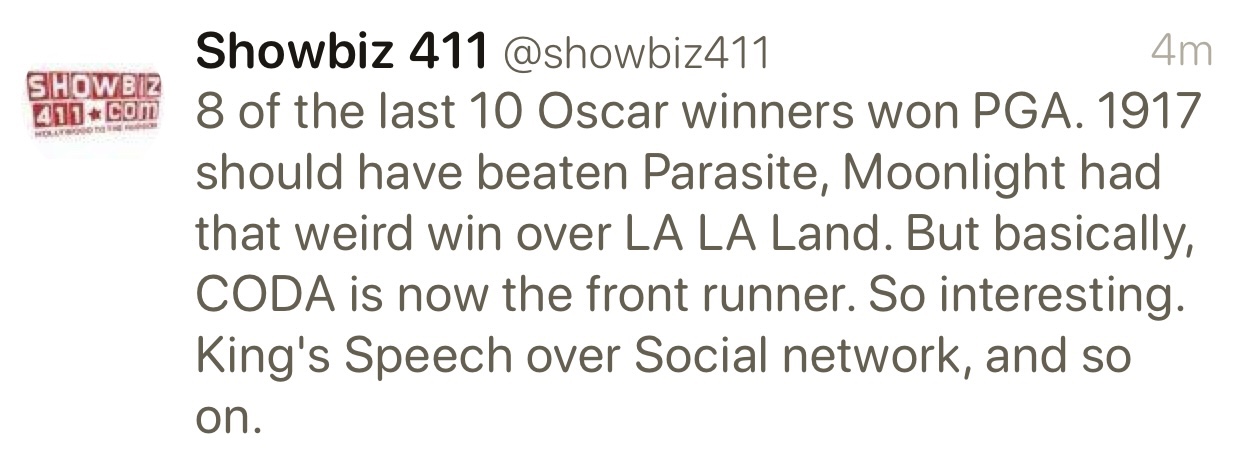
“CODA” Takes PGA Zanuck Award

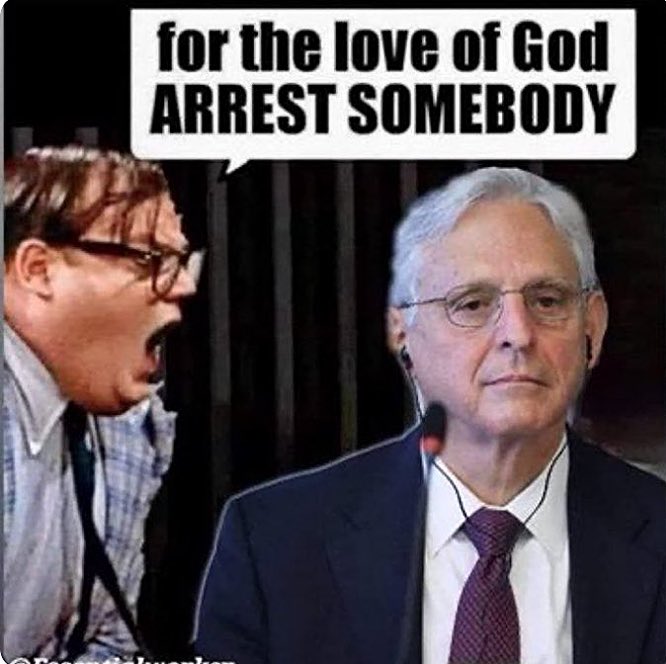
And that, finally and absolutely, almost certainly signifies the end of the road, Best Picture-wise, for The Power of the Dog. Hyuuuge sigh of relief.

Read more

Repulsion Around The Corner

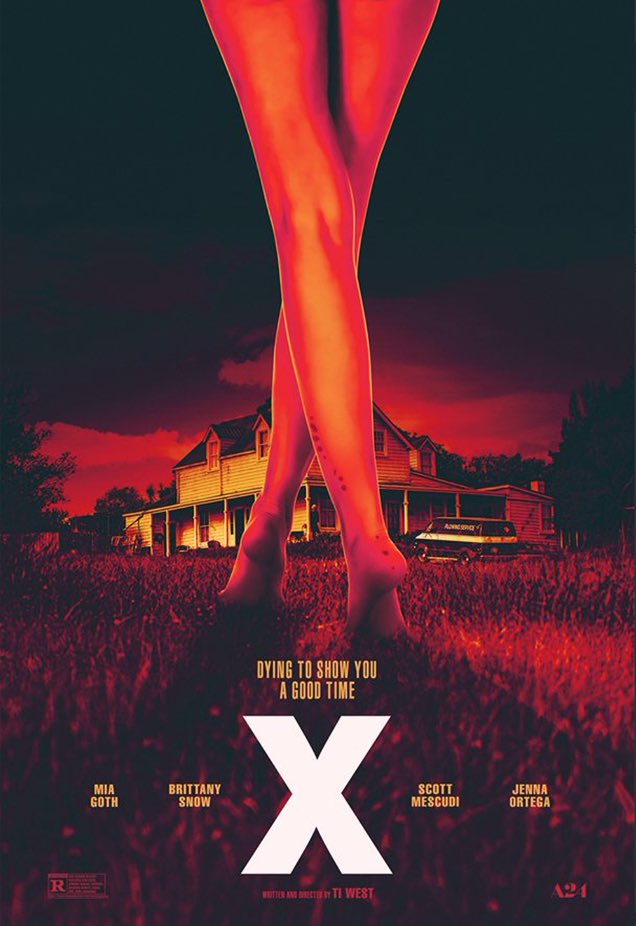
I can smell it, sense it. And I will therefore wait for streaming. I don’t care how well made X is — my inclination is to steer clear for the time being, even though it’s probably a much better film than The Lost City.

“…And You Know You’re Right”

There’s something I never paid attention to in the famous “you’re not a loser, Eddie, you’re a winner” scene from The Hustler. The “something” is this: traffic noise nearly floods this scene.

Director Robert Rossen could have shot in some remote woodsy area or in upper Central Park, but he chose to shoot near a highway of some kind. I’m guessing the Henry Hudson Parkway, somewhere near the 80s or 90s. They couldn’t be more than 40 or 50 feet from it — listen to those cars and motorbikes whirring by.

I think Rossen chose this spot because…I don’t know why. Perhaps he wanted to say that there’s no peace in New York City for some people…no calm, no havens, no real cover or seclusion. The clutter and clamor never leave you alone.

Oh, and Newman addressing Jackie Gleason‘s Minnesota Fats over and over as “fat man” doesn’t seem right by today’s standards. Gleason was somewhere between portly and hefty, but his girth is nothing compared to your typical 21st Century Jabba. Lost City costar Da’Vine Joy Randolph is twice Gleason’s size.

Wiki excerpt: “According to Bobby Darin‘s agent, Martin Baum, Paul Newman‘s agent turned down the part of Fast Eddie. Newman was unavailable to being committed to star opposite Elizabeth Taylor in Two for the Seesaw. Rossen offered Darin the part after seeing him on The Mike Wallace Interview.

“When Taylor was forced to drop out of Seesaw because of shooting overruns on Cleopatra, Newman was freed up to take the role, which he accepted after reading just half of the script. No one associated with the production officially notified Darin or his representatives that he had been replaced; they found out from a member of the public at a charity horse race.”

Musical Approach Could Have Saved “Power of the Dog”

An hour ago Erik Anderson posted a genius tweet…a tweet that, if conceptually heeded two or three years ago, could’ve saved Jane Campion‘s The Power of the Dog from itself. If that morose and tiresome melodrama had been made into a grand musical tragedy, and if a 12-years-younger version of Madonna had played Kirsten Dunst‘s role of Rose, the alcoholic newlywed with a gay, covertly homicidal son, it could have been something. Really. I’m not being facetious. Especially, I’m thinking, if it had been made Evita-style, as a sung-through musical.

Read more