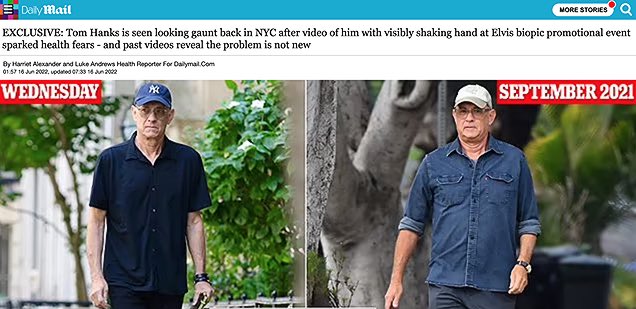
It isn’t irresponsible or disrespectful to share concern about Tom Hanks‘ severe weight loss. There may be a very simple, no-big-deal explanation. (Radical dieting for a forthcoming performance in Robert Zemeckis‘ Here?) If I were Hanks I would put out a statement or explanation of some kind. Spit it out, put it to bed, no biggie.
HE somberly acknowledges the passing of liberal political commentator and former election consultant Mark Shields, 85. Analysis and commentary for the PBS NewsHour for 32 years — 1988 to 2020 — and partnered with David Brooks for 19 of those years (’01 to ’20). Previous partners: William Safire, Paul Gigot, David Gergen. Regrets, respect, condolences.
Life is a grim bowl of cherries, betrayal lurks around every corner (especially in the realm of relationships), and your worst enemy is more often than not yourself.
This is Woody Allen‘s basic view of things, as echoed in nearly every one of his films. Ditto Stanley Kubrick when it comes to Lolita, Barry Lyndon and Eyes Wide Shut; ditto the relationship-oriented films of RomanPolanski, David Fincher and Paul Thomas Anderson, but not so much Chris Nolan (who doesn’t focus all that much on relationships).
Let’s flip it around by asking which auteur-level filmmakers haven’t embraced this basic view of the human condition? In other words, which auteur-level directors and producers (excluding broadly-commercial-minded hacks and high-concept, Jerry Bruckheimer-type producers) have deliberately embraced a somewhat…well, less skeptical view of life?
“…when straight people were uncomfortable with it.”
I don’t want to watch any long, slurpy, saliva-drooling tongue kisses, but I’m willing to trust producer Judd Apatow to…uhm, keep things in check, CallMe ByYourName-style
Right off the top you can tell that Bros (Universal, 9.30) is clever, funny and well-written. Co-penned by star Billy Eichner (he played Matt Drudge in Impeachment, that Monica Lewinsky miniseries) and director Nicholas Stoller.
On the strength of the writing alone, I’m down for this. Conditionally.
If I were gay I wouldn’t go for a pale neckbeard type like Eichner…sorry. I would go for a pretty-looking guy without chest hair.
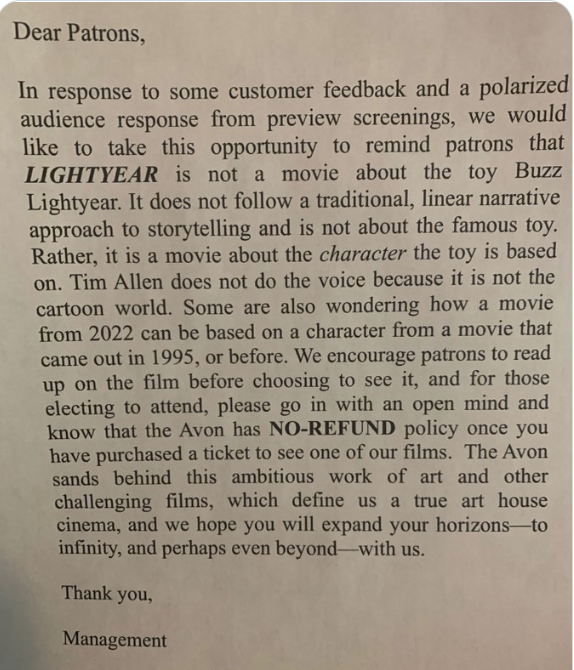
Lightyear is playing everywhere now. I avoid most animation features, of course, and certainly all corporate Disney animated product…no offense. Those who intend to see it this weekend, enjoy.
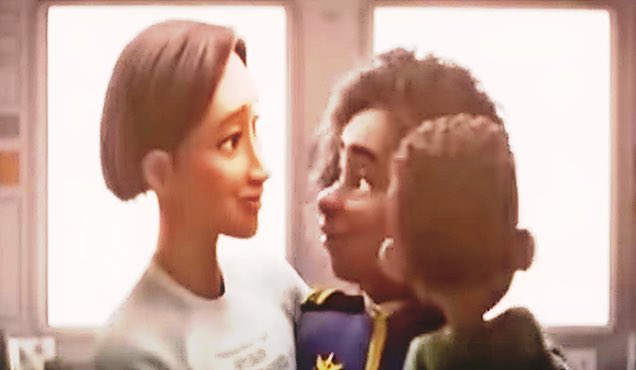
As for the brief, tender lesbian family kiss between Space Ranger Alisha Hawthorne and her wife, who cares? HE doesn’t, although some Arab countries do, it seems, and so Disney will take some kind of financial hit.
The scene was originally cut from the film before being reinstated following Disney and Pixar staff pushback, claiming that Disney wasn’t supporting the gay community like it should, etc.
Chris Evans to Reuters: “The real truth is those people are idiots. Every time there’s been social advancement as we wake up, the American story, the human story is one of constant social awakening and growth and that’s what makes us good. There’s always going to be people who are afraid and unaware and trying to hold on to what was before. But those people die off like dinosaurs.”
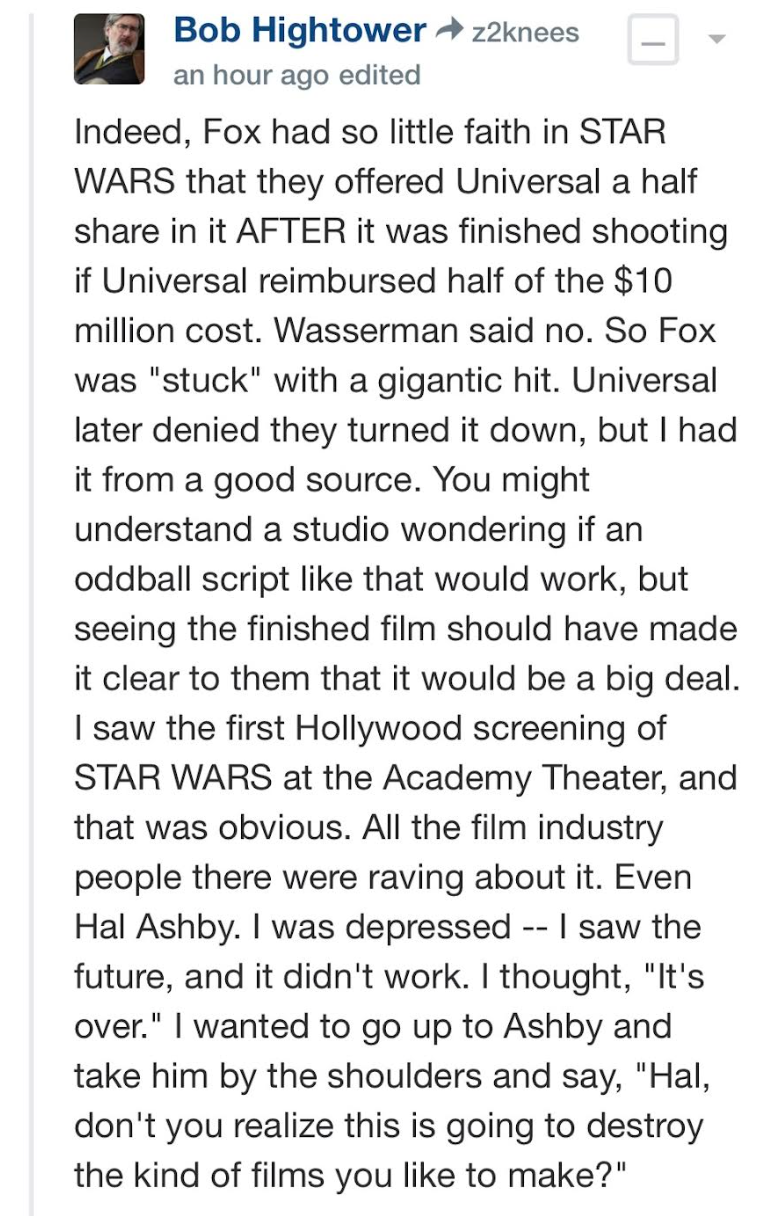
Hal Ashby to Joseph McBride after early StarWars screening: “What about yours, film critic?” McBride to Ashby: “The difference is I know it.” Ashby to McBride: “All right, so we’ll all turn in our Arriflxes and Avid editing machines to the Academy, and we’ll all go to work at Pink’s. Is that it?” McBride to Ashby: “Not quite yet. [turns to George Lucas, standing nearby] We haven’t heard from your friend here.” Lucas: “I wouldn’t push too far if I were you. Our fight ain’t with you.” McBride: “It ain’t with me, Lucas?” Lucas: “No it ain’t, Joe.” Ashby: “I wouldn’t pull on Lucas, Joe. [to Will Atkey] Will, you’re a witness to this.” McBride: “So you’re George Lucas.” Lucas: “What’s that mean to you, Joe?” McBride: “I’ve heard about you.” Lucas: “And what’ve you heard, Joe?” McBride: “I’ve heard that your movies are injecting an infantile serum into American commercial cinema, and in so doing are helping to destroy a cinematic golden age. You and Steven Spielberg, I mean.” Lucas: “Prove it.”
The great Jean-Louis Trintignant, 91, has left the earth. In my mind he was the most deeply French actor alive for so many decades, even going back to the ’50s. That unaffected, un-acted manner, that deepish voice and handsome face, that air of casual unpretentiousness. He was a marquee name for seven decades, but mostly in the ’60s, ’70s and ’80s.
The cancer-stricken Trintignant announced his retirement from acting four years ago.
My favorite Trintignant performances are probably the same as everyone else’s. My three all-time faves are Marcello, the snivelling coward, in Bernardo Bertolucci‘s The Conformist (’70); the tough, low-key prosecutor in Costa-Gavras‘ Z (’69); and the elderly, quietly suffering husband in Michael Haneke‘s Amour (’12).
My fourth favorite is his vaguely Humphrey Bogart-like Cote d’Azur detective in Without Apparent Motive (’71), which was based on a 1963 Ed McBain novel.
I also loved his protagonists in Roger Vadim‘s And God Created Woman and Les liaisons dangereuses, “Éric Grandin” in Costa-Gavras‘ The Sleeping Car Murders, the race-car-driving smoothie in Claude Lelouch‘s A Man and a Woman, the Trintignant guy in Ettore Scola‘s La Terrazzaand Roger Spottiswode‘s Under Fire (’83)
His last great performance was as the horrified, overwhelmed and finally resigned-to-fate Georges in Amour.
Last night I finally caught Audrey Diwan’s Happening, which is easily the most sobering, harrowing and artful abortion drama I’ve seen since Cristian Mungiu‘s 4 Months, 3 Weeks and 2 Days, which premiered at Cannes almost exactly 15 years ago.
Happening premiered at the 2021 Venice Film Festival (where it won the Golden Lion), but IFC Films didn’t open it theatrically until last month with streaming set to launch on 6.21. So it’s shooting right to the top of HE’s best of 2022 list.
I wouldn’t call Happening a “horror film,” but in its plain, frank and unfettered way it comes close to that. Honestly? The conservative wing of the Supreme Court should watch it before rendering their final positions on Roe vs. Wade.
Based on Annie Ernaux’s 2011 memoir and set in a small French town in 1963, or 12 years before abortion was finally legalized in that country, it’s about Anne (Anamaria Vartolomei), a bright 23 year-old college student who finds herself unwelcomely knocked up. “I’d like a child one day,” she tells one of the doctors she goes to, “but not instead of a life.” She wants agency, to possibly write — a woman at least a decade ahead of her time.
The film is about Anne’s agonizing attempts to terminate, and I’m telling you right now what she and the audience go through together at times is not easy to sit through. Three scenes are especially tough. We’re talking graphic, “God, this is awful”, avert-your-eyes stuff.
But it’s the honest truth, and given the film’s low-key, straight-up directness and uncomfortable naturalism there’s no way to respond except with admiration and awe.
The film lasts 100 minutes, and there’s not a single moment that feels theatrical or manipulative or over-cooked.
Vartolomei, 24, doesn’t “play” Anne as much as submit to the reality of the story — she’s just there, quietly alarmed, trying to figure it out, guarded, persistent and going through hell.
In his 5.12.22 review, Newsday‘s Rafer Guzman wrote something very strange: “Whether you condone this film or condemn it, Happening presents a brutal reality.” Condemn it? Who the hell would condemn an honest account of what a young pregnant woman went through 60 years ago? Pro-life fanatics, I suppose, but God.
HE to critic friendo: “Happening is drop-dead brilliant — the best anguish-of-women film since 4 Months, 3 Weeks and 2 Days. Have you seen it?
Friendo to HE: “Haven’t yet, will check it out.”
HE to friendo: “I can understand a woman who’s been through an abortion not wanting to see this. A friend has never seen 4 Months, 3 Weeks and 2 Days for this reason. I said to her that 4 Months, 3 Weeks and 2 Days “is not an ‘abortion film’ — it’s a Cristian Mungiu film.’”
Friendo to HE: “But it’s totally an abortion film. I think 4 Months is an unassailable work of cinema, although I found it painful to watch and, truth to tell, a touch arduous, though I don’t deny that it’s superbly done. If you look at the box office grosses for Happening, you’ll see it’s not a film that even what’s left of the art-house audience has much interest in seeing.”
HE to friendo: “But it’s a forecast of what’s to come after Roe is trashed.”
Friendo to HE: “I think that political issue transcends movies. Frankly, I have not seen a drama about abortion that truly confronts what I think is the most complicated factor in the issue: how much certain women are hauntedbyhavingabortions, and in any number of cases regret it.”
What are the odds, I asked myself, that in the Joe Biden era a bunch of half-in-the-bag Millennial-aged Navy pilots would stand around and sing “Great Balls of Fire,” a 65-year-old pop song that predates peak boomer-cycle music (’60s and ’70s)? What are the odds that even one of these guys, presuming he/she is a classic rock aficionado, would be able to recite the lyrics to this Jerry Lee Lewis tune like their social security number?
Some Millennials know and respect Dylan/Beatles/Stones/Who/Elton John/Steely Dan/The Band/Hendrix/Allman Bros./CSNY, etc., but they generally regard anything recorded before 1980 as unworthy of comment. Bottom line: Even if you’re up on the Goosehistory, this scene is kinda bullshit.
Another, very human side of Tom Hanks…understood, sympathized with, HE-approved.
Tom Hanks momentarily, and understandably, loses his nice guy persona as over eager fans practically knock over his wife Rita Wilson. pic.twitter.com/vS2xfCqOIO