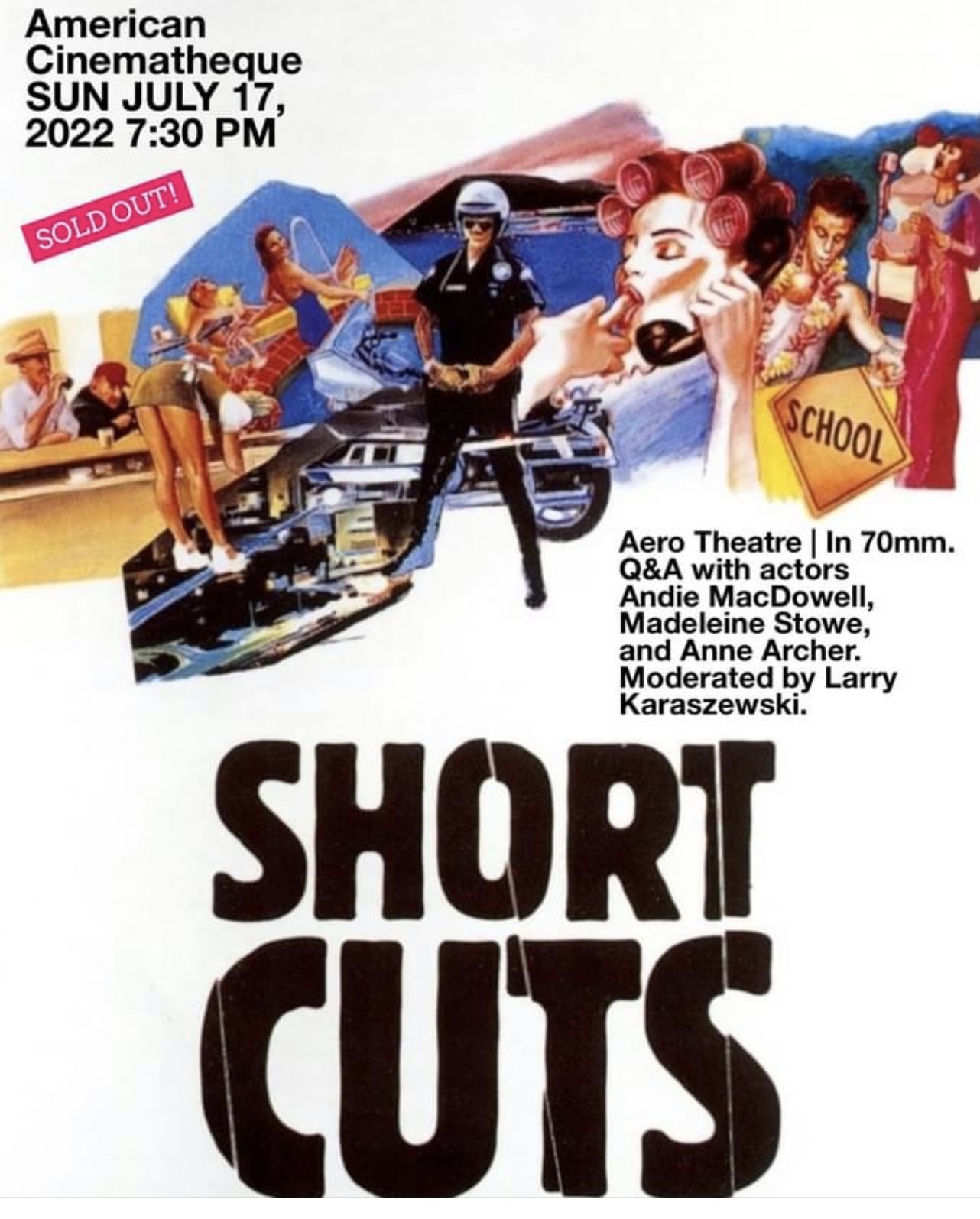
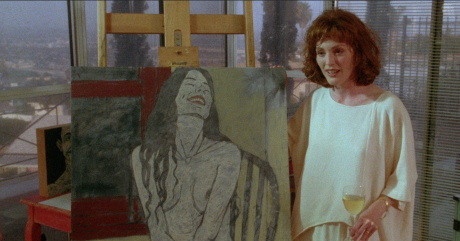
Sincere apologies to Larry Karaszewski, but I don’t have many fond memories of Robert Altman‘s Short Cuts (’93). I saw it 29 years ago, once, and all I remember is the faintly dreary vibes and the cast behaving in the usual eccentric, Altman-esque ways and the visual drabness and the Julianne Moore-Matthew Modine argument scene with the pubic hair and that soul-baring scene with Jack Lemmon “acting” in his usual actor-ish fashion.
I “respect” Short Cuts, of course, but there’s a reason why I haven’t re-watched it in all this time. The reason is the miserable downishness of Raymond Carver‘s short stories. If I was suddenly stuck in a Carver story or wearing the shoes of a Carver character, I would become a heroin addict.
Respectful disagreement with the late Michael Wilmington: “Short Cuts is a Los Angeles jazz rhapsody that represents Robert Altman at an all-time personal peak—and it came at just the right time in his career. For anyone who believed that what American movies needed most, after the often-moribund cinematic eighties, was more of the old Altman independent spirit and maverick brilliance — and more of a sense of what the country really is, rather than what it should be — the director’s sudden cinematic reemergence with 1992’s The Player and 1993’s Short Cuts was an occasion for bravos.”
Without even thinking it through it’s my earnest belief that Harrison Ford‘s best performance ever is Jack Ryan in Clear and Present Danger (’94), followed by his Philadelphia detective in Witness (’85 — his only Best Actor nomination), Han Solo in The Empire Strikes Back (’80), Ally Fox in The Mosquito Coast (’86), Deckard in Blade Runner (’82), the widower in Random Hearts, the hosthot executive in Working Girl and the TV anchor in Morning Glory.
[Posted two years ago] “Frantic is an example of the kind of film that we used to make in the olden days, and for me [there were certain] directors who were really important in the formation of a career. I didn’t actually do it all myself. I got to work with Alan Pakula, Sydney Pollack, Mike Nichols, Phillip Noyce, Roman Polanski, Peter Weir, Ridley Scott, Wolfgang Petersen].
“Those kinds of films are as important on a human level as, uh, those more successful films” — the Star Wars and Indiana Jones franchises. “Which I keep revisiting in interview situations, because they are the most successful films.” [Unspoken: “Most successful” because your basic whiteside and T-shirt-wearing knuckle draggers obsess over these films and seem to need them like babies need their blankies.]
“But [making big franchise movies for the unwashed salivating hordes] is not what makes a life. That’s not what makes a career. That’s not what brings pleasure to the pursuit of something effable.” — Harrison Ford, starting around the 8:26 mark.
Why, then, did Ford turn down the Michael Douglas role in Traffic? And why did he make something so flagrantly non-organic and digitally antiseptic as Call of the Wild? Legend has it that a lot of what Ford agreed to do over the last 20 years was first and foremost about producers meeting his quote. The bottom line (and please correct me if I’m wrong) seems to be that “the kind of films that we used to make in the olden days” are to some extent still being made, but their producers can’t afford Ford.
Remember that scene in Manchester by the Sea when Casey Affleck is arguing with Lucas Hedges and finally says “I’m gonna knock your fucking block off” and director-writer Kenneth Lonergan, playing a passerby, sarcastically says “great parenting” to Affleck and the yelling ratches up another couple of notches?
Imagine that you’re aware of the whole story behind this tragedy, and you come upon the parents of these kids outside the police precinct. What would be the appropriate dialogue? Would you say “great parenting” or would you say “the poor guy was beaten to death around 3 am, for Chrissake…what kind of parents let their kids run wild at 3 am?? And what kind of parents raise kids who would even want to beat a guy to death??”
A 10 year-old kid who helps beat an old guy to death is going to turn out wrong…that’s obvious. But imagine how it feels if you’re the father or the mother of these little shits.
Friendo: “This story is a complete disaster and one the media will barely cover, for obvious reasons.”
HE: “What do you mean ‘a complete disaster’? It was a matter of neighborhood culture and whatnot, but mainly derelict parenting…poisonous, appalling, derelict parenting.”
“[Many of today’s] screenwriters have gone to college for four or five years, and where they’ve been told incessantly [that] the world is inherentlyracist and sexist…everyone is awful, everyone hates each other and it’s just this big heirarchy of everyone getting oppressed by everyone else, and so that’s going to be reflected in what they write and what they try to rationalize in their stories, and that’s why [we’re getting what we’re getting].”
In the view of Will Jordan‘s “Critical Drinker” (or, if you will, just plain Jordan) a good portion of the woke poisoning of iconic characters has happened under the influence of the Disney death star.
“They took over the Stars Wars brand, they took over Marvel…and in the case of Star Wars you would see characters like Han Solo, Luke Skywalker…these classic heroes from 20, 30 years ago” — actually 40 to 45 years ago — “that were awesome, and suddenly they’re gettin’ brought back and [they’ve become] deadbeat dads or grumpy old men livin’ on an island, and they want to die and have lost all hope…it’s a terrible thing to do to these characters…it’s one thing to kill them off, and another to destroytheirlegacy and theveryessenceofwhotheywere.”
Sara Dosa‘s Fire of Love (Neon/National Geographic, 7.6) tells the story of devoted (one could say obsessive) volcanologists Katia and Maurice Krafft, who died in a volcanic explosion atop Japan’s Mount Unzen on 6.3.91 — 31 years ago.
The married couple — French natives, deep soulmates — had been studying, cataloguing, filming and photo-snapping volcanic eruptions since the early ’70s, and were among the most fearless and exacting in their field.
Dosa’s 93-minute doc is mostly composed of volcano footage (color, 16mm) that the Kraffts shot over the years, and which apparently was only made accessible to Dosa and her producers somewhat recently. The film also contains a fair amount of footage of the Kraffts themselves.
The dynamic visuals (miles-high clouds of gray ash, thunderous rumbling, pools of intense red-gold lava bubbling over and streaming down mountainsides) are exciting or at least fascinating until they become familiar, at which point you’re left with “okay, here are some more lava flows” and “wow, more shots of nuclear blast ash clouds.”
The problem, for me, is Dosa’s decision to weave it all together with Miranda July‘s whispering, barely enunciated narration. I was on the verge of abandoning the doc because of this aspect. July sounds like a parent quietly reading a Babar the Elephant story to a small child at bedtime.
The idea, presumably, is to pass along a certain romantic sensibility as well as (I gathered) soft-spoken Katia’s view of volcano worship, marriage, the twists and turns of nature…the whole magilla. But if ever a narration track rubbed me the wrong way, it was this one.
.
The honest truth is that I found Fire of Love a tad boring at first. If the Kraffts hadn’t been killed there would be no film, just as Werner Herzog‘s Grizzly Man wouldn’t have been a film if Timothy Treadwell hadn’t been eaten by a bear.
Herzog’s Into The Inferno (’16) covers roughly the same ground as Fire of Love, andIforonefounditabitmoreintriguingthanDosa’sdecent–enoughfilm.
Why were the Kraffts so into volcanoes? “Both Katia and I got into volcanology because we were disappointed in humanity,” Maurice said. “Since a volcano is greater than man, we felt this is what we need. Something beyond human understanding.”
But were they really seeking a mystical communion with the primal forces of nature? Or were the Kraffts simply volcano junkies in the same way that some photojournalists obsessively cover war zones, and Joanne and Bill Harding (Helen Hunt, Bill Paxton) were tornado junkies in Twister?
The Kraffts were doing valuable work, but they were primarily, it seems to me, moths lured by flame. Was their story a replay of the ancient myth of Icarus? You could certainly start with that interpretation.
The Kraffts were killed not by lava but a pyroclastic cloud — a fast-moving current of boiling hot gas and volcanic matter that flows along the ground away from a volcano at average speeds of 100 kph but sometimes as fast as 700 kph. They and American volcanologist Harry Glicken were standing on a ridge near the volcano and suddenly the cloud surged up and over and killed them “instantly.”
I found it odd that Dosa’s doc doesn’t mention that 43 people were killed that day by the same tragic event — the Kraffts, Glicken and 40 journalists. Wouldn’t the deaths of so many people in the same area warrant an explanation of what happened? Dosa barely gets into the specifics.
Narration quote: “Katia and Maurice know that these [volcanic] rocks will long outlive them. They are not religious. [They know] we all have one short life, and then we return to the ground.”
Okay, except I knew that large rocks would outlive me when I was nine years old and going on nature hikes with my Cub Scout pack. I remember asking this very question of an adult — “how long have these rocks been here?” Thousands of years, I was told.