It occasionally happens to recently-arrived Americans, and anyone who tries to make fun of this syndrome is a hopeless asshole.


It occasionally happens to recently-arrived Americans, and anyone who tries to make fun of this syndrome is a hopeless asshole.
Paul Newman and Joanne Woodward acted together in ten films, but they never really hit the jackpot, quality-wise. Only their first outing, Martin Ritt‘s The Long, Hot Summer (58), holds up reasonably well by today’s standards. The next four — Leo McCarey‘s Rally ‘Round the Flag, Boys! (’58), Mark Robson‘s From The Terrace (’60), Martin Ritt‘s Paris Blues (’61) and Melville Shavelson‘s A New Kind of Love — are on the dicey or strained or underwhelming side.
James Goldstone‘s Winning (’69) and Stuart Rosenberg‘s WUSA (’70) are decent but unexceptional. Rosenberg’s The Drowning Pool (’75), a Lew Harper detective film, wasn’t anywhere near as good as Jack Smight‘s Harper (’66). Harry and Son (’84) was never anyone’s idea of a knockout, and their final film together, James Ivory‘s Mr. and Mrs. Bridge (’90) is…well, it’s okay.
And yet nobody acknowledges in Ethan Hawke‘s The Last Movie Stars that the Paul-and-Joanne brand was never that stellar. Separately they were great from time to time (Newman more than Woodward) but never as a couple.
One of Hawke’s strategies is to choose clips that reflect Paul and Joanne’s real-life issues. Example: Prior to shooting The Verdict director Sidney Lumet challenged Newman to use his own drinking problem to give dimension to the character of Frank Galvin, a lushy, ambulance-chasing Boston attorney. It would follow that Hawke might also use a clip from Mark Robson‘s The Prize (’63), in which Newman plays an alcoholic novelist who’s been awarded a Novel Prize in Literature. But he doesn’t.
We’re allowed to mention the fact that Elvis Presley was attracted to women who had petite, geisha-like feet and that the sight of non-dainty feet made him run for cover.
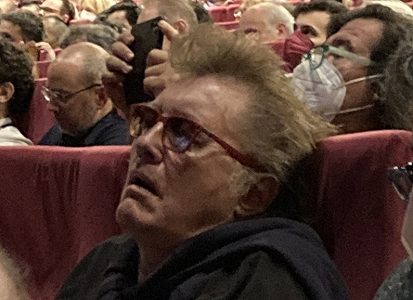
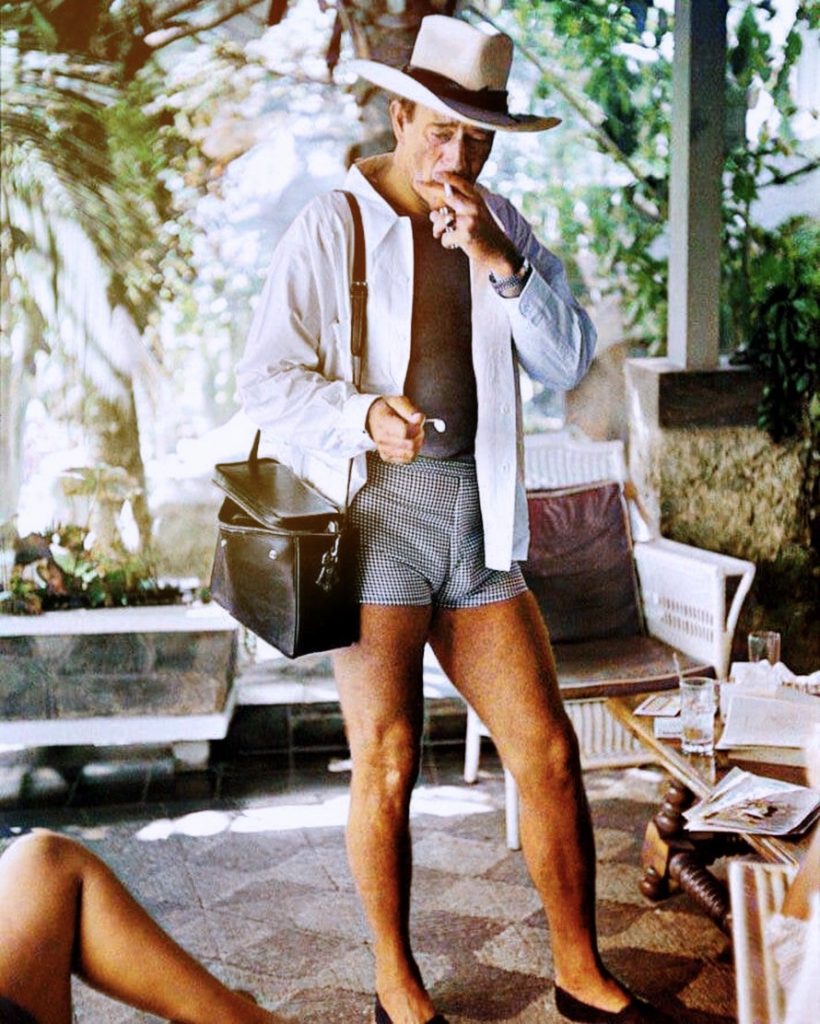
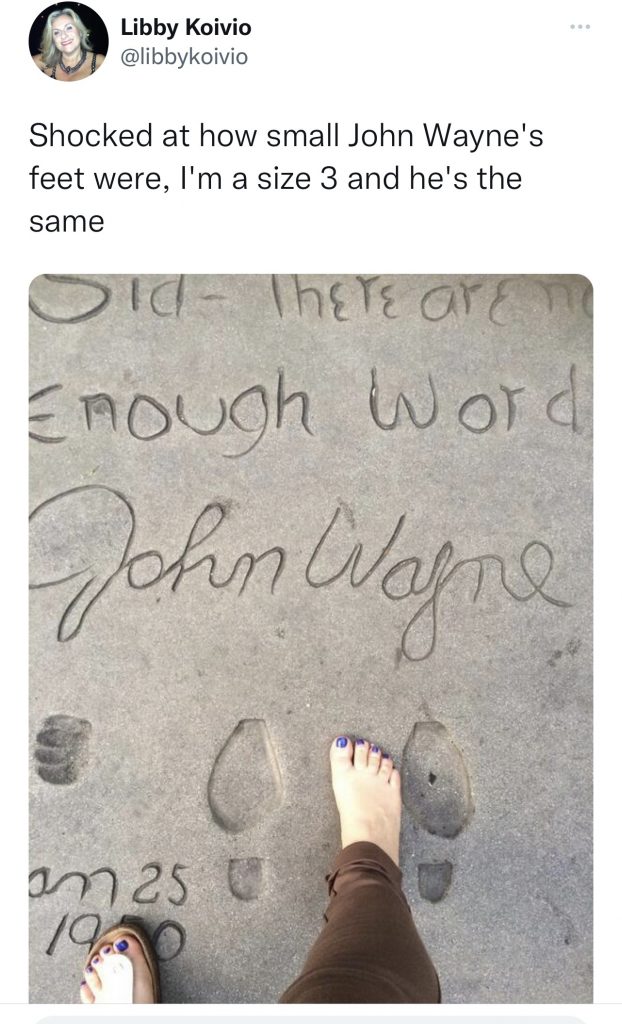
We’re allowed to acknowledge that John Wayne had relatively small feet for a guy who stood six-four — his shoe size was eight and 1/2.
We’re allowed to write about Greta Garbo having had long feet and long toes — a combination that would have made Presley shriek with horror.
But we’re not allowed to mention the fact that a certain, much beloved actress had feet that might (I say “might”) have been larger than her husband’s, and possibly larger than Wayne’s.
Ethan Hawke would never touch this topic with a 20-foot pole, I can tell you.
I can only say generally that perception-wise, a woman with man toes is…well, somewhat on the periphery. That’s fair to say, surely.


…can suck on a baguette. Okay, I don’t mean that. No, wait…I do mean that.
Having opened in France last March and yesterday in England and Ireland, Jean-Jacques Annaud‘s Notre-Dame on Fire is apparently (emphasis on the “a” word) going to open at AMC IMAX theatres in New York and Los Angeles before long. Maybe, I should say.
The well-reviewed French-language docudrama is listed on the AMC website without opening dates or showtimes. If it were playing today I would see it right away, no hesitation. I’m an agnostic Hindu LSD guy, but Notre Dame is my cathedral. I’ve been eyeballing it upclose for 45 years or so. I’ve been to mass twice there.
Oh, and by the way? The fact that investigators have never revealed what caused the fire tells you it was embers from a workman’s cigarette. Of course it was, but the Macron government doesn’t want to alienate the French proletariat.
From Phil de Semlyen’s 7.22.22 Time Out review:
“Jean-Jacques Annaud’s dramatization of the 2019 Notre-Dame fire holds a vice-like grip as it records the 12 hours or so of the blaze in forensic detail. Considering we all know how it ended — spoiler: the cathedral didn’t fall into the Seine — it’s a seriously impressive feat.
“The fire’s cause is kept vague. It’s yet to be established in real life, though Annaud hedges his bets by showing us both a workman’s rogue ciggie and an electrical short. But when the flames start to consume the upper reaches of the cathedral, melting scaffolding and pouring molten lead through the mouths of its gargoyles and on the city below, the 2,200 degree blaze takes an almost demonic presence at the heart of the drama. It’s a formidable villain.
“From there, Notre-Dame on Fire zeroes in on the often haphazard, but ultimately heroic response to the unfolding disaster. The Paris traffic, sluggish response times (early photos of the fire on social media are initially dismissed as fakes), locked doors, and the struggle to get firefighting equipment up medieval spiral staircases all ramp up the tension.
“But Notre-Dame on Fire is really good at conveying an iconic building’s place in a nation’s soul, and the grief that its potential loss can provoke. Most of its symbolism is well-earned and resonant.”
There’s nothing “wrong” with the strategy behind Ethan Hawke’s The Last Movie Stars, the six-part HBO Max series that examines the lives of Paul Newman and Joanne Woodward.
It’s actually half-inspired in a workmanlike way. Shot during the pandemic dog days, the (roughly) 360-minute epic leans upon 20-plus actor pallies (George Clooney, Laura Linney, Sam Rockwell, Vincent D’Onofrio, et. al.) to voice scores of transcribed interviews conducted by Newman collaborator Stuart Stern along with 20-plus original interviews. (All of it Zoomed.) The doc reps a livelier, more inquisitive approach to this kind of worshipful tribute, and Hawke certainly deserves points for orchestrating.
But it wore me down. I felt the sand particles of my soul starting to drain out of the hourglass. Hawke’s opus gradually made me feel as I was carrying it rather than vice versa. Too much gush, not enough meat. It was sometime during the third episode that I started to say “man, I’m getting a little sick of all these performative Zoom players expressing so much damnable delight and fascination for this rightly admired power couple…can we wrap this up, please?”
Three hours would’ve sufficed; I might have even been okay with four. But not six.
I’m certainly indebted to Hawke for educating me about Newman-Woodward in various ways that I wasn’t expecting. Newman’s description of himself as an “emotional Republican” is not something I’m likely to forget. We all knew he was a steady beer drinker but somehow the term “problem alcoholic” had never sunk in. The doc afforded me a fuller understanding of Newman’s journey, of how much better he was when he got older and stopped trying so hard. And it made me want to watch Hud for the 13th or 14th time.
I’d like to believe that my own Hud-like traits have been schooled and diminished over the years, and perhaps even locked in a box. But they haven’t been erased, and I strongly suspect that traces of same existed within Newman himself. Nobody’s perfect; some people behave badly from time to time. Hawke’s doc implies this but mostly slip-slides away.