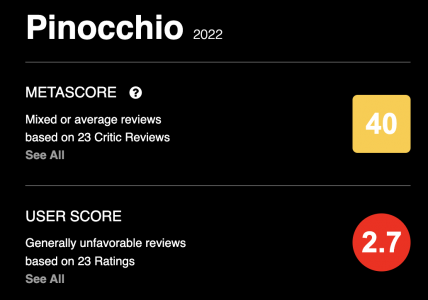
I’ve said before that I’m not especially interested in Disney’s live-action, Robert Zemeckis-directed, Tom Hanks-starring musical Pinocchio (Disney, 9.8), and that my real interest is in Guillermo del Toro‘s fascist-Italy version, which Netflix will premiere on 12.9.22. I don’t think I even want to see the Disney version, to be honest. But what a trouncing by Rotten Tomatoes and Metacritic.
If I, Jeffrey Wells, were to suddenly be thrust into the living pages of Bethan Roberts‘ romance novel and thereby literally become Tom Burgess, a young British policeman in 1950s Brighton, I would not secretly fall in love with Patrick Hazlewood, a 40ish museum curator. I might find him excellent company and a good fellow, but no heavy breathing…sorry.
Primarily because (a) I’m not gay despite lifelong metrosexual tendencies, (b) because David Dawson (who plays Hazlewood) isn’t good looking enough, (c) because I’m more or less committed to being a good husband to Emma Corrin‘s Marion, even if she lacks the sensuality of Ingrid Bergman, (d) because I’ve never found men’s hairy legs the least bit attractive and (e) because I’ve always been profoundly fearful of or turned off by certain physical intimacies that would go with the territory. (Sorry but I don’t think I’m alone on that one.)
Amazon will give My Policeman a limited theatrical release on 10.21 and a streaming debut on 11.4.
Bernard Shaw was a first-rate TV news journalist who peaked during his time at CNN (1980-2001).
Shaw’s second most memorable moment with CNN was reporting from Baghdad on the 1991 Gulf War (“This feels like we’re in the center of hell“).
But there’s no question that Shaw’s most consequential moment happened when he drilled Democratic presidential candidate Michael Dukakis with a highly emotional question that by normal human standards demanded some kind of emotional response. Dukakis’s refusal to answer with his heart did a lot to kill his chances of being elected.
Shaw had asked if Dukakis would support an “irrevocable death penalty” for a man who had hypothetically raped and murdered Dukakis’s wife. Dukakis’s reply was logical, measured and legalistic, and so doing he defined himself as a chilly technocrat.
In the wake of his mother’s passing at age 96, the 73-year-old Charles, Prince of Wakes, has unofficially become the King of England, to be ceremoniously crowned in due time. It was only two days ago when Queen Elizabeth received the new Prime Minister, Liz Truss, in Balmoral Castle. The moment has happened; no one is gut-punched; tradition soldiers on. Ten days of pomp and cirumstance to follow.
Postedyesterday: “You know who radiated an undercurrent of sexuality along with a sexual past, and who would’ve been a perfect Lady Chatterly (albeit one with a slight Swedish accent)? The Ingrid Bergman of 1945, when she was making Notorious or, if you will, Spellbound. There was never the slightest question that Bergman knew her way around a four-poster and then some.
6 pm update: I’ve been wised up about Don’t Worry Darling, and basically the ’50s thing is all bullshit. I won’t say how or why but it’s not to be trusted. So everything that follows is beside the point as the ’50s thing, and therefore the “presentism” I’ve spoken about, is off the table, so to speak.
Earlier today:
Don’tWorryDarling’s presentism was given a good going over in yesterday’s comment thread responses to “When AFilmHasIssues.” Just for the record…
It began with HE’s “HumanaHumana” taking issue with a line in Glenn Kenny’s 9.5.22 Venice Film Festival review, in which he lamented the film’s “condescending racial dynamic.” Darling is set in a 1950s desert community called Victory, and Kenny complained that “the sole Black female with a speaking part is relegated to a martyrdomprop.”
I don’t know what this means as I haven’t yet seen the film, but the mere presence of BIPOC characters in such a community is a woke projection thing.
“Within the suburban realm of 1950s homogenized America,” I wrote, “there were very few BIPOCS or Asian Americans living ‘next door’, so to speak.
“Outside of your liberal big-city enclaves, the US of A of the Eisenhower era was a largelysegregatedsociety**, and especially in planned Wonderbread communities like Victory.
“Where are the BIPOC residents in Martin Ritt’s NoDownPayment (‘57)? There was a Black longshoreman in the Hoboken-based OnTheWaterfront (‘54) but not a single Black motorcycle rider in TheWildOne (‘53), which was set in rural California.
“So if you’re making a film about an isolated suburban community in the mid ‘50s, you have to create an alternate vision of how things were. The key to this alternate vision is a little thing called ‘presentism.’”
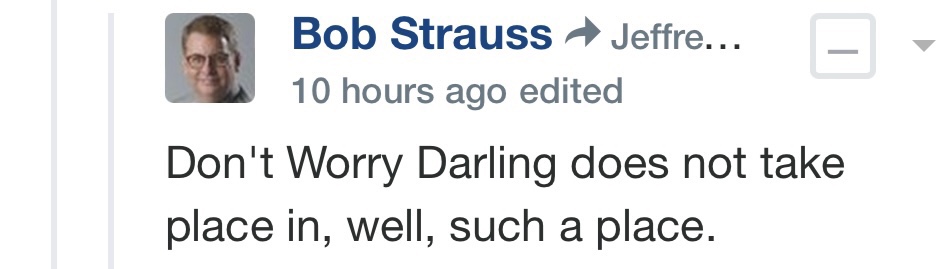
At which point the erstwhile Bob Strauss chimed in:
HEreply: “Then why not set it in a more socially liberal time? In the ‘80s or ‘90s or early aughts, say?
“My presumption is that director Olivia Wilde and her screenwriter, Katie Silberman, fell in love with the affluent ranch-style or KaufmanHouse-inspired architecture of the ‘50s (displayed in NoDownPayment as well as 1955’s TheBigKnife) as well as the cool ‘50s retro cars and clothing fashions.
“In 1961’s ParisBlues (also directed by Ritt) Sidney Poitier plays jazz performer Eddie Cook, who lives in Paris, in part, because he despises the racist culture of the U.S. whereas racial attitudes are much more casual in the City of Light.
“When Poitier himself was making ARaisinintheSun in Los Angeles in ‘60 or early ‘61, he was more or less obliged to stay at the liberal-minded Chateau Marmont because no one in the affluent nabes (including Beverly Hills) would rent their home to a black dude, even if he was a big-time movie star.
“If the exalted Poitier (Tony Curtis’s costar in 1958’s TheDefiantOnes) wasn’t able to rent in the nominally liberal Beverly Hills, what are the odds that Kenny’s ‘Black female martyrdom prop’ would have been living in Victory a few years earlier?”
** In the South and, I think, other regions, even public transportation was segregated in the ‘50s. Which, of course, is what triggered the Freedom Rider movement among black activists.