Christian Bale has been exceptional or certainly admired in several roles over the last 30 years. His finest performances, HE feels, are, in this order, the following: Dicky Eklund in The Fighter (’10), Patrick Bateman in American Psycho (’00), Dick Cheney in Vice (’18), and Bruce Wayne in his three Batman films (Batman Begins, The Dark Knight, The Dark Knight Rises).
But the Bale “performance” that made the strongest and most lasting impression, hands down, is “Bale Out: RevoLucian’s Christian Bale Remix!“, which popped in early ’09. A satirical dance remix of Bale’s Terminator Salvation rant (which happened for real in July 2008), it’s absolutely real, brilliant and unforgettable in a relentless sort of way. Every angry word is 110% genuine.
This is a distasteful subject, but I’ll just mention it and be done with it. I’ve ridden on underground subway systems all over the world — Paris, Boston, Berlin, Prague, Washington, D.C., Barcelona, London, Zurich, Rome, Munich, Frankfurt, Firenze — and New York’s subway system is the only one that has a serious problem with homeless urine stink. Okay, I might have encountered one or two faint whiffs in the Paris metro, but it’s not a regular thing there. You can, on the other hand, absolutely count on The Unpleasant while waiting for the IRT, IRT Lex, R or IND trains in Manhattan. Is it because homeless guys in Barcelona, London, Berlin and Prague are slightly more sanitary? Is alcoholism less of a problem over there? Do the overseas subway systems use more effective (i.e., more fragrant) disinfectant or employ more clean-up crews?
I’ve been saying for years (and there’s no question about this) New York City subways are the slowest, stinkiest and least reliable of all the major metro systems worldwide. Things have improved since the ’90s but the substandard service has been in place for decades.
Okay, there’s a vague resemblance between Casper Phillipson, who plays JFK in Pablo Larrain‘s Jackie and Andrew Dominik‘s Blonde, and the Real McCoy. The nose, the jawline and the eyes, to some extent, but at the same time Phillipson’s eyes lack something important. In his off moments JFK’s eyes had a haunted, hangdog quality — a slightly gloomy and exhausted look that was captured by Time magazine illustrator Pietro Annigoni. There was a vibe about Kennedy in these moments that seemed to say “I’m probably not going to last into old age, and you know it as well as I.” No offense to Phillipson but this grave undertone vibe is missing in his features. Gotta have that flickering awareness of death hovering.
Any guy knows that if you put on a pair of tallish rubber wading boots, the color has to be olive drab or dark blue. Or black-and-yellow fireman boots. But what kind of clueless dork puts on a pair of white go-go boots a la Nancy Sinatra? That’s more than clueless — it’s borderline suicidal from an image standpoint. And worse when you throw in the pot belly. If I was DeSantis I would drop at least 15 or 20 pounds — he’s too chubby to be a Presidential candidate. And while I’m working on the gut I would wear a midriff girdle under my shirt. Orson Welles wore one while playing the fresh-out-of-college Charles Foster Kane.
As you begin to watch Park Chan-wook‘s Decision to Leave (MUBI, 10.14), there’s no denying that you’re being carried along by a masterful visual composer. Every shot is exquisite, a painting, an eye bath…and so perfectly balanced.
And during the first 30 to 40 minutes you can’t help saying to yourself “wow, this guy is really good” while at the same time hoping that it’ll amount to more than just a delicious film noir by way of a haunting mood trip.
And of course it doesn’t. As the first hour comes to an end it begins to hit you. This film is all visual swoon and superficial noir strokes, you realize — it’s not going to build or pivot or dovetail into anything. But it’ll look great every step of the way.
And then you look at your watch and go “oh Jesus Mary mother of God, there’s another 70 or 80 minutes to go!” And you realize that you’re stuck, and you descend into a feeling of being locked in an animal cage filled with straw. And you realize, of course, that the minutes are just going to drag on and on. You’d like to leave but you can’t because you’re watching a film by the great Park Chan-wook, and only a rank philistine would do such a thing.
I’m just saying that Decision to Leave is opening on a week from Friday, and that…oh, hell, do what you want. Some critics are nuts for this guy. But this film should ideally be called Decision to Avoid.
Posted from Cannes on 5.23: With all due respect for Park Chan-wook’s smoothly masterful filmmaking chops (no one has ever disputed this) and the unbridled passion that his cultish film critic fans have expressed time and again…
And with respect, also, for the time-worn film noir convention of the smart but doomed male protagonist (a big city homicide detective in this instance) falling head over heels for a Jane Greer-like femme fatale and a psychopathic wrong one from the get-go…
The labrynthian (read: convoluted) plotting of Park’s Decision To Leave, though initially intriguing, gradually swirls around the average-guy viewer (read: me) and instills a feeling of soporific resignation and “will Park just wrap this thing up and end it already?”
Jesus God in heaven, but what doth it profit an audience to endure this slow-drip, Gordian knot-like love story-slash-investigative puzzler (emphasis on the p word) if all that’s left at the end is “gee, what an expert directing display by an acknowledged grade-A filmmaker!”
Being something of a clueless baseball “fan” (i.e., having not really followed the sport since I was 10 or 11), I was initially confused by last night’s Washington Post story, written by Chelsea James, about Aaron Judge‘s historic 62nd home run against the Texas Rangers.
In so doing the Paul Bunyan-sized Judge (6’7″, 282 pounds) passed Roger Maris “for the most homers in a single season by an American League player.”
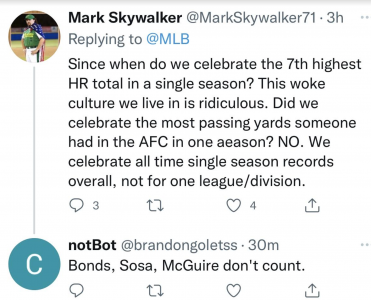
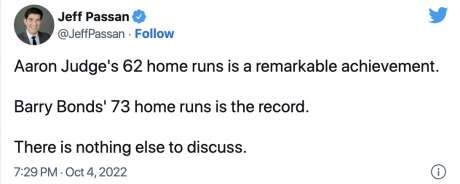
That’s very commendable, I thought, but why didn’t James’ lead paragraph convey two basic, crucial facts? One, Judge’s 62-home-run record was topped six times by three National League players — Barry Bonds, Mark McGwire and Sammy Sosa — during the steroid era (mid ’90s to early aughts). And two, Judge had beaten Maris’s American League record without the aid of steroids. Or, put another way, that he had slammed those 62 in a “clean” way.
In paragraph #3 James gently puts it as follows: “All three played at a time when MLB did not test for performance-enhancing drugs as stringently as it does now.”
And how come the TV cameras — here comes the ignorant, don’t-follow-baseball part — how come the cameras cut away to an older white couple (Patty and Wayne Judge), jubilant and hugging, when it seemed apparent they they weren’t related to the biracial Judge? Oh, I see…the 30 year-old Judge was adopted by the Judges in ’92. Didn’t realize that…sorry.
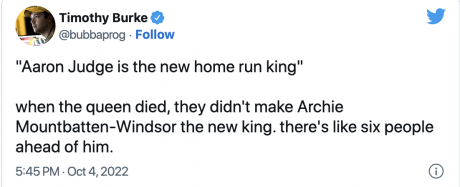
“One thing is certain after Yankees outfielder Aaron Judge hit his 62nd home run of the season Tuesday,” Neumann began. “The American League has a new home run king.
“The blast lifted Judge past another famous Yankees outfielder, Roger Maris, giving him sole possession of the AL record.
“However, that mark was exceeded six times in the National League during the heyday of the steroid era. Barry Bonds set the MLB record of 73 in 2001. Mark McGwire hit 70 in ’98 and 65 in ’99. Sammy Sosa hit 66 in ’98, 64 in ’01 and 63 in ’99.
“By being associated with performance-enhancing drugs, the feats of Bonds, McGwire and Sosa are discredited by some fans who view their accomplishments as tainted.”
We could celebrate the "clean home run king", whatever that means, or we could watch this two minute collage of balanced breakfast Barry Bonds nuking balls out of the park and into the bay https://t.co/FhoxKxnaykpic.twitter.com/eLm3lU2WUT