
Day: October 7, 2022
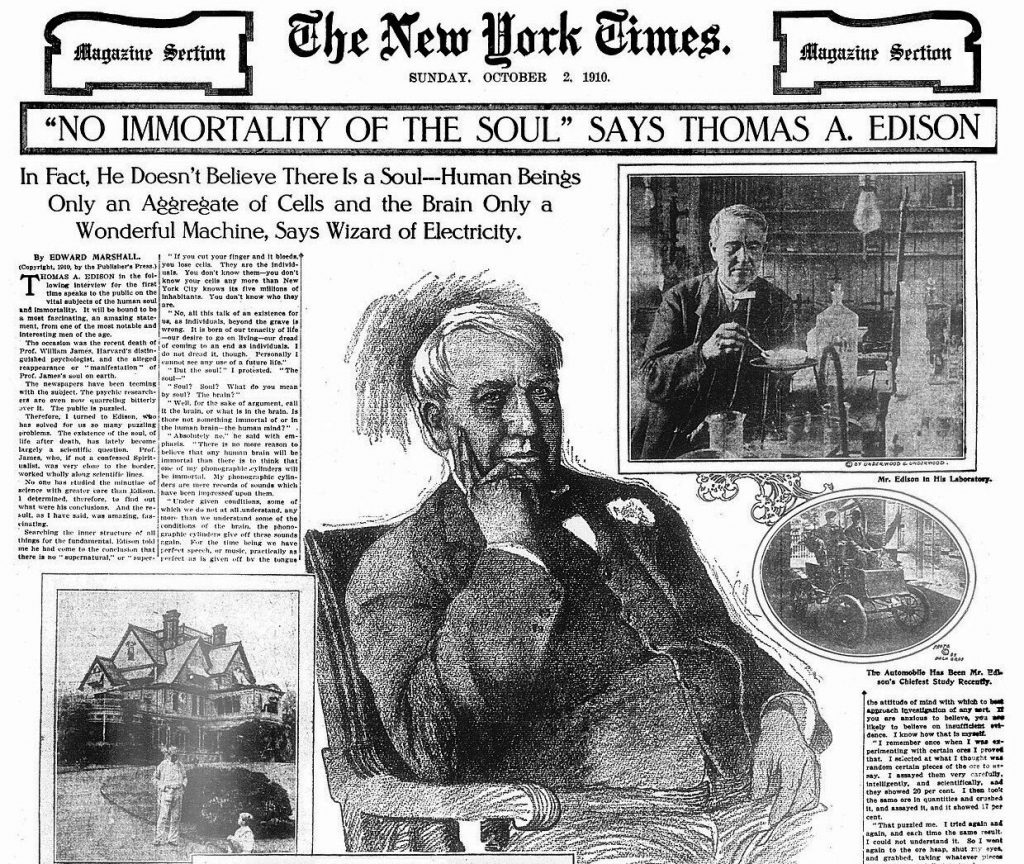
Elvis Mitchell Directs!
“How did one decade change American cinema — and culture — forever? Elvis Mitchell explores the history of Black** representation and the cultural impact of witnessing unapologetic Blackness.”
IS THAT BLACK ENOUGH FOR YOU?!? debuts on Netflix on Friday, November 11.
Off the top of my head, I’m presuming that the “one decade” in which everything changed for Black movie actors and filmmakers was the ’60s, right? Or more specifically 1963 (Lilies of the Field) to early ’70s Blaxploitation?
“Glass Onion” Is Not An Oscar Thing…Please
There are five Gold Derby guys (Brian Truitt, Kevin Polowy, Clayton Davis, Shawn Edwards, Chris Rosen) who apparently believe Rian Johnson‘s Glass Onion is a credible Best Picture contender. Then again they’ve all got it ranked low so they’re probably thinking “place-holder until further notice.”
On the other hand EW and TCM‘s Dave Karger has Glass Onion ranked fourth on his 10.5 Best Picture spitball list. And I’m telling you there’s no effing way that a way-too-expensive film that combines the traditional plot-schemings of Agatha Christie (or, more recently, Johnson’s Knives Out) with Herbert Ross‘s The Last of Sheila…I’m telling you there’s no way for such a film to be Best Picture nominated.
Because (and this is not a putdown) it’s just an expensive, presumably clever whodunit wank-off flick that’ll make a lot of money. And that’s all.
Plus it has Dave Bautista in a principal role, and it’s explicitly stated in the 2022 edition of the AMPAS rules and regulations that any movie costarring a musclebound meathead type wearing a backwards baseball cap can’t be nominated for Best Picture. Don’t believe me? Go ahead and check…I’ll wait.
If Karger is going to fantasize an Oscar future for Glass Onion why not also predict a Best Picture nomination for Ticket to Paradise?
Selected Gore vs. “Bros” Transcribing
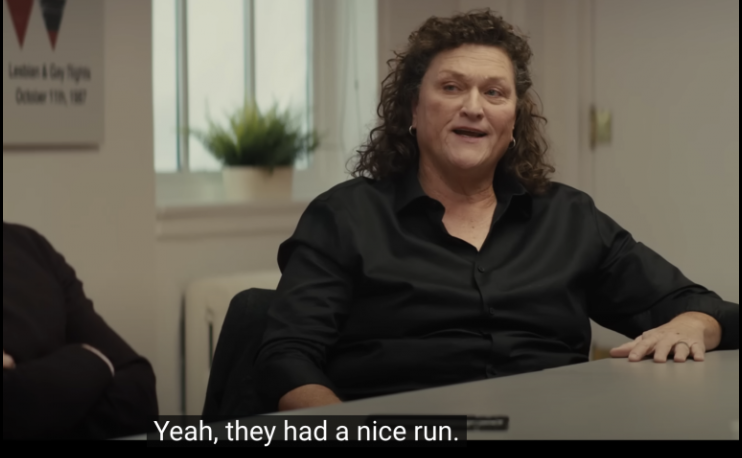
Partial transcript from Chris Gore comments in 10.3 YouTube conversation titled “Billy Eichner’s “Bros” DESERVED to FAIL”:
Gore #1: “I hope I’m not offending anyone by saying this, but the majority of people [in this country] are straight. That is just a fact, and that is the way things are.” HE modifier: Gore forgot to say the word “vast” before “majority.” Before Zoomers came along (and I mean as recently as the mid-to-late teens) the LGBTQ populations was somewhere in the vicinity of 3.8% nationwide. Now it’s in the vicinity of 7.1%, but you can chalk that up to trendy Zoomer identity issues and fluidity.
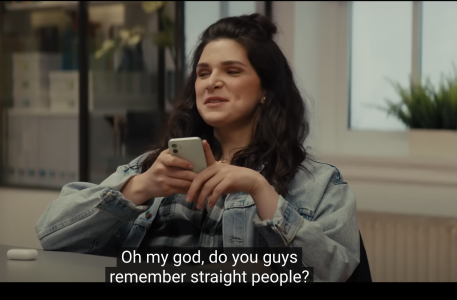
Gore #2: “And that trailer…I saw that trailer in a theatre, and it ends with a character asking ‘do you remember straight people?’ and another saying ‘yeah, they had a nice run.’ People in the audience cringed. You could hear audible groans. Or silence. When your trailer for a romantic comedy…it should end with your biggest laugh, and yet they basically ended it with a ‘fuck you’ [to straight people]. It is never a winning strategy to insult your audience.”
Gore #3: “This movie is all about being gay…all about [Billy Eichner‘s] sexuality. If Eichner had made this movie for a million dollars and it had made $5 million dollars, we would be having a different conversation.”
Gore #4: “There are parts of the movie that I found offensive. [Eicher and Luke MacFarlane] are having dinner with Luke’s parents, and there’s a conflict with Luke’s mother, a second-grade teacher, who says ‘I think second graders are too young to be exposed to or educated about LGBTQ issues.” Which Eichner disagrees with. It turns into a huge argument, and also drives the third act of the movie. The scene is effectively commenting on the parental rights bill in Florida, described in [woke circles] as the ‘Don’t Say Gay’ bill…it’a a comment on that [Florida law]. The movie ends with the mother bringing her second graders to the LBGTQ museum that Eichner is the top administrator of, and I don’t know if this is a conversation that we need to be having…a plot point written by and made by people WHO DON’T HAVE FUCKING CHILDREN! I was offended and pissed off when I saw that.”

Complete Absence of Humanity

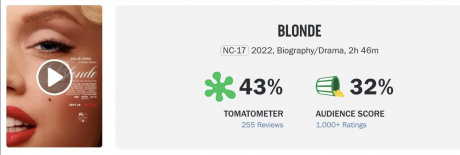
When I think of Blonde, I don’t think of Ana de Armas‘ impressive, open-veined performance or the mostly black-and-white cinematography or the 1.37 aspect ratio or the expert craft levels or Andrew Dominik‘s ambition to create a serious art film. (Which he’s obviously done.)
What I think of is the cruelty. Whatever the degree of actual psychological anguish and emotional abrasion that the real Norma Jean Baker suffered through in her actual life, Blonde doubles if not triples the ante. It re-brutalizes and re-exploits the poor woman all over again, and more than earns its reputation of being a cruel, sadistic, bludgeoning film.
What other noteworthy films could be fairly described as cruel, heartless and sadistic toward their main protagonists?
Off the top of my head I would say Pier Paolo Pasolini‘s Salo, or the 120 Days of Sodom. And certainly Lars von Trier‘s Dancer in the Dark. Not to mention Robert Bresson‘s Au hazard Balthazar, Mel Gibson‘s The Passion of the Christ, Vaclav Malhoul‘s The Painted Bird (“a highbrow art film for elite critics and cineastes who have the fence-straddling ability to enjoy magnificent b&w cinematography (all hail dp Vladimir Smutny) and austere visual compositions while savoring the utmost in human cruelty and heartless perversion“), Hostel, Irreversible, A Clockwork Orange, Funny Games (both versions), Inglourious Basterds…what others?

Ears Don’t Lie
My default response to all the major Beatles album remixes (Abbey Road, White Album, Sgt. Pepper, Rubber Soul) has been to scoff. And then to buy them.
I’m no audiophile but I’ve always held that while the new versions sound agreeably enhanced they aren’t significantly different than the originals, and that these remixes, when all is said and done and digested, are mainly a marketing hustle. But I bought them anyway because of the lifelong emotional investment factor.
But guess what? This morning I compared the 2022 remix of “Taxman” vs. the 2009 version, and discovered to my surprise that the differences in the ’22 mix are striking. This is due to a technological innovation, engineered by Get Back director Peter Jackson, that allowed Giles Martin and Sam Okell to separate all the instruments and do a remix from scratch.
George Harrison‘s vocal track is on both sides now and not just the left, John Lennon‘s rhythm guitar is louder and more distorted sounding (in a good way), and the sound of the amplifier hum at the beginning of “Taxman” is now missing. You could argue that you’ve always liked the amplifier hum and that removing it kills the historic, low-tech 1966 vibe and I wouldn’t call you wrong, but if you listen on headphones the new “Taxman” is, I feel, a fuller, more alive rendering.
For What It’s Worth…
Between my mid to late teens I was feeling more and more bored in school. Okay, not by everything. I liked English composition, literature and American history. But overall it seemed as if too much of school was a San Quentin experience, and I always felt instinctually suffocated by math (algebra, geometry) and science (biology, geology), to put it mildly.
It followed that I developed an intense loathing for certain professors who, I felt, were not only boring me to tears but giving me shitty grades and thereby harming my future.
Sorry for the ignorance and arrogance but I was young, angry and nihilistic, and this is how I saw things.
All to say that if the current Age of Zoomer and Millennial Entitlement Insanity had somehow been a thing during my years of educational agony, I definitely would have signed a petition to get some of my teachers fired. It wouldn’t have been fair but I saw these teachers as absolute villains who were bringing unmitigated misery into my life. So I understand the impulse of those 82 NYU students whose signatures on a petition managed to trigger the firing of NYU organic chemistry professor Maitland Jones Jr.
I don’t agree with whacking the poor guy and feel that the 82 students should have studied harder, but some teachers do have an almost magical ability to suffocate their students’ souls, and it’s possible that Jones was one of those.
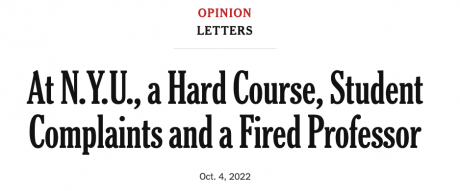
From a letter to the N.Y. Times by Martin E. Ross of Boston: “The overpampering of children by parents and teachers combined with soaring tuition has turned students into entitled customers demanding to be catered to as such. The student-professor interaction has become far more transactional than in previous years, with administrators increasingly inclined to side with their customers. Students expect their professors to be like either Mister Rogers or Stephen Colbert, and woe to those less entertaining ones who dare to assign poor performers the grades they deserve.”