Therapy isn’t supposed to be easy (it certainly isn’t if you take it seriously), but my general view is that it’s one of the greatest luxuries out there. I haven’t seen a therapist in years but a documentary about a famous patient and his therapist…? I’m not sure.
Honest confession: I would make a great therapist. Seriously. Know why? Unlike most therapists, I wouldn’t just sit there and listen and occasionally ask “how did you feel about that?” Maybe I could offer my services along these lines. HE guerilla therapy.
Every so often I reflect on what the accumulation of time does to some people, and what it’s done in particular to…well, friends and family, of course, but hotshots I’ve run into over the years and especially the occasional supernovas. I began thinking about Jack Nicholson a couple of days ago. William Faulkner‘s concept of eternity will always apply (“the past is never dead…it’s not even past”), but the more it sinks in the more the present seems to concurrently intensify.
Things change, of course. and some weather the storm better than others. Luckier, healthier, better genes.
The general rule is that you can “party” like a madman in your teens and 20s and maybe even into your early 30s, but you have to behave more sensibly and turn that activity down (or better yet embrace sobriety) when you hit 40 or thereabouts. You really do. If you don’t, you’ll probably have to pay the piper when you get old. Some who were famous and flush and relatively young during the great cocaine binge era of the ’70s and early ’80s can tell you about that piper. Not all but some.
Speaking of which you have to admire how Martin Scorsese (who will celebrate his 80th birthday on 11.17) is by all accounts still lucid and wise and charging along like a 47 year old, or a decent facsimile of same.
Feel free to ignore the following if you’ve re-read it too many times…
It was mid January of 1982, and I, representing the N.Y. Post, was interviewing Mr. Nicholson at the Hotel Carlyle. I’d been told that my time slot was, believe it or not, about an hour. The subject was Tony Richardson‘s The Border (Universal, 2.12.83). I arrived at the Nicholson suite on the 23rd floor around 10:30 or 10:45 am. I was greeted by publicist Bobby Zarem in the foyer. Nicholson was seated about 25 or 30 feet away, down the hall and around the corner but within earshot.
“How are ya, Jeff?” Zarem asked with his usual urgent energy. Manhattan had been going through a long frigid spell and it seemed especially icy and and windy that morning. I was wearing a gray leather jacket that wasn’t nearly warm enough, so the first reply that came to mind was “oh, cold as usual.” A split second later I heard Nicholson doing an imitation of me, saying “cold as usual.”
Our discussion was all over the map, and I was trying to keep things cool and steady. But deep down I was saying to myself “wow, this is really happening.” I didn’t know if I was coming or going, but at some point I asked Jack for his reaction to a tartly written review of The Border by Time‘s Richard Corliss. Jack hadn’t read it so I showed it to him. The review began as follows:
“When, early in The Border, Nicholson muses about how, back in California, ‘I liked feeding those ducks,’ one’s first reaction is: ‘Feeding them what? Strychnine?’ Nicholson’s voice, with the silky menace of an FM disc jockey in the eighth circle of hell, has always suggested that nothing in the catalogue of experience is outrageous enough to change his inflection. Even when he goes shambly and manic (Goin’ South, The Shining), Nicholson’s voice and those tilde eyebrows give the impression…” and blah blah.
Nicholson chuckled faintly when he read it, and then went into a minor tirade about how he was “mad” that he’d convinced the public he was a murderer, and about being stuck in that box. This image disappeared the following year, of course, after he played Garret Breedlove, the randy ex-astronaut, in James L. Brooks‘ Terms of Endearment.
Earlier or later I had shared a view (my own) of Nicholson’s performance in The Shining. The idea was that aspects of his Jack Torrance performance seemed, to me and others I knew, to be self-referential or, if you will, a kind of inside joke between Jack and his fan base. Nicholson disputed this. He wasn’t rude but his response was basically who was I, a mere journalist, to assume I had an inside view of things? He was relaxed and droll about it, but his point was that he was “inside” and I wasn’t.
Like a lot of X-factor guys, Nicholson has a habit of jumping the track in terms of conversational threads. We got to talking about cold-weather jackets and he mentioned he was planning to head downtown later to buy himself a nice warm one. “What are you looking for?”, I asked, meaning goose down, motorcycle jacket, Brooks Brothers or whatever. And Nicholson answered, “I don’t know. I haven’t known for quite some time.”
The most poignant moment was when he began sipping a Miller High Life about 15 or 20 minutes into our chat, and my deciding to drink one also as a gesture of solidarity.
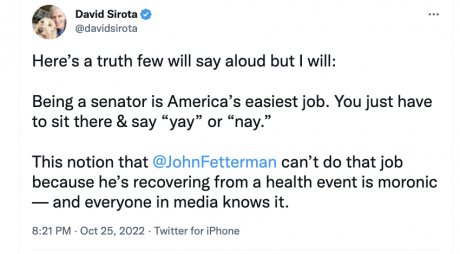
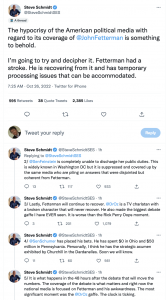
I was terrified that Pennsylvania’s Democratic candidate for the U.S. Senate would make some sort of grammatical mistake or lose his train of thought or something. He stumbled once or twice but he did…well, okay. (Except for the fracking answer.) Anyone who would vote against John Fetterman because he isn’t fully recovered from his stroke has no heart or compassion for those who’ve had to cope with a serious but temnporary medical condition. Fetterman is a soul man and a much better human being than Mehmet Oz, who said last night that he would support Trump in the ’24 election if nominated.
I first interviewed Drew Barrymore in the summer of 1982, when she was seven. It was for an Us magazine cover story about E.T., The Extra-Terrestrial. I ran into her again in ’99 at that Sunset Marquis bar (Bar 1200) — she and Luke Wilson were parked at a table, and I sat down for a chat.
The Drew Barrymore Show has been happening since 9.14.20. I like the red-yellow-green flag game, and I enjoyed this session in particular because Stewart strikes me as a no-bullshit type who has her own opinions and holds her ground when challenged or prodded.
Unlike Barrymore, I should add. During a 5.17.21 interview with Dylan Farrow and during a discussion of Allen v. Farrow, Barrymore threw Woody Allen under the bus. In ’96 Allen cast Barrymore in Everyone Says I Love You, the second best film she made in her life.
I’m not talking about Jack Nicholson‘s Bobby Dupea abandoning Karen Black‘s Rayette Dipesto at a gas station in rural Washington. This I understand. Dupea comes from an eccentric musical family and, despite his job history as an oil worker, regards himself as an intellectual rebel artist. He’d rather slit his throat than submit to a conventional middle-class Bakersfield life as Rayette’s husband (and perhaps as a father to their unborn child). And so, like a chickenshit junior high-school nihilist, he decides to escape.
That part adds up. Dupea is a tragic figure who’s running away from himself…hell, from everything. I was almost like that in my early 20s.
What I don’t get is why Bobby leaves his brown suede jacket hanging in the gas station bathroom. He’s heading into “colder than hell” weather without protection from the elements? That’s crazy. And how much money could he possibly have in his wallet? It all fits except leaving the jacket in the bathroom.
I said yesterday that I don’t like the look of The Son‘s Zen McGrath, the 20-year-old Australian actor who plays the son of Hugh Jackman and the grandson of Anthony Hopkins in Florian Zeller’s upcoming film (Sony Pictures Classics. 11.25.22).
“Baobob dylan to HE: “So you hate McGrath before you’ve even seen the movie? Or you hate the actor because he’s…acting?”
HE to Babobob dylan: “I took an instant dislike to the guy, and tough shit if you don’t like that.”
Bobby Peru: “When will you grow out of this juvenile bullshit and give films and characters fair shakes?”
HE to Peru: “You’ve never experienced an instant no-thanks to anyone in your life, simply because of how they look or because of some vibe they were putting out? No stranger has ever glanced at you and given you a dirty look? Peter Ustinov once said that Charles Laughton felt this way toward Laurence Olivier. It happens. It’s called instant animal dislike.
“There was a moment when I was 19 or 20 when I walked into a bar in rural New York State, and there was a guy sitting at the bar who was giving me a look that said “fuck you.” I hadn’t done or said a thing and he was almost ready to take a poke at me.
“Why should I have to make an extra effort to get to know Zen McGrath and discover things about his character that I might find acceptable or tolerable or likable? I’m not about to work with the guy at an office or on a movie — he’s a character in a film, and if he doesn’t rub me the right way (which is to say at least in a neutrally inoffensive way) that’s on him, not me. I’m just a face in the crowd. A face and a voice.
“There used to be actors who were hired and worked a lot by playing villains or shifty shitheads BECAUSE they rubbed or struck you as bad news. One look at these guys and you just KNEW they were trouble. That’s why Hollywood hired them time and again. Guys like Neville Brand, say. Every so often a bad or ornery guy would graduate into playing a good guy — Humphrey Bogart and Lee Marvin come to mind.
“Does McGrath have the potential to graduate in this fashion? Maybe…who knows? I wish him well in a general sense, but I really don’t like the vibe he’s putting out in The Son. And I don’t have to apologize to you or anyone else if I feel this way.
“There have been many, many actors in the past who hit it fairly big & even became movie stars because audiences instantly liked or trusted them or at least felt a certain familial kinship. McGrath is not part of this fraternity. In The Son he has a face that says “I am a sullen, scowling, pissed-off malcontent, and I’m going to turn this movie down a dark alley. If at all possible I’m going to infect you with the poison in my soul, and you are going to know what it feels like to be miserable and self-loathing…I’m going to bring you down, man.”
“I don’t care if McGrath’s character was blown off or rejected by Hugh Jackman’s character when young. That was a cruel and hurtful thing for Jackman to have done to the poor kid, agreed, but some people are narcissist shitheads, or they just aren’t cut out to be good or decent fathers. My dad was clever and witty and a hard worker in the office and amusing at parties, and a decent, honest, stand-up fellow character-wise. But he was also brusque and gruff and moody and dismissive when it came to me. I didn’t feel all that loved or supported by the guy (not to mention the alcoholic personality toxicity) but life is sometimes like that. You have to somehow make do and roll with the punches.