“Silver Streak” Collision in New Canaan

Trains don’t derail or plow through a station barrier in real life — only in movies. It’s possible, I suppose, if the chief engineer has suffered a heart attack or something. Like that elderly subway engineer in The French Connection. In Silver Streak Gene Wilder‘s heroic George Caldwell, knowing that the throttling engine car is unstoppable, disconnects it from the rest of the train. All to say that the Metro North engineer who allowed a train to smash into the New Canaan end-of-the-line barrier was either unconscious or suffering some kind of seizure or whatever.

Read more

Nikki Haley’s “Trifecta Flip-Flop”

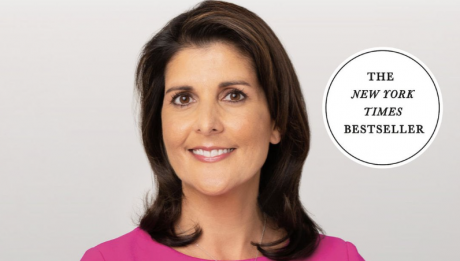
Earlier today Nikki Haley, the former South Carolina governor and United Nations ambassador, announced her candidacy for the 2024 Republican presidential nomination.

This makes her the first Republican to challenge a certain bloated sociopathic mob boss, who may or may not emerge triumphant in the ’24 Republican primaries but hasn’t the slightest chance of defeating President Joe Biden in the general election.

Even with a majority of Americans persuaded that Biden is too old for a second White House term, Donald Trump‘s criminal record and sociopathic compulsions will prove a strict no-go. Which means there’s a half-reasonable chance that Haley or Florida governor Ron DeSantis (if and when he announces) could prevail.

And yet Haley has shown over the last couple of years that she’s a Trump toady, or at least is willing to sound like one, and is hence saddled with the appearance of an ethical problem. A case against her has been laid out by Stuart Stevens, a former Republican political consultant who worked on the presidential campaigns of Mitt Romney and George W. Bush. The essay is titled “Nikki Haley Threw It All Away.” Here’s a taste:
“As governor, Haley’s defining action was signing legislation removing the Confederate flag from the State Capitol. This came after the horrific massacre at the Emanuel African Methodist Episcopal Church in Charleston, and after social media photos surfaced of the murderer holding Confederate flags. Ms. Haley compared the pain South Carolina Black people felt to the pain she experienced when, as a young girl named Nimrata Nikki Randhawa, she saw her immigrant father racially profiled as a potential thief at a store in Columbia.

“‘Iremember how bad that felt,’ Ms. Haley told CNN in 2015. ‘That produce stand is still there, and every time I drive by it, I still feel that pain. I realized that that Confederate flag was the same pain that so many people were feeling.’

“Then came Donald ‘you had some very fine people on both sides’ Trump, and by 2019 Ms. Haley was defending the Confederate flag. In an interview that December, Ms. Haley told the conservative radio host Glenn Beck that the Charleston church shooter had ‘hijacked’ the Confederate flag and that ‘people saw it as service, sacrifice and heritage.’

“In her 2019 book, ‘With All Due Respect,’ Ms. Haley mentions Mr. Trump 163 times, overwhelmingly complimentary. In one lengthy passage, she insists that she was not referencing him in her 2016 Republican response to President Barack Obama’s State of the Union speech, when she called on Americans to resist ’the siren call of the angriest voices.’

“It is always sad to see politicians lack the courage to say what should be said, but sadder still to see them speak up and later argue any courageous intent was misinterpreted.

“It didn’t have to be this way. No one forced Ms. Haley to accept Mr. Trump after he bragged about assaulting women in the Access Hollywood tape. No one forced her to defend the Confederate flag. No one forced her to assert Mr. Trump had ‘lost any sort of political viability’ not long after the Capitol riot, then reverse herself, saying she ‘would not run if President Trump ran,’ then prepare to challenge Mr. Trump in the primary.

“There is nothing new or novel about an ambitious politician engaging in transactional politics, but that’s a rare trifecta of flip-flop-flip.”

Due Historical Diligence by Jerry Harvey

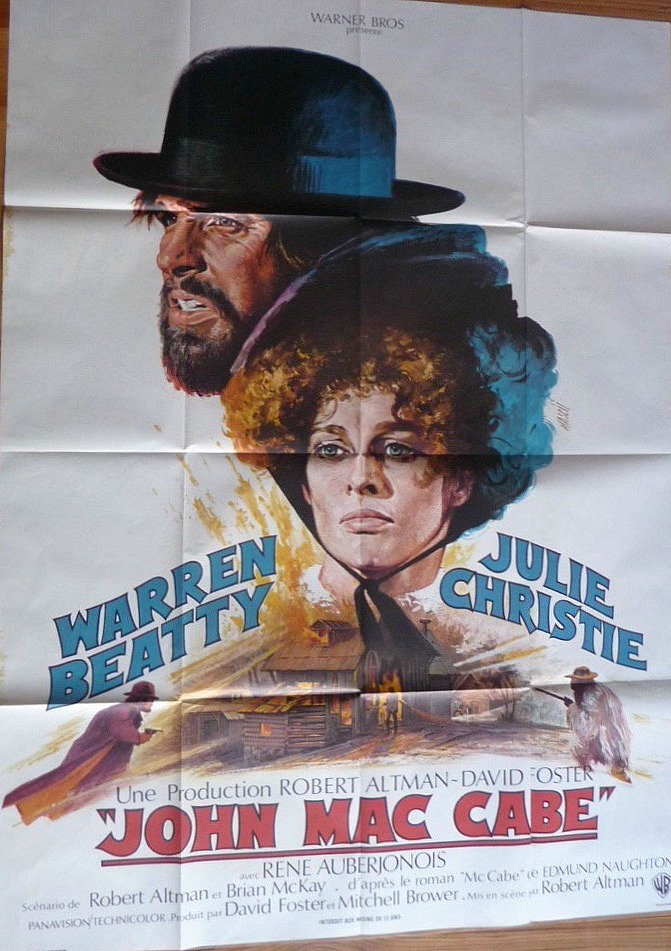
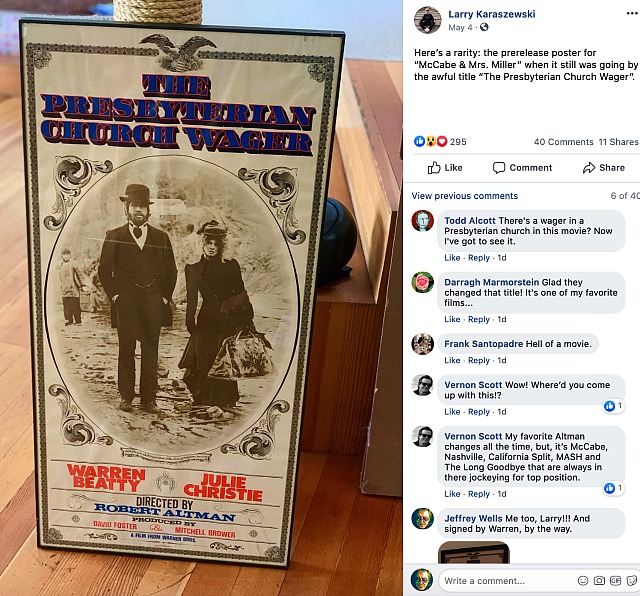
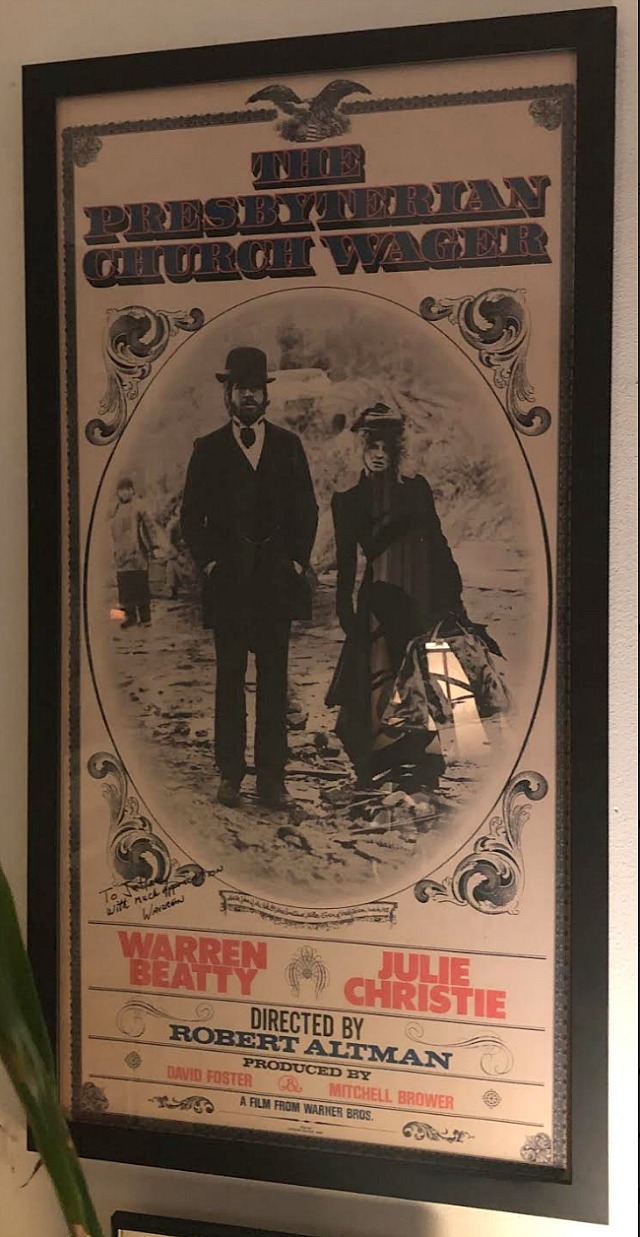
I’ve written two or three times about an extremely rare one-sheet for The Presbyterian Church Wager, which is what Robert Altman‘s McCabe and Mrs. Miller (’71) was called before it was twice re-titled. After learning of the original title certain Presbyterian Church honchos objected to their church being associated with the superficially tawdry subject matter (prostitution, gambling, opium use). The initial re-title was John Mac Cabe (the last name strangely spelled as two separate words), and then it became McCabe and Mrs. Miller.

What I’ve never conveyed until this moment was that I first learned of the existence of the Presbyterian Church Wager one-sheet when I saw it hanging in the interior lobby of the Beverly Canon theatre (205 No. Canon), a renowned art house for which the late Jerry Harvey (later of Z Channel fame) was the programmer and manager in the ’70s.

Posted on 4.16 20: “As a proud owner of a Presbyterian Church Wager poster (along with Larry Karaszewski, Anne Thompson and Svetlana Cvetko), I’m wondering if anyone has ever seen this French-market poster for sale (can’t find it online) or if they know somebody who has one on their wall? How odd that the designer decided to change the last name of Warren Beatty‘s character from John McCabe to John Mac Cabe.

Posted on 5.6.19: A couple of days ago on Facebook, Larry Karaszewksi, the renowned screenwriter (along with partner Scott Alexander), director, producer and co-chair of the Academy’s Foreign Language Oscar executive committee, posted a photo of a rare cultural artifact — a framed poster for Robert Atman‘s The Presbyterian Church Wager, which later became McCabe and Mrs. Miller.

Until Larry posted this I was under the impression that only three Los Angelenos owned mint-condition TPCW postersIndiewire‘s Anne Thompson, myself and dp Svetlana Cvetko.

The poster hanging in my living room is an expensively scanned digital copy of an original that Thompson loaned me in 2008. Three copies were made. I asked Warren Beatty if he would be good enough to sign them. I dropped them off at Beatty’s home, and after two or three weeks I was told they hadn’t been signed. I waited another week or two, and then, not wanting Beatty’s gracious pledge to become a thing of any kind, I decided it would be better to just say “okay, no worries but let’s forget it…I’ll just come by and pick them up un-signed…no harm, no foul…thanks for pledging assistance but it’s totally okay if it can’t work…you’re a good fellow and thank you.”

The next day his assistant told me the one-sheets had finally been signed. I said “thanks enormously” and picked them up later that day.

Raggedy Aspect Makes It Work…Right?

A part of me would honestly love to work for Dunkin’ Donuts. A very small part of me. A micro-sliver. Okay, I hate the idea. Plus I might not have the character for such a job. Okay, I don’t have the character for it — let’s be honest about this.

For The Love of Tom Luddy

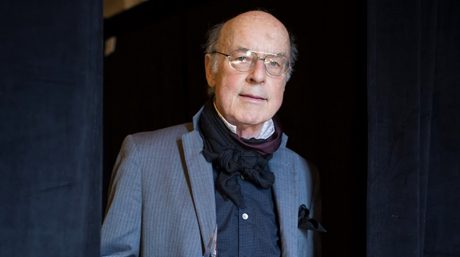
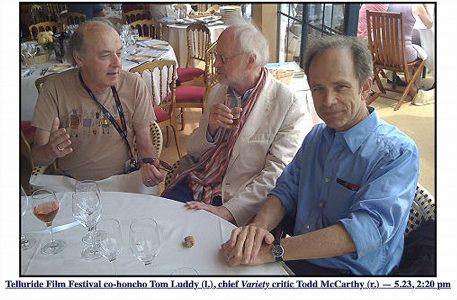
The great Tom Luddy, co-founder and artistic director of the Telluride Film Festival…a gentle hombre who always greeted and treated me like a brother and who long ago turned me on to Adam Curtis‘s The Century of the Self, a gift that I’ve never gotten over…a world-travelling cinematic sophisto who understood everything, knew everyone and always championed this or that overlooked film…Tom Luddy has died at 79.

I first dealt with Tom through my Cannon Films employment in the mid to late ’80s. Four films which Luddy produced or associate produced — Barfly, King Lear, Tough Guys Don’t Dance, Manifesto and Powaqqatsi — were financed by Cannon, and I was the in-house press kit writer. (I’ve never re-written anything in my life as much as I rewrote the Barfly press kit — Barbet Schroeder made me chisel and rephrase it over and over — I couldn’t even read it after the umpteenth try, but Schroeder taught me the meaning of “truly hardcore.”) And then Tom and I rekindled when I ran into him at the San Francisco Film Festival in the early aughts. And then Telluride, of course, which I began attending in 2010.

If you were ever lucky enough to attend a Frank Sinatra concert (which I did in Long Beach back in ’83), you’d know all about Sinatra’s emotional body language as he sang a song. He would act out the lyrics and the feelings. Luddy would do almost the exact same thing when speaking to the Telluride press contingent at the start of the festival. He would lean forward and convey his heart vibes about this and that film, gently grinning and making eye contact with some of us. You could really feel the fervor. Luddy’s regard for great cinema was religious…evangelical at times.

Roddy McDowall in heaven: “Is that how one says it? As simply as that. ‘Tom Luddy is dead…the soup is hot, the soup is cold…Luddy is living, Luddy is dead.’ [beat] Boast that you were honored to speak his name even in death! The dying of such a man, must be shouted, screamed! It must echo back from the corners of the universe. ‘Luddy is dead! Tom Luddy of Telluride lives no more!”

From Telluride rep Shannon Mitchell: “It is with deep sorrow the Telluride Film Festival announces the passing of its founder and inspiration. Tom Luddy died peacefully on February 13, 2023, in Berkeley, California after a long illness.

“Tom was a force in the film industry for nearly six decades. He had a life-long love and passion for film, and a tireless dedication to film restoration, distribution, and exhibition. His presence will be profoundly missed by the many people whose lives were touched by his kindness, artistry, and his innate ability to bring people together to make something beautiful.

“’The world has lost a rare ingredient that we’ll all be searching for, for some time,’ reflects Julie Huntsinger, Telluride Film Festival Executive Director. ‘I would sometimes find myself feeling sad for those who didn’t get to know Tom Luddy properly. He had a sphinx-like quality that took a little time to get around, for some. But once you knew him, you were welcomed into a kingdom of art, history, intelligence, humor, and joie de vivre that you knew you couldn’t be without. He made life richer. Magical. He called Telluride a labor of love for a very long time. We’re so much better off because of him and that labor.

“We at the Festival owe it to him to carry on his legacy; his commitment to and love for cinema, above all.”