I Don’t Know How I Feel About This

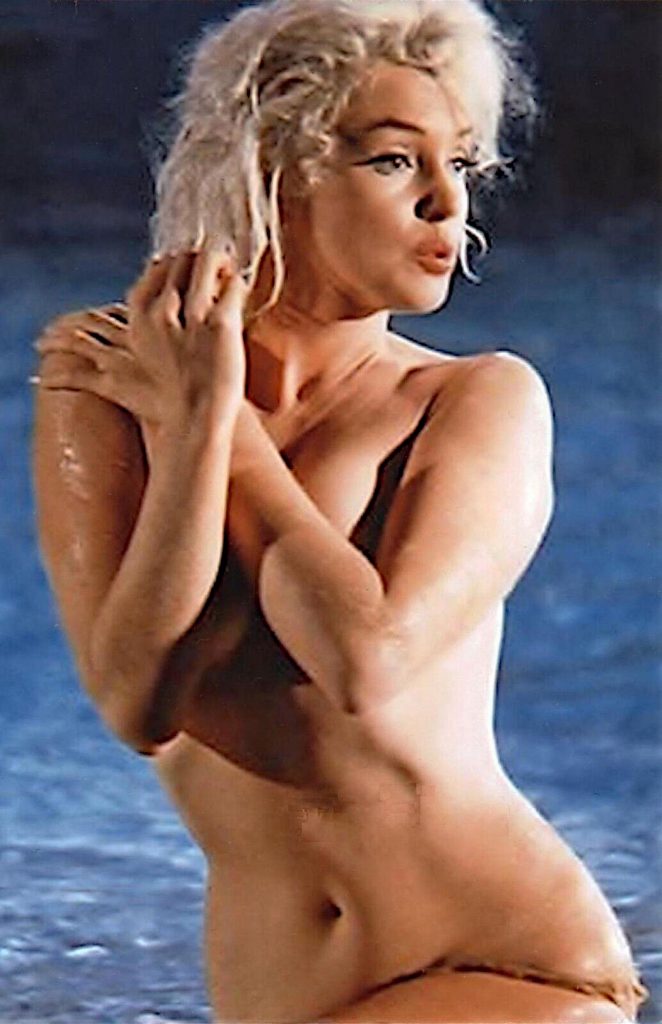
But when I saw this imaginary Reddit image of an 82 year old Marilyn Monroe, I almost said to myself “gee, there’s something to be said for dying at age 36.”

I don’t really mean that. If she’d only hung on and lasted into the Bonnie and Clyde era and beyond, Monroe could have had a great second act and perhaps even a great third or fourth. Her spirit would’ve been ignited by the mid to late ‘60s. She would have loved the Beatles and the Stones…all of that. She would’ve been levitated by Rubber Soul and Revolver. She might’ve attended that ‘65 acid trip party with John Lennon, and when Peter Fonda sauntered over and said “I know what it’s like to be dead,” she might’ve said “Peter, stop it…just open your heart and be happy.” She might even have fit right in with Ken Kesey and the Merry Pranksters. She would’ve adorned the cover of Ms. magazine in the early ‘70s.

Luscious Hottie Has Affair With Ginger Nottie

Last night I watched the first installment of David Kelley‘s Love and Death, an HBO Max three-parter about the 1980 Candy Montgomery Texas murder saga. I had recently watched Candy, the Hulu five-parter starring Jessica Biel, that premiered in early May of ’22.

At this stage I’m totally Candy Montgomery’ed out.

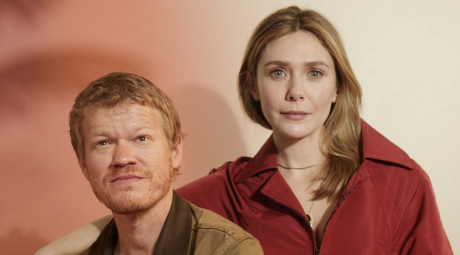
I tried to roll with the Love and Death teleplay, but as I mentioned last month after watching the trailer, the Jessie Plemons casting got in the way. When Elizabeth Olsen‘s Candy asks Plemons character, Allan Gore, if he’s interested in having an affair, something inside me recoiled and went “no effing way…no!”

Posted last month: “It would be one thing if the actress playing Candy was shlumpy or overweight or less than dynamically attractive. But Olsen, 34, is a double-A hottie and has been so for many years, so why in the real world would she want to have sex with a C-minus guy (at best) who looks like Jesse Plemons? Fleshy and ginger-haired, pale and puffy-faced, tiny pig eyes.”

When Olsen and Plemons, after much hemming and hawing, finally do the deed in a motel room, I couldn’t stand it. Guys like Plemons never score with double-dishies. It just goes against human nature.

That said, I want to offer serious respect to Plemons for recently dropping all that weight…seriously.

Read more

Why Did I Subject Myself to “Goldfinger”?

For decades I’ve been convinced that there are only two Sean Connery 007 films worth re-watching — Dr. No (’62) and From Russia With Love (’63), both directed by Terence Young. Because they’re the only two Connerys that aren’t undermined by high-tech gadgetry, silly stunts, Daffy Duck-level plotting and an attitude of smug financial arrogance on the part of the producers.

Guy Hamilton‘s Goldfinger (’64) was the film that demonstrated how the burgeoning Bond franchise had become drunk on its own fumes and begun to degenerate into foolery. The first two Bonds at least flirted with realism from time to time, but with Goldfinger the realism was more or less out the window.

For a reason I can’t quite fathom I popped in my Goldfinger Bluray last night and endured the damn thing. Okay, I watched it because it boasts a wonderfully clean and richly colored 1080p transfer. There’s no faulting the tech.

Goldfinger runs 110 minutes but feels a bit longer, mainly because it starts to descend into silliness starting with the Auric metal conversion plant sequence in Switzerland (which arrives around the 35-or 40-minute mark), and then it turns a truly ridiculous corner when the setting moves to Goldfinger’s horse farm in Lexington, Kentucky.

The instant wham-bam conversion of Honor Blackman‘s Pussy Galore from a flinty lesbian into a heterosexual James Bond ally is my favorite bit of absurdity, but compacting that black Lincoln Continental with a dead gangster in the back seat and a sizable load of gold bars in the trunk…none of it makes a lick of sense. Not to mention those Fort Knox Army troops pretending to succumb to knockout gas with absolute uniformity…arguably the dopiest display of substandard action choreography in the history of motion pictures.

What a surreal satire Goldfinger is…an unwitting lampoon of the old-school macho sexism that prevailed in late ’63 and early ’64. And yet the same basic foibles were tolerable in Dr. No and From Russia With Love.

Yes, okay — the first three sequences are approvable. Bond blowing up the drug laboratory in Latin America is pretty good, and I love that moment when Connery spots an oncoming assailant in a reflection in a woman’s eye. Screwing up Goldfinger’s crooked card game in Miami Beach while seducing Shirley Eaton‘s Jill Masterson, only to discover her dead, gold-painted body the next morning. And then the golf game with Goldfinger in a British country club, complete with a gold bar wager and some last-minute golf ball switching. But then it’s off to Switzerland and it all starts to fall apart.

Corden’s “Late Late Show” Was An Unprofitable Sinkhole

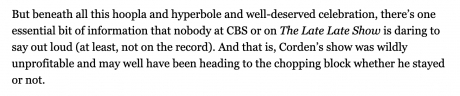
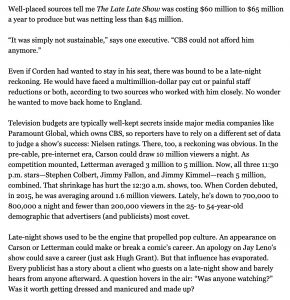
A five-day-old Los Angeles article by Brian Stelter (“James Corden Bows Out,” posted on 4.24) reports that the departure of the Late Late Show host was primarily about sinking ratings and a total absence of profits. The show, in fact, was losing money hand over first.

It’s been “costing $60 million to $65 million a year to produce but was netting less than $45 million,” Stelter writes, and was “simply not sustainable,” according to one executive. “CBS could not afford him anymore.”

Per Custom, ’23 Cannes Awards Will Most Likely Be Nutso

…or certainly infuriating, no matter who the jury chairman is or what the general mood may be.

Celebrating films of quality has come to matter less than celebrating films with the right socio-political narratives. That’s certainly been the rule since the woke virus began to infiltrate the Cannes bloodstream six or seven years ago. Or perhaps over the last decade, now that I think about it.

Many felt that the Jane Campion-led, mostly female jury, for example, had taken leave of their senses when they didn’t hand the Palme d’Or to Andrey Zvagintsev‘s drop-dead brilliant Leviathan (’14) and gave it instead to Nuri Bilge Ceylan‘s Winter Sleep, a respectably solemn but slow-moving 196-minute drama that no one was over the moon about.

Okay, I applauded when Ruben Ostlund‘s The Square won the Palme d’Or in 2017 — a good, smart call.

But two years later Bong Joon-ho‘s Parasite won the Palme d’Or, and with that awarding the crazy bird had flown the coop. That movie obviously and completely crippled itself when the con artist family let the fired maid indoors during that rainstorm, but the Alejandro G. Inarritu-led jury (which included Elle Fanning, Yorgos Lanthimos, Paweł Pawlikowski, Kelly Reichardt and Alice Rohrwacher) didn’t want to know from nothing. Rich vs. poor, class-warfare social satire + a bespectacled, food-loving Asian director known for focusing on genre fare — the right kind of director had made the right kind of film, and nobody much cared about script flaws or how well the film’s final third had been assembled.

It was even more wackazoid when Julia Ducournau‘s Titane, admittedly a fierce and metallic act of erotic imagination, won the Palme d’Or in 2021.

Ostlund, the savagely satiric Swedish helmer of Triangle of Sadness, The Square and Force Majeure, is heading this year’s jury. Given the attitude of his films, it’s my presumption that Ostlund will not be in favor of bestowing Cannes jury prizes for reasons of virtue signalling and social justice warrior motives. It would be truly delightful if the ’23 Cannes winners were to be determined by actual artistic merit as opposed to woke points.

That probably won’t happen, of course. The Cannes awards pattern is almost set in stone — films strongly preferred by Cannes journos will almost certainly not win the top prizes (Palme d’Or and Grand Prix). The juries live and breathe on their own planet.