I used to do Elmer Fudd for my friends when I was eight or nine. I was renowned for this. You could call the current version “Old Fudd between oxygen tank inhalations”, but this is what I sounded like as a kid.
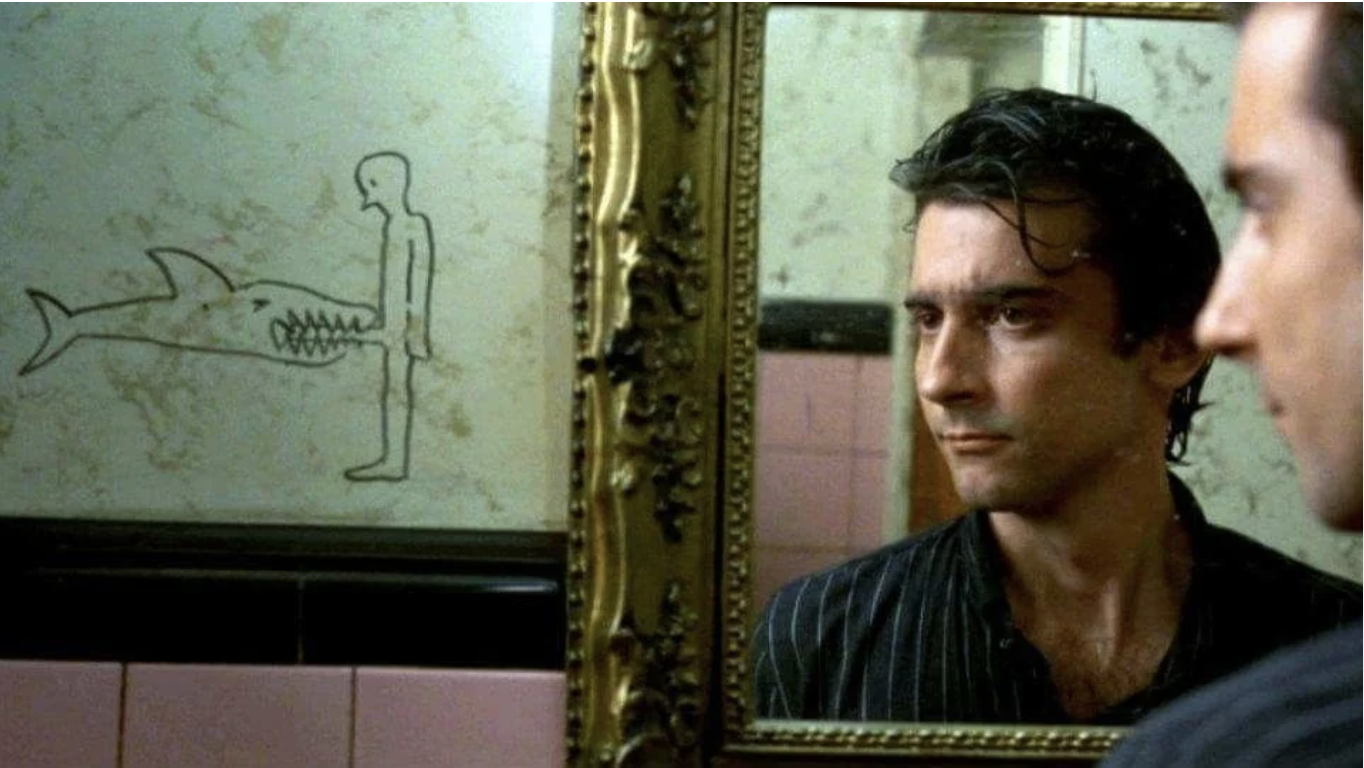
There’s a moment in Martin Scorsese‘s After Hours (’85) when Griffin Dunne‘s miserable lost soul eyeballs a graffiti drawing of a guy’s schlong getting chomped on by a shark.
That’s the one transcendent, pure-light moment in this dark, hard-to-swallow situation “comedy” about how a thirtysomething Manhattan male gets swallowed up by a predatory vortex of Soho hostility.
But After Hours isn’t really about the vortex as much as Dunne’s feelings of panic, helplessness and self-loathing. Why does this guy refuse to man up and figure his way out of a difficult but far-from-insurmountable situation? And why have we paid to watch a film about this wormy?
All the hipsters and know-it-alls swear by After Hours, but it’s not very good..it really isn’t.
In the same sense that Parasite slit its own throat when the drunken con artist mom allowed the fired maid into the home of the rich family, After Hours never even tries to sell the idea that Dunne would visit Soho to see about trying to fuck Roseanna Arquette with a lousy $20 in his pocket (just under $60 in 2023 dollars), or that the $20 would somehow fly out of the taxicab window, or that Dunne believed he was actually stuck and stranded in Soho when all he had to do was hop the turnstile and catch a subway back home.
If he was too chicken to hop the turnstile all he had to do was scrape together 90 cents, which is what a subway ride cost at the time. 90 cents!
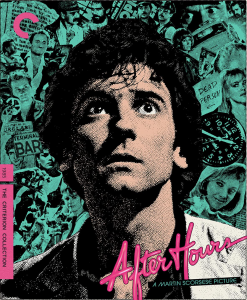
Criterion will release a 4K and 1080p Bluray combo of After Hours on 7.11.23. Why would anyone want to pay $40 for this?
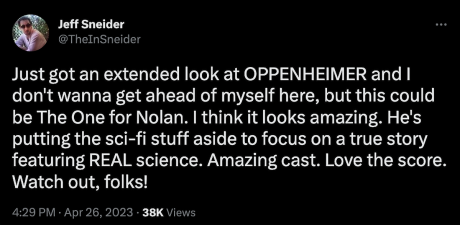
When was the last time Chris Nolan had no choice but to explore or otherwise settle into a reality realm — a realm defined by the same terms that all sane earthlings are more or less obliged to live by? The answer, of course, is 2017’s Dunkirk. But before that, Nolan’s last RR flick (i.e., no exceptional visual augmentation) was Insomnia, which is nearly 20 years old. (It opened at the Tribeca Film Festival on 5.3.22, and commercially on 5.24.02.)
If you ignore Dunkirk, Nolan World was defined by indulgent, highly imaginative flights of visual fancy for 15 years — Batman Begins, The Prestige (HE’s 2nd least favorite Nolan film), The Dark Knight, Inception, The Dark Knight Rises, Interstellar (HE’s all-time unfavorite…most infuriating sound mix in motion picture history) and Tenet.
Memento (’00) is Nolan’s most satisfying reality-based film, hands down.
But surely he understands that reactions to the Bud Light and Maybelline promotions demonstrate that he’s triggered fierce emotion in the hinterlands. He can’t dismiss that entirely. DM is living on an isolated island, and residents of the territory surrounding that island have spoken. They can’t all be idiots.
Mulvaney is obviously free to promote whatever as long as corporate America sees an upside. More power, no skin off my backside, etc.
My understanding is that DM is biologically male and hasn’t resorted to surgical alteration…right? I further understand that Dylan regards anyone who may allude to his biological origins and/or ignores his preferred pronouns as a bad or even criminal person. But he has to understand, surely, that pretending to be a woman is different than having actually been born as a biological woman or, failing that, having been surgically altered into womanhood.
This message from Dylan Mulvaney…I cannot even imagine being in her shoes. She's received a level of venom that is beyond belief. But she shows so much more grace in this 3.5 minutes than all of her detractors combined. pic.twitter.com/UiajP0AR29
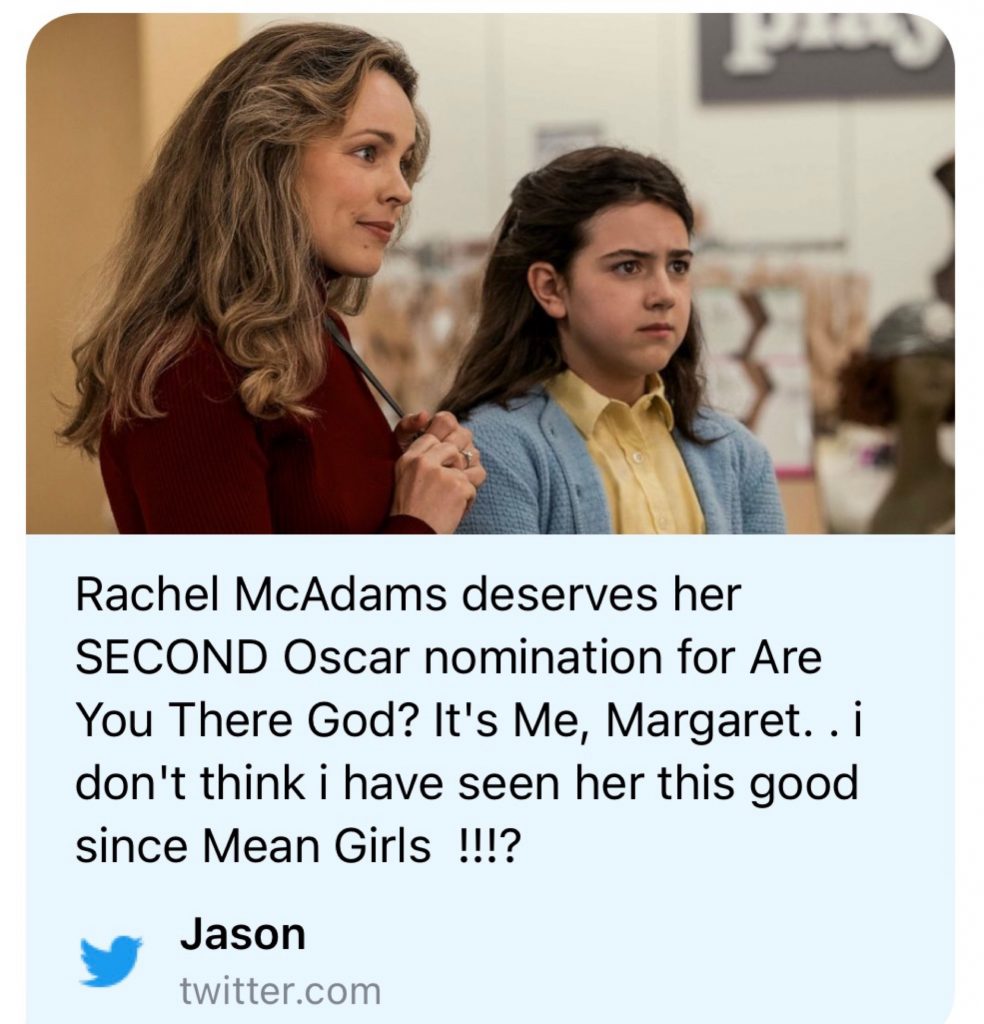
Rachel McAdams‘ performance in Are You There, God? It’s Me, Margaret is fine as far as it goes. As Barbara Simon, the mother of Abby Ryder Fortson‘s titular character, she radiates calmness, caring, focus, fortitude. Which is all she’s been asked to do. It’s not an attention-seeking performance, and it certainly isn’t an end-of-the-year thing. A lot of people have lost their composure over this film, jumping up and down and insisting upon its greatness. To put it as mildly as possible, they’re embarassing themselves. It’s a nice little movie, but let it go.
I re-watched my 4K UHD Apocalypse Now Bluray last night, and I wasn’t totally happy. I saw this 1979 classic at the Ziegfeld theatre two or three times in August and September of ’79, and the big-screen presentation (we’re thinking back almost 44 years) blows the 4K disc away. Aurally and visually, but especially in terms of sharp, punctuating fullness of sound.
Apocalypse Now was presented at the Ziegfeld within a 2:1 aspect ratio, which Vittorio Storaro insisted upon through thick and thin. The 4K disc uses what looked to me with a standard Scope a.r. of 2.39:1.
And the general sharpness of the image on that big Ziegfeld screen just isn’t replicated by the 4K. It looks “good”, of course, but not as good as it should.
As we begin to listen to The Doors’ “The End” while staring at that tropical tree line, John Densmore’s high hat could be heard loudly and crisply from a Ziegfeld side speaker. Before that moment I had never heard any high-hat sound so clean and precise. But it doesn’t sound nearly as pronounced on the 4K disc, which I listened to, by the way, with a pricey SONOS external speaker.
Remember that “here’s your mission, Captain” scene with G.D. Spradlin, Harrison Ford and that white-haired guy? When that scene abruptly ends, we’re suddenly flooded with electronic synth organ music…it just fills your soul and your chest cavity. Filled, I should say, 44 years ago. But not that much with the disc.
When Martin Sheen and the PBR guys first spot Robert Duvall and the Air Cav engaged in a surfside battle, Sheen twice says “arclight.” In the Ziegfeld the bass woofer began rumbling so hard and bad that the floor and walls began to vibrate like bombs were exploding on 54th Street…the hum in my rib cage was mesmerizing. Not so much when you’re watching the 4K.
As Duvall’s gunship helicopters take off for the attack on a Vietnamese village (“Vin Din Lop…all these gook names sound the same”), an Army bugler begins playing the cavalry charge. It was clear as a bell in the Ziegfeld — less so last night.
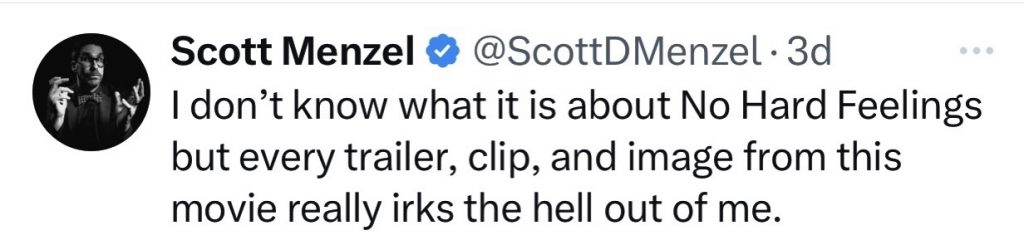
Two days ago (Wednesday, 4.26) I wrote about anticipating negative vibes from Kelly Fremon Craig‘s Are You There God? It’s Me, Margaret. All those obsequious reviews (falsetto-voiced Scott Menzel called it “one of the best films of ’23”) got my dander up. Florid praise from a notoriously unreliable cabal of sensitive virtue-signallers will do that. I was ready to hate-vent but needed to wait, obviously, until I saw it.
Well, I saw Margaret early Thursday evening, and within minutes I knew my suspicions had been justified — the critics had overpraised it. But at the same time I realized it was a harmless and congenial thing — a mild-mannered ABC After-School Special that would never allow butter to melt in its mouth.
Based on Judy Blume’s celebrated 1970 novel, it’s just a mezzo-mezzo, no-big-deal saga about the trials and tribulations of an 11 or 12 year-old girl. Uncertainty and anxiety about God Fantasy #1 (i.e., that the Cosmic Almighty cares or is even aware of Margaret’s existence), for one thing. Not to mention moving from the comforts of New York City to a wonderbread New Jersey suburb; not to mention new girlfriends (including a socially awkward giraffe), boys with armpit hair and the twin prospects of menstruation and budding breasts.
“This?” I said to myself. “This is what inspired Scott Menzel and his congregated colleagues to shift into gush mode?”
There’s nothing to hate here, and at the same time nothing to get all that excited about. It’s not even a meal, this movie — more like a baloney and lettuce sandwich on toast with mayonnaise. It just toddles and ambles along in a nice massage-y way…fine.
Abby Ryder Fortson overacts a bit (i.e., tries too hard) as Margaret, but not to any harmful degree. Rachel McAdams and Kathy Bates as her mother and Jewishy grandmother are fine. Even Benny Safdie is inoffensive.
How does it fuck things up then? It doesn’t — it’s modest and unassuming and stays within a certain perimeter. It does, however, stumble here and there.
Are You There, God? It’s Me, Margaret is set in either ’70 or the very late ’60s — a long time ago in a galaxy far, far away. If the fictitious suburb of Farbrook, New Jersey (where Margaret and her parents move to) bears any resemblance to my old home town of Westfield or, let’s say, SaddleBrook or Plainfield or Montclair, then it wasn’t Newark or Trenton or Rahway or East Orange. Which is to say it was most likely a middle- to upper-middle-class, mostly segregated white town. (For what it’s worth, Far Brook is the name of a private school in upscale Millburn, New Jersey.)
I’m sorry to break it to some of you but that’s how things were during the LBJ and Nixon administrations. I was there so don’t tell me. There were some POCs in Westfield but not many, and they lived in a less-flush section of town that was south of the railroad tracks.
It is therefore not honest for Margaret to cast a bearded, good-looking black guy as a home room teacher. (If a black teacher had theroetically been hired by a white school district he certainly would’ve ditched the beard, which is way too Eldridge Cleaver-ish.) And there are too many black kids in Margaret’s class. It’s just not an honest representation of how things were in whitebread towns 53 years ago. Teenagers of different feathers simply didn’t hang together for the most part. Even WASPs and Italians (i.e., “guineas”) kept their distance.
There’s a big Act Two scene in which McAdams’ bigoted parents, who opposed her marriage to the Jewish Safdie, decide to pay a sudden visit, and an argument ensues between them and Bates about which religion the ambivalent Margaret will sign up for. The dialogue has a clumsy, too-blunt quality…it doesn’t flow. And Bates, we’re told, has impulsively driven all the way up from Florida in order to confront McAdams’ parents, and not alone but with a new white-haired boyfriend. That’s a two-and-a-half-day drive!
The offshoot is that Margaret gradually divorces herself from God and religion. Plus she finally starts menstruating so all’s well on that score.
Amy Nicholson repeated: “As charming as the film is in its best moments, it’s hard not to be frustrated as it backpedals from the book’s awareness that not all wrongs are righted. Sometimes, our heroines might stay buddies with bullies. Sometimes they might run from conflict and never explain themselves. Sometimes, they might even hurt people without making amends. Sometimes frank talk is more impactful than an idealized fantasy.”
“My favorite Sicario character by far was Benicio del Toro’s Alejandro, a shadowy Mexican operative with burning eyes and his own kind of existential attitude about things. Benicio the sly serpent…the shaman with the drooping eyelids…the slurring, purring, south-of-the-border vibe guy.
“My second favorite, a senior veteran with a semi-casual ‘whatever works, bring it on’ attitude, is played by the ever-reliable Josh Brolin.
“The tale, such as it is, is told from the perspective of Emily Blunt‘s FBI field agent, who, being a 21st Century woman who’s in touch with her emotions, is of course stunned and devastated by the unrelenting carnage blah blah.
“You know what I’d like to see just once? A female FBI agent who isn’t in touch with her emotions, or at least one who tones it down when it comes to showing them. Too much to ask for, right?
“Sicario is basically about heavily militarized, inter-agency U.S. forces hunting down and shooting it out with the Mexican drug-cartel bad guys, and at other times flying here and there in a private jet and driving around in a parade of big black SUVs and so on….zzzzzz.
“It’s a strong welcome-to-hell piece, I’ll give it that, but Sicario doesn’t come close to the multi-layered, piled-on impact of Steven Soderbergh‘s Traffic, portions of which dealt with more or less the same realm
“I knew for certain that a lot of what was happening on-screen — the super-grisly violence, the despairing godforsaken atmosphere — wasn’t that interesting or logical even, and that Villeneuve seemed more interested in nightmare vibes than compelling specifics.
“Villeneuve has called Sicario, which was written by Taylor Sheridan, ‘a very dark film, a dark poem, quite violent…it’s about the alienation of the cycles of violence, how at one point we are in those spirals of violence and ask ourselves ‘Is there a solution?’ My movie raises the question, but it doesn’t give any answer.’
Once he found his groove in ’94 or thereabouts, the antics of Jerry Springer never failed to lower the conversation and degrade the sordid remnants of American lower-middle-class culture. All during the ’90s, aughts and 20teens I never once sat down and watched The Jerry Springer Show…24 years of the scurviest, most genetically deprived low-life behavior ever seen on American television. (The low-rent stuff didn’t begin until ’94.) Yes, I occasionally watched Springer clips on YouTube but only when I was in a slovenly mood. The reigning trash TV pioneer passed earlier today.