I Didn’t Mind “Bridge of Spies”

Posted on 10.4.15: Steven Spielberg‘s Bridge Of Spies (Dreamworks, 10.16) isn’t half bad — a sombre, dialogue-driven, fact-based spy tale. It’s a little Spielbergy in the second half (i.e., visual punctuations or signatures that feel a bit pushed or manipulative) but not in ways that I would call excessive or tedious. It’s aimed at the over-40 crowd as younger auds will most likely steer clear.

The only obvious stand-out, Oscar-worthy attribute is Mark Rylance‘s droll supporting performance as real-life Russian spy Rudolf Abel, but it’s a keeper. Rylance owns this movie the way Jane Fonda owns Youth; he may very well snag a BSA nomination.

Regular HE readers know how I feel about Spielberg, and I’m telling you I didn’t feel as if I was suffering through this at all. Half of Spies is actually pretty good and the other half is…well, in and out but basically tolerable. From me that’s almost a rave. And I don’t think that’s proportional. This is not a “great” film but a smart and mostly satisfying one, especially if you’re getting older and fatter and have a few faded memories of the days when Russian commmies were the big baddies.

Tom Hanks, once again portraying a walking emblem for American front-porch decency and Atticus Finch-style values, is James B. Donovan, the late American attorney who defended Abel after his arrest in ’57, and then, following the 1960 Russian capture of U2 spy-plane pilot Francis Gary Powers, was asked to fly to Berlin to negotiate for Powers’ release by swapping him for Abel. Donovan also managed to free wrongly accused academic Frederic Pryor, whom the East Germans were holding on suspicion of espionage.

Spies is basically two espionage flicks, the first and best taking place in New York City in the late ’50s and the second occuring in Berlin in ’61 and early ’62. The Spielbergy stuff starts to kick in during the second half, and when it happens you’ll say to yourself “okay, here we go…time for Spielberg to remind us every so often what a great and exacting cinematic composer he can be.” What’s so great about part one (i.e., the New York chapter) is that Spielberg doesn’t insert any conspicuously brilliant flourishes at all, or at least none that demanded my attention.

Read more

“We’re Takin’ On Too Much Wah-Wah”

Nobody talks anymore about Sir “Low” Grade‘s Raise The Titanic, which opened and bombed in August 1980. Which means they’re also not talking about an incident that happens around the halfway point, when salvage experts begin to prepare for the dangerous job of actually raising the Titanic from the ocean floor.

At a depth near 10,000 feet, one of the project’s submersibles, Starfish, experiences a cabin flood and implodes.

“This is Turtle…we got Starfish in visual contact.”

Two Angry Men (Jew vs. Kraut)

The early car conflict scene between two old guys (Lou Gilbert‘s “Rosenbaum” and Ben Dova‘s “Klaus Szell”) is one of the most gripping sequences in John Schlesinger‘s Marathon Man (10.8.76).

Set on a one-way street in the 70s or 80s in Manhattan’s Upper East Side, it must have been a bitch to shoot with all the traffic control issues and whatnot.

One problem: I’ve never believed that both men would recklessly and obliviously drive full-speed into a fuel truck. Perhaps one of them but not both. A potentially great scene ends on a note of disappointment.

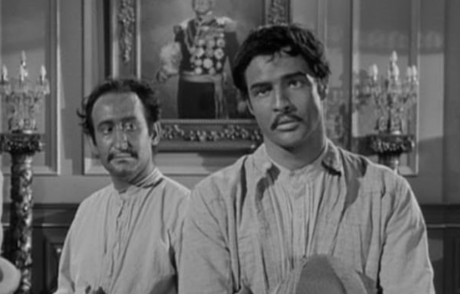
Sidenote: 24 or 25 years before Marathon Man Gilbert played “Pablo,” a trusted friend and ally of Marlon Brando‘s Emiliano Zapata, in Elia Kazan‘s Viva Zapata (’52)

Jeff & Sasha: Hollywood’s Ongoing Woke Implosion

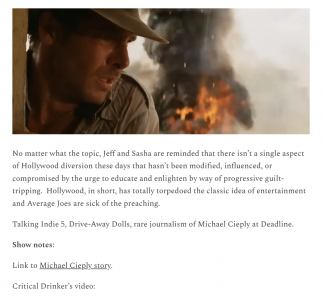
No matter what the topic, Jeff and Sasha are reminded that there isn’t a single aspect of Hollywood diversion these days that hasn’t been woke-modified, influenced, or compromised by the urge to educate and enlighten by way of progressive guilt-tripping. Hollywood, in short, has totally torpedoed the classic idea of entertainment and Average Joes are sick of the preaching.

Oscar Poker Substack topics include the imminent financial disappointment of India Jones and the Dial of Destiny, Ethan Coen and Trish Foster‘s Drive-Away Dolls and the rare journalistic cojones of Deadline‘s Michael Cieply.

Again, the link.

Read more

Woke Valkyries

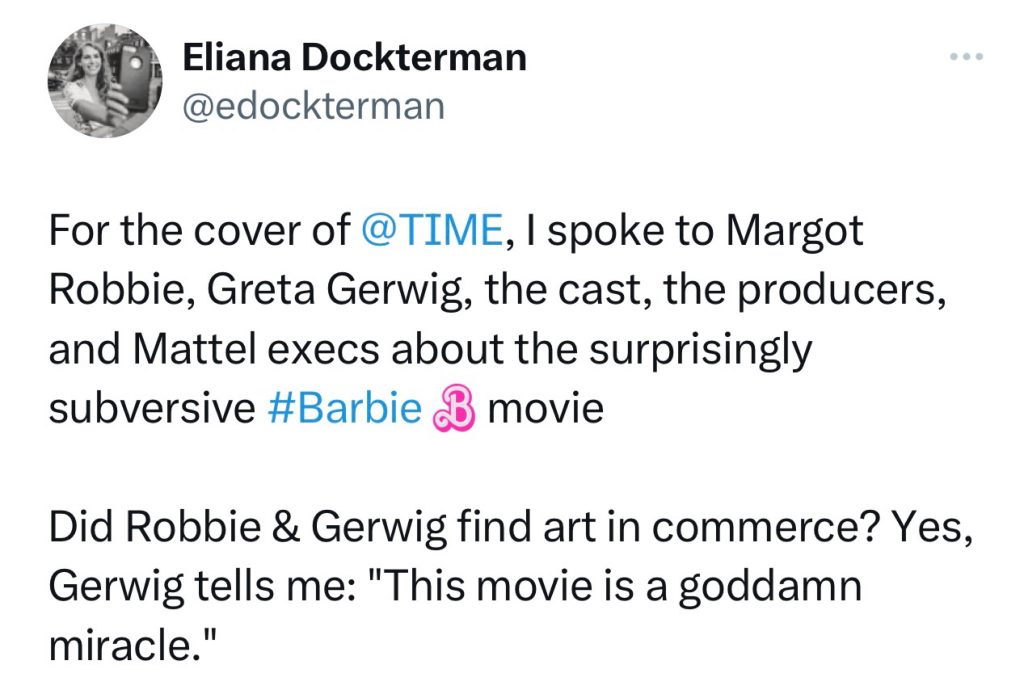
Subhead for Eliana Dockterman’s 6.27 Time cover story about Greta Gerwig’s Barbie (Warner Bros., 7.21): “The year’s most surprising movie finds humanity in the iconic doll.”

“Surprising,” in this context, means that rather than celebrating and reveling in flush-pink, girly-girl materialistic splendor, which is what 97% of the film’s audience will be gleefully anticipating and paying to see, Barbie will unfurl feminist-inclusive-gay-trans colors.

It will not only push a satiric attitude of the pinker-than-pink aesthetic but perhaps (if the new Time cover story is any indication) even endorse a soulful renunciation of same. Those retro-fest values are strictly in the packaging and will not be fulfilled. Surprise! Barbie is Maoist wokey-wokey.

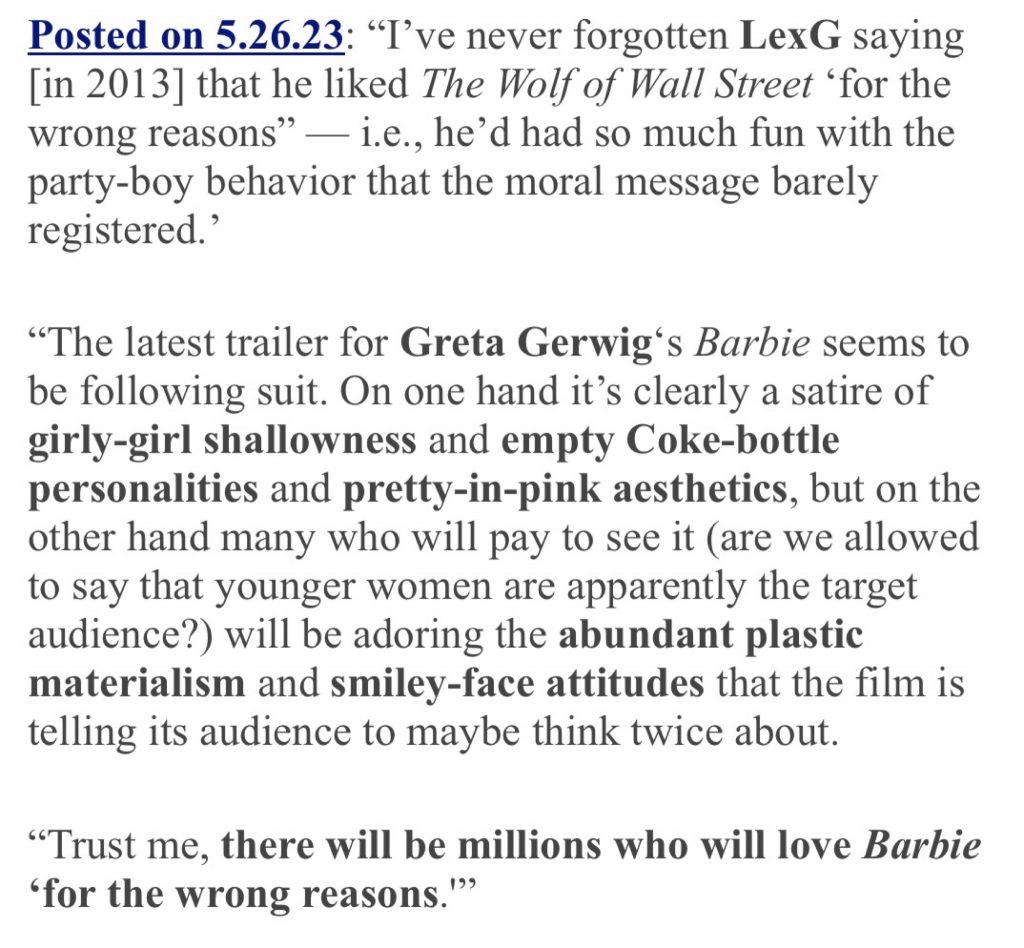
But of course, as anyone who routinely visits TikTok can and will tell you, Barbie’s bottom-line message is going to be ignored nationwide and worldwide. Because the most ardent Barbie fans are going to enjoy it, as I’ve recently stated, for “the wrong reasons.”

Genre Sinking Under Its Own Weight

It’s true — the original Raiders of the Lost Ark (’81) cost $20 million to make — the 2023 equivalent of $66,914,631. Raiders wound up earning just shy of $390 million.

Indiana Jones and the Dial of Destiny (Disney, 6.30) cost $295 million to produce. In order to perform proportionately as well as Raiders, it would have to earn….ahh, forget it. Indy 5 will be lucky to break even. Then again that’s Disney’s concern, not ours.

I’m sick of repeating myself but Indy 5 is a reasonably good ride for what it is. It’s a familiar-feeling thing (naturally) but handsomely produced, well cut, nicely energized, humorous, etc. It certainly doesn’t make you feel burned.

Incidentally: The IMDB says that Ford look-alike and sound-alike Anthony Ingruber performed during the opening Indy flashback sequence.

And by the way: I’m dying to debate a certain plot point that happens during the final act. The film ends in a way that I find doubly astonishing, which I’ll be happy to explain if anyone wants to know the particulars. Please get in touch at gruver1@yahoo.com.

Where’s The Kindle Version?

6.24.23 (two days ago) was the 40th anniversary of the opening of Twilight Zone: The Movie, which was produced by Steven Spielberg and John Landis.

The anthology film (four segments directed by Landis, Spielberg, Joe Dante and George Miller) is primarily known for the ghastly on-set helicopter blade tragedy that killed Vic Morrow and two Vietnamese child actors, Myca Dinh Le and Renee Shin-Yi Chen.

Morrow’s segment (Called “Time Out”) is about a racist who gets an imaginary taste of his own medicine.

The accident happened on 7.23.82 at an Indian Dunes location in what is now Santa Clarita, during a late-night filming of a Vietnam nightmare sequence. A helicopter lost its tail rotor due to a stronger-than-expected VFX detonation and it suddenly crashed, killing Morrow and the kids.

The rap against Landis, the segment’s director, was that he was incautious, but there’s always been a fine line between reckless disregard and capturing that extra element of super-charged realism. It was an accident, yes, but attitudes about safety certainly weren’t paramount.

I’ve always wanted to read Stephen Farber and Marc Green‘s “Outrageous Conduct: Art, Ego, and the Twilight Zone Case” (1.1.88). The hardback and paperback versions are out of print and the surviving copies are outrageously priced. Why isn’t it purchasable on Kindle?

Read more

Whither Woke LGBTQ Pinkitude?

I was under the impression that intense hot pink and the LGBTQ associations that tend to accompany same was on some kind of cultural upswing, mainly due to the approach of Greta Gerwig‘s Barbie, which is totally pink-flooded and (to judge by promotional materials) buoyantly and energetically gay in certain ways.

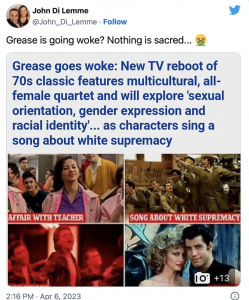
But on the other hand we have the abrupt cancellation of Grease: Rise of the Pink Ladies, the poorly reviewed Paramount + musical series. Pink Ladies is a 1954-set prequel to the original Grease (’78) with something of an anti-straight mindset, despite hetero values and lifestyles having absolutely ruled with an iron fist during that post-Korean War, Commie-hunting, James Dean-flavored era.

The Pink Ladies cancelling doesn’t appear to have been a let’s-turn-off-the-woke-spigots thing — it mainly resulted from the merging of Paramount + and Showtime.

Pink Ladies was whacked after a single season. The animated Star Trek: Prodigy series was also cut loose; ditto Queen of the Universe and The Game. I don’t care about any of these shows…blaahh.

Read more

Couldn’t Watch The Whole Thing

It’s not very hip of me to say this, but I thought Steven Soderbergh‘s re-scored, dialogue-free, black-and-white version of Raiders of the Lost Ark (initially posted on 9.22.14) looked too shadowed and inky. I blew it off after a half-hour.

Yes, the combination of Steven Spielberg‘s scene-by-scene blocking and Douglas Slocombe‘s camera placements are wonderful, but we’re still left with a cavalcade of overly dark monochrome images that make you feel as if your eyesight is going.

It’s generally difficult for me to rewatch Raiders anyway because of Karen Allen, whose performance as Marion Ravenwood I literally can’t stand. If I never hear her shrieking rendition of “Indiieee!” ever again, it’ll be too soon. And there’s no way this slender, midsize woman (5’7″) could drink any brawny guy under the table.

Raiders is a great film of its type, but I honestly feel that Allen ruins it.

My favorite chapter is Indiana Jones and the Last Crusade, otherwise known as the Sean Connery one. Indiana Jones and the Temple of Doom is my second favorite. It took me two viewings to realize that I hated Kingdom of the Crystal Skull. I’m pretty much okay with Dial of Destiny.

Never mentioned this before: Sometime in April of ’81 I caught a not-fully-finished version of Raiders at the NYC Paramount building (Columbus Circle). It contained footage of Harrison Ford‘s Indiana Jones hanging on to the outside of a German submarine on the way to the island where the big finale takes place. It made no sense, of course, that Jones could hitch a ride on a sub that would naturally be travelling underwater, but that’s what I saw. Unless I’m misremembering, this footage was cut from the final release version.

Again the link to the Soderbergh version.