Career Tribute Docs — A Genre Unto Themselves

Nobody loves Albert Brooks more than myself…nobody. I’ve worshipped him since the early ’70s…a long time. In fact, please listen or re-listen to this relaxed 2012 phoner I did with him…sounds good, nobody’s trying too hard, only 11 years old.

Rest assured I’ll be watching Albert Brooks; Defending My Life (HBO, 11.11) without fail, but I wish these tribute docs could occasionally be different or surprising in some way. You know what I mean. I wish they could somehow unfold without the same old talking heads delivering the same old praise cliches. Make no mistake — Brooks deserves all praise and more, but he also deserves ingenuity and unusualness from his admirers.

I would rather watch an essay piece in which some bright person analyzes Brooks’ best material (stand-up, SNL, self-directed movies, performances for other directors) and then ties them all together…ties his life together in terms of universal themes and how his films reflected the changing zeitgeist, etc. I’d like to see an Albert Brooks tribute doc that’s conceived, written, performed and directed by Brooks himself…how about that?
Read more

Best Films About Death’s Inevitabilty

Almost exactly 13 years ago I riffed about films that have dealt with death in a “good” way: “The best death-meditation films impart a sense of tranquility or acceptance about what’s to come, which is what most of us go to films about death to receive, and what the best of these always seem to convey in some way.

“They usually do this by selling the idea of structure and continuity. They persuade that despite the universe being run on cold chance and mathematical indifference, each life has a particular task or fulfillment that needs to happen, and that by satisfying this requirement some connection to a grand scheme is revealed.

“You can call this a delusional wish-fulfillment scenario (and I won’t argue about that), but certain films have sold this idea in a way that simultaneously gives you the chills but also settles you down and makes you feel okay.

“Here’s a list of seven top achievers in this realm. I’m not going to explain why they’re successful in conveying the above except to underline that it’s not just me talking here — these movies definitely impart a sense of benevolent order and a belief that the end of a life on the planet earth is but a passage into something else. I’ve listed them in order of preference, or by the standard of emotional persuasion.

“1. Martin Scorsese‘s The Last Temptation of Christ. 2. Stephen FrearsThe Hit. 3. Brian Desmond Hurst‘s A Christmas Carol. 4. Warren Beatty and Buck Henry‘s Heaven Can Wait. 5. Henry King‘s Carousel (based on Ferenc Molnar‘s Lilliom). 6. Tim Burton‘s Beetlejuice. 6. Michael Powell‘s A Matter Of Life And Death, a.k.a. Stairway To Heaven. 7. Albert BrooksDefending Your Life.

Read more

This Is What Happens

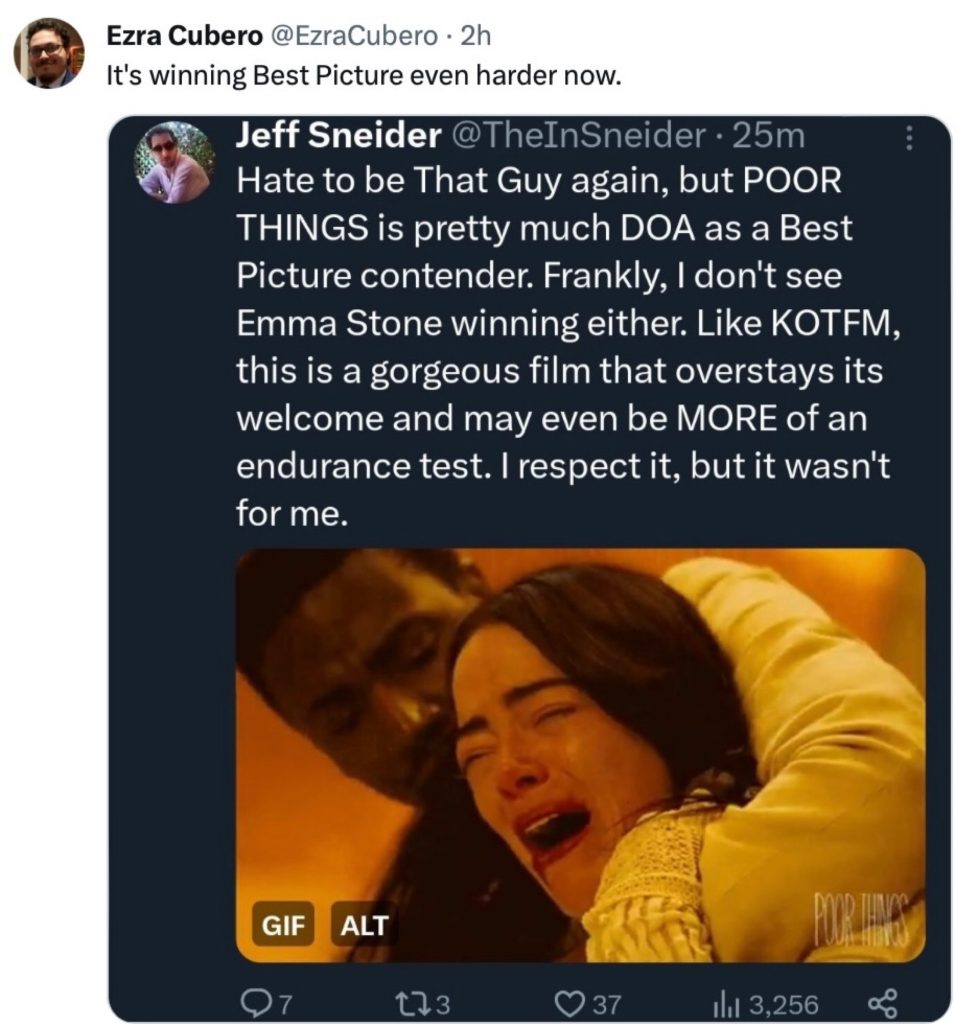
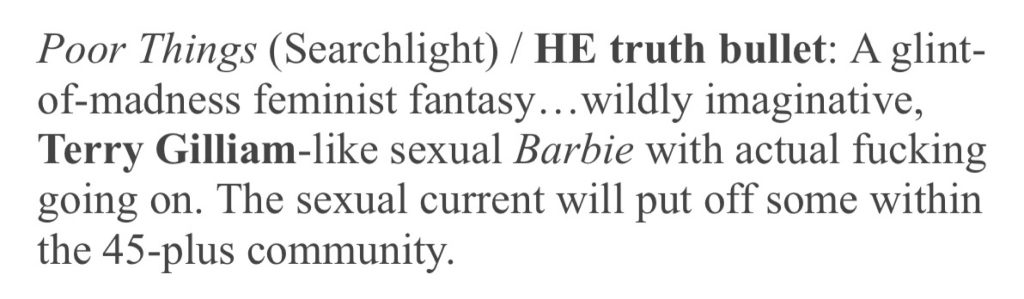
…when a brazen envelope-pusher has been heavily hyped in overlapping festival pressure-cooker environments like Venice and Telluride, and then Jeff Sneider comes along and goes “wait…whut?

Allow me to clarify — Poor Things is Barbie meets a heterosexual Victorian British empire version of Fellini Satyricon.

Chang Punishes

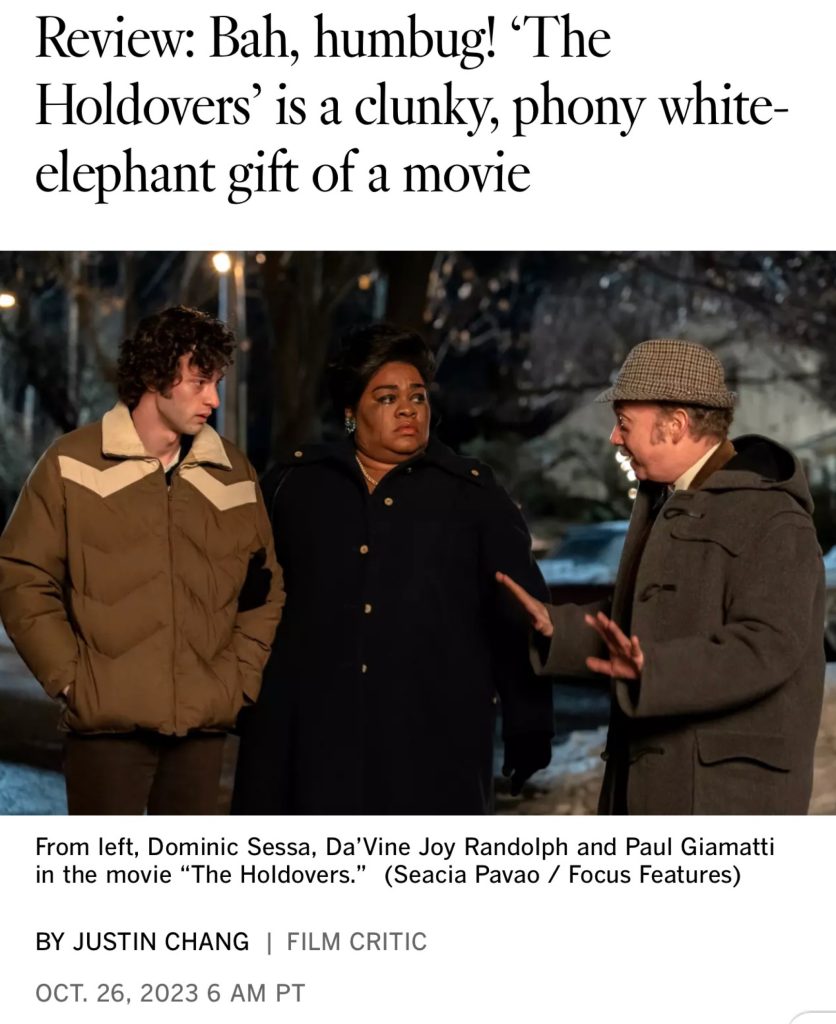
Let no one say L.A. Times critic Justin Chang isn’t a man of character. For he’s panned Alexander Payne’s The Holdovers, the almost universally praised, odd-couple prep school comedy with Paul Giamatti as a curmudgeonly ancient history professor, and newcomer Dominic Sessa as a bright malcontent student. Chang may be an outlier in this regard, but it takes balls to stand against the majority. I should know.

Chang slams The Holdovers for being insincere (“flat, phony, painfully diagrammatic”) but also, it seems, because of an incident of racial animosity between two minor characters — a snotty white kid named Teddy Kountze (Brady Hepner) and a fragile Korean student named Ye-Joon Park (Jim Kaplan).

Early on Kountze belittles Park, you see, by calling him “Mr. Moto” — apparently a trigger in more ways than one.

Chang: “In reducing Ye-Joon to such an abused prop, is The Holdovers really any better [than Kountze]? Can anyone watch a scene this callous and then be honestly moved by [Giamatti’s] speech about the injustices of American racism, classism and white privilege?”

In short The Holdovers, which is mostly set in December 1970, is guilty of a 2023 woke crime. In Chang’s head, I should add.

Eye of the Beholder

What exactly are “good” sex scenes? In my book they’re scenes that make you feel something primal and deep down. Scenes that make you damp or hard. It doesn’t extend much beyond that.

This morning a friend asked for suggestions for some good ones. I thought she meant “out of the ordinary” so I mentioned the subtle eroticism of Gunnel Lindbloom‘s sex scenes in Ingmar Bergman‘s The Silence (’63). Or the Kris Kristofferson-Sarah Miles sex scenes in The Sailor Who Fell from Grace With The Sea (’76), or the Kristofferson-Jane Fonda scenes in Rollover. Or the stand-up fuck in Last Tango in Paris (’72). Or the Cry Tough bedroom scene between John Saxon and Linda Cristal. Or the Straw Dogs rape scene, which no one is allowed to mention because it represents the sordid sensibility of a reviled chauvinist.

Friendo: These are not good sex scenes. To me they have to be full of sensuality, tension, romance, love.
HE: What’s love got to do with it?
Friendo: I need one more title and none of these work
HE: How about those incredibly hot beard-stubble gay sex scenes in Andrew Haigh‘s All Of Us Strangers? Or Burt Lancaster & Deborah Kerr on the beach in From Here to Eternity, and in The Gypsy Moths? Or Patricia Neal and Gary Cooper in The Fountainhead.
Friendo: I like the ones more from my generation, like the 1980s
HE: Jesus, just Google it.

So she settled on the fabled sex scenes in Shakespeare in Love, The Year of Living Dangerously, Body Heat, The Postman Always Rings Twice, Betty Blue, 9 1/2 Weeks, Striptease, Witness, Damage, Bugsy, The English Patient. Bull Durham and The Notebook. They work for me also, sure, but everyone references them.

Limited “Killer” Bookings Convey Disrespect

Why is Netflix shorting David Fincher‘s The Killer in terms of theatre bookings? I don’t know what’s happening in Biloxi, Albuquerque, Fresno or Montpellier, but people who live in the suburbs of New York and Los Angeles are definitely being told “sorry, guys, but we’ve decided not to show The Killer in your neck of the woods this weekend or next…no offense but tough darts.”

As a gesture of award-season respect and a tip of the hat to Fincher’s rep as a major-league auteur, Netflix will be showing The Killer in several theatres starting tomorrow, or between Friday, 10.27 and Friday, 11.10, which is when it’ll begin streaming.

And yet it won’t be playing in any AMC or Cinemark theatres in the general area, which means that NYC-area suburbanites looking for a big-screen experience will have to see it in Manhattan or Brooklyn (it’s at the Paris, Regal Union Square and various Alamo theatres) or at the Jacob Burns Film Center in Pleasantville.

Why restrict access? Netflix seems to be saying “we don’t think The Killer will please Joe Popcorn types or suburban audiences and that it’s better to restrict bookings to hipper big-city theatres and cutting-edge crowds.”

That’s an insult, man…”we don’t think you’re deep or sharp or thoughtful enough to get this film.”

There’s no question that The Killer is one of 2023’s beautiful oddities…arguably the most curious-feeling, finely crafted, possibly-residing-on-another-planet film around. Actually the only one that adheres to a perverse and particular scheme of this sort….fascinating but ice-cold.

At first it resembles a typical genre programmer about a professional assassin, but it soon gets hold of something more, something else. We all know what “escapism” generally feels like, and that it tends to feel slick and smoothed-over and occasionally frothy. I only know this isn’t the deal with The Killer…that there’s something weirdly isolated, existentially detached and almost liberating running through it…something above and beyond and residing within.

All I can say is that Netflix’s “we don’t want to make it easy for suburbanites to see this film” isn’t cool. If I were Fincher I would be hugely pissed, but then I’m not him.

Enraged by Overpraise

To hear it from the vast majority of critics, new movies are always one of two things — (a) masterful, brilliant, fulfilling and irresistably enjoyable or (b) disappointing or slack or even stinky. They’re never in-betweeners — not great but passable, very well made but not especially riveting, 70% worthwhile but 30% problematic, etc. Or mostly problematic but with a few really good aspects.

Worst of all, critics will often distort with overpraise. Sometimes you can just tell that they’ve decided to give a certain film is getting a pass because it exudes the right kind of social bonafides, and that’s that.

Take this line from an Anatomy of a Fall review by Film Yap‘s Nate Richards (posted on 10.26). The subhead calls Justine Triet’s murder investigation drama “one of the most gripping and memorable movies that you’ll see this year”…that’s a 100% decisive nope.

Anatomy of a Fall is a thorough, exacting and meticulous (read: exhausting) “what really happened?” exercise by way of a courtoom procedural, and is certainly smart and interesting as far as it goes but let’s not get carried away…please.

Sandra Huller is excellent as a bisexual writer accused of murdering her angry, pain-in-the-ass French husband (Samuel Theis), but the film goes on for 152 minutes, and the cloying kid playing Huhler’s half-blind son (Milo Machado-Graner) lays it on too thick, and the loud and relentless playing of an instrumental cover of 50 Cent’s “P.I.M.P.” drove me fucking nuts. The more I heard it, the more angry I felt…”Why is Triet making me listen to this over-loud track over and over?”

Another highly dubious declaration from Richards: “What makes Anatomy of a Fall so compelling is that Triet and Arthur Harari’s script has you constantly battle with yourself over whether or not you believe in Sandra’s innocence.” Not so! No battle! I was never even faintly persuaded that Huller might be a murderer…not for a minute.

Read more

I Would Never Post This Myself

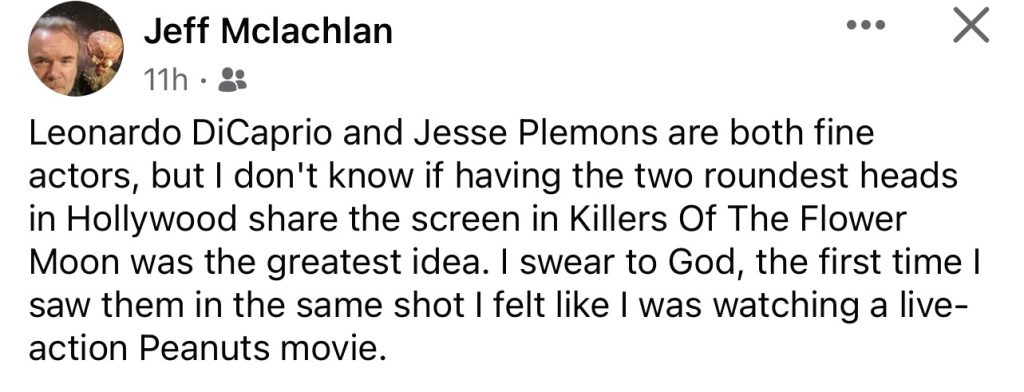
…but since Jeff Mclachlan already has, there’s no harm in commenting. Both men were somewhat overweight during filming. Plemons has since dropped a ton of weight (he’s almost skinny now) and Leo has also slimmed down. Plus Plemons never takes his cowboy hat off, and that camoflauges or offsets his facial appearance.

Patton Seethes and Growls

I watched my Patton Bluray this evening for the seventh or eighth time (I’ve lost count), mainly to savor Fred J. Koenekamp‘s glorious cinematography.

Franklin J. Schaffner‘s Oscar-winning film (Best Picture, Best Director, Best Actor and Best Adapted Screenplay plus three more) was captured in 65mm Dimension 150, which has a panoramic, large-canvas feeling…acres of head and side room, and no MCUs or close-ups or inserts except at the very beginning, just before the big American flag speech. Plus every shot is crisp, windowpane clear, spit-shined to perfection.

During the slapping-of-Tim Considine scene in Sicily a delicious fantasy came to mind — George C. Scott‘s three-star general somehow straddling the swamps of time and coming face to face with a trio of Millennials or Zoomers from ’23, and listening to their white-male suppressive, enemies-of-free-speech, our-way-or-the-highway theology and views on gender fluidity and hormone injections and occasionally slicing dicks and breasts off, and finally becoming enraged and slapping the shit out of all three with a leather glove….”shut aahhhp!…ya goddam wokesters!!”

Schoenkamp’s cinematography and Jerry Goldsmith‘s legendary score were Oscar-nominated, and both lost. The winners in their respective categories were Freddie Young for Ryan’s Daughter and Francis Lai for Love Story.

Roundtree & Williamson (Theatre District Luncheon, 1982)

Since the news of Richard Roundtree’s passing I’ve been trying to think of something specific to say. A legendary and iconic actor, sure, but they’re all saying that. And then a hazy memory, 41 years old, surfaced this morning.

I attended a midtown Manhattan press luncheon for One Down, Two To Go (’82), a cops vs. bad guys martial-arts film that was directed and written by Fred Williamson. Roundtree costarred with Williamson, Jim Brown and Jim Kelly, and the gang was all there.

The gathering happened somewhere in the theatre district. There was a meet-and-greet before the food and speeches, and Roundtree was warm and congenial. (Or so I recall.) Wonderful smile, great vibes.

The film was about to come out, and apparently the word was that exhibitors weren’t that happy with it. (Or it wasn’t tracking all that well with Joe Popcorn….something like that.)

At the lecturn Williamson delivered the comic highlight — a now-classic story about a tasty new brand of dog food that had been carefully prepared and brilliantly marketed, but unfortunately the dogs didn’t like it and that was the bottom line.