Jenna Ortega Says Everybody in Hollywood Wants to Be 'Politically Correct' but That 'Lacks Honesty' and Makes Us 'Lose a Lot of Our Humanity and Integrity' https://t.co/8tliSWibW0
— Variety (@Variety) August 8, 2024

Jenna Ortega Says Everybody in Hollywood Wants to Be 'Politically Correct' but That 'Lacks Honesty' and Makes Us 'Lose a Lot of Our Humanity and Integrity' https://t.co/8tliSWibW0
— Variety (@Variety) August 8, 2024
Rachel Zegler a year ago: “It’s no longer 1937. [My] Snow White is not gonna be saved by the prince. She won’t be dreaming about true love, but about becoming the leader she knows she can be.”
Just suddenly occurred to me, I’m gonna have to remove him from my Best Actor predictions. No matter how good his performance is, the industry will not want to reward him after walking out on the Haynes film and leaving all those people out of work. pic.twitter.com/ljLzBDy5ag
— Matt Neglia (@NextBestPicture) August 10, 2024
The other day I equated Jon Watts‘ Wolfs with a warm plate of waffles, served in a friendly roadside diner. A thin slice or two of melted butter and a light pouring of Maple Syrup. Maybe a pinch or two of cinnamon. It may be pleasurable to eat or, heh-heh, wolf down — I would be hugely surprised if it doesn’t satisfy the usual expectations — but at the end of the meal it’s still waffles.
Dale Launer replied on Facebook: “I’m not sure what you mean because I fucking love waffles. I could eat them three times a day. Pancakes too. Especially the crispy ones at Chez Ma Tante in Brooklyn. Tio which I replied, “Yeah, Dale, but they’re still waffles.”
This led me to equate The Friends of Eddie Coyle to a plate of corned-beef hash with a raw egg on top, and a beer-shot on the side.
And that opened the floodgates.
William Wyler‘s The Best Years of Our Lives is a plate of piping hot meat loaf, mashed potatoes and steamed green beans, followed by a hunk of apple pie and maybe a cuppa joe.
The Departed is a serving of fried, heavily battered shrimp, greasy french fries and a glass of cranberry juice, no ice.
The Shape of Water…sorry but I don’t want to associate that film with food. It kills my appetite. No offense to Guillermo.
Everything Everywhere All At Once is a plate of lukewarm seaweed dumplings, little or no flavor. Feed it to the dog.
Parasite is a bowl of Korean Gochujang stir-fried vegetables.
The Last Picture Show is a full plate of chicken-fried steak and grits. No vegetables.
Quentin Tarantino‘s Pulp Fiction is a Buddy Holly burger, bloody, with a vanilla milk shake.
North by Northwest is a serving of brook trout and wild rice, best savored with a Gibson.
Full Metal Jacket ie a tin of C-rations….no bananas, no vegetables, just cans of human dog food.
Beetlejuice ie a plate of chocolate-covered insects.
Ordinary People is a breakfast of cold French toast, quickly shoved into the garbage disposal.
The Treasure of the Sierra Madre is a heap of baked beans on a tin plate.

I’ve lost count of all the “subtitled Hitler rants in the bunker” videos I’ve posted over the last 15 years, but I’ve always posted their embed codes. I don’t know why I can’t find a workable, size-adjustable e.c. for this recent “Hitler rants about J.D. Vance” video, but I can’t. I’m sorry but it’s funny.

You can have your little top-ten lists and champion your life-long favorites, but cinema is always shape-shifting…an impermanent feast…and the seas are always surging and receding, not to mention our mood pockets. And if anyone knew that it was Stanley Kubrick.
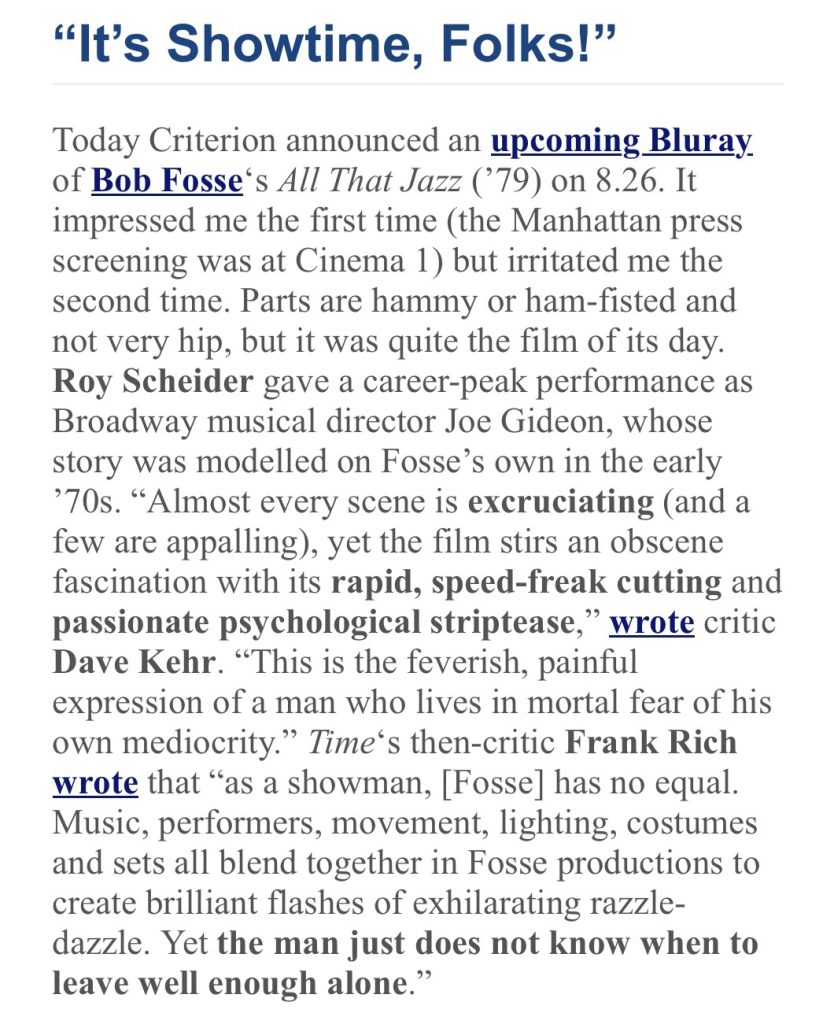
On top of which All That Jazz hasn’t aged well. It’s slick and cynical and very inside-baseball, but aimed at the none-too-brights…heavy handed, over-underlined. The “On Broadway” audition sequence is levitational but there’s too much “acting” going on in the second and third acts. Bob Fosse’s ironic points wear you down.

Depending on the stress and alienation and fantasy levels in my head, which I’ve been grappling with since I was three. I’m not always day-dreaming about something or some place else, but I often am. I hear songs (both transcendent and banal), listen to movie dialogue, recall emotional pit-of-the-stomach moments, sometimes weep inexpressively, etc. Every now and then I’ll shake myself by the shoulders and scold the dreamer: “Will you stop this, please? You’re here right now…this is real…you’re not watching a screen…eyes on the road.”
No two-headed frog, I.