Flabbergasted

Before last night I’d never watched Holiday Inn (’42), the Bing Crosby-Fred Astaire romantic musical that introduced “White Christmas” and “Happy Holiday.” I found it a wee bit silly and even boring at times, but then the Abe Lincoln minstrel show sequence began.

My jaw fell on the floor. Has to be seen to be believed.

Wiki excerpt: “Beginning in the 1980s, some broadcasts of Holiday Inn entirely omitted the ‘Abraham’ musical number, staged at the Inn for Lincoln’s Birthday, because of its depiction of a blackface minstrel show incorporating racist images and behaviors.

“Turner Classic Movies nonetheless screened the film with the ‘Abraham’ number intact; AMC also aired the film intact before it became an advertiser-supported channel.”

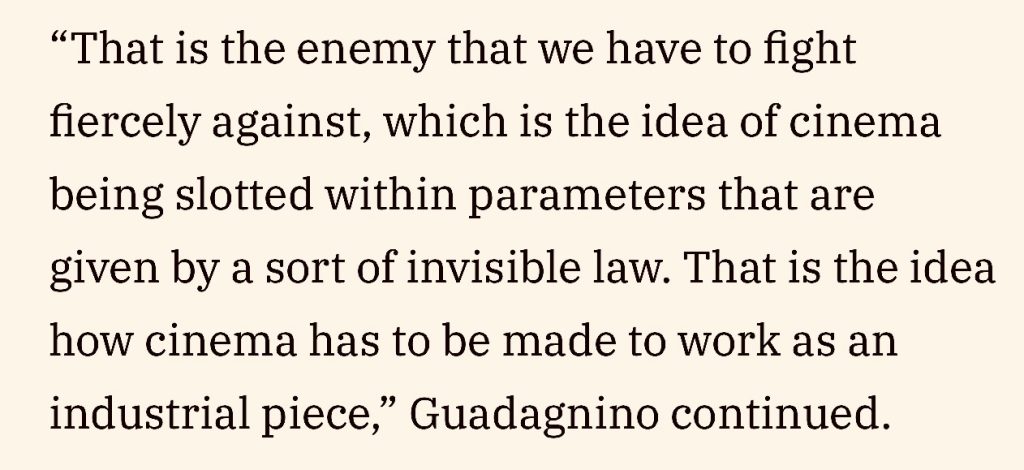
Guadagnino: “We Have Only One Enemy, Which is Industrial Taste”

Variety’s Elsa Keslassy from Marrakech:

We all understand what Luca is saying here. We all understand who the proponents of industrial taste are, the easy lays and the obsequious whores, not to mention the lazy rubes and slowboats who support big shitty franchise movies and tumble all over themselves when films like Wicked (which is not so much problematic as overwhelming in a blitzkrieg, Jon M. Chu-like way, which is what makes it industrialized) come along.

Pitchforkers Never Stop

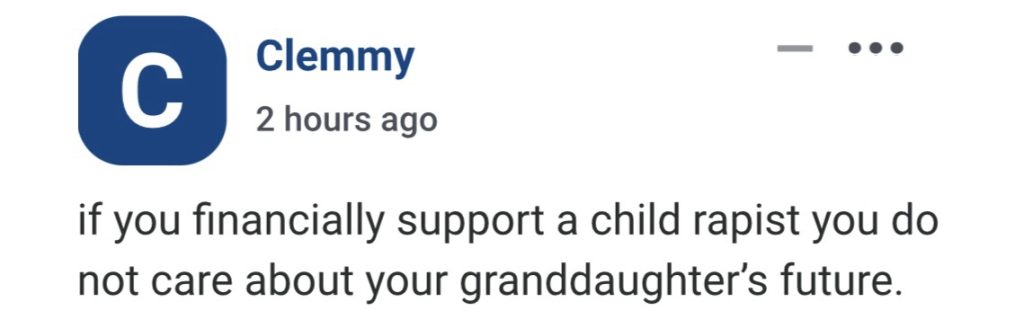
HE to Clemmy: You really do need to consider the possibility that you simply don’t have a sufficient brain-cell count.

HE supports the cinematic art of the obviously gifted and indisputably great Roman Polanski.

HE does not and never has supported the notion that anyone proven guilty of sexual abuse or assault should skate. Crimes of the loins have penalties. Nobody’s disputing this.

Then again are you telling me that Polanski hasn’t been made to suffer and submit to the proverbial lash for the last 47 years?

Are you telling me that Polanski’s kids, Morgane and Elvis, live in a state of perpetual fear and horror about what their allegedly monstrous dad may do to them?

We’re talking about two twains here, two separate boxes.

History is flooded with accounts of great artists who didn’t behave well at certain points in their lives, or who behaved abusively or with cruelty or callousness.

Enlightened art scholars have long argued and understood that at the end of the day you can’t throw the baby out with the bathwater.

#MeToo ideologues will never understand or accept this. Their basic creed is “if the bathwater smells bad or is tainted in some way, the baby must either submit to the sword or be banished to the desert.”

Submit “Wicked” to Howard Hawks Test

Howard Hawks is famous for having said that a movie is properly regarded as a major stand-out or perhaps as an Oscar contender if it has “three great scenes and no bad ones.”

What are Wicked’s three great scenes? Put up or shut up.

I’m not sure musical numbers should count as the point of all musical scenes is to express a significant thematic or emotional moment while stopping the narrative in its tracks. Musical numbers are what I would call highly arresting as opposed to great.

Great scenes hit home, touch emotions, signify or deliver major plot pivots or wake-up moments, accomplish something at least semi-profound.

In The Wizard Oz, for example, the three…make that four great scenes are (a) Dorothy being effectively counselled by Professor Marvel, (b) returning to her farmhouse as the tornado approaches and being hit on the head, and then the house landing in Munchkinland as the film turns to color, (c) she and her three comrades managing to vanquish the witch and take her broom back to the wizard, and (d) the “there’s no place like home” finale in Dorothy’s bedroom.

I’ve been running Wicked in my mind and trying to recall the three great qualifying scenes. I’m not being cynical. I’m open to instruction. Please inform.

HE’s annual “By the Measure of Howard Hawks” article will follow later today, applying Hawks criteria to all the major Best Oicture contenders.