Shooting “Red River” in Monochrome Was A Bad Call

Nothing turns me on like luscious, highly detailed, well-rendered HD black-and-white films. I’ve loved watching them all my life and especially, since the aughts, in 1080p or 4K.

And by the same token, of course, I have no interest in watching crudely colorized monochrome knockoffs. No honorable cineaste tolerates them.

But — but! — if someone were to finesse an expert, top-of-the-line color transformation of Howard HawksRed River (’48) and issue it in 4K or at least 1080p, I would buy a copy tout suite.

I’m a fully contented owner of Criterion’s Red River Bluray, mind — it’s one of the handsomest monochrome westerns ever shot — but not capturing it in Technicolor was, I believe, a serious mistake on Hawks’ part.

Black-and-white was chosen for cost, I’m sure, but if there was ever a Hollywood example of penny-wise and dollar-foolish, Red River is it. Every frame of that film cries out for Technicolor hues.

Ditto in the matter of Hawks’ The Big Sky (‘52), another eye-filling outdoor adventure that was unfortunately shot in vivid monochrome. If you ask me the absence of color in this Kirk Douglas vehicle is a flat-out tragedy.

Which reminds me of the fact that you can’t even watch The Big Sky in 1080 or 4K — only in 480p standard def. It looks fairly awful. Which is kind of ridiculous in this day and age.

Richard Chamberlain’s Theatrical Glory Decade

The long, lustrous and distinguished life of Richard Chamberlain ended yesterday at age 90, two days short of his 91st birthday.

If you’re an older couch potato, Chamberlain’s career began, peaked and gradually dwindled on television — the Dr. Kildare series (’61 to ’66), Shogun miniseries (’80), The Thorn Birds (’83). But between ’68 and ’77 — a full ten years — he did himself proud as a feature film actor (mostly in ensembles, twice in starring roles) in a few high-end films directed by grade-A auteurs.

The general obituary buzz, yes, has been that Dr. Kildare or the dashing Thorn Birds star has died, but some of us respect Chamberlain for better, deeper reasons.

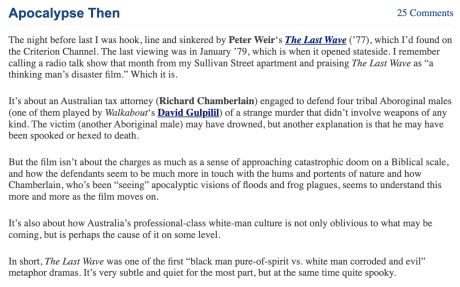
Chamberlain’s greatest and richest big-screen role was in Peter Weir‘s The Last Wave (’77); his second best role was the anguished Peter Tchaikovsky in Ken Russell‘s The Music Lovers (’71). He was directed twice (technically thrice) by the great Richard Lester in 1968’s Petulia and then ’74’s The Three Musketeers and The Four Musketeers.

Chamberlain played one of the most despicable scumbags of all time in Irwin Allen and John Guillermin‘s The Towering Inferno (’74 — one of the biggest hits in the ’70s disaster wave), and four years later costarred in the most embarassingly awful disaster film of all time, The Swarm, which Allen produced and directed. (Michael Caine called it “a bee movie.”)

If you count Dr. Kildare and The Thorn Birds, Chamberlain was at the top of his fame=and-achievement game for over 20 years…he fully peaked throughout the ’60s, ’70s and early ’80s…longer than most big-name stars.

“Kind of a Nixon-to-China Thing…”:

Sometime this week Bill Maher will break bread in the White House with Orange Mussolini. The difference between this and Richard Nixon going to China in ’72 is that Mao Zedong and Chou en Lai, despite being Communist tyrants, were at least nominally sane, which is to say governed to some extent by rationality.

There are boilerplate dictators who have cold-bloodedly presided over mass murder, and there are emotional-infant tyrants like Trump and Kim Jong Un…different equation.

How will Maher pass along the detailed story of his dinner (McDonalds?) or some kind of sit-down with — I can’t believe I’m writing this — the first U.S. President since FDR to at least ponder the possibility of a third term in the White House, depending on how acquiescent the Dems and the courts may be to this possibility.

Read more

He Who Hesitates, Masturbates

I ran into Terrence Malick and a friend of his on the Cannes Croisette during…I can’t recall which festival but probably sometime around ‘12 or ‘13 or ‘14…somewhere in there. On the narrower, northern side of the boulevard as opposed to the southern beach side, not far from the Carlton.

I realized it was Malick right after we passed each other. The eponymous Panama hat, the shades, the salt-and-pepper beard. And so I paused and turned around and saw he’d done the same thing — stopped or slowed, half-turned, quizzically eyeballing me. Maybe he thought I was Chris Walken.

Candy-ass that I am, I didn’t seize the opportunity to approach and launch into a brief chat. I could have kept the ball in the air. I could’ve reminded him that I cold-called Mike Medavoy’s home in ‘95 because I’d heard he was staying there, and that he’d picked up and we’d bantered for three or four minutes.

Instead I wimped out. I just said “hey, Terry…how ya livin’?” and offered a casual salute and he returned the gesture, and I moved on. I wasn’t instantly seized by a feeling of self-loathing, but a hint of this had taken hold. It never left me.

What About Fickle?

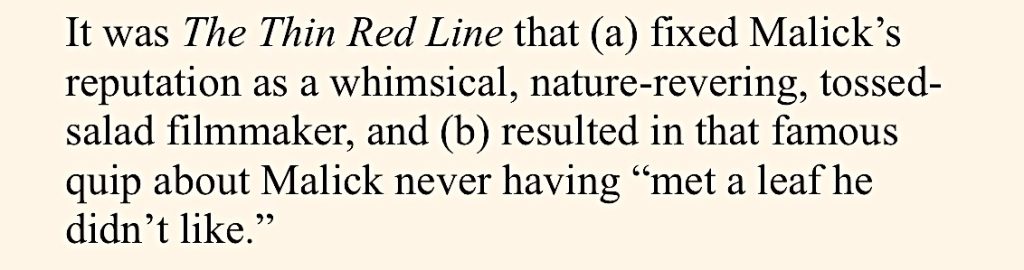
Whimsical is pretty much synonymous with capricious, and post-Days of Heaven Malick has shown himself to be nothing, creatively speaking, if not “given to sudden and unaccountable changes of mood and behavior.”

Again — ask Adrien Brody about this. Ask the late Chris Plummer. Ask Geza Rohring, who plays Jesus in Malick’s STILL unfinished The Way of the Wind, which shot principal photography in 2019 and has been subject to Malick’s tossedsalad, elusivebutterfly editing aesthetic (you can’t call it a process) ever since — five and a half years as we speak.

“Sudden and unaccountable changes of mood and behavior” = the man does not know his mind, or is so engrossed in the mystical that there can be no destination. “The farther one travels, the less one knows” — George Harrison, “The Inner Light.”

One could adopt a brusque attitude and conclude that Malick has no sense of decency or fundamental follow-through when it comes to post-production.   How about them apples?