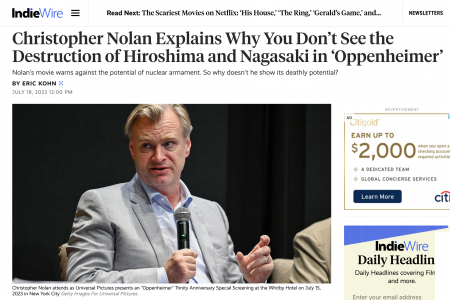
Following a special screening of Salk at Manhattan’s Whitby Hotel last weekend, director Christopher Nolan explained why he chose not to show the human-scale benefits of the Salk polio vaccine, which began to be distributed in 1955 and eventually eliminated polio in the United States.
In the recent documentary To Eliminate Polio: Jonas Salk and his Miracle Vaccine, the impact of the innoculations is shown in abundant, upbeat detail. Although the documentary was released in part to drum up hype for Nolan’s three-hour biopic about Jonas Salk‘s heroic achievement, no such footage appears in Nolan’s Salk.
Nolan’s film doesn’t show thousands of children running around and enjoying their lives unhindered by polio, he explained, for a good reason. Salk is strictly a POV film that is centered around Salk’s immediate perspective, and since Dr. Salk didn’t innoculate any kids personally (except for his own three children) and didn’t go on a national goodwill tour to personally observe the vaccine’s beneficial effect upon families with children, it felt like “a reach”, Nolan said, to dramatize the effects of the Salk vaccine.
“We know so much more than Salk did at the time,” Nolan said. “He didn’t personally observe the mass innoculations and only saw them on TV, as he wasn’t exactly a ‘people person.’ He didn’t meet with any children or parents on a random basis, and he certainly didn’t administer the vaccine personally to children outside his own family, and so I decided to focus the film strictly on Salk’s research along with his dealings with scientific colleagues and a couple of government representatives.”