Reportedly Dave Green‘s Coyote vs. Acme will not be tossed into an infinite black hole but acquired by one of the usual suspect streamers, mostly likely Amazon. This, at least, is what Deadline‘s Anthony D’Alessandro reported this morning.


Reportedly Dave Green‘s Coyote vs. Acme will not be tossed into an infinite black hole but acquired by one of the usual suspect streamers, mostly likely Amazon. This, at least, is what Deadline‘s Anthony D’Alessandro reported this morning.


Hollywood’s second version of Mutiny on the Bounty opened on 11.8.62, or ten days after the conclusion of the tension-filled Cuban Missile Crisis.
This almost felt like a fitting crescendo as the film was widely regarded as a crisis itself, albeit a “what the hell happened?” kind. The final production tab was $27 million, or roughly $275 million in 2023 dollars — a startling level of exorbitance.
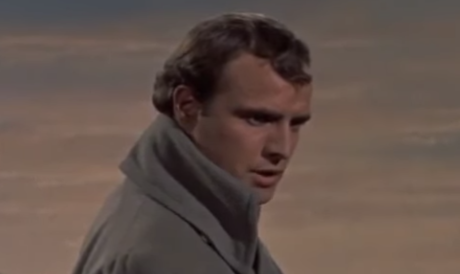
Bounty had been shooting for two years, partly under the directorial command of Sir Carol Reed but mostly Lewis Milestone, who didn’t get along wih star Marlon Brando and vice versa. A few months earlier the film had been publicized as a cost-overrun disaster, particularly by a June 1962 Saturday Evening Post cover story, written by Bill Davidson, that identified Brando as the principal culprit.
Production was marked by constant tempest (Reed either quit or was let go, and Milestone, his successor, also left under turbulent circumstances), largely, according to Davidson, due to Brando’s egoistic big-star behavior. Brando sued the Post for $5 million over claims that the article had wrongfully damaged his professional reputation. It did, in fact, do that.
Filming was almost as prolonged and costly as the $31 million Cleopatra, which would open seven months later in June 1963.
I wouldn’t call Mutiny on the Bounty a flawed film as much as a “good but not quite there” one. It’s actually a well-written, handsomeiy produced, eye-filling wow for the first 70% or 75%, and Bronislau Kaper‘s score is inescapably rousing in a crash-boom-bang sense.
I would give it an 8.5 grade up until and including the mutiny sequence. But the tension flies out the window after the mutiny, and the remainder of the film is just okay. And Brando’s (i.e., Fletcher Christian‘s) high-minded urging that he and the crew should return to England to plead their case? Totally absurd. Tantamount to suicide. I agree with the decision by Richard Harris‘s Mills and other crew members to burn the ship after Brando suggests this hair-brained notion.


Say what you will about Bounty‘s problems — historical inaccuracies and inventions, Brando’s affected performance as Christian, the floundering final act. The fact remains that this viscerally enjoyable, critically-dissed costumer is one of the the most handsome, lavishly-produced and beautifully scored films made during Hollywood’s fabled 70mm era, which lasted from the mid ’50s to the late ’60s.
It has a flamboyant “look at all the money we’re spending” quality that’s half-overbaked and half-absorbing. It’s pushing a certain pounding, big-studio swagger.
There’s a way to half-excuse Bounty for doing this. It was made, after all, at a time when self-important bigness was regarded as a kind of aesthetic attribute unto itself, with large casts, extended running times, dynamic musical scores (overtures, entr’actes, exit music) and intermissions all par for the course. And there’s no denying that a lot of skilled craftsmanship and precision went into this manifestation.
Bounty definitely has first-rate dialogue and editing, and three or four scenes that absolutely get the pulse going (leaving Portsmouth, rounding Cape Horn, the mutiny, the burning ship). And I happen to like and respect Brando’s performance — it gets darker and sadder as the film goes along — and you can’t say Trevor Howard‘s Captain Bligh doesn’t crack like a bullwhip. (Bosley Crowther‘s review said his emoting was imbued with “wire and scrap iron”, and that Brando’s came from “tinsel and cold cream”.) And Richard Harris and Hugh Griffith are fairly right-on. And everybody likes the topless Tahitian girls.
I’d forgotten how foppy and buffoonish Brando’s Fletcher Christian character is, and how frequently his contentious relationship with Trevor Howard‘s Captain Bligh is played for easy laughs during the first 100 minutes.
The extremely wide 2.76 to 1 Ultra Panavision image, shot by Robert Surtees and derived from the original 70mm elements, is really quite beautiful, and the colors are full and luscious.
My difficulties with the jokey humor aside, I have to acknowledge the “make love to that damn daughter of his” scene between Howard and Brando, and pay my respects to the way Brando pauses ever so slightly before and after he says the word “fight”. It’s the film’s wittiest moment — the only line that still makes me laugh out loud.
The decision not to offer a “making of” documentary on the Bounty Bluray was unfortunate, given that Mutiny on the Bounty‘s production history was one of the most expensive and out-of-control in Hollywood history, and therefore worth recounting for history.
Fox Home Video included an ambitious making-of-Cleopatra doc along with their Cleopatra disc, and it’s a far more engaging thing to watch than the film itself. Too bad Warner Home Video didn’t follow suit. Laurent Bouzereau or someone on his level could’ve really gone to town with it.
In an 11.12 Variety essay Variety‘s Owen Gleiberman conveys general of Alexander Payne’s The Holdovers. But he also discretely pisses on its pants leg or, you know, its desert boot.
“I like The Holdovers fine; I just don’t love it,” Gleiberman states. “Like Sideways, it’s a journey of redemption. Yet Paul Giamatti‘s ancient history teacher, in his mournfully witty and gnarled misanthropic way, is such a controlled, hemmed-in character that it’s hard to feel the force, however buried, of anything wild in him.”
Gleiberman laments that Giamatti’s Paul Hunham, like Sideways‘ Miles Raymond, doesn’t have more volcanic turbulence inside him. But Hunham is roughly 15 years older than Raymond, and isn’t even a struggling would-be novelist. His arc, obviously, is about somehow putting aside the knee-jerk disdain and behaving more like a human being.
“But in terms of how it stacks up in this year’s awards sweepstakes, I think The Holdovers now occupies a very ironic place,” Gleiberman goes on. “It’s competing with films, like Oppenheimer and Poor Things and Maestro and Barbie and Killers of the Flower Moon, that feel far more of their own time (even though several of them are rooted in history).
“Will The Holdovers have traction, at the box office and in the awards race? If so, it could be the contender that occupies what you might call the Green Book niche — a kind of retro comfort-food zone destined to appeal to more traditional Academy voters.
“For The Holdovers is at heart an odyssey of nostalgia that’s being sold as a holiday feel-good movie. The grand and rather nagging paradox at the heart of the film is that it’s a planned-out version of a ‘free form’ movie. The ’70s film it most recalls is The Last Detail, the Hal Ashby classic about three sailors, led by Jack Nicholson, wandering from city to city on a quiet odyssey of remorseful discovery.
“Watching The Last Detail, you always feel like you’re glimpsing lives that extend beyond the frame of the movie itself. The Holdovers, by contrast, is a movie where you can feel the calculation that went into every last detail.”
That’s not fair. Are you going to tell me, Owen, that Last Detail screenwriter Robert Towne didn’t carefully rewrite and hone and chisel every last line so it would deliver just so? Of course he did, and then Ashby and Nicholson probably chiselled and refined and maybe improvised a bit more on a page-by-page basis.

THE KILLER had the best fight scene of the year. The sound of every excruciating punch shook my theater, eliciting gasps from my crowd.
— Dan Marcus (@Danimalish) November 12, 2023
[Originally posted on 8.13.16]: There’s an anecdote in David Handleman‘s 1985 California piece about Terrence Malick (titled “Absence of Malick“) that has always amused me. It’s a brief recollection about Malick having landed a New Yorker assignment in the late ’60s to write a piece about Che Guevara, and his having travelled to Bolivia to research it. But he over-researched it, Handleman wrote, and “got drowned in it, and never turned [the piece] in.”
The story made me chuckle and shake my head because I did the same damn thing in ’84. I had pitched an article to an American Film editor, Jean Callahan, about the inner lives of film critics — who they were deep down, what had lit the initial spark, what drove them on, whether they’d become corrupted by their access to film industry titans and were nursing dreams of becoming screenwriters or producers.
For a while I called it “The Outsiders”; I also called it “The Big Fix.” I knew it had the makings of something really good. So I talked to many, many critics and transcribed the interviews and wound up with at least 25 or 30 pages of single-spaced pages, all typed out and corrected with side notes and thoughts about structure and whatnot.


I got into it more and more, and it became a small mountain. And then a bigger one. And then it became quicksand and I began to sink into it. The feeling of having gotten myself into this kind of trouble was awful. I was unsure about whether to keep trying or to forget it and walk away. I felt like I was covered in glue or tar. I finally gave up. The guilt was agonizing. I’d never worked so hard on something to no avail.
Today I came upon a letter — a confession of defeat — that I sent to Callahan in December of ’84. The letter was sitting in a manila folder in the bottom drawer of a small wooden chest filled with magazines from early to mid ’90s. It was mortifying to write and certainly to send.
But at least the experience taught me three things.
One, never churn out that much research about a single topic ever again without writing anything down — write as you go along. Two, forget about big subjects and grand designs — always choose a topic that appears to be small or smallish and then make it bigger or richer with your interpretation of it. And three, always listen to what people say and let that material point the way.
The title of this piece is a quote from the late Stuart Byron, former movie columnist for the Village Voice and development exec for producer Ray Stark. In ’89 or thereabouts I briefly partnered with Byron in a venture called re:visions, which was about analyzing the problems of screenplays that had gotten stuck in development and weren’t going anywhere.
Friendo: Was there ever an actress who graced more blockbusters but had less to show for it than Anne Archer? Adrien Lyne‘s Fatal Attraction. and Phillip Noyce‘s Patriot Games and Clear & Present Danger. Big hit movies, and she was even Oscar-nominated for her performance in Lyne’s thriller. But she never seemed to reap the appropriate benefit. Now 76, Archer was very talented, beautiful and quite likable, but was there finally just something a tad insubstantial going on?
HE to friendo: Archer was a classy and respected second-tier actress, and of course she peaked during her late ’80s to mid ’90s heyday. She’s been acting since the early ’70s, and at least she peaked during the Poppy Bush and Clinton eras! Plus she’s still with us at age 76 or thereabouts.
Archer was always a highly skilled actress, but there was always something a bit conservative and Fairfield County about her. I saw her in John Ford Noonan‘s “A Coupla White Chicks Sitting Around Talking” at a theatre across the street from the Public at Astor Place, and thought she was excellent. But she mainly seemed to play bland, nurturing wife-mothers who were married to corporate, upper-middle-class alpha-males.
Archer never played cold corporate types on her own steam or sexual dynamos or murdering bitches a la Glenn Close or action sidekicks or frosty district attorneys. Like almost every young actress of yore she performed in the requisite number of sex scenes, but nothing in the 9 1/2 Weeks realm.
Noyce and Lyne cast Archer in her most commercially successful films, but in so doing she kind of became known as the consummate classy wife. In a way these castings seemed to vaguely suppress her career. Or do I mean that she was too convincing as the classy homemaker, such that no one could see her as anything but?
Wiki excerpt: Since the 2000s, Archer has sporadically worked in acting. She appeared in the film Lullaby (2014) and made her stage debut as Mrs Robinson in the West End production of The Graduate in 2001. She played the eponymous actress in The Trial of Jane Fonda at the 2014 Edinburgh Festival Fringe, and had recurring roles on television shows such as Boston Public (2003), It’s Always Sunny in Philadelphia (2006) and Ghost Whisperer (2006–2008).
Friendo to HE: Maybe JoBeth Williams is another of her ilk (and from roughly the same time period): Attractive and talented, but, as the producers and agents are fond of saying, “She’s just not a lead.” I’d love to have seen Archer playing an amoral Maddy Walker-type (i.e., Body Heat). Or someone whose warm, nurturing demeanor masked a heart of ice.
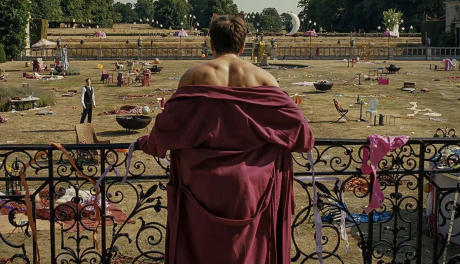
Yesterday Warner Bros.s David Zaslav shelved the finished and ready-to-go Coyote vs. Acme — no theatrical or MAX release. From this act of brutality WB derived an estimated $30M writedown, with Coyote vs. Acme having cost $70 million.
Had a lot of fun scoring Coyote Vs Acme. As no one will be able to hear it now, due to bizarre anti-art studio financial shenanigans I will never understand, here is a bit of behind the scenes footage of our “Meep Meep” Roadrunner choir, with apologies to Tchaikovsky… pic.twitter.com/HL7h00rXpp
— Steven Price (@SteveBPrice) November 10, 2023

I was lucky with the ladies for a fairly long stretch, from the mid ’70s until the late 20-teens. My hound-dog period ended precisely in June of ’17, when Tatiana and I tied the knot.
Before that moment I was mostly just fortunate. Either women find you attractive or they don’t. You can’t talk them into anything they don’t want to do — they hold the cards and control all the traffic lights.
I was a celibate, low-self-esteem nerd in my teens, but after hitting my early 20s I was blessed with dozens of glorious green lights for many subsequent decades. (I was faithfully married between ’87 and ’91.)
In this respect Alfred Hitchcock was one of the unlucky ones. He was obviously quite brilliant, wealthy and powerful during his directing heyday (mid 1920s to mid 1960s), but women found him ugly and Uriah Heepish, and despite his obvious interest and heated libido he never got anywhere.
When he entered his early 20s he should have just said “aahh, fuck it…God has both gifted and cursed me, and I’m just not going to score…women find me grotesque and that’s that.”
Alas, Hitch kept expressing himself in sexual ways throughout most of his life. Indirectly (mostly through surrogates) but creatively and forcefully.
For many decades the standard narrative about Hitchcock has been that he was more than a bit of a misogynist — cruel, pervy, sexually frustrated.
This view was launched almost exactly 40 years ago by Donald Spoto‘s “The Dark Side of Genius” (’83). It certainly got the ball rolling.
Roughly 29 years later Spoto served as script consultant for Julian Jarrold‘s The Girl (2012), an HBO/BBC flick based on Spoto’s Hitchcock books (the other two were “The Art of Alfred Hitchcock” and “Spellbound by Beauty”). Hitch and his Birds/Marnie victim Tippi Hedren were played by Toby Jones and Sienna Miller. (Not a good film.)


In the fall of 2016 came “Tippi: A Memoir”, in which Hedren passed along first-hand accounts of Hitchcock sexually assaulting and generally pressuring and tormenting her…”I’m giving you a career…how about some reciprocity?”
On 6.21.18 noted critic David Thomson posted a London Review of Books essay about Hitchcock‘s notoriously perverse (and arguably misogynist) Vertigo. The piece questioned whether Vertigo was an acceptable fit in the #MeToo era. Given Hitchcock’s creepy attitudes toward women on-screen (and his behavior toward Hedren in the early ’60s), Thomson doubted that Vertigo would be #1 again when Sight & Sound critics voted in 2022.
Thomson turned out to be right. In an act of seeming woke ballot-stuffing, Chantal Akerman‘s Jeanne Dielman became the new S&S champion.
Now comes another Hitchcock study, one that basically says that he greatly enhanced the careers of several blonde actresses even though he was a fascinating creep — Laurence Leamer‘s “Hitchcock’s Blondes.”
Yesterday The Atlantic posted a mostly negative review by Matthew Specktor, titled “The Baffling Cruelty of Alfred Hitchcock.” Here are excerpts:
“Despite a title that may come off as objectifying, Leamer’s book is in many ways empathic and thoughtful, and he seems ready to train a generous eye on these actresses, to extract them from Hitchcock’s shadow without shoving the director under the wheels of his own limousine.
“The Hitchcock depicted in these pages is lonely and remote, yet also controlling and often vicious, at once fearful of and fixated upon sex, a devoted caregiver to his wife during her later years and, as Leamer is not the first to speculate, possibly undiagnosed with Asperger’s syndrome.
“The intention here is not so much to redraw our understanding of Hitchcock as it is to shift the emphasis altogether: to provide a new picture, or rather a series of pictures, of the actresses whose lives and careers are too often viewed in relation to the director’s.
“The problem is, Leamer doesn’t quite bring enough to the table. He doesn’t have much in the way of new information, and however nobly he strives to foreground the women in Hitchcock’s orbit, the book comes to life only when the director emerges from the wings to reclaim the stage. Leamer’s attention to the details of the actresses’ erotic lives can also give off a whiff of misogyny.