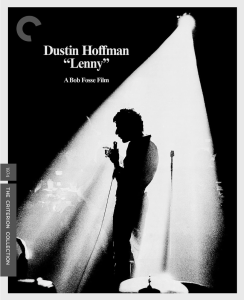
Right now there’s a Criterion 4K Bluray of Bob Fosse‘s Lenny (’74) out there, and I have to be honest — I’m not sure I want a copy of this thing to have and to hold.
Thirteen years ago (3.18.13) I posted the following:
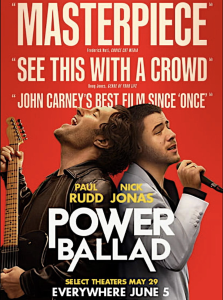
I’m telling you that this latest John Carney film — easily his best since Once — indisputably works and I mean in a naturally behaved, wholly believable, occasionally subtle, well-written and finely-calibrated way. It never feels slick or “theatrical” or tonally off-balance or over-cranked. I went into yesterday afternoon’s AMC Lincoln Square screening with a “show me” attitude, and I was won over less than 20 minutes into Act One. Hell, earlier than that.
Carney is generally loved for his spirit-vibey, music-themed dramas (Once, Begin Again, Sing Street, Flora and Son); his films always leave audiences soothed or at least sated. But Carney is primarily a hard-working, highly skilled filmmaker par excellence — skilled at pacing, at getting his actors to deliver in a fashion that feels honest and true, at natural-sounding dialogue, at plot construction, at peeling off this and that layer of a story in just the right way.
Boiled down I believed each and every aspect of Power Ballad…every character shading, every modest revelation, every line and performance. When a confection-type drama advances and unfurls in just the right way, as Power Ballad does, it settles you down while flipping on a relax-and-enjoy switch. I was waiting for something to go wrong or for a bit or a scene feel like it was somehow mishandled, and disappointment never arrived. And it ends not just happily, but in an emotionally satisfying, un-forced, non-sappy way.
Power Ballad is basically a two-hander — a story about the elusive butterfly of song-writing inspiration**, the every-present seductions of big-time money and fame, and what feelings of disappointment and desperation can do to frustrated or insecure musicians.
Plot-wise Power Ballad is about a kind of rivalry between performers who are 20 years apart but engulfed in a vaguely similar career dynamic — Paul Rudd‘s Rick Power, a 50ish American wedding-band performer, happily married and Emerald Isle-residing, whose rock-star career kinda started to happen in the ’90s but then ran out of gas, and Nick Jonas‘s Danny Wilson, a former boy-band star (as in the real-world Jonas Brothers of the aughts) who, though wealthy and hanging in there, is worried about his ability to succeed as a solo act in the big-time realm.
You’ve no doubt read that Power Ballad is about Danny and Rick jamming together after a lavish Irish wedding, and then Danny stealing Rick’s unproduced love song, “How To Write A Song (Without You)” — a tune that Rick wrote 13 or 14 years earlier but never recorded or even has a digital demo of. Danny adds a bridge and records the tune in exactly the right Richard Perry way, and a few months later it’s become a number one hit. Danny is suddenly recharged and back in the groove, but Rick, after randomly hearing the track in a shopping mall, is enraged and wants some kind of revenge or payback.
Danny’s conveyance of guilt and inner conflict is fascinating. He never quite lets it out in so many words, but when Rick finally confronts him in the third act — at a lavish, Los Angeles birthday party at his own hillside home — he defensive, half-assedly admits that he plagiarized the song, but at the same time emphasizes that it never would have become a hit unless he’d given it a power-pop makeover with a well-crafted bridge. Which he’s probably right about. (Jonathan Shields made the same point about Fred Amiel‘s script of The Far Away Mountain.)
I’d just re-watched Rudd’s performance in Judd Apatow‘s This Is 40, which was shot 14 years ago, and here he is again in more or less the same same spiritual and physical shape.
And what a coincidence that Marcia, Danny’s girlfriend, is played by Havana Rose Liu, who plays the female lead in Tuner, which I saw three or four hours before Power Ballad at the same plex.
I really do believe that the critics who’ve pissed on this film have exposed themselves as…I don’t know, pinched or screwed up or emotionally malignant on some level. Los Angeles Times staffer Amy Nicholson, UPI’s Fred Topel, Fresh Fiction’s Courtney Howard.. These people have urine running through their veins.
My approving view of Power Ballad is not, like, “an opinion, man”, mind. I know when I’ve seen a film that’s been assembled with charm, humanity, skill, confidence and assurance. This is not something to be debated. I know this.
** how a good song doesn’t necessarily become a hit unless it’s been recorded and produced in just the right way, and with just the right mood and dynamic.
An early trailer for Daniel Roher’s Tuner(Black Bear, 5.22) suggested it was some kind of socially complex two-hander about a pair of piano tuners (Leo Woodall as the apprentice, Dustin Hoffman as the old veteran).
Well, it’s not that. It’s all Woodall, for one thing — Hoffman’s role amounts to a bit more than a cameo but only that. It is, however, my idea of an above-average, character-driven crime thriller with a believable romantic relationship on the side.
Tuner is a solid B-plus — a pressurized crime thriller that starts out in a moderate-amiable vein but gradually becomes more and more of a blend of (a) Michael Mann’s Thief, (b) Karel Reisz’s TheGambler (in a moralistic sense —- Woodall’s protagonist isn’t a gambler) and (c) Darius Marder’s Sound of Metal.
Woodall is Niki, a gifted piano tuner (he has exceptional musical ears, knows all the notes and piano keys) as well as a grade-A safe-cracker (also due to exceptional hearing). He’s burdened, however, with a sensitive hearing condition (hyperacusis). He’s also a brilliant piano virtuoso whose super-sensitivity to strong sound prevents him from playing.
Niki soon feels compelled to work with a team of coarse Israeli thieves out of financial necessity (the aging Hoffman, his piano-tuning uncle, is deeply in debt after a heart attack), but he can’t deal with their crude, heavy-handed behavior and eventually runs afoul.
Niki also hooks up with a beautiful Asian girlfriend (Havana Rose Liu), a skillful concert pianist who composes her own stuff.
Pic becomes too brutally violent toward the end, and the ugliest, crudest and most animalistic character — Lior Yaz’s Yuri, the leader of the thieving Israeli brutes — isn’t punished or disiplined in any way for behaving viciously toward Niki. Audiences always want justice — one way or another the bad guy should always be slapped down.
I basically liked Tuner much more before the Israeli pigs muscled their way onto the narrative.
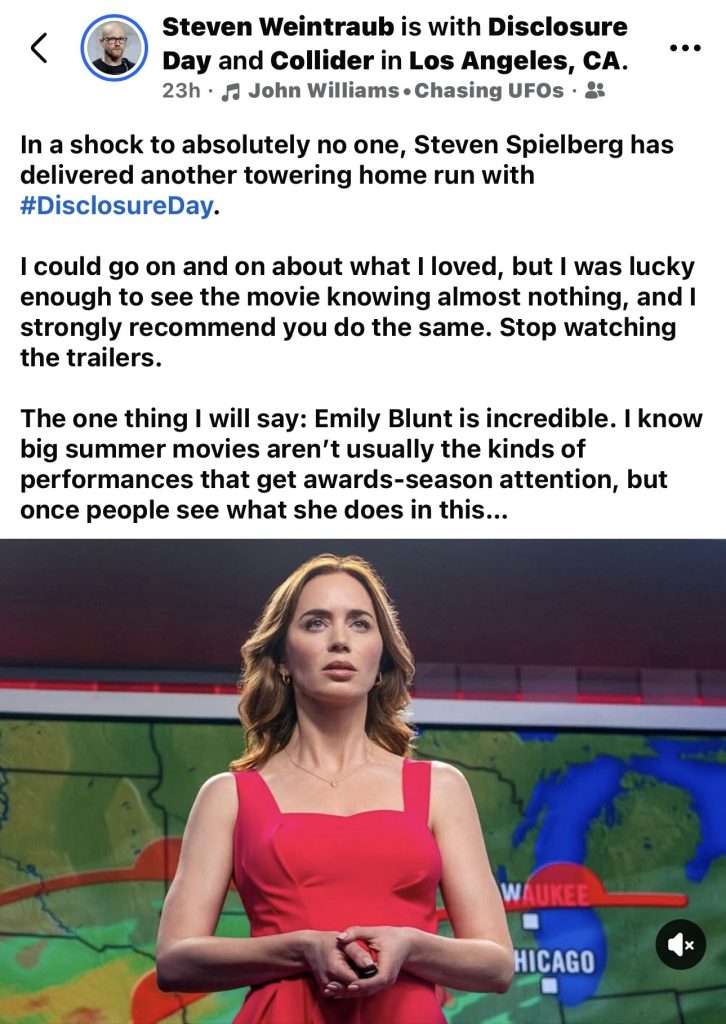
HEtoWeintraub: You knew “almost nothing” before seeing it? You knew it would be a UFO-slash-alien movie. You knew that many in the cast would be wearing “Spielberg alien gaze face” in certain scenes. You knew that a young, watery-eyed British actor with jug ears (Josh O’Connor) would be playing a lead role. You knew that Emily Blunt’s weather-girl character would experience a bullshit on-air meltdown. You knew that Janusz “milky bleachy gray” Kaminski had shot it. You knew Spielberg and Universal didn’t want DisclosureDay playing Cannes, presumably for a reason. You knew lots of things so don’t give me that babe-in-the-woods routine.
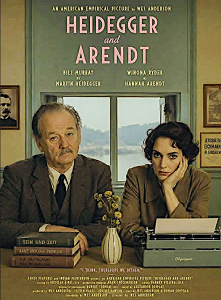
I quickly realized that the teaser poster for American Empirical’s Heidegger and Arendt was AI bullshit, but for a half-minute or so I was hugely impressed that you were apparently stepping outside the WesWorld realm by tackling an odd relationship story that has real political-cultural teeth…a real grabber of a story about two politically incorrect thinkers.
I was saying to myself “whoa!…Wes is going to make a film that’s actually about something substantial this time…no more Jacques Tati influences!…a film that the woke community will utterly despise, of course, but man, Wes has grown a serious pair of balls!…”
For less than a minute I was envisioning a real-deal romantic and philosophical bond between a pair of big-league 20th Century philosophers and outside-the-box minds. A brief love affair between a Nazi apologist philosopher in his mid to late 30s (Bill Murray would be roughly 40 years too old), and a younger Jewish intellectual who reported about and commented on Adolf Eichmann’s trial for The New Yorker, and allegedly coined the phrase “the banality of evil”. (The 55-year-old Winona Ryder Is 35 years too old as Hannah Arendt’s affair with Martin Heidegger began in 1925, when she was 19 or 20.)
The fantasy of you actually making this film evaporated in less than 40 or 45 seconds (I was drowsy, wasn’t sipping coffee), but I was hugely impressed before it dissolved. I really was.
HE advice to Travis Bickle while standing outside the Belmore Cafeteria (Park Avenue South and 28th Street): “Look…you write a diary…right? You got a typewriter? Get one, get some typing paper and tap out a daily diary about your cabby life…not just the fares but your deepest thoughts…hates, fears, longings. And submit these pages on a weekly basis to the Village Voice and the Soho Weekly News or some other weekly rag. Who knows?…you could become a New York version of Charles Bukowski.”
Here’s a small but curious oddity in Rob Epstein and Jeffrey Friedman‘s Linda Ronstadt: The Sound of My Voice, which will open just after 2019’s Labor Day.
The film begins with footage of Ronstadt, 73, visiting the Mexican town of Banamichi, where her grandfather was born, and listening to a music festival. A significant portion of the doc is about Linda’s ethnic as well as musical identity. The last 25% is about Ronstadt’s decision to musically celebrate her Mexican heritage with 1987’s “Canciones de Mi Padre” as well as “Mas Canciones” (’91) and “Frenesi” (’92).
The film conveys a clear sense of Ronstadt having found spiritual fulfillment and completion by way of embracing her family’s history and traditions.
Except all through the ’60s, ’70s (her biggest commercial decade) and most of the ’80s nobody knew Ronstadt was of Mexican descent. For the simple, obvious reason that she has a German last name.
In the doc media mogul David Geffen and fellow troubador Jackson Browne both say they didn’t know about Ronstadt’s Latin ancestry. Nobody did until she went ethnic in the late ’80s. All fine and good, but that’s a significant cultural-identity issue — German last name vs. Mexican heritage — so you’d think that Epstein and Friedman would include a line or two of explanation. But they don’t.
In a statement provided to Hollywood Elsewhere, the filmmakers said that “we only went back as far as her grandfather, the generation she would have personally been acquainted with. Otherwise it was just too much backstory to work in, and didn’t seem relevant to her musical story, which was our focus.”
I understand this answer, but ignoring where “Ronstadt” comes from still seems a bit odd. The Wiki fact is that Linda’s great-grandfather, graduate engineer Friedrich August Ronstadt (who went by Federico Augusto Ronstadt) “immigrated to the Southwest in the 1840s from Hanover, Germany, and married a Mexican citizen, eventually settling in Tucson.”
It’s a minor omission and unimportant in the greater scheme of Ronstadt’s musical life, but the decision to avoid mentioning Friedrich or Federico is still a head-scratcher.
So here’s a theory or, if you will, a suspicion. The reason Linda’s great-grandfather is completely ignored is because it would have been politically incorrect to have mentioned him. [Full disclosure: My mother’s family, named Grube, was half-German.] The arc of the last third of Linda’s life was about reconnecting with her Mexican family roots. The movie, as mentioned, is all over this aspect, but no one wants to hear about some knockwurst-and-sauerkraut guy from Hanover, Germany who came to this country 175 years ago. Even if a brief mention of same would have explained the basics.
Because whiteness, let’s be honest, isn’t especially cool these days. Certainly by the standards of the progressive community. The basic agreement in media circles is that white culture (whether descended from England, Germany, France, Russia or the Nordic countries) can be acknowledged but is better off ignored. Because we’re living in an era of positive progressive redefining in which non-white cultures are experiencing a significant upsurge, media-recognition- and ethnic-celebration-wise.
“Death’s honesty” is a BobDylan coinage. And now EddieRoach, a good-vibe guy within devotional, long-of-tooth Beach Boys circles and a warm presence from my old California days, has been dealt an honest hand.
I was chummy with Roach in the early to mid ’70s, partly due to our liking each other (he was a permanent up dude…a buoyant Brooklynite) but mainly due to living next to each other in the same Santa Monica apartment building (948 14th Street).
A gifted photographer who toured with the Beach Boys in the ’70s and early ’80s, Eddie was a good friend of Dennis Wilson, whom I found snobby and dismissive but who dropped by Ed’s place from time to time. And Brian once or twice! It was my proximity to Eddie that resulted in my first encounter with Brian Wilson during his drugged-out phase.
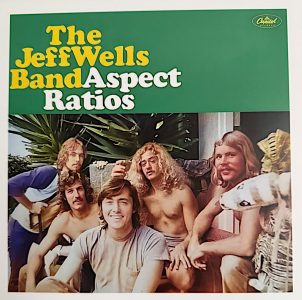
Eddie was the one who gave me that Jeff Wells Band / Aspect Ratios shot. (Taken at 948 14th!) He didn’t give it up easily. It took months of badgering and begging, but Eddie finally relented. I’ll always be grateful.
Yes, Eddie was a grandson of Hollywood comedy pioneer Hal Roach.
Tim Grierson‘s Screen Dailyreview, however, gives me concern. “The showdown between Paul Rudd and Nick Jonas is not nearly as illuminating or cathartic as Carney assumes. The music industry is cutthroat, but Power Ballad’s insistence on emphasising the heartfelt and comforting undercuts the inherent hell of a man who watches his dream get to be lived out by someone else.”
Collider‘s Ross Bonaime: “Compared to his other recent work, Carney’s latest pulls back a bit on the music and leans more into the comedy side of things, yet Power Ballad maintains the heart and optimism that is brimming from all his films, and hopefully, it will get the attention it deserves.”
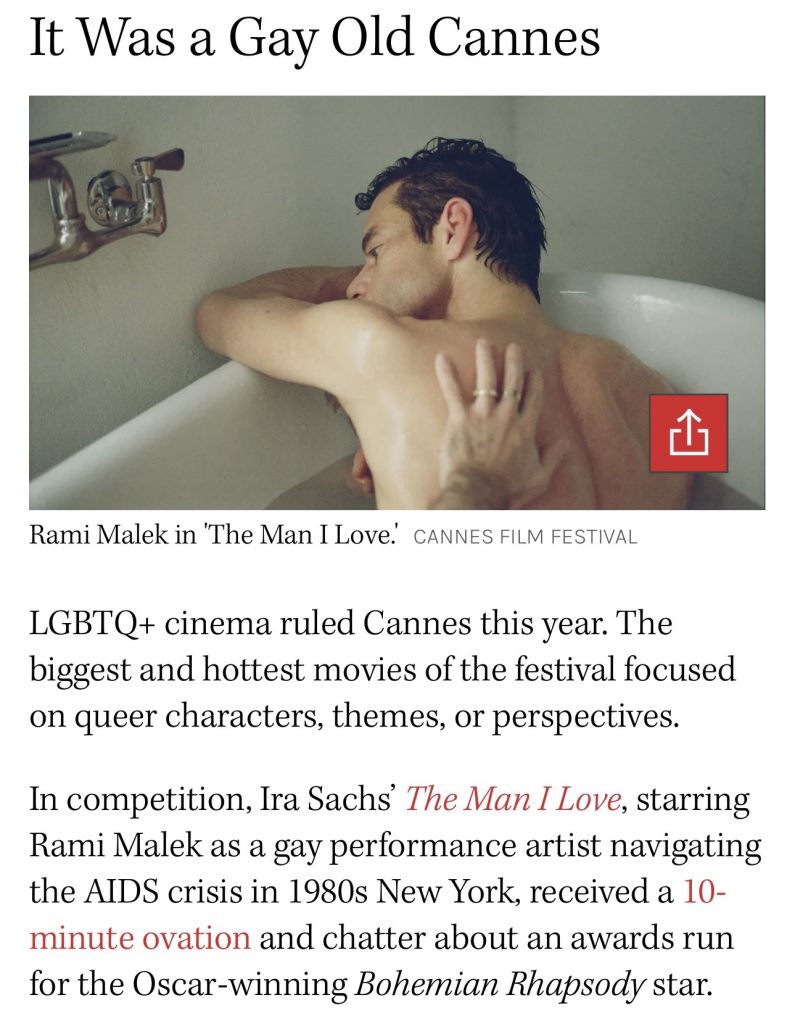
But when THR’sDavid Rooneystated that much of Cannes ‘26 was gay, gay, totally effing gay, nobody said boo. Because Rooney is a member of the tribe, and therefore shielded.
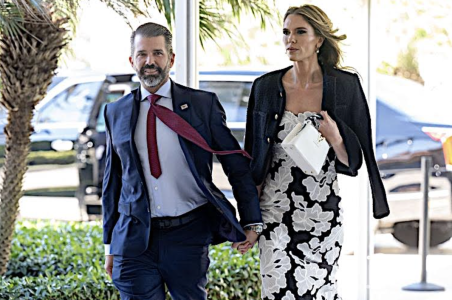
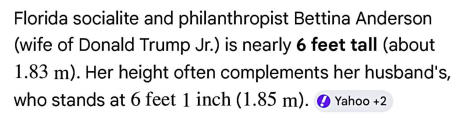
This recent below photo aside, Donald Trump, Jr. is apparently an inch taller than Bettina Anderson, whom he recently married (and vice versa) at a ceremony in the Bahamas.
But what if the sizes were reversed? Taller women-shorter men relationships occasionally happen, of course, even though we’ve all read or heard about hetero women routinely discriminating against shortish guys on dating apps.
I don’t regard myself as a size-ist (I dealt with a certain amount of pushback from classmates when I was young for being a “giant”) but it’s quite rare to see a husband or boyfriend who can obviously be beaten in a wrestling match by his wife or girlfriend.
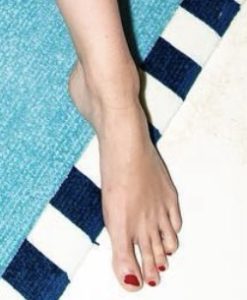
I do know that no dude wants to date a woman whose feet are bigger than his own. This is certainly true in my case.
Did anyone ever cast a tall, leggy actress opposite Alan Ladd or Dustin Hoffman in their respective heydays? It’s not a male-ego thing — it’s a reality thing. Yes, runty guys occasionally hook up with tallish women (5’11” Nicole Kidman was four inches taller than Tom Cruise, and Katie Holmes had him by two inches). But generally this doesn’t happen much. Not in 7-11 land, it doesn’t.