Wolves Wearing Wool

Trey Parker and Matt Stone are clever filmmakers and inspired comedians, but I can’t help despising where they’re coming from politically in Team America: World Police (Paramount, 10.15), their R-rated puppet flick.
I’d love to fall in line with my journo friends and call them the cat’s meow in all respects, but man, I can’t. Matt and Trey are in league with the bad guys, or at the very least doing what they can to undermine the legitimate and (hello…?) insightful convictions of the anti-Bush lefties everywhere, so no offense but leaving aside the fact that they’re a couple of extremely funny dudes, they can both cram it sideways.
Let’s get the compliments out of the way first….
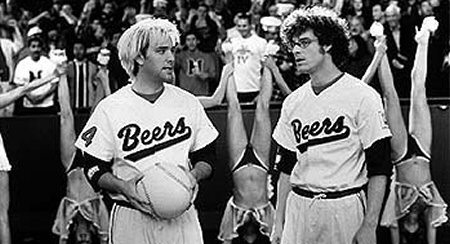
Matt and Trey really know how to sell a joke or a bit, and are clearly operating ahead of the curve. I was laughing pretty hard here and there when I saw Team America last weekend. It’s an appallingly funny film at times. It’s going to be a fairly big hit.
I never thought I’d find myself saying that a scene showing a drunken puppet repeatedly vomiting on a New York City sidewalk is a comic jewel, but Team America has such a scene and it’s a bona fide classic — right up there with the most celebrated comic bits of Laurel and Hardy, the Marx Brothers and Martin and Lewis.
< ?php include ('/home/hollyw9/public_html/wired'); ?>
In fact, it’s the best funny-vomiting scene to happen in American cinema over the last 40 years. The last truly remarkable scene in this vein was included in Arthur Hiller’s The Americanization of Emily in 1964. (There’s not much to it — just a bit with a young sailor on a ship heading for Omaha Beach on D-Day throwing up into a steel-pot helmet. The sound he makes while doing this is amazing.)
But I’m also ticked off, dammit, about what roughly half of the political jokes in Team America are saying deep down.
And what is that? Basically that showbiz liberals are pompous jerks with broom handles up their ass. It also implies righties aren’t quite as bad because the film doesn’t criticize them, so maybe it’s okay to vote for Bush.
I should acknowledge that none of the journalists and critics I’ve spoken to are taking the political content of this film even half-seriously. “I don’t agree with you…they’re just funny guys,” a journalist friend told me last Sunday. So maybe I should back off, lighten up, grow a sense of humor?
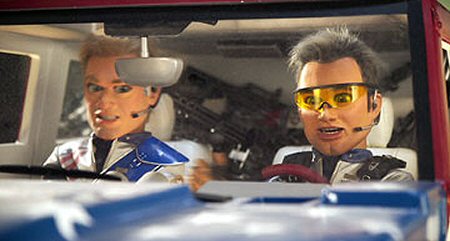
Parker and Stone have been telling journos all along that Team America is a goof on Jerry Bruckheimer-type action movies. “People are saying that [the film is] about politics,” Stone told Washington Post columnist Anne Thompson. “It’s a satire of movies.”
That’s partly true, but it’s also a smokescreen thing to say. Never trust the artist — trust the tale.
Some of Team America‘s political humor is about how American military forces have acted like high-tech brutes in their fight against the terrorist baddies on foreign soil, and how their single-minded desire to be the world’s #1 tough hombre has pissed off millions in Europe and the Middle East.
There’s also a funny song about how Pearl Harbor sucks, but it came out four years ago. Why not trash Hudson Hawk and Last Action Hero while they’re at it?
The biggest percentage of the gags are about how all the big leftie Hollywood types — Tim Robbins, Janeane Garafalo, Sean Penn, Alec Baldwin, Susan Sarandon, Michael Moore, Matt Damon — are ignorant blowhards who give aid and comfort to America’s enemies.
The anti-American, fellow-traveller metaphor is conveyed in Team America when these leftie dickwads join forces with the North Korean leader Kim Jong Il. Stone and Parker respond by making sure the dirty lefties get blown up, shot or incinerated to death, decapitated or thrown off tall balconies.
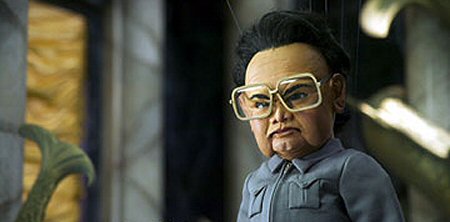
In a movie like Team America, there’s no such thing as just plain hah-hah funny. It’s all about the sub-currents, and the message here is that these liberal snobs aren’t worth listening to, and therefore everything they’ve said about Bush being wrong and arrogant on Iraq is probably suspect. You can throw ’em all out with the trash, the film says. Moore is a lunatic, Baldwin is deranged, Robbins’ complaints about Clear Channel are deluded, Garafalo’s rants on Air America radio are hot air, etc.
Stone told the New York Post‘s Megan Lehmann, “We diss on people like actors who get on a soapbox and say, ‘Let me tell you how it works in Iraq,’ cause they don’t know fucking shit.”
In other words, you can’t have a halfway legitimate opinion about Iraq if you’re a leftie actor, because all you really know is what you’ve read in newspapers, magazines, books and the internet…which isn’t good enough. You have to work for the government or a think tank, or better yet you need to go over to the Middle East and absorb what’s going on first-hand.
But not like what Sean Penn did when he went to Iraq because he’s one of those leftie wack-jobs. To really know what you’re talking about you have to join the military or be a U.S. Senator or work for the CIA or Halliburton.
Maybe Matt and Trey know something we don’t. Maybe Tim, Sean, Michael, Janeane, Alec and the rest of them really are clueless assholes. They probably know them a lot better than I do, so maybe I should shut up.
But I’ll bet Stone and Parker will never accuse actor Ron Silver, a “9/11 Republican” who’s been praising Bush’s record on the news channels, of not knowing what he’s talking about. And he’s just another SAG member getting his information from the same sources.
Could any of this have something to do with E Online‘s Emily Farache, who interviewed Stone and Parker in early ’01 over their Comedy Central series That’s My Bush!, and reported that “they’re both Republicans” and that they “don’t plan on ridiculing Bush” in their then-upcoming series?
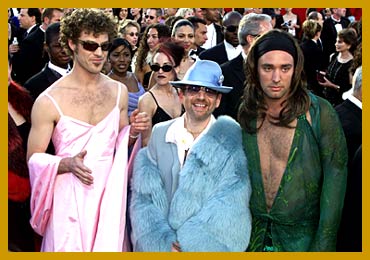
“What we’re trying to do is way more subversive,” Parker told Farache. “We’re going to make you love this guy.”
Or a story by Brit Hume on the Fox News site that ran in December ’01, in which it was reported that Stone and Parker had announced at a People for the American Way fundraiser “that they were Republicans. `It’s true,’ said Parker, who was wearing a stars and stripes outfit.”
Some people have written in and said I’m taking their comments too literally, and that they might have been putting everyone on when they said they’re Republicans. As if.
In a just-posted interview with the Guardian‘s Heather Havrilesky, Parker summed up the film’s political philosophy. To understand his meaning, understand that “dicks” means law-enforcers or international cops (i.e., U.S. forces in Iraq) and “pussies” means Hollywood liberals. Here it is:
“Dicks are bad, and it sucks to be a dick, but it’s way worse to be an asshole, and because there are assholes, we need dicks. So shut the fuck up, all you pussies!”

Guarded Guy

I think all of us felt pretty sad about Chris Reeve’s death. Especially given his image as a kind of never-say-die spiritual hero.
There’s no question in my mind that his life as an impassioned quadraplegic and stem-cell-research advocate made a much greater impression than his performances ever did. I enjoyed his acting from time to time, but I was in awe of who he became after that tragic horse-jumping accident paralyzed him in ’95.
Reeve had a ten-year run (’78 to ’88) as a marquee name. Superman got him off the ground; Switching Channels finished him off. His best film performances were in Jeannot Szwarc’s Somewhere in Time (’80), Sidney Lumet’s Deathtrap (’82) and James Ivory’s The Bostonians.
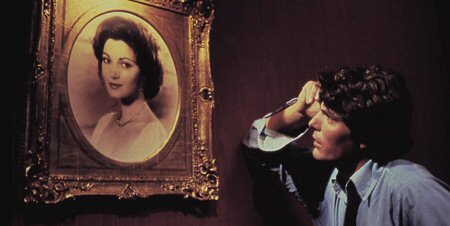
His best performance ever was in the Broadway stage production of Lanford Wilson’s The Fifth of July, in which he played a gay paraplegic Vietnam veteran. It ran in the late summer or fall of 1980. Jeff Daniels and Susie Kurtz co-starred.
I had an experience with Reeve in 1980, when I was a pup journalist living in New York. It began with an interview piece I wrote about him for a New Jersey weekly called The Aquarian, the main subject being Somewhere in Time.
Reeve and I met for the interview at a restaurant on upper Columbus Avenue. I had done my homework and prepared a lot of deep-focus questions, and I think he enjoyed our talk. Sonia Moskowitz, a gifted photographer whom I was seeing at the time, sat in for the interview and then took some photos of Reeve (plus one of him and me) outside the restaurant. Then we went back inside to sort out the bill.
I was a bit green back then, but I’d done a few celebrity interviews and knew that the basic rule was that the studio always picked up the tab. I assumed this would be the case but there was no Universal publicist at the restaurant to cover the check, and I didn’t know what to do because my Aquarian editor had never talked to me about expenses, and I didn’t have the cash to cover it on my own.
I thought Reeve (wealthy actor, right?) might step up to the plate and get his money back from Universal. It was that or somebody would have to leave a personal check or wash dishes. Talk about embarrassing. When I told Reeve I was a bit light I could see he was irritated. We kind of hemmed and hawed about it on the sidewalk, I offered everything I had (about $15 bucks), and he finally dug out his wallet and said, “Well, all right” and paid the balance.
When I wrote my piece I threw in a couple of graphs at the end about this bill-paying snafu. I thought it was both amusing and humanizing on some level that a successful big-name actor who’d played Superman was capable of getting flustered about paying a check, just like anyone else.
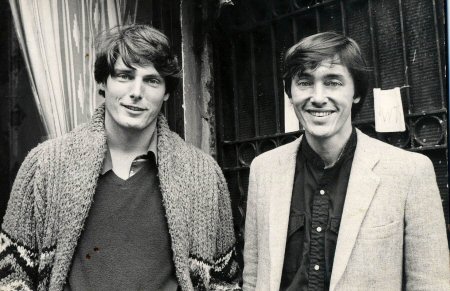
A week or two later, just as the Aquarian piece came out, I went with a couple of friends to see Reeve in The Fifth of July. We visited his dressing room to say hello after the show, and as an ice-breaker I asked if he’d seen the article. Bad question. Reeve hadn’t liked my closer and said so. He was scowling at me. I felt like I was suddenly in the Twilight Zone. I thought I’d written about the restaurant-tab thing with humor and affection. I’d figured this plus the fact that the overall piece was highly flattering would have charmed him.
To soothe things over I wrote him a note the next day saying I was sorry he had that reaction, that I really thought the humor I got out of our check-paying episode made it a warmer, fuller piece, and that I hoped he wouldn’t hold a grudge.
A few weeks later I ran into Reeve at an invitational party at a Studio 54-like roller skating joint in Chelsea. As soon as he spotted me he came right over, smiling, and said, “Hey, Jeff. Got your note…everything’s cool…don’t worry about it.” We shook hands, he smiled again and said “peace,” and that was that.
What this told me about Reeve is that he was gracious, obviously, and able to handle embarassments and whatnot. It also told me that deep down he was into dignity and protocol and doing things a certain way. I think that attitude bled into his acting on a certain level, and that’s why he wasn’t quite Marlon Brando.

Let There Be Sound

My writing skills are more precise than my verbal skills, to judge by this sound file. But I decided to just throw this in as a way of explaining what I’d like to do henceforth, which is turn Hollywood Elsewhere, or a portion of it rather, into an occasional sound-clip thing.
I’ve always wanted to do radio, I’m fairly loquacious, I have a decent-sounding voice and I like trying new stuff. So let’s see what happens. It makes sense to do this. Everyone’s computer has sound these days — we’re not living in 1998 or ’99 — and it’s easy to record a digital segment and throw it in to the column as a link.
I’ll probably start doing this next week. My speaking style will sharpen up after a while and I’ll get rolling with the whole thing and the segments will eventually be interesting.

Sideways Guys

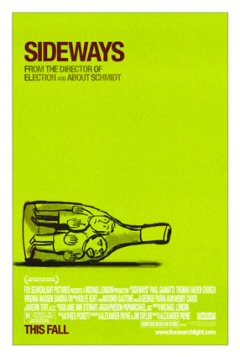
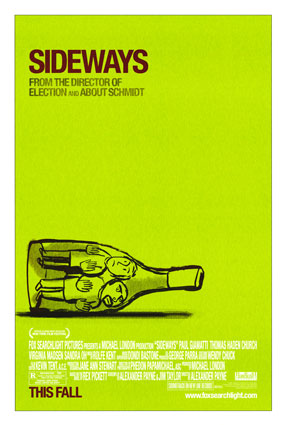
I’ve seen Sideways three and a half times, and it’s gotten better with every viewing. It’s my favorite movie of the year now, enjoying a slight edge over Collateral, Touching the Void and The Motorcycle Diaries.
The halfer happened Monday night at a screening for the Broadcast Film Critics Association that was sponsored by Movie City News. I knew I’d be seeing it again at the Sideways premiere on Tuesday evening (10.12), and I mainly wanted to listen to the q & a screening between Sideways director-co-writer Alexander Payne and his writing partner Jim Taylor.
Movie City News editor David Poland handled the interviewing and question-fielding with his usual aplomb. I’ve since read that the session went on for just over an hour; it felt like half that.
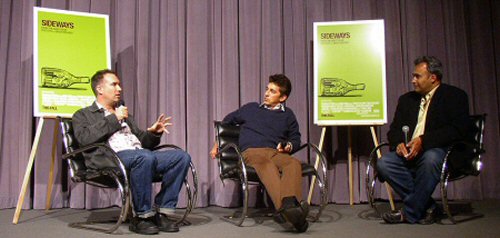
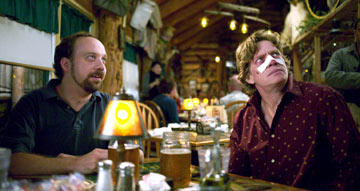
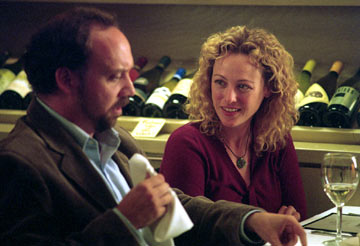
I raised my hand and passed along a comment from an agent friend of mine. She said she didn’t believe that Virginia Madsen would hook up with a guy like Paul Giamatti, which is what happens in the film. Her point was that Madsen is too brainy, busty, beautiful and rich of spirit to pay any mind to a glum and pudgy neurotic.
I told Payne that I think her view is short-sighted, but I wanted to pass along his own response, and here it is: “I think your friend is kind of shallow. I mean, she sounds so L.A.”
I spoke to Payne last night at the after-screening reception. He said he’s working with Taylor on something new, but plans on taking some time off after he finishes promotional duties for the film.
Payne said he’s particularly looking forward to visiting Greece in a few weeks time and attending the 45th International Thessaloniki Festival, which runs from 11.19 through 11.28. (Payne is of Greek ancestry — the IMDB says his birth name was Alexander Papadopoulos.)
The official website says the Thessaloniki festival “assumed its present dynamic internatrional character in 1992, under the direction of Michel Demopoulos.” The site features a quote from Bernardo Bertolucci that says Demopoulos has brought in “a new vitality, opening [the festival] up to a young audience.”
Major filmmaker attenders have included Istvan Szabo, Ivan Passer, Goran Paskalijevic, David Thewlis, Dean Tavoularis, Bernardo Bertolucci and Jerzy Skolimowski. Hey, Demopoulos….do you ever fly in columnists?

Nairobi, Part 2

“It was a nice surprise to see my e-mail posted on the site last week, with a great picture of Nairobi no less.
“Though you might be tempted to think that those giraffes were doctored into the photo of the Nairobi skyline, it is actually possible to see such a view without the aid of PhotoShop.
“The picture must have been taken at Nairobi National Park, which is on the outskirts of town and boasts plenty of giraffes, zebra, gazelles, ostrich and a few rhinos and lions within view of downtown Nairobi’s skyscrapers. Since we get resident rates on park admission ($5 versus the $15 to $30 the tourists pay to get in), my wife and I sometimes bring a picnic blanket and a bottle of wine (South African, of course) to NNP and watch the sun go down as giraffes amble by. A real hardship post, Kenya.

“Kenya’s natural beauty, mix of cultures and ample wildlife have made it a prime location for Hollywood movies about Africa. Ralph Fiennes and Fernando Meirelles were in town a few months ago filming John Le Carre’s The Constant Gardener. Some people I know saw Fiennes in the bar of the Serena Hotel, and a friend-of-a-friend white Kenyan journalist reportedly had dinner with him.
“I’m waiting patiently for the arrival of Nicole Kidman, who is supposed to be starring in Tony Scott’s adaptation of Emma’s War, a non-fiction book about a British aid worker who married a Sudanese warlord. I heard somewhere that the filming of this movie (much of which takes place in Nairobi) has been delayed by the crisis in Darfur. Scott is apparently determined to film in the Sudan.
“Incidentally, Kidman’s character, Emma McCune, was killed in a collision with a matatu (minibus taxi) about a block from where I live. Oops…spoiler.
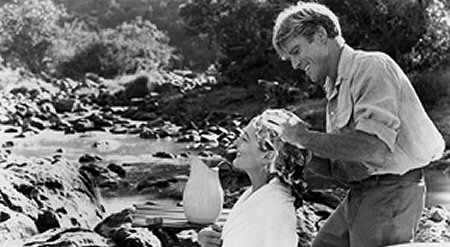
“The most famous movie filmed in Kenya is, of course, Sydney Pollack’s Out of Africa, based on the life of Karen Blixen, the Danish baroness who “hahd a faaaahm in Aaahfrica.” In her honor, the southeast side of Nairobi, where white farmers and corrupt government officials still own huge pieces of land, is still called Karen. You can tour her former house there. At first glance it looks exquisitely preserved from the colonial days, until you learn that Karen took almost everything she owned back to Denmark with her and that much of the furniture and decorations now filling the house were made for the movie.
“You can also take a hike in the nearby Ngong Hills and linger at Denys Finch-Hatton’s grave, and also contemplate why Robert Redford didn’t at least attempt a British accent.
“An hour outside of Nairobi you can visit Lake Naivasha, another prime filming location. The arabesque Djinn Palace, site of several gauzy debauchery scenes in White Mischief, is still there. You can see it from a boat on the lake when you take a hippo tour, though the mansion now belongs to a Dutch flower magnate and is not open to the public.
“My favorite place to stay at Naivasha is Elsamere, the former lakeside home of George and Joy Adamson, who were the subjects of the old Disney flick Born Free. (the management keeps a scratchy VHS copy at the ready for anyone who wants a screening). Joy, a painter and nurturer of orphaned lions and leopards, was not the prim, bland British babe of the movie but a feisty and abrasive Austrian whose third husband was George, a game warden in Kenya.
“Both Joy and George were murdered — George by Somali poachers and Joy by a
disgruntled servant. The movie, which was a huge hit in its time (just try to get that song out of your head), now looks pretty dated and the production values are pretty embarrassing even by 1960s standards. (Pauline Kael body-slams the movie in her book “Kiss Kiss Bang Bang”).
“One of the funniest things is that whenever the Adamson’s go on safari, none of the animals are just standing there peacefully grazing. Every shot is a wild stampede of elephants, gazelles, zebras, etc., as if a production assistant had fired an assault rifle in the air just before the cameras started rolling.
“Up in the Kikuyu highlands near Mount Kenya, you can see where the recent Oscar- winner Nowhere in Africa was filmed. You can also have a drink in the severed-head festooned bar of the Mount Kenya Safari Club, which was founded by William Holden and some of his Hollywood pals so they would have a place to shoot the shit after bagging big game. At least one of the old Tarzan movies was filmed nearby.
“It has recently become vogue for Hollywood producers to throw a few Maasai warriors from Kenya into action flicks to signify `darkest Africa,’ to the extent that one East African journalist recently referred to the Maasai as `the Red Indians of today’s Hollywood adventure movies.’ The most recent example is Tomb Raider 2, partially filmed in Kenya and featuring Djimon Hounsou as an unusually buff Maasai.
“Why are most movies set in Africa pretty bad? Probably because the Africans never get to tell their own stories. I’m hard-pressed to think of more than a couple of Western-produced movies set in Africa (Lumumba, Sarafina, The Gods Must Be Crazy) where the African experience is not filtered through the persective of the Sensitive White Actor to whom the Africans are little more than tragic victims or trusty servants — in other words, reflections of the white man’s own nobility.
“Maybe someday Africans will have a global film industry of their own and more realistic African characters will appear on screen. Nigeria (or Nollywood, to Africans) cranks out nearly as many films in a year as Hong Kong or India, but they are universally crap. And yet that country did produce Chiwetel Ejiofor, so maybe there’s hope.” — Peter Mackenzie, Nairobi, Kenya.
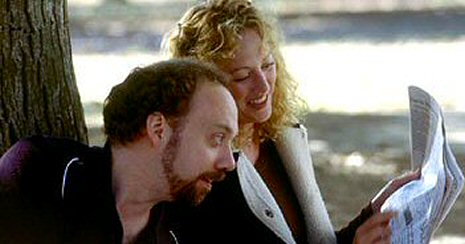
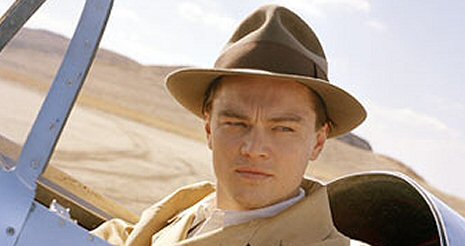
Basic Instinct

It’s built into our genes to show obeisance before power. It’s obviously a big tendency in Hollywood circles, but hardly an exclusive one. Every culture, every species does the bow-down.
I was speaking the other night to this know-it-all guy who goes to a lot of Academy screenings and parties, and we were talking about possible Best Actor nominees. We’d both just seen Ray and knew for sure Jamie Foxx was a shoo-in, but who else?
“Paul Giamatti,” I said.
“Who?” he asked.

“The lead in Sideways,” I reminded him. “He’s amazing, heartbreaking… and the film is masterful.”
“Yeah, he was good,” he replied. Uh-huh…. not impressed. He’d seen Sideways and liked it, he said, but he had a certain criticism of something Giamatti did in the film that I’m not going to repeat. It was about something obscure that nobody anywhere has mentioned.
What he really meant, I suspect, was that he didn’t empathize with Giamatti and/or his “Miles” character because he’s balding and chubby and a bit of a loser, and the guy wasn’t feeling the tribal urge to celebrate the splendor of Giamatti’s craft. Because for him, superb performances in and of themselves lack a certain primal current.
< ?php include ('/home/hollyw9/public_html/wired'); ?>
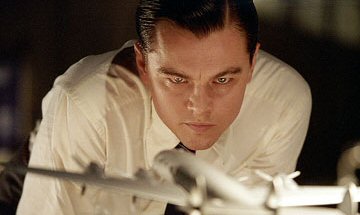
Then he started in about Leonardo DiCaprio in The Aviator. He’d seen the upcoming Martin Scorsese film (opening 12.17) and didn’t want to tell me much, but he liked Dicaprio’s portrayal of Howard Hughes… mostly. But he had a couple of beefs. One was that Leo doesn’t look much like Hughes, and the other is that he looks too young.
“He’s 29 now,” I reminded.
“He looks like a kid.”
“But does he get Hughes?” I asked. “You know, does he channel him?”
He kept beating around the bush, but the basic answer seemed to be that he found DiCaprio worthy but not overwhelming.
“That’s what people said about him in Gangs of New York,” I replied. “Some said he was miscast, but I thought he was absolutely believable as an immigrant. He really had that scared-rat look in his eyes.”
The conversation went on a bit and then he suddenly flipped over. He said that based on his awareness of Academy types and their inclinations, DiCaprio would probably end up with a Best Actor nomination.

“But you just said he was pretty good but not great in the role, and looks like a kid and doesn’t really resemble Hughes,” I said.
Yeah, he said, but a Best Actor nom is still a likelihood, or so his instincts were telling him.
In other words, however good, pretty good or wonderful the Aviator might turn out to be, it’s a big expensive movie coming at the end of the year, and corporate-funded films that have spent well north of $100 million in their desire to win the admiration of the community are given the benefit of the doubt, sight unseen.
Big subject, big canvas, fascinating lead character grounded in old-Hollywood lore. Just what the Academy ordered. And so DiCaprio gets the come-hither and Giamatti has to struggle and prove himself and wait out on the sidewalk.
I realize, of course, that DiCaprio may be phenomenal in The Aviator. He’s a truly gifted actor. And I don’t trust that guy I spoke to at all — he’s not the most insightful, ahead-of-the-curve person I know.
But something smells in the town of Carmel when a performance as skilled and deeply expressive as Paul Giamatti’s in Sideways is reluctantly regarded as a “maybe.”

Respect

Laura Linney is one of our great actresses. She’s the successor to Meryl Streep. In just about every film she’s in, she kills.
I’m saying this because ’04 is turning out to be her best year since ’00, when she gave a pitch-perfect performance in Kenneth Lonergan’s You Can Count on Me and snagged a Best Actress Oscar nomination.
In my estimation, Linney has given far and away the best female lead performance in Dylan Kidd’s P.S. (Newmarket, 10.15), in which she plays a 40ish Columbia University admissions consultant who falls head over heels in love with a young student (Topher Grace) who seems like a dead ringer for a former boyfriend, and who might even be a reincarnation.

If you ask me, she’s also delivered the second-best supporting actress performance of the year (after Sideways‘s Virginia Madsen) as Liam Neeson’s spirited wife Clara in Kinsey.
Please send in any reactions to her performance in P.S. when it opens a week from today. I’m not over-reacting, but tell me if you think I am.
It’s good that these roles happened this year for Linney, since she had a terrible phase last year with two clunkers.
Her performance in the thoroughly revolting Love Actually was fine, but smothered in treacle as thick as Elmer’s Glue-All. There was nothing un-genuine about her performance in Alan Parker’s The Life of David Gale, but it was such a widely-panned film that it sank like a stone and took everyone down with it.

North

The plan was to drive up to San Francisco this morning to take in part of the Mill Valley Film Festival, which began last night (Thursday, 10.7) and continues until Sunday, 10.17. Except I decided this morning to blow the whole trip off, for reasons you don’t want to hear.
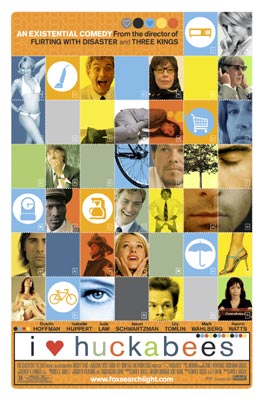
The plan now is to go up next weekend for the final three days. Festival director Mark Fishkin got David O. Russell to come up for Thursday’s opening-night showing of I Heart Buckabee’s, which opens in cities all over starting today (10.8). (Be sure to read Kim Morgan’s piece on Huckabee’s in her new High and Low column, which went up last night.)

Wired

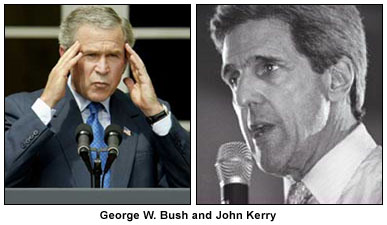
A piece by Dave Lindorff that went up on Salon this morning (10.8) is keeping alive the Big Question of the Moment, which is about whether President Bush cheated during last week’s debate with John Kerry. The speculation is that he was fed cues and answers through an earpiece hooked up to a wireless receiver.
There’s a similar story about this by John Reynolds on Salon that went up last weekend. There’s also a site called www.isbushwired.com that gets into the whole thing with links and commentary.

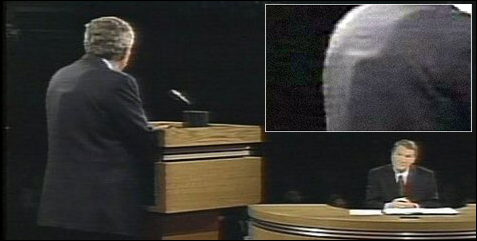
There are two pieces of evidence that make this charge hard to dismiss out of hand. One, there’s a photo taken of Bush’s back during the debate showing something bulging under his suit jacket, between his shoulder blades. Two, Bush inexplicably said “Let me finish” in the middle of responding to a Kerry statement when nobody was trying to butt in or challenge him.
The speculation is that Bush was listening to input from Karl Rove or some Rove flunky, and, being the stream-of-consciousness type, vocally and unintentionally told the earpiece guy to shut up while he was trying to make his point.
You can hear the sound bite here. And the photo in question shows some kind of solid object under Bush’s suit jacket poking through in the upper middle portion of his back.
We all know Bush is always being prompted and propped up tto within an inch of his life by his handlers, but relying on earpiece prompts during the debate, if it turns out to have actually happened, clearly isn’t cricket. Why isn’t “Hardball”‘s Chris Matthews all over this? The evidence isn’t conclusive, but it sure is intriguing.

Kenya

I heard from a reader named Peter MacKenzie in Nairobi, Kenya, the other day. I asked him what the weather is like, how the air smells, what the women are like, what movies are playing and how much it costs to get a beer in a local bar. Here’s his reply:
“Kenya is beautiful right now. I just went on safari for a couple of weeks with some friends visiting from the states. The ‘short rains’ start soon, but for now it’s sunny, dry and about 80 degrees every day. Although Nairobi is only about 50 miles from the Equator, it’s about the same altitude as Denver so it’s not too hot, not too cold most of the year.

“The air in Nairobi smells like burning trash and diesel exhaust a lot of the time, though once you get out of the city it’s about the freshest air you could ask for. And yes, there are some unbelievable women, though unfortunately many of the real knockouts can be seen hanging off the arms of dumpy septuagenarian British expats (shades of Michael Caine in The Quiet American).
“A bottle of Tusker (the local brew) will set you back 100 shillings (about $1.25) in the expat-frequented bars, and barely half that in the roadside shack pubs the local workers hit on their way home.
“Movies playing at the cinemas in Nairobi: King Arthur, Pride And Prejudice, The Terminal, Garfield, The Village, Chronicles of Riddick, I, Robot, Dodgeball, The Butterfly Effect and several Bollywood musicals for the local Indian community.
“Two four-screen movie theaters will be opening within five miles of my home in
the next six months, so hopefully the selection will improve.
“I would definitely recommend an East African safari if you ever have a couple of weeks to kill, thought there aren’t a lot of film festivals in the region to provide a work excuse (unless you think your readers absolutely need to be updated on the Zanzibar International Film Festival).”

Linney

“I’ve seen Laura Linney in P.S. and completely agree with you it’s the best work done by an American actress this year, although Kate Winslet in Eternal Sunshine of the Spotless Mind comes close in a role that is equally tricky and complex. There isn’t a note in this film that Linney doesn’t play, and her performance (and the film) gets deeper as the film progresses, particularly in the late scenes with Paul Rudd, Gabriel Byrne and Marcia Gay Harden.
“The relationship between the two women is at least as complex, if not more, than between Linney and Topher Grace. When was the last time you saw a female character in an American film who’s this developed and interesting on both personal and professional levels — daughter, sister, best friend, ex-wife, lover, possibly failed artist? Linney does it all here.
“And P.S. is a very clever film, using a potentially fantastical premise as a tool to deconstruct and repair a series of bitter relationships. I’m not sure if I can think of another actress who could sell me on this role, at least not with the number of dimensions Linney plays — angry, astonished, disillusioned, in love, confused, jealous, at peace. Possibly her best moment comes in a small scene set in a pool-hall restaurant where Grace says exactly the right thing to her at the right moment.
“Linney doesn’t striek me as the new Meryl Streep as much as a variation of Linney in each performance, which I mean not in any derogatory fashion. It’s just that she always seems to drive through films with a cynical, hard-edged intelligence that seems very contemporary, even in films like Kinsey and The House of Mirth. I thought Love Actually (you’re being too hard on this one) and Linney were both fine, though interesting that she’s the only one in the picture who ends up stoic and alone, without a happily-ever-after.” — Lee Shoquist

Wells to Shoquist: The saccharine grotesqueness of Love Actually aside (I wasn’t too hard on it — it’s a deeply disgusting film), your perceptions about Linney are very well put, and you’re obviously coming from a place of great feeling.
“Thanks for voicing your appreciation for the magnificent Laura Linney. I’d always liked her in the mediocre studio movies she was doing in the mid ’90s (Congo, Primal Fear, Absolute Power), and was glad when she started landing quality film roles in recent years.
“What sold me on Linney as a world-class talent, however, was seeing her on Broadway in Sight Unseen this past summer. I found her work was astonishing in a slightly above-average, somewhat dated play. The story unfolds out of chronological order, so that we transition between scenes of bitter ex-lovers meeting again in their late 30s and flashbacks to their college romance.
“The play climaxes when Linney’s ex-boyfriend, now a famous artist whom she never really got over, reveals that the only reason he’s tracked her down is to buy back a portrait he painted of her that is now worth a fortune. Linney’s character, who has since entered into a marriage of convenience and secluded herself in rural England, cherishes this piece as the one remnant of her youthful, happy self. When the ex-boyfriend and new husband convince her to give up the painting, her breakdown scene is gut-wrenching. No one in the
audience seemed to be breathing.
“Then the final scene of the play flashes back to when Linney and her ex (Angels in America‘s Ben Shenkman) first met, when she posed for the portrait. The transition from the bitter, lonely, heartbroken version of Linney’s character to the naive, youthfulversion is mesmerizing. You could swear she looked a decade younger.
“After the performance (a Saturday matinee in which my friend and I seemed to be the only people under 90), Linney even came out onstage in a bathrobe to do an audience Q&A, nobly responding to inane questions and shouts of ‘What’d she say?’ She seems like a real class act.” — Rob Watson, Boston, MA.

Sex Detective

I admired and enjoyed Bill Condon’s Kinsey (Fox Searchlight, 11.12) upon seeing it Monday night. It’s a smart, probing, movingly performed portrait of what it was like to live in sexually suppressed times, and how a startling work of research by an gangly odd-duck scientist named Alfred Kinsey (Liam Neeson) began to lift the cloak of sexual puritanism.
I’ve just made it sound like one of those plodding, dutiful, good-for-you biopics. It’s not. It’s alert and focused and keeps you thinking and re-thinking.

Neeson hasn’t been this concentrated and affecting since Schindler’s List (and this time without any “forgive me!” breakdown scenes). Costar Laura Linney, as Kinsey’s plucky wife Clara, delivers yet another perfectly-tuned performance. And John Lithgow’s acting as Kinsey’s constipated pathetic prick of a father sneaks up and touches you in a third-act scene — you go from hating the bastard to feeling compassion in one surprisingly swift stroke.
Kinsey is even a howl at times, and I’m surprised that the Toronto Film Festival reviews I read didn’t mention this more. It’s not a comedy, but when the laughs come they’re uproarious.
< ?php include ('/home/hollyw9/public_html/wired'); ?>
I’ve been asking myself whether this curious but undeniably intriguing story about what Kinsey went through in the 1940s and early `50s in delivering two culturally convulsive best-sellers about human sexual behavior (“Sexual Behavior in the Human Male” and “Sexual Behavior in the Human Female”) is going to touch people where they live, or at least make them care about Neeson’s heroic character.
As Caleb Crain’s Times article observed last weekend, “Not everyone applauds [Kinsey’s] accomplishment,” adding that there are those who “revile him as a fraud whose `junk science’ legitimized degeneracy.” There may be some people in the more conservative quarters of this country who will recoil slightly from the film, being of the belief that Kinsey helped bring about far-too-liberal attitudes about sexual matters in general, thus hastening the grim slide into the swamp.

But aren’t most of these people living in underground bunkers and old-age homes? Is there anyone with any advanced education or moderate sophistication who still feels queasy about sexual candor?
We live in an era, after all, in which a previous U.S. President found comic infamy a few years back as the recipient of an Oval Office blowjob. In which Kitty Kelley has reported that Dubya may have had extra-marital episodes. In which Vice President Cheney’s daughter is an uncloseted lesbian.
The U.S. is still a somewhat prudish nation in some respects, certainly compared to European folk, but isn’t every libidinal stirring known to man pretty much out on the media table these days? When a Kansas conservative like Bob Dole jokingly refers to being a Viagra man, you know sexual constipation levels aren’t what they used to be.

Feeling It

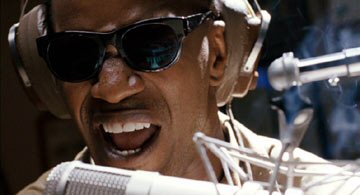
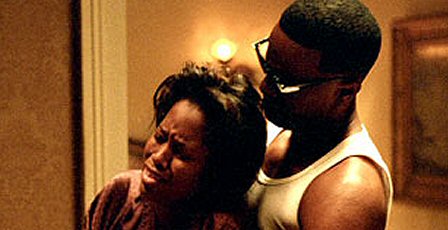
I caught Taylor Hackford’s Ray (Universal, 10.29) on Tuesday night, and the talk is not overblown: Jamie Foxx’s performance as the legendary Ray Charles totally, righteously kills. This is the exact sort of tour de force thing that always seems to hit a bulls-eye with the Academy. I almost said to myself, “This is it…he’s got the Best Actor Oscar.”
Then I reconsidered. This race isn’t over. Not with Paul Giamatti’s doleful sad-sack performance in Sideways kicking ass. The more I think about the moody dance that his lonely, pissed-off junior high-school teacher goes through, looking for love and struggling with a troubled novel, the more affecting it seems, especially given the quality of Alexander Payne’s film.

If you want to be provincial and small-minded about it, and I’m sorry to be passing these thoughts along, but the other apparent contenders have this or that strike against them.
Javier Bardem is moving and dignified in The Sea Inside, but the film is a bit too enamoured with the nothingness of death. Liam Neeson in Kinsey gives a beautifully measured performance, but a view that the real-life Kinsey was a bit of a perv gained a certain legitimacy from a piece that ran in last Sunday’s New York Times. Kevin Bacon’s acting in The Woodsman is top-drawer, but the sexual deviancy element is probably going to give some people pause.
I think these guys have all done superb work, but I (think I) know how Academy types tend to size things up.
The fact is that Foxx’s performance, which carries sensitivity and grace but also impresses because it’s a superb impersonation piece, is the only one that conveys that positive uplift theme (a gifted man is beset and nearly undone by his demons, but eventually overcomes them) that always seems to strike a chord.
I’ll get into the film itself down the road, but it’s clearly a foot-tapping, highly charged thing and pretty much impossible to resist. Hackford has assembled a right-down-the-middle biopic in most respects. It isn’t a Martin Scorsese or a Paul Thomas Anderson film. It more or less just tells a life story, albeit with rhythm and feeling.

Sometimes a ball thrown straight across the plate is okay. Not every pitch has to be a curve or a slider or a knuckleball.
I also agree on some level with David Poland’s view that Ray runs a bit too long. To be fair, I’ve spoken to others about this and I seem to be in the minority. The odd thing is that I’ve thought it over a few times since last night and I can’t really figure what should have been cut. Maybe it needed a thousand tiny cuts. All I know is, I was feeling one of those Harry Cohn ass-twitchings during the last 20 to 30 minutes.
A friend of the film, responding to this concern, wrote the following on Wednesday morning: “I’d encourage you to see it again, despite of (or maybe because of?) its length. I have found that on my second and third viewings, my appreciation for how delicately Hackford feathers the drama and the music really grew. Now that you know the beats and the arc, you can really sit back and enjoy some of the finer filmmaking points.”

Recruiting

I’ve made this point before, but in trying like hell to fill Hollywood Elsewhere with all kinds of new columns and sidebars and whatnot, I’ve overlooked a logistical fact or two.
One, I can’t do everything, even at the pace I’ve been keeping (work days starting at 7 am and lasting until midnight or so, with time-outs for screenings). I can handle two weekly columns, the WIRED items, arranging for weekly DISPATCHES pieces from filmmakers, and editing and composing the regular contributor columns.
And two, I need more skilled contributors living on trust funds to pitch in and fill things out. The longer I do this, the more I realize that the appeal of Hollywood Elsewhere isn’t just about me and my big mouth, but a whole community of spirited film lovers — people who know how to write and need to be heard and ought to be heard.
I need some more people to send in VISITORS articles, interview transcripts that can go into VERBATIM, and writers who want to bang out DVD reviews for DISCLAND. Plus I need someone willing to do some grunt layout work with articles from time to time.

Squared Away

The Castle Keep DVD brouhaha is officially over, soothed and rectified.
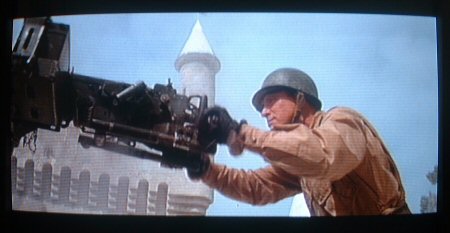
Earlier this week I received a handsome widescreen version of Sydney Pollack’s 1969 anti-war film, and I have no complaints. Everyone can now dismiss from memory the pan-and-scan version released in August by Columbia TriStar Home Video. Unless, of course, CTHV president Ben Feingold approves the issuing of more pan-and-scan versions of widescreen films.

The hurried release of the widescreen version, due on 11.2, happened in response to an angry letter written sometime in mid-August by Steven Spielberg, George Lucas and Martin Scorcese to Sony vice-chairman Jeff Blake. The letter “raised hell” about the Castle Keep pan-and-scan transferring, according to an insider who read it. Blake passed the letter along to Sony honcho Michael Lynton, who in turn conveyed his concerns about negative p.r. to Feingold.
The Spielberg-Lucas-Scorsese letter also complained about a pair of Three Stooges DVDs released last August that offered colorized versions of four Stooges shorts, along with black-and-white versions. No word on what response, if any, CTHV had on the Stooges.

Rahoi’s Rant

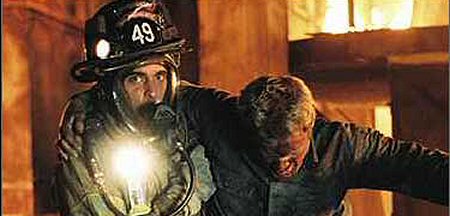
Hollywood Elsewhere art director Jon Rahoi sent me the following last weekend about his experience with Ladder 49, the Disney-produced firefighter movie with John Travolta and Joaquin Pheonix:
“I usually give movies the benefit of the doubt,” he began. “I almost always leave the theater saying something nice or focusing on what I liked. It helps to be picky about what you see, but even so during the show I’m a forgiving viewer. It’s not until much later that any criticism works its way out.
“So imagine my surprise when, during the middle of Ladder 49, I actually thought about walking out. The last time this happened, Alec Baldwin was bombing Japan with Ben Affleck. You know how fun it is to be at a party where everyone else is drunk except you? Others in the theatre were laughing, sighing, and letting go with a sniffle or two. And there I was, the designated driver.

“My Cheese Detector beeped in the first few minutes, but it wasn’t off the charts. There were cardboard characters, jovial male-bonding scenes set to music, the “tell my wife I love her” scene, past footage of a beloved character freezing into a black-and-white photo scene, and even the obligatory get-hold-of-yourselves-after-a-devastating-tragedy scene.
“I know some firefighters, and most of them talk about how little they work. They talk about the pay, the benefits and the pension. That’s why most of them get into it in the first place. These are guys who were middle-of-the-roaders in school. Maybe they were athletes, maybe they got into it when that Business Admin degree was looking like less of a sure thing. They’re not haunted, and they’re not idealistic heroes living to help all. I respect them, but certainly don’t see them as heroic. It’s a job. They’re working just hard enough to avoid the axe, like every other schmuck in the western world.
“Every man in this crap movie is a hero. None of them do anything remotely human, except for the token aging asshole character cheating on his wife, the token father figure sharing how he chose his job over his wife, and the token black guy saying he didn’t want his kids to see him burned because “this is something kids don’t forget.” Who are these guys? If you want realistic firefighters, watch Rescue Me on F/X.
“Joaquin Phoenix lives with another hero-movie staple, the wet-blanket woman. Whether it’s Adrian in the Rocky movies, Aretha Franklin in The Blues Brothers, Diane Keaton in Godfather II or Gretchen Mol in Rounders, the wet-blanket woman is there to throw salt in the hero’s game, upping the personal stakes on his quest for glory.

“Pheonix’s wife (Jacinda Barrett) fights his longing to be a hero and urges him to take a safer job. I’m a father and a husband, and there’s no way I could fight off constant `you’re putting yourself in unnecessary danger’ scorn for ten years. And why would I want to? First of all, it’s not fair to the spouse — marriage is a partnership, not a sidebar to a career. It’s not like Baltimore needs him and only him.
“The wet-blanket woman character is based on a mistaken assumption, which is that a hero needs to listen only to his internal compass, and that his closest friends and family couldn’t possibly have anything important or informed to say about his situation. Because a man has to go his own way.
“What does it say about us that we cheer this attitude? We will our heroes into acting irrationally for the same reasons Earl gave Tiger a putter at 3 years, and why Jon Benet Ramsey wore makeup — we feel like failures. So instead of being happy with life, we force others to succeed for us.
“This movie could not have been made before 9/11. It’s a FDNY suckfest — they’re not fooling anyone by setting it in Baltimore. And just as movies in the late ’70s and ’80s paid hamhanded tribute to the fallen in Vietnam, it looks like we’re in for a rough few years of movies about the war on terror.
“Maybe some people will say I’m unpatriotic or an unfeeling ass. But how heroic is it to take stupid risks to the eternal chafe of your soulmate, and to eventually leave your wife and two kids to fend for themselves?
“‘Yes, Daddy’s a hero. Now look really sad when you hold up the cardboard sign.'”

Alleged Commie

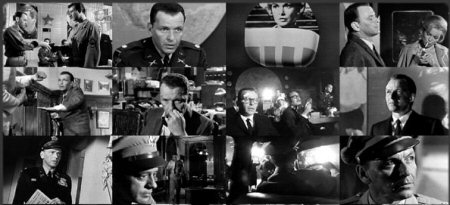
“My wife and I both felt the same way you seem to regarding Janet Leigh’s performance in The Manchurian Candidate until we happened to read an article airing the theory Leigh’s Eugenie Rose is a Communist agent assigned to keep watch over Frank Sinatra’s character.

“That odd conversation she has with him on the train is used as an example of her taking control over him by her use of words (just as a card and words are used to control Laurence Harvey). This explains why he goes immediately to her apartment, as well as some of the reaction shots of Leigh’s face when Sinatra is telling her what is going on. Her expression is particularly chilling during their last encounter near the end of the film.
“Anyway, I cannot say if this idea is right or wrong, but when we watched the film recently with this thought in mind, Leigh’s character worked much better for us.” — Wade Warshal.
Wells to Warshal: Yeah, I’ve heard that one. It doesn’t hold water or add up in the slightest in terms of what John Frankenheimer directed or George Axelrod wrote, but if the boat floats for you, fine.

Chaos Theory

I’m all over the place this morning (researching, ad concerns, re-designing) and running late with Wednesday’s (10.6) column. It probably won’t be up until 3 pm Pacific time. If only there two of me…or three of me, for that matter. One could sleep on the couch and the other on a cot in the dining room.

I’m tapping something out about Ray, which I saw last night. Nothing new here, but the rumble is not overblown: Jamie Foxx’s performance as Ray Charles totally kills, and is the exact sort of tour de force dazzler that always seems to appeal to Academy criteria. I almost said to myself last night, “This is it…he’s got the Best Actor Oscar.”
But then I held back when I thought of Paul Giamatti’s morose sad-sack performance in Sideways. The more I reflect on the particulars of his pissed-off junior high-school teacher struggling with a troubled novel, the more affecting it seems, especially given the quality of the film.

If you want to be provincial and small-minded about it, and I’m sorry to be passing these thoughts along, but the fact is that the other apparent contenders have this or that strike against them.

Javier Bardem is moving and dignified in The Sea Inside, but the film is a bit enamoured with the nothingness of death. Liam Neeson in Kinsey gives a beautifully measured performance, but a view that the real-life Kinsey was a creepy perv gained a certain legitimacy from a piece that ran in last Sunday’s New York Times. Kevin Bacon‘s acting in The Woodsman is top-drawer, but the sexual deviancy element is probably going to give some people pause.

I think these guys have all done superb work, but I know how Academy types tend to size things up and categorize, etc.

The fact is that Foxx’s performance, which carries sensitivity and grace but also impresses because it’s a superb impersonation piece, is the only one that conveys that positive uplift theme (a gifted man is beset and nearly undone by his demons, but eventually overcomes them) that always seems to strike a chord.

Alfie-ville

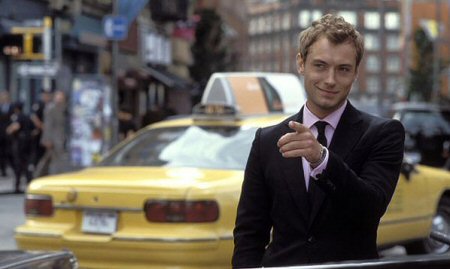
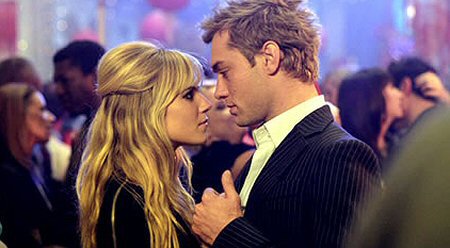
Jude Law’s acting in Alfie (Paramount, 10.22) is the big fulfillment move of his career thus far. It’s the kind of supple and immensely charming performance that presumptive, good-looking movie stars in their prime are supposed to deliver sooner or later. It’s the richest thing Law’s ever done. Between this, Closer and his hilarious work in I Heart Huckabees, he’s really riding high.

I usually hate emotional-bath movies aimed at women and couples, but I liked Alfie a lot, and for substantial reasons.

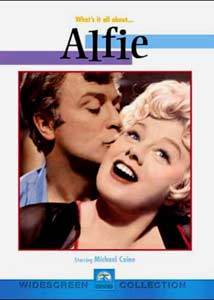
A story about a carefree womanizing louse and his eventual comeuppance, Alfie is a remake of the popular 1966 original, directed by Lewis Gilbert.

The present-day version, directed and co-written by Charles Shyer, isn’t a pretty good remake — it’s better. It retains the things that made the ’66 version grounded and touching, and at the same time is an appealing upgrade.

A 32 year-old Michael Caine made his first big score in playing the lead in the mid’60s version, just as the 31 year-old Law has done here. And he makes a more vivid impression than Caine did.

His Alfie is sexier and more seductive, and at the same time more befuddled and sad-pathetic. He’s a prick, but you can’t help feeling for him. He doesn’t have much of a clue at the finish, but at least is starting to recognize that he needs a bit more humanity.

Law could have gone hammy or too perverse or too cute…but he did it just right. It’s a performance that viewers everywhere are going to get and say, “Yup…really nailed it.”

Law has been Oscar-nominated twice so far — for Best Supporting Actor in The Talented Mr. Ripley and for Best Actor in Cold Mountain — and if it happens again for any one of his six performances this year, it’ll be for Alfie.
Then again the consensus may be that Alfie isn’t dark or heavy enough for Law to qualify. (It is for me, but you never know how these things will shake out.)

The only other possibility is his performance in Mike Nichols’ Closer (Columbia, 12.3), but that’s an ensemble piece — Law’s screen time is said to be roughly the same as costars Julia Roberts, Clive Owen and Nathalie Portman’s — and what he does may not register as a lead.

Plus he’s got seven or eight hard competitors — Javier Bardem in The Sea Inside ), Jamie Foxx in Ray, Don Cheadle in Hotel Rwanda, Jeff Bridges in The Door in the Floor, Kevin Bacon in The Woodsman , Paul Giamatti in Sideways, Liam Neeson in Kinsey and Tom Cruise in Collateral. Who knows?

Alfie is a mainstream confection of an unusally high order. It’s not a Jean Pierre Melville or a Robert Bresson film, obviously. It’s a well-funded glossy thing that’s meant to seduce, at least initially. But it doesn’t stay on that level. Inwardly it’s a movie about values, caring, human frailty. And getting to the heart of things. Smooth romantic films funded by big studios rarely have this kind of depth or flavoring.

I said the following in Wednesday’s WIRED item:
“Coming from the director of the schmaltzy Baby Boom, Father of the Bride and I Love Trouble, Alfie feels like some kind of life-change movie.
“The old Shyer movies (which he co-wrote with former wife Nancy) were massage-y and conventional in their audience pleasing ambitions. Alfie obviously intends to please also, but it does so in a much more measured and subtle fashion and without copping out with a feel-good ending (which Shyer was pressured to deliver by Paramount production executives).
“After the failure of Affair of the Necklace, Shyer knew it was do-or-die time…and he did.”

The only other Alfie reaction I’ve read so far is Drew McWeeny’s (a.k.a. “Moriarty”) in Ain’t It Cool News. He agrees with me, or vice versa.
“It would be hard to pinpoint exactly why Alfie feels so different from [Shyer’s] previous work, but there’s no denying that it does,” he wrote in a piece posted ten days ago. “There’s a pulse here, a new sense of vitality, and the result is a sleek, smart slice of adult entertainment that has some real soul amidst the slick.

“This isn’t a film about Alfie solving all of his problems, and it’s not a film about redeeming him and rounding off his rough edges. Instead, it’s just a journey towards some degree of self-recognition.

“When the big-studio romantic comedy is so often used to sell generic happily-ever-after horseshit to us, it feels brave to see someone make one as relentlessly realistic and even pessimistic as this [film]. Oddly, it’s this cad, this bastard, that may finally make Jude Law a full-fledged movie star here in the U.S. He manages to make you care about this guy even at his lowest moments, and there’s something genuinely affecting about watching him struggle for his soul.”

The smart move would be for Paramount to sneak Alfie a week before opening, or two weeks from today.

I realize it makes me sound slightly square to be enthusing about this thing, and that a more serious film aficionado would save his greater enthusiasms for the latest Bela Tarr movie instead, but I know good, shrewd filmmaking when I see it, and I know that Shyer has bumped his work up to a higher level.

The costars are Marisa Tomei, Sienna Miller, Nia Long, Susan Sarandon (in the Shelley Winters role), Omar Epps. I wish I knew the name of a kindly white-haired actor whose character bonds with Alfie in two nicely-written scenes.

I was a little scared at first when a pink-tint Paramount logo appeared at the beginning and a echo-y fragment of Dionne Warwick’s singing of the “Alfie” tune (or what sounded like this) on the soundtrack. It felt too girly, but my concerns didn’t last long.
Alfie has one of the most emotionally agreeable end-credits sequences ever composed. (Not that this is necessarily a goal pursued by other filmmakers.) Black-and-white photos of significant behind-the-camera contributors are shown: Shyer, co-screenwriter-producer Elaine Pope, editor Padriac McKinley, production designer Sophie Becher, casting director Mindy Marin, executive producer Shawn Daniel, performer Mick Jagger, etc… and it feels really nice.

The final Alfie barometer, of course, will be whether Variety‘s Robert Koehler likes it or not.
Koehler’s general rep is that of a smart guy who never met an obscure foreign film he didn’t like, and who’d rather take cyanide than give a thumbs-up to a Charles Shyer film. I figure if he goes for it, the rest of the world will follow.

What Happened Was…

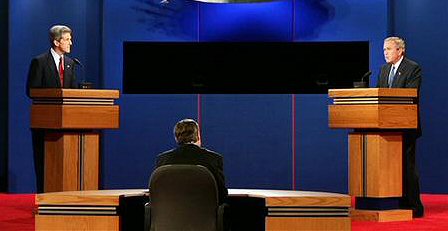
John Kerry won the debate last night because of what his body language said, and Bush lost for the same reason on his own end. Words can be rehearsed, edited, sold. But body language tells all, and everybody knows this.
A body-language expert named Sonya Hamlin said as much this morning on MSNBC, and as soon as she explained why, I knew she was right. I could be the biggest Bush guy in the western world….I could be Karl Rove or Matt Stone or Trey Parker, and her judgements would still be correct.
Kerry carried himself with dignity. He never looked irritated or defensive, as Bush did all through the debate whenever Kerry said something he disagreed with.

Unlike Bush, Kerry stood up tall and straight and didn’t slump over the lecturn. That little encouraging pat on the right arm that Kerry gave Bush as they shook hands at the very beginning, and the way Bush suddenly broke away before the handshake moment was concluded, was very telling.
Hamlin said that Bush was hurt by the simple fact that Kerry is taller. More of Kerry’s upper body was viewable behind the lecturn, and because of this seemed more stature-esque.
Bush’s petulant, pissed-off expressions obviously showed a lack of substance. I get that he’s a guy who wears his emotions on his sleeve, fine, but this also suggested he’s not accustomed to contrary opinions, and probably lives in a bubble in which he hears what he wants to hear from his advisors.
But I have to be honest: I really enjoyed Bush’s anger moments. His expressions were very, very funny. The second time I watched the debate I was laughing out loud.
Not because I was thinking, “Oh, great…this will help Kerry.” It’s because Bush is a very readable regular-guy type, like any good actor. His discomfort was almost endearing. He looked like some malcontent being scolded by a domineering authority figure. His face said, “Is he serious?…am I really listening to this?…c’mon!”
New York Times columnist Allessandra Stanley wrote that “the cameras demonstrated that Mr. Bush cannot hear criticism without frowning, blinking and squirming (he even sighed once).
“They showed that Mr. Kerry can control his anger and stay cool but that he cannot suppress his inner overeager A student, flashing a bleach-white smile and nodding hungrily at each question. ”
The latest results of a non-scientific MSNBC poll this morning said that 61% of viewer respondents felt Kerry had won, vs. 39% calling it for Bush.

Mein Fuhrer!

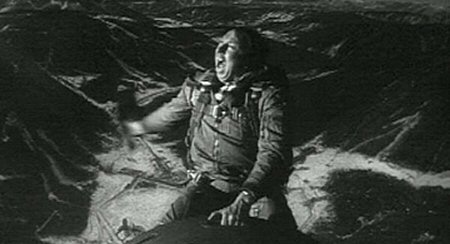
I’ve got the old Criterion special-edition laser disc of Dr. Strangelove, and a special-edition DVD from two or three years ago with all kinds of bells and whistles. Now Columbia Tristar Home Video is releasing a two-disc, 40th anniversary edition coming out in a few weeks (on November 2nd…election day!).
I’ll get into a fuller review down the road, but I should proclaim right now that the image is darker and murkier-looking than the previous CTHV Strangelove. And instead of using the proper alternating aspect ratios of 1.33 to 1 and 1.66 to 1 (the look used in the earlier CTHV DVD), the new DVD goes with a 1.85 to 1 crop, which pointlessly lops off visual information from the tops and bottoms of the frame.

There’s a fascinating snafu contained in a video interview with Robert S. MacNamara, Secretary of Defense under Presidents Kennedy and Johnson in the `60s and star of Errol Morris’ Oscar-winning The Fog of War.

The astonishing mistake is….the camera jiggles. McNamara is being asked about what it was like living under a nuclear Sword of Damocles ever day, and someone bumps into the camera tripod. Thump…jiggle…what happened? This kind of thing never makes the final cut of a taped interview. It was kept in because there wasn’t time to re-do anything because they were on a clock that McNamara had insisted upon.

There’s a new documentary called “No Fighting in the War Room or: Dr. Strangelove and the Nuclear Threat.” It includes talking-head interviews with McNamara, author Bob Woodward, Roger Ebert and Spike Lee, and is fairly interesting. It’s playing as I write this, but I can’t really watch it because the column needs to be up in an hour.

There’s also a doc called “Best Sellers: Peter Sellers Remembered.” I watched about five minutes’ worth and it seems reasonably smart and perceptive.

What I really want from a Dr. Strangelove DVD but will never get is (a) lost footage of the climactic pie-fight sequence in the War Room that was shot but never used by director Stanley Kubrick, and (b) 16mm color behind-the-scenes footage. That’s what I want. I know the pie-fight sequence didn’t work, etc., but I want to see it anyway.

One of the funniest moments in Dr. Strangelove is a slip-up. Go to the famous scene in which the wheelchair-bound Dr. Strangelove (Peter Sellers), a German scientist based on Dr. Werner von Braun, is fighting with his prosthetic arm, which has a sporadic tendency to give “seig heil!” salutes all on its own.

As Sellers tries to overcome the arm by beating on it, Peter Bull, the actor playing the Russian ambassador and who’s standing right behind Sellers, breaks character by smiling. He nearly starts laughing, but he checks himself. This is an absolute no-no, of course. However, Bull’s face was heavily shadowed and Kubrick probably figured all eyes would be on Sellers at that moment. But it’s a fairly glaring error, especially for a film made by a legendary control freak.

Break Your Heart

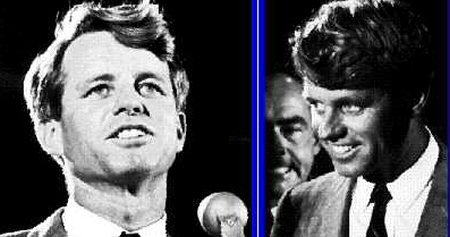
As long as we’re on a political jag, I’m recommending RFK , a two-hour documentary about the life and times of Robert F. Kennedy. It airs on PBS next Monday evening (10.4) at 8 pm.
Directed by David Grubin (who did LBJ, a superb four-hour documentary about the tragedy of Lyndon Johnson, for PBS’s “The American Experience” roughly fourteen years ago) and produced by Grubin and Sara Colt, RFK has the earmarks of a penetrating emotional experience. Translation: a good cry.

Check out the RFK website. It’s got a teaser, bios, a synopsis, a transcript…everything.

This new biography features interviews with historians, journalists and biographers, including Robert Dallek, Anthony Lewis, Jeff Shesol, and Ronald Steel, and the first-hand recollections of those who knew him well: Peter Edelman, Richard Goodwin, Nicholas Katzenbach, John Seigenthaler, Adam Walinsky, Jack Newfield, Roger Wilkins, and Harris Wofford.

I love this line about Kennedy, written by one of his biographers: “He was brave precisely because he was fearful and self-doubting.”

“RFK is a story about change and suffering,” Grubin writes on the site. “Robert Kennedy not only changed his mind about the great issues of his day — civil rights and the war in Vietnam — he changed himself. I wanted to explore his enormous capacity for growth and its relationship to the death of his brother, clearly the defining moment in his life.”

The titles of the hour-long sections are “The Garish Sun” and “The Awful Grace of God.”
The latter title is from a quote by Aeschylus: “He who learns must suffer. And even in our sleep pain that cannot forget falls drop by drop upon the heart, and in our own despair, against our will, comes wisdom by the awful grace of God.”

Right Thinkers

“If you’ve followed South Park without missing an episode, as I have, you would have noticed Republican talking points popping up several hundred times.

“Matt Stone and Trey Parker seem to have a problem with anyone who’s an environmentalist. They rag on global warming every now and then. SUV’s are good. Unregulated Corporations ditto. Dumping waste in Third World countries is great. So is cutting down rain forests and destroying sundry wildlife. But people from Mexico coming across the border are bad.
“And they have this weird Rob Reiner food-eating fetish which manifests itself on several occasions. As far as I can tell Reiner just a harmless ol’ guy who raises money for several worthwhile causes. But he’s a Democrat, so he needs to be skewered. Barbara Streisand isn’t a royalist plutocrat like Newt Gingrich, so she gets the short end of the schtick. The Baldwins get killed in the South Park movie, and on and on.
“It’s interesting that no one from the Hollywood Republican section ever lands on their shit list. No Arnold, no Bruce Willis, no Kevin Costner, no Shannen Doherty, no Chuck Norris, no Freddie Prinze Jr., no Jessica Simpson. Oh, they did do a really good hatchet job on Mel Gibson turning him into some sort of fanatical sado masochist wacko. Which in their minds probably balances out the rest of their right-wing gibberish.
“But Cartman’s a really funny fat boy. There’s also Jimmy, Butters, Mr. Mackey’s mmkay, Mr. Garrison and Mr. Hat and Mr. Slave, Officer Barbrady and Marlon Brando and his sidekick from The Island of Dr. Moreau. So you’ve gotta give them at least that.” — Vinod Narayanan
“As a longtime fan of South Park, I have to agree with you about their right-leaning ways. The celebrities they’ve attacked on the show have been people like Strisand, Rob Reiner, and Ben Affleck, all pretty famous liberals. My problem with their attacking both sides is they don’t have to choose sides. If you’re making fun of everything, you don’t have to take a stand on anything. — Alan Dingham.
“Parker and Stone are barely closeted righties–and more closeted by people’s perceptions (anti-censorship satirists must be lefties!) than any real hiding on their part.
“I believe they’ve identified themselves as Republicans in past interviews (more in passing, I think, as it was during the Clinton years). You can see some of that coming through on South Park –a funny show, but one I’ve sometimes had trouble stomaching because of those conservative undercurrents. Not because all satire needs to be from a liberal point of view for me to enjoy it, but because sometimes Parker and Stone can unbearably smug.
“I’ll certainly see Team America, but I’ve felt wariness for awhile now, based on what looks to be a torrent of /celebrities should just shut up!’ jokes. Which–as you seem to realize — are not inherently funny, and far from clever.” — Jesse Hassenger.

Eddie and the Thugs

“I second the motion for a The Friends of Eddie Coyle DVD. I finally managed to tape a censored version of the movie on AMC a couple of months back and quickly became obsessed with it. I ended up watching it it three or four times to catch all of the nuances, and then read George Higgins’ classic novel.

“This is the most realistic look at low-level criminals ever made, and maybe the purest example of how different the studios were in the ’70s. Is there even one remotely attractive or heroic character in that film? Everybody, from the cops to the criminals, is run-down, depressed or a mercenary desperate just to grapple to the next low rung in the ladder.

“And I love how the film just ends, with no catharsis or hope, just the implied question (as written in the book): `Is there any end to this shit?’
Eddie Coyle is the rarest kind of film that makes absolutely no contrived concessions to entertain the audience, yet there’s some intangible quality to it that makes the movie lodge into your memory.
“A lot of that probably has to do with atmosphere. I worked in the South Shore of Massachusetts (the movie’s milieu) one winter and Victor Kemper’s cinematography really captures the bleak, lonely ambience of the cold months there. Let’s hope the eventual DVD producers don’t skimp on the transfer.
“And for perhaps the only time in movie history, the Boston accents in the film aren’t the kind to make New England viewers wince.
“I initially started thinking that a re-make is in order (I’m sure Tarantino would really sink his hooks into the story’s low-life characters), but screw it — the original is damn-near perfect. ” — Chris Pizzello

Update

The column is supposed to be completed and up on Wednesdays and Friday mornings, and today (10.1) it’s not. Again. My work load has tripled since Hollywood Elsewhere launched in August, and I haven’t figured how to work faster or better. I’ve been trying to wash and dry some clothes this week, and it’s taken me three or four days so far — they’re still down in the laundry room. The column will be up around noon.

Right On

The satirical audacity of Matt Stone and Trey Parker, man…wow. Love their humor, irreverence, anti-Hollywood sentiments and general smart-assed coolness, etc. And I love those strings.
Those fishing-line marionette wires, I mean, in their new film Team America: World Police. Holding up the cast and doing the heavy emoting all through it, and nobody (least of all cinematographer Bill Pope) making the slightest effort to obscure the basic mechanics.
With any imaginable dreamscape fully creatable and ripe for CG-manifestation these days, there’s something at least moderately cool about a movie starring actor dolls held up by invisible hovering humans. It’s such a Being John Malkovich thing, and with such authority.

Last Monday afternoon (9.27) I saw a 20-minute reel from Team America: World Police (Paramount, 10.15)…the same thing that journos were shown during the Toronto Film Festival.
It looks…well, pretty good. Pope (Spider-Man 2, all three Matrix movies) has given this political-satirical puppet show a handsome, carefully rendered lighting scheme and shot it in widescreen (2.35 to 1).
< ?php include ('/home/hollyw9/public_html/wired'); ?>
Of course, Matt-and-Trey movies are essentially internal affairs. They’re selling wit, attitude and politically incorrect goadings. The feature version of Team America, which I presume will start to be screened within a week or so, seems to have this in spades…although some of the more outrageous bits (as I’ve heard them described, at least) weren’t on the tape.
The plot involves a low-grade Jerry Bruckheimer-by-way-of-Barbara Broccoli team of square-jawed jerkwads called Team America trying to stop North Korean leader Kim Jong Il from selling weapons of mass destruction to Muslim fundamentalist terrorists.
There’s an affair of some intensity happening between a blonde commando-intelligence female and a dopily earnest action hero named Gary, a stage actor who’s brought into the team so he can infiltrate an Islamic terrorist cell so…you know, I don’t think anybody wants to read about a parody plot.

We’ve all digested the proposition that team America isn’t a leftie satire but some kind of neutral equal-opportunity offender. It nonetheless seems to have a penchant for leftie-celebrity bashing. It rags on Michael Moore, Sean Penn, Alec Baldwin, Sean Penn, etc., and alludes to their character by making them members of FAG — i.e., the Film Actors Guild.
“We diss on people like actors, who get on a soapbox and say, ‘Let me tell you how it works in Iraq,’ cause they don’t know fucking shit,” Stone told the New York Post‘s Megan Lehmann.
Of course they don’t. Sean Penn went to Iraq and he doesn’t know a thing. The lefties who’ve spoken out against the war are complete ignoramuses. Any liberal-leaning actor who reads up on current affairs and tries to make a political speech should be pulled off the podium and slapped around. They’re all a bunch of elitist, out-of-touch, Mercedes-driving weenies.
But then Matt and Trey are proclaimed Republicans, so what do you expect?
Here’s Parker with another observation from the Dennis Miller handbook: Team America “is about the main characters going through a journey of what it’s like to be an American, to be the only country that has to deal with stuff, but then gets bitched at for dealing with it.”

Yeah…guldurn it! Standing up like men and dealing with the threat of domestic terrorism by invading Iraq, the absolute mother of all terrorist-embracing Islamic ….well, not really.
“The whole idea of positioning our movie as this important cultural event that people are going to be mad about is just a joke — it’s a puppet movie,” Stone told Lehmann.
“Before there even was any political environment, we wanted to make a big Bruckheimer action movie with puppets,” Parker added. “The original idea was to make a big disaster film like Armageddon with puppets. Super funny, right?”

Missing Friends

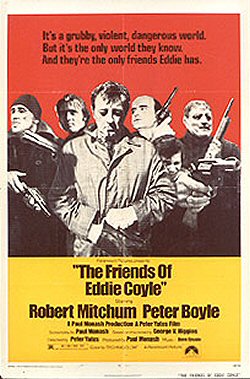
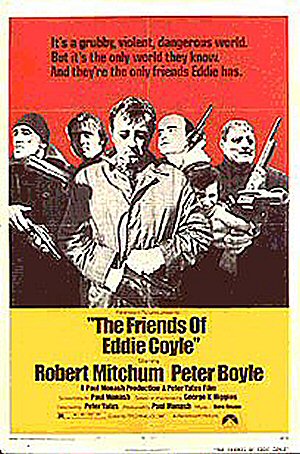
Oh, how I long for The Friends of Eddie Coyle. Oh, how I long for that long-gone, far-away realm in which bleak noir-type movies with fall-winter color schemes and hard-boiled criminal characters played by name actors used to turn up every so often.
Maybe I can help a little bit. It seems like every time I bitch about this or that great `70s movie not being on DVD, somebody at some DVD distribution company pulls the trigger two or three weeks later. So let’s see…

We all know the basics — directed by Peter Yates, based on the George V. Higgins novel, and starring Robert Mitchum, Peter Boyle, Richard Jordan, Steven Keats, James Tolkan, et. al.
Eddie Coyle is one of the great all-time Boston movies. Every actor in this thing reeks of blue-collar or criminal-class attitude, and they all have that pale doughy-faced Irishman look that comes from too much cold weather and cruddy food and too many boilermakers. The bleak downbeat mood of this film combines with the grayish colors and general down-at-the-heels atmosphere to produce a kind of gloomy beauty that stays with you.
Mitchum’s performance as Coyle, an aging small-time criminal looking for a scheme to trade his way out of a long prison term, is one of his best ever. It’s part of the pantheon along with Out of the Past, Macao, The Locket and Night of the Hunter.

Texas Pride

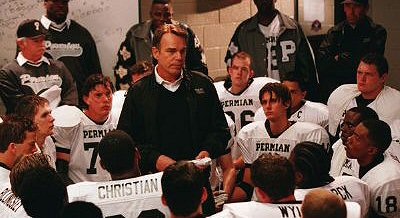
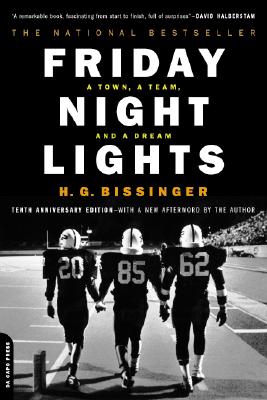
There are elements of light and darkness in Friday Night Lights (Universal, 10.8), the new football movie from director Peter Berg. But it’s the light that stays with you. The light of desire, glory and struggle combined with a plain but stirring look at the residents of an ordinary Texas middle-class town.
It’s got more of a moody, funky quality than the last great football movie, Oliver Stone’s Any Given Sunday, and it’s got a muddier look (grainy and worn and a bit brownish), but, like Stone’s film, this is a movie with a rock-solid value system that you can’t help but agree with and admire.
The theme of Any Given Sunday, as summed up a climactic locker-room speech by coach Tony D’Amato(Al Pacino), is “life is inches.” Every inch of yardage has to be fought for with your life, and it all adds up. It’s not easy, it can be a real bitch…but that’s what it takes to win.

The theme of Friday Night Lights, as summed up by coach Gary Gaines (Billy Bob Thornton) on the night of the Big Final Game, is “be perfect.” Football isn’t about the score board, but about being able to look in the mirror and into the faces of your friends and loved ones and say, “I gave everything I had…I held back nothing.”
This is a beautiful life philosophy, but tell that to the woman who was walking in front of me as everyone was leaving a screening at the Mann Chinese a week or two ago.
The ending of Fright Night Lights is in keeping with Billy Bob’s philosophy, but it doesn’t exactly conclude in a typical blaze-of-glory explosion. I guess the woman in front of me wanted that good old “we’re number one!” feeling at the finish, because she said very loudly to her date, “It sucks!”
Well, she sucks. She wanted what she wanted, but she didn’t get what the movie had to say….or refused to let it in. I hate people like this. “We have to win all the time….winners!…gold medal! …king of the hill!” Obnoxious creeps.
Be concentrated and resourceful and push yourself as hard as you can, and if you win the prize, great….but if you don’t, don’t quit, keep coming and have a cup of green tea every so often.

In other words, Berg and his co-screenwriter, David Aaron Cohen, aren’t peddling the same-old same-old. And yet they explore the eternal fundamentals that the playing of good football always tends to teach.
Based on H.G. Bissinger’s 1990 best-seller, Lights tells the true story of a triumphant 1988 season played by the Odessa Permian Panthers, a high-school team based in (you’ve already heard this, right?) Odessa, Texas.
The slightly grungy digital widescreen photography is by Tobias Schliessler. The oerfect-or-close-to-it editing is by David Rosenbloom and Colby Parker Jr.
Thornton is first-rate (when is ever not?), but he looks a bit fuller of body and face than usual, and I’m wondering if he went on a cheeseburger and fries diet so as to look more rural or something.
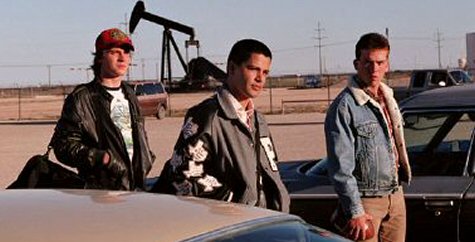
The football player performances — Lucas Black (the kid in Sling Blade), Derek Luke, Jay Hernandez, Garret Hedlund have the leads — feel non-actor-ish, which is one of the highest compliments there is, in my book.

Set of Steak Knives

“I need you to clear something up for me (and a lot of others out there I’m guessing.) How is the new Mike Nichols film Closer pronounced? Is it ‘closer’ as in getting more intimate or is it ‘clozer’ in the Glengarry Glen Ross that-guy-is-a-closer kind of way? I always assumed it was the intimate way but then I saw Natalie Portman on The Daily Show and she said it the second way.
“You’re the man with titles, and I’ve learned this the hard way (I lost a DVD to you over the whole I Heart Huckabees thing. Help us all out so we don’t sound stupid.” — Matthew Morettini

Wells to Morrettini: Nathalie Portman wasn’t supposed to let the cat out of the bag this early, but the real plot of Closer — it’s set in the take-no-prisoners world of London real estate, and was once referred to in Screen International as “son of Glengarry” — should tell you how to pronounce it. “Always be closing,” as the saying goes. No, seriously… it’s the emotional pronounciation. You probably mis-heard Portman.

Creepy?

“I saw Kevin Spacey’s Bobby Darin biopic Beyond the Sea the other night. It wasn’t a final cut — it was shown at one of those test screenings — but looks pretty much done and it was…ecch.
“It didn’t know what it wanted to be — edgy biopic, sitcom, drama, musical…? Spacey tried to make it play avant-garde, but it covered the same old territory of other entertainer biopics, including a mundane sequence where the hippie-ish Bobby Darin goes to find himself, blah blah.
“It took some risks, but Spacey’s just too old to play Darin. I think Darin was 37 when he died and Spacey is… what, 45 or so? It was a little creepy when Spacey went in to kiss Kate Bosworth, who’s barely drinking age. I liked the musical numbers, but that’s my inner gay guy talking and he’s rather biased.” — Dezhda Mountz

Sideways and Youth

I think Laurence Price’s claim that no under-25s are going to enjoy Alexander Payne’s Sideways is a rash generalization, but I also acknowledge the truth of it.
“I’m 23, and when I rattle off names like Paul Giamatti or Thomas Haden Church to my friends they respond with blank stares. I may not have seen everything these actors have been in, but I know some of their films, and these lead to more blank looks. (Well, maybe for the exception of the god-awful Planet of the Apes remake with Giamatti or George of the Jungle with Church.)
“You can blame MTV for the trend if you want, but I would point to a more insidious influence over what my generation was raised to like: our parents. Thankfully mine raised me on To Kill a Mockingbird, Ben-Hur and the like. Sure there were some duds that I saw as a kid that I liked then but can’t stomach now, but overall I was blessed to learn what good cinema was, even if I didn’t fully appreciate it.
“And yet some of my friends can’t watch dramas without falling asleep and have only patience for Ben Stiller for the zillionth time in a year. (I like a few of his movies, but I wish he’d go away now). Their parents let the TV stay on throughout the day, never questioning if this practice was a good one (or did they and not admit it?).
“Also I blame the lack of book-reading among my peers. They were not encouraged to do so when they were younger, and few do with any regularity. I read more books than I watched TV as a kid. I’ll make damned sure my kids are raised the same way too.
“When I took a girl on a first date to Election back when I was 17, it was just a suggestion based on buzz I’d read on Ain’t It Cool, but I was thoroughly entertained. (Although my date wasn’t especially enthused.) I watched About Schmidt and enjoyed it, and I’m pretty sure I’m the only one in my age group that I know that would admit that.
“I was interested in Sideways from the time I heard Alexander Payne was involved, so put me down as one under-25 who will see it. Plus I’ll be dragging at least one other under-25 to it with me. And I’m betting I at least will enjoy it based on the talent. What more can I say?” — Daniel Revill


George W. Bush image composed of head shots of most of the U.S. soldiers and civilians who’ve died thus far in the Iraqi War

Masked Man

I forgot a likely development when I made some forecasts about ’04 Best Picture Oscar nominations a couple of days ago. I guess I didn’t want to consider it.
Almost every year there has to be one semi-awful, vaguely embarrassing Best Picture nominee. You know…a flick that people like me tend to despise or worse but the Academy tends to (a) emotionally support despite overwhelming taste considerations to the contrary and (b) is more than willing to risk tarnishing the Academy’s reputation in history books by actually giving it the Best Picture Oscar.
I’m talking about nominees like Chicago, Ghost, Babe, Lord of the Rings: Return of the King, Chocolat, Four Weddings and a Funeral, The Mission or The Color Purple.
(Let’s acknowledge upfront that my including Return of the King on this list will provoke a torrent of letters calling me a rash and injudicious Peter Jackson hater. Okay? Now you don’t have to write them.)

If there’s a contender of this sort this year, it’ll most likely be Joel Schumacher’s The Phantom of the Opera.
It may turn out to be wonderful, devastating, heart-palpitating, etc. But with Schumacher at the helm the odds favor the likelihood of something overwrought and oppressive.
I know it’s imprudent to stick my neck out like this, but I feel I’ve come to know Joel, and I’m convinced that his directorial hand is generally something to be wary of.
I became a surprised Joel fan after Falling Down and The Client , but then he did A Time to Kill (an all-time Otto Preminger film from hell) and his two nipple ring-and-codpiece Batman movies (both awful) and I was off the boat.
Okay, Tigerland was a decent bounce-back effort and Phone Booth was a solid urban thriller with a good Colin Farrell performance, but Flawless was a wash and Veronica Guerin missed it big-time.
Phantom‘s chances may be upped by acting and tech credit noms. I was told last night that Emmy Rossum, who plays the lead Phantom role of Christine, will emerge with an enhanced rep…assuming she scores. She was last in Dan Ireland and Jim Jermanok’s Passionada, which I’d now like to finally sit down and watch just to see how she is.

Once Again

So figure the five finalists will probably be selected from the following nine movies:
(1) Sideways, (2) The Aviator (although I’m starting to feel a little bit twitchy about this one), (3) possibly Alexander, (4) quite possibly Spanglish, (5) The Motorcycle Diaries (an increasingly big maybe, like I said two days ago), (6) probably Hotel Rwanda as a liberal guilt-trip nominee, (7) probably Closer if the alleged “plays a little cold” factor doesn’t overwhelm the content, (8) The Phantom of the Opera, and (9) if Bush loses (and we all know the odds at this stage), Fahrenheit 9/11.

I think it’ll be criminal if Sideways and The Motorcycle Diaries are left out, but that’s me.
If it was me alone choosing from the films released so far I’d make it these two plus Collateral and Touching the Void.
And oh, yeah…I haven’t even considered John Madden’s Proof (Miramax, 12.25), but the Broadway play was awfully good and playwright David Aubrey wrote the screenplay, so who knows?
There’s a concern in that Proof has the slight Gwynneth Paltrow curse factor to contend with. (Everything she’s done since The Talented Mr. Ripley five years ago has been mediocre, with the significant exception of The Royal Tenenbaums). On the other hand, one should never dismiss an end-of-the-year film starring the great Anthony Hopkins.

Blanket

I Heart Huckabees (Fox Searchlight, 10.1) shot right through my skull on Wednesday night and came out like some cosmic effusion and just sort of hung there above my head like a low-altitude cloud, sprinkling gentle misty rain.
No, that sounds too tranquil. A movie this funny and frantic and this totally off-the-planet (and yet strangely inside the whole universal anxiety syndrome that we all live with day to day) can’t be that cosmically soothing. That’s not the idea.
But it is soothing… that’s the weird thing. Huckabees makes you laugh fairly uproariously, but it leaves you in a spiritual place that feels settled and well-nourished. Variety‘s David Rooney said it was “largely an intellectual pleasure with a hollow core.” Rooney has probably never been wronger in his life. Not because he isn’t smart or perceptive, but because he failed to do a very important thing.
He didn’t see Huckabees twice.

This is one of those rare movies in which you have to double-dip it. You obviously don’t have to take my advice. Go ahead and just see it once and then say to yourself, “Well, that happened!” Just understand that Huckabees is, I feel, too dense and arch with too much going on to fully get it in one sitting.
On one level it’s a kind of psychobabble satire; on another it’s the most profoundly spiritual Hollywood film since Groundhog Day. And the amazing-ness of it may not come together in your head…if at all.
That’s how the first viewing happened with me, at least. I was initially into it on a “whoa…what was that?” level and for the antsy, pedal-to-the-metal pacing …but it goes beyond that. The first time is the eye-opener, the water-in-the-face, the violent lapel-grabbing; the second time is da bomb.
There’s something else that Rooney probably couldn’t help when he wrote his review. I’m guessing he’s not really a “blanket” kind of guy. Blanket acceptance is what this film is about (and is what passing through the doors of illumination usually entails…you can’t reason your way into a Godhead realization).
Huckabees is about the blanket, and you either get this and it makes you laugh and turns you on at the same time…or it doesn’t and you don’t.

Imagine sitting in a theatre and laughing in a half-chuckling, half-hysterical way. And mulling over some basic tenets of eastern mysticism at the same time. And also feeling amazed and throttled by the most relentlessly verbal machine-gun Hollywood comedy since His Girl Friday. And also doing that outboard-motor thing against your lower lip with your right index and middle fingers and going, “Bee, bee, bee, bee, bee…”
(Recognize that graph? I just plagiarized my own WIRED item.)
Huckabees is about movie stars and laughs and hyper-energy, but boiled down to basics it’s essentially about a philosophical feud between two schools of thought — one that says life is perfect, harmonious and essentially divine, and one that says that life is merely a series of random and disconnected occurrences that are more often than not painful, and sometimes much worse.
The more positive alpha view is articulated and passed along by an existential detective agency run by Bernard and Vivian Jaffe (Dustin Hoffma, Lily Tomlin). The darker, more nihilist approach is espoused by Isabelle Huppert’s Caterine Vauban, a former colleague of the Jaffes who’s crossed over to the dark side like Annakin Skywalker.
The guy in the middle of these two factions is an environmental activist named Albert Markovski (Jason Schwartzman). First he goes to the Jaffe’s for help in sorting out his life, then he takes up with Huppert (an alliance that carries a side benefit of great mud sex), and then….I’m not spilling the ending.

The Jaffes quickly discover that Albert’s troubles are mainly stemming from a rivalry with a shithead executive named Brad Stand (Jude Law) who works for a retail chain store called Huckabees. Albert is pissed at Brad for challenging his authority as the head of an envuronmental actiivst outfit called the Open Spaces Coalition group. Albert is fervently anti-development when it concerns marshlands and whatnot while dickhead Brad is pro-development and pro-greed.
Then, weirdly, Brad hires the Jaffes to look into his own life. This in turn leads to his girlfriend Dawn (Naomi Watts), Huckabees’ sexy spokesperson/model, to hire the Jaffes to look into her life, which leads to her refusing to play the sexpot and to exploring her inner infinite self, an exercise that involves shunning makeup and wearing an Amish bonnet.
Albert eventually becomes disillusioned with the Jaffes and hooks up with a philosophically-driven firefighter named Tommy (Mark Wahlberg), another client of the Jaffes who’s drifted over to Vauban’s way of thinking. For a while they’re a kind of threesome, but then Tommy gets cut out of the equation. He rebounds when he couples with Dawn during a rescue mission at her home. For him (and unlike Law), her bonnet is totally cool.
Does I heart Huckabees get you emotionally? No…and yet, the more you let it in and the longer you think about it, yeah.
Wahlberg gives my favorite Huckabees performance (he’s really good as conveying that frenzied-spiritual-seeker quality), but the entire cast is fairly killer. They all do amazing stuff, and there are all kinds of fine actors (the great Richard Jenkins, for one) giving great supporting perfs.
Schwartzman has finally tied into a role as good as “Max” in Rushmore, and hail to that. Jason’s a very spirited and likable fellow. I’ve been running into him at parties and restaurants and whatnot going back to the Rushmore days.

Law is seven or eight times more intriguing here than he was in Cold Mountain . I love his unsuppressable vomiting in the Huckabees boardroom scene. There’s another bit in which he sticks his tongue out while looking in a bathroom mirror that’s oddly classic. I’m predicting right now it’ll be used for a Jude Law tribute reel when he’s in his late 60s or early 70s and being honored by the AFI or the American Cinematheque.
Tomlin’s performance is the best she’s given in years on-screen. Hoffman is mostly hilarious. Watts is tonally on-target in every scene she’s in. Huckabees allows everyone to stretch and wig out in such unusual ways it’s almost like a theatre high. It’s an unleash-your-inner-nutbag thing for everyone involved.
I might as well borrow from another WIRED graph for a wind-up…
Russell told the New York Times that I Heart Huckabees is “all an existential meditation.” You will go into this movie as one person, and come out a little less regimented, a little more free. In the final analysis any film that makes you want to find spiritual clarity or satori is, I think, a good thing. Or don’t you agree?

Buzzing

I went to the I Heart Huckabees premiere and after-party at the Grove the night before last (9.22). It happened inside a two-story retail space normally inhabited at the Grove by…I forget.
Like all parties, it got better the more everyone had to drink. There weren’t too many people, which was nice. All kinds of great food was served, most of it prepared in thematic harmony with the film.
I worked my way past the goons in the roped-off area and had friendly chats with David O. Russell, Lily Tomlin, Isabelle Huppert and Naomi Watts.


(l. to r.) Huckabees theme song composer Jon Brion, writer-director David O. Russell, unidentified brunette posing for photographers at end of Wednesday night’s Huckabees shindig

I especially enjoyed meeting songwriter-singer Jon Brion, who performed the Huckabees theme song “Knock Yourself Out” in front of the crowd before the screening began. I love this song. Hearing it made me want to badger the Searchlight publicists for a free Huckabees soundtrack. I’ve been told I should buy Brion’s CD “Meaningless.” If you’re in L.A. he performs at Largo on Friday nights.

Aspect Ratios

I asked two or three publicists at a recent press junket whether the film being promoted had been shot in Scope or widescreen (2.35 to 1) or standard Academy ratio (1.85 to 1), and nobody could answer. Two of them said words to the effect of “I’m not up on the technical side of things.” The aspect ratio of a film is pretty basic stuff. Why did I need to ask? Good question. I guess the movie was so absorbing for its inward elements that I simply didn’t notice.

Two New Columns

There’s a new front-page column starting today called “What Lies Beneath,” written by Dezhda Mountz. The focus is more or less the social-political issues that are highlighted by this or that film. It’s located just below the VERBATIM column on the lower right. Dezhda’s a good spirited writer, so please give her a read. There’s no e-mail link for her presently, but I guess we’ll fix that soon enough.

There’s also a new Hollywood Elsewhere DVD column debuting on the front page, on the left just under the navigation bar. It’s called DISCLAND: DVDs Are Crack. It’ll be up and running no later than Friday, October 1.
DISCLAND will be co-authored by myself and Hollywood Elsewhere columnist Kim Morgan on a weekly…I was going to say a weekly basis but we’ll probably bang it out as often as the passion strikes.
The deadlines and writing load will probably get overwhelming from time to time, so if anyone wants to submit a review of any upcoming or just-out disc, or if they have a think piece or investigative inquiry of any kind, send it on.

Dowd


New York Times columnist Maureen Dowd during a discussion of her book, Bushworld, at L.A.’s Skirball Center on Thursday, 9.23. I arrived late and there were no seats, so I sat on the floor right in front of the stage. Dowd’s book is a brilliant Dubya dissection and well worth reading, and she’s a fascinating off-the-cuff speaker. However, she was a bit on the guarded, circumspect side when it came to probing questions from the audience. Dowd was interviewed for roughly 100 minutes by fellow Times columnist Alessandra Stanley

Sideways and Under 25s

“I have to disagree that adolescents will line up with anticipation for Sideways even if the buzz is outstanding. There is no chance teenagers and young adults will be able to relate to a wine tasting journey taken by two middle-aged men who are are coping with personal issues, etc.
“It doesn’t matter how much of a genius Paul Giamatti is — they still will not be persuaded. The majority of adolescents are not looking for a sophisticated, thoughtful, critically acclaimed film. They’re into cheap, easy-to-swallow crap.
“Hopefully the movie will be lucky and make as much as About Schmidt at the box office but that will only happen if Sideways gets substantial Oscar heat and word-of -mouth. Sideways should not rely or count on loyalty or support from the majority of the under 25 crowd.
“Since Payne’s Election was set in a high school and had teenage characters (okay, 25 year-olds pretending to be that age) in lead and supporting roles, and was conspicuously produced by MTV Films, it should have almost been a decentp-sized success at the box office. The movie regretfully turned out to be a flop. I went to see it in an almost completely empty theater on opening weekend.
“The sad reality is that if adolescents want to witness `guy rage’ on screen they’re going to go and seek out the latest Adam Sandler movie.
“For the record I can’t wait to see Sideways since I trust Alexander Payne to be immensely talented and skilled at his craft. I regard him as a truly exceptional director who consistently produces quality. From what I have read about Sideways I am sure it will be an incredible and [thing] and well worth waiting for. I’ve never been let down by Payne and I hope he this will continue.” — Laurence Price , Toronto, Canada.

Howling Man

“I have a friend who is a struggling film maker who certainly agrees with you that George Lucas is the devil incarnate, but I have a tough time agreeing with that. He’s just doing what he wants to do. I’m not saying that his recent stuff has been good, but its his dollar so he can make whatever he wants.
“The real blame has to fall on the viewing public. They’re the ones who pony up the cash to watch mind-numbing garbage like Van Helsing or The Day After Tomorrow. The fact that both Aliens vs. Predator and Resident Evil 2 opened up at number one says all that needs to be said.
“One other big point on George Lucas, I absolutely love both Empire and Raiders, and the fact that he produced those two films atones for all the other junk that he’s kicked out.
“By the way I was pretty impressed by your political analysis last week. You made me realize that Republicans and Democrats can agree on one thing — our candidates both suck! It also showed me how desperately we need a true third party in our election system.” — Jeff Horst

“Don’t think the irony of the Star Wars plot is lost on George Lucas either. He conveys this in a documentary called “Empire of Dreams” that’s included in the Star Wars Trilogy DVD set. (A one-hour version of the doc was aired on A&E before the DVDs came out, which has a two-hour cut). It has footage of Lucas ruminating on becoming the corporate empire he was trying to destroy, and a lot more.
“I guess you had to get a new George Lucas rant in on the new site (nice job, btw), but just let go of your hate. Or when Episode III: Revenge of the Sith comes out in May ’05, just run the same stuff you have up to now with a disclaimer at the top that this is a reprinting. It will save a lot of time for everyone. ” — Dave Murdock
“There is a tendency to look upon great artists the same way one looks upon one’s parents, which is that they have to be perfect. Any slight shortcoming is magnified as a horrendous flaw, and any mistep in motivation seems utterly evil.
“You can’t call George Lucas evil, though. He hasn’t done that kind of bad thing.
“Lucas’ only real mistake of late is to not bring in outside screenwriters to subdue the flaws in his more recent screenplays, thus disappointing millions of fans who expect to relive that moment of spellbinding trasfixtion with which the greeted the first Star Wars movie with every new one. But that’s not evil.
“Microsoft is evil. Their monopoly is so pervasive that word processing programs are no longer being improved through competition.
“Lucas, however, is working to expand the technology of filmmaking and share that expansion with his fellow artists. He has never tried to suppress a technological innovation, or prevented its development. You could make a case that by initiating Pixar he is responsible for the eventual death of traditional animation, at least on a feature scale, but that would be stretching things given the progress of technology outside of his control.
“It was the development of television, not Lucas, that brought forth the death of gradual roll-outs. While it took Hollywood a little bit to pick up on the trick, it has long been a staple of entertainment flim-flam that you try to fool as great a potential audience as possible before word gets out, and with network commercial buys and saturation bookings, any decent movie that receives that kind of treatment is going to get the blame for the turkeys that follow.

“‘Idiotic high concept movie formulas’ have been around since the 1910s. Any time there is a hit film, greedy movie companies try to get out their cookie cutters and profit from the scraps. They have also been dumbing movies down for just as long.
“How has Lucas possibly `maligned the idea that the making of quality movies had value in the Hollywood marketplace’? Not counting Howard the Duck and Radioland Murders, even his failures have been quality productions, and he has lent his support and reputation to numerous artists from Akira Kurosawa to B.W.L. Norton. He’s led the development of improved quality in sound systems and mixes in motion picture theaters and in home theaters, and he has hastened the development of the integration of animation and live action, opening a vast array of subject material to be tackled by the motion picture industry that has been beyond their grasp in the past, such as the outstanding Lord of the Rings trilogy.
“Nope, George Lucas’ supremely evil act was to make Star Wars in the first place, because it is such a good, wholesome, exhilirating and satisfying film that it made almost all other movies, including many of his own, seem inadequate; just as the supremely evil act parents make is to conceive the individual who then blames them for the disappointements brought on by life.” — Doug Pratt, editor, DVD Newsletter.
Wells to Pratt: “Outstanding” Lord of the Rings trilogy? You don’t have to say this stuff any more, Doug. Jackson has his Oscars and all you Rings lovers can come clean now and admit to the world what agony these films have always been to sit through. C’mon, man…you’ll feel better. Spill it.

Shaun Bites

If only the second two-thirds of Shaun of the Dead (opening 9.24) were as good as the first third…
The geeks calling this thing a way cool horror-comedy are deluding themselves. The threat element is shit and the story tension goes south around the 35-minute mark. You can’t just say “it’s a spoof” and leave it at that because spoofs have rules. They’ve got to show the same levels of propulsion and credibility that the films they’re spoofing have, or the game falls apart.
I got into this briefly in a WIRED item, but the Shaun script (by director Edgar Wright and costar Simon Pegg) is about two London slacker-somethings in their late 20s having to contend with a sudden invasion of flesh-eating ghouls in their local neighborhood (and which is manifesting all over England, a la 28 Days Later.)
Shaun (Pegg) has fed-up-girlfriend issues and is resisting the growing-up process, and to call his fat layabout friend Ed (Nick Frost) emotionally retarded would be a form of understatement.

The funniest scene happens just as the ghoul plague has begun. Simon walks through the neighborhood on his usual run to the grocery store and doesn’t even notice what’s going on. Then he goes home, turns on the tube and surfs right past the horrific reports on the news channels.
The problem is that the zombies aren’t threatening enough. They walk and react way too slowly, so agile humans aren’t in any kind of serious peril and so the story tension suffers. The Shaun zombies are like the mummy in Abbott and Costello Meet the Mummy (’55). They rarely do anything that even a seven year-old would consider half-threatening.
The Shaun zombies catch and eat people on occasion, but they’re much slower and less ferocious than George Romero’s zombies in Night of the Living Dead or Dawn of the Dead.
And all you have to do is give them a hard blow to the head and they’re dead. What happened to having to penetrate the skull? The Shaun survivors use a repeat-action Winchester rifle to defend themselves at one point, but it seems silly to have only 32 shells at their disposal with 100 or more ghouls trying to get at them.

Shakedown

I’ve already mentioned how rich, flavorful and well-ordered Sideways is. It’s Alexander Payne’s best film since Election ; his most emotionally ripe and mature. It’s a candidate for Best Picture, Best Director…blah blah, I’ve said all this.
I’m getting the idea that Sideways‘ s Oscar chances are pretty fair, actually. Not just the film itself but Giamatti for Best Actor, Haden-Church for Best Supporting Actor and costar Virginia Madsen for Best Supporting Actress, et. al.
I obviously don’t know anything about films I haven’t seen, but I’m getting these queer premonitions about Oliver Stone’s Alexander and Martin Scorsese’s The Aviator. (Dan Fellman’s recent comment about Alexander (see WIRED) is the kind of thing I’m talking about. And I don’t trust Martin Scorsese with big budgets — he’s better when there’s less to paint with).

These films might be spectacular, pretty good’s or just so-so’s. It goes without saying there should be no assumptions about anything.
Taylor Hackford’s Ray is good but too long, I’ve read. Closer has been playing “a little cold,” I’ve heard, and we all know what that means when it comes to a certain brand of Academy voter. Others don’t seem to love and worship Collateral as much as me, but maybe I’m reading it wrong. And more and more people are telling me they were disappointed by The Motorcycle Diaries.
The Best Picture race may come down to Spanglish, The Motorcycle Diaries (an increasingly big maybe), Hotel Rwanda, Sideways and, depending how the election goes, Fahrenheit 9/11.
I was told last weekend that Sideways will probably take in $30 million, at best. But if word gets around in the right way, it’ll do better.
A good portion of Sideway‘s story is driven by adolescent behavior. This is catnip for under-25 crowds. My kids loved that scene in Election when Matthew Broderick throws the plastic container of Pepsi at the limousine (i.e., the one with Tracy Flick in it) and then runs when the limo driver hits the brakes. Payne gets adolescent guy-rage. He’s obviously tethered on some level.
There are three such scenes in Sideways, two of them gut-bustingly funny. They’re going to be word-of-mouth selling points when it opens. No descriptions. Just see it on 10.20.

Sipping Sideways

Fox Searchlight invited several press people up to Santa Barbara last weekend for a Sideways film junket. I accepted at the drop of a hat. I reside in a nice minimum-security prison with privileges (cable TV, music, food, evening screenings), and any time away from my work space is prime.
The deal included a suite at the Bacara hotel and spa in Goleta (about 12 minutes west of Santa Barbara, just past Isla Vista), a complimentary T1 line in the hotel room, too much food, a wine-tasting party, moonlight walks on the beach, all kinds of beautiful women everywhere, more food, and chats with Sideways writer-director Alexander Payne and costars Thomas Haden Church and Virginia Madsen.
I drove up late Saturday afternoon. About 90 minutes, give or take. I checked into the Bacara around 6 pm. Swanky, expensive, built four years ago. Spanish mission style. A series of two-story buildings sloping downhill and all of it landscaped to death. The cheapest rooms go for $400 a night. The vibe felt a bit too rich for my blood.
The drive back to Santa Barbara for the wine party felt longish. (If the Bacara were farther away it couldn’t be in Santa Barbara. It’s out there.) Publicists at the door told me I’d missed a 5 pm screening of Sideways, which nobody told me about. I’d like to catch it again soon.
Alexander Payne was there without his wife, Sideways costar Sandra Oh. I asked him why his usually longish hair was cut short. “You have to cut back the rose bush every fall,” he replied. I spoke briefly to Madsen. Paul Giamatti wasn’t there due to a family situation. I saw Church but didn’t approach.


Top to bottom: At the Bacara Hotel round tables : Sideways producer Michael London (l.) and director Alexander Payne; Thomas Haden Church (in blue shirt); Virginia Madsen; Payne again (below Church); my hotel room at the Bacara; view from the terrace

There wasn’t enough food but plenty of wine. Santa Barbara Film Festival director Roger Durling was there and friendly, as always. Marina Zenovich, who’s making a doc about Roman Polanski, was sitting at a table with producer Jasmine Kosovic (The Adventures of Sebastian Cole).
I would say a great majority of business cards you hand to people at these parties end up in the garbage can. I would say that a great majority of things people say to each other at these parties are insincere or flat-out false. But I like going to them anyway.
I wandered around the Bacara bar area when I got back. The hotel is nicely designed, but it gives off a strange feeling of segregation. I’ll bet the same vibe existed in the ruling-class-only Palatine section of Rome during the reign of Tiberius.
I’m going to run the interviews I recorded with Payne, Sideways producer Michael London, Church and Madsen in the VERBATIM section starting next week.
I’m a particular fan of Church’s performance as Jack, an actor friend of Paul Giamatti’s Miles who’s due to be married in a few days but is determined to get laid during their wine-country safari any which way he can. It’s one of those last-gasp, go-for-the-gusto-before-surrendering things. Jack is a small child, but Church gives him a kind of dignity because he takes hound-dogging very seriously.
You should have heard the journos at the table imparting their p.c. sentiments about what a despicable misogynist Jack is. Bullshit — he’s like 80% of all the engaged guys I’ve ever known or heard about. (And for what it’s worth, I’ve been lucky twice with women who were about to get married. I know that the main reason they waved me in was because they knew this was their last shot before reciting marriage vows.)

The Sideways shoot had been described by Payne as extremely pleasant. I asked Payne and London if there’s anything analogous between on-set alpha vibes and first-rate final cuts. I’m not saying everyone has to miserable during shooting in order for a film to turn out well, but creative endeavors of consequence are rarely a slap-happy thing. Distillation — compressing, honing — is not a day-at-the-beach activity.
There’s no fixed rule. Bad films have been made on happy sets and superb ones have come from sets in which everyone hated each other. I just know my guard always goes up when I hear how much fun it was to make this or that film. Nobody seemed to get what I was saying. They all said, “You don’t have to be miserable to make a good movie.” I didn’t say you had to be miserable. I said…forget it.
There was a journalist from About.com who brought up the issue of Virginia Madsen’s performance being a comeback, but he did so in a chickenshit way by remarking she’d never really been away. Madsen said thanks, smiled and corrected him. Her last big hit, she said, was 1992’s Candyman.
Madsen said her career has been up and down, but has basically been okay. She said she’s proud of her performance opposite the late James Coburn in the unreleased American Gun. And of course she’s heartened that people are talking about her Sideways performance as being award-worthy, etc.
“But I’ve already won,” she said. “Just getting a role as good as this in a film as good as this one…this will never happen again.”

Separated at Birth?

Does anyone see a vague similarity between the Fox Searchlight’s Sideways one-sheet and the cover of Kenji Hodgson and James Nevison’s wine-appreciation book, “Half a Glass: A Modern Guide to Wine” (Whitecap)?
Nevison pointed this out to me at the Sideways junket last Sunday. I don’t see how Fox’s ad department can sidestep charges that their poster is…what’s the polite term?…an homage of some kind.

The Howling Man

As with all DVD box sets, there’s an understory to the just-out, superbly-remastered Star Wars trilogy. Or an undersaga, rather.
Star Wars is an efficently made space-myth movie that still plays pretty well and which I have no problem with. (Except for Lucas’s tinkering with Greedo shooting first. Is is true that the latest version has Greedo and Han shooting simultaneously?).
The Empire Strikes Back is, as we all know, the very best Star Wars film ever made. It’s the only big-budget fantasy flick in which the characters lose at every turn and end up worse off than when they started. Every step of the way Luke, Han Solo, and Princess Leia are ducking and running for cover and trying not to get killed. That’s all they do — they never get the upper hand. Plus it’s the best-looking (i.e., most lovingly lighted) Star Wars film ever.

Return of the Jedi was a travesty, a dud….a signaling of the corruption and the banality that was evolving in Lucas’s creative soul.
Lucas, of course, was Luke Skywalker at first — a lonely-kid dreamer who marshalled his resources and went up against the empire, succeeded hugely, and wound up creating his own kingdom. But once this power was firmly in hand, Luke started to devolve into a benign, flannel-shit-wearing Darth Vader figure — a technically-obsessed enemy of anything resembling organic creativity, a toymaker rather than a filmmaker, a digital remixer and reviser ad infinitum.
It’s the story of how a good guy grew into a kind of ogre….a demonic figure, really. A demonic figure with a mild-mannered personality, hundreds of employees who think he’s terrific, and two kids he loves and raises like any deeply devoted dad.
Remember how Albert Brooks’ character said in Broadcast News that William Hurt’s character was the devil? Meaning he was a guy who was helping to bring about degradations of standards in the TV news business and in the culture at large?

Lucas was a once-interesting filmmaker who almost singlehandedly (along with Steven Spielberg) managed to infantilize the film industry (in terms of the movies the bottom-line guys were willing to finance after the success of Jaws and Star Wars), and who also helped bring about, again with Spielberg, the first-weekend blockbuster mentality.
Lucas didn’t deliberately set out to undermine the art and wonder of film, of course, but the blockbuster mentality (a) killed the idea of gradual roll-outs, (b) brought about the idiotic high-concept movie formulas of the ’80s and ’90s, (c) maligned the idea that the making of quality movies had value in the Hollywood marketplace, and (d) helped launch the idea that to succeed big you had to dumb movies down.
Is there any one person out there who’s more responsible (on a symbolic as well as literal level) for these things than Lucas? I’d like to hear arguments.

Russ Meyer, R.I.P.

“I had dinner with Russ Meyer in Glendale back in the 1980s when I was living in Los Angeles. A friend of mine from Philly knew him, and Russ wanted to meet me since he wanted to meet everyone who’d ever mentioned him in print, and I’d mentioned him in a Siskel-Ebert Calendar story I did for the L.A. Times.
“Russ lived in a sort of Swiss chalet-like A frame somewhere in, I guess, Burbank, or in the vicinity of the Hollywood sign. Inside the house was filled from top to bottom with memorabilia, including framed stories about him, nudie pix of his wives and girlfriends, and special plaques featuring photos of certain lovers with the phrase “to the precious exchange of bodily fluids” etched into them.

“Russ was a guy’s guy. We went to eat in one of those darkly lit man’s type restaurants that featured leather banquettes and steaks, and discussed — what else? — photography and women.
“But what I really loved about him was, first, he was a real WWII man, a combat
photographer who’d seen it all. And secondly, he may have been the only truly indie filmmaker in the business (William Goldman said this about him), considering that he had total creative and marketing control over his work. He was also a stylist of some note, and had a great sense of humor.
“My friend Irv thinks Meyer’s life would make a great movie: the war, the titty movies, the studio productions, the obscenity fight, the many lovers. I really hope someone out there in Hollywood sees the dramatic possibilities here.
“RIP, Russ — you were a true original.” — Lewis Beale

Vintage Sublime

A couple of 40ish guys drive up from L.A. to go on a wine-tasting tour of vineyards north of Santa Barbara for a few days. They get lucky with a couple of local women. The lying they use to get going with these women, not to mention certain character flaws (immaturity, impulsiveness), comes back to bite them, but the truth is faced and modest growth steps are taken.
That, in a nutshell, is Alexander Payne’s Sideways (Fox Searchlight, 10.20). It may not sound like much on the surface, but there’s a whole lot going on beneath it, believe me. The sum effect is that Sideways is one of the best films of the year. I don’t care what comes out between now and 12.31 — it stays on the top-ten list.

A day after seeing Sideways on Tuesday night, I put it into the Oscar Balloon as a Best Picture contender, as well as one for Best Director (Payne), Best Screenplay (Payne and Jim Taylor), Best Actor (Paul Giamatti), and Best Supporting Actress (Virginia Madsen). I don’t think I’m over-reacting. I know I’m not.
This is Payne’s most mature and fully realized film ever, and that’s saying something when you’re talking about the guy who made Election, About Schmidt and Citizen Ruth.
But can we agree to cool it with the wine-tasting allusions in the rave reviews to come? No sloshing the movie around in your mouth and mentioning the tannic undertaste, no coming to appreciate this or that character’s vaguely nutty flavor or subtle fruitiness…none of that.
This will be hard, I realize. If there’s ever been a movie awash in the culture of wine-loving, it’s Sideways. It says people are grapes or bottles of wine (or both), and vice versa. It observes how the potency of a life, like a bottle of good wine, can peak at a certain point and then start to inexorably lose it. (Whoa…downer, man.) It plays with the idea of a certain character having the behavioral tendencies of a Pinot grape and another character being more like a Cabernet, etc.

I wrote these words for the WIRED column on Thursday morning: “Sideways is fantastic in lots of small little ways that add up to one big score. It’s not a rock-your-world, drop-your-socks, home-run type of thing, but at the same time it’s damn near perfect and gets better and better the more you mull it over.”
This is what matters in spreading the word, I feel, and not the wine-lover metaphors, which will put off Joe Sixpack types for obvious reasons.
The worst thing a film can do (apart from being awful or boring you to tears) is to deliver this or that cheap high when you’re watching it but then fall apart on the way home. Sideways does the precise opposite. It’s okay at first, and then better, and then deeper and then really funny, and finally very touching. Then it seems to get even better the next morning, and better still a couple of days later.
Sideways walks and talks at times like a buddy movie, but it’s so much more emotionally mature than any buddy movie I’ve ever seen that it doesn’t feel right to call it that.

It’s mainly about Paul Giamatti’s character, a divorced wine connoisseur and would-be novelist named Miles. Calling him a guy with a downer attitude isn’t the half of it. To quote again from WIRED, Giamatti is “a master at conveying morose, cynical, self-loathing funkitude,” and he nails Miles with moves that are always sad and honest, and sometimes hilarious.
Co-stars Thomas Haden-Church and Virginia Madsen are nearly as well drawn, and the fourth character, played by Sandra Oh, is believably inhabited in every imaginable way. Haden-Church doesn’t start out as the funny half of the duo, but he sure as shit ends up that way, and without trying once to be overtly “funny.”
Although Haden-Church plays it real and earnest each step of the way, the reality is that his character, a marginally employed actor named Jack, is close to being a total goon. I’ve known plenty of guys like Jack; they see themselves as reasonably mature and aware, and they’re mostly about nine years old.
Virginia Madsen, who just turned 41, plays Giamatti’s love interest, which struck me as a bit surprising, frankly, if you follow the rule that birds of a feather go out together. She also plays the character with the most soul. She doesn’t have one of those big shouting or crying scenes that great performances are supposed to include, but every time she appears she’s grounded and heartfelt and never once seems to be “acting,” if that’s not too vaguely put.

(It’s funny but I was standing behind Madsen in the check-out line at Pavilions a few weeks ago and trying to remember what she’d last been in. If I’d seen or known about Sideways at the time, I still wouldn’t have said anything…but I wouldn’t have had all those life-is-hard thoughts. Actresses have a very tough time once they pass 35 or so.)
This is a film about some very fundamental things. It’s not an up movie, per se, but only because it’s dealing with recognizable mid-life issues — hurt, fear (of age, failure, loneliness), falling for someone special, stupidity, middle-aged adolescence — in mostly non-Hollywood ways.
And it’s got the funniest scene I’ve seen in any film since the accidental death-of-Wheezy-Joe bit in Intolerable Cruelty. And it involves terrible, turn-your-eyes-away nudity. I was laughing so hard I couldn’t stop, which got in the way of my paying attention to the follow-up scene.
So don’t take a big sip of Sideways or stick your nose in the glass. Don’t swirl it around in your mouth, and don’t wait for the flavor to grow or any of that other wine-snob crap. Just see it and write me and tell me I’m wrong about this film. It won’t happen.

World of Disappointment

[Like I said on Wednesday, I didn’t care enough about getting into a screening of Sky Captain and the World of Tomorrow, so I asked Alex Stanford, a Team Elsewhere member based in Ottawa, Canada, to weigh in.]
I collected comic books as a kid, I used to work in a video store and my current job is in the high-tech field. All of these things should have made me the perfect reviewer for this film. Who if not someone like me should be able to fully appreciate the pulp-level thrills, the homage to a classic film genre and the technical achievements that Sky Captain and the World of Tomorrow has to offer?
I didn’t.

The movie starts off with intrepid reporter Polly Perkins (Gwyneth Paltrow) searching for a group of missing scientists in a stylized 1940’s New York (called Gotham City …clever!) The audience is treated to the backstory through newspaper headlines and radio-news voiceovers, and for the most part the intro works. The problems begin when it’s time to greet our hero.
Sky Captain (Jude Law) is a mercenary for hire, but for what, exactly, we’re never told. He has a fantastic array of gadgets and a super-secret airbase, but again, for no reason I could fathom. Maybe they were just waiting for giant robots to attack. Luckily for them, that’s exactly what happens.
The military calls in Sky Captain, who manages to stop a few of these invaders before they complete their mysterious task and leave a job well done. The only real thing that Cap does in this sequence is rescue his ex-girlfriend. Yeah, you guessed it — Polly.
The most interesting part of this film is the brief moments they lend to the investigation of why these scientists have gone missing and where the robots are coming from. This lasts only about 10 minutes, unfortunately. The rest of the film consists of set pieces and spectacles aimed at wowing an audience right until the end. And they do everything they can to keep your interest, but it always seemed forced.
From references to Indiana Jones, James Bond, THX1138, The Empire Strikes Back and Jurassic Park, you might get the idea that this film is a fun-filled action adventure. But it’s essentially a collection of scenes that hasn’t been strung together in any kind of way that lets you just “enjoy” it for the fun stuff.

There’s a serviceable enough plot in this film, but unfortunately they don’t give you enough time to appreciate it. I’m reminded of the scene in Spaceballs where the evil plan is revealed in intricate detail, and Rick Moranis looks at the screen and says, “Everybody got that? Good.”
Before you know it, we’re brought to another locale or given another whimsical exchange between Polly and Cap. It felt after a while that we were just moments away from having the “Mystery Science Theatre 3000” silhouettes show up.
The characters all seem to be stereotypes: The Hero, The Dame, The Other Woman, The Sidekick , The Villain. I suppose that, given a green screen and little script to work from, each of the actors involved were expected to bring as much as they could to the roles.
Jude Law plays the square-jawed-Joe as well as could be expected. He’s dashing and heroic, but never more than a plot outline. Gwyneth Paltrow does a good job in trying to weave herself into every facet of her character, but unfortunately she’s more whiny than intrepid. Give me Jennifer Jason Leigh from The Hudsucker Proxy any day.
Angelina Jolie has ceased to be an actress, and now resides in the pre-Matchstick Men, Jerry Bruckheimer era of Nic Cage-styled acting. If someone told me that she was totally created in CGI, I wouldn’t blink an eye.

I can’t say much about the villain as it might infringe on the surprise element, but I’m still waiting for the payoff. And the bad guy’s Darth Maul-esque sidekick (played by Bai Ling, another character that could have been all CGI) was, again, less a character than a plot device.
The only character I actually liked was Dex (Giovanni Ribisi), Sky Captain’s sidekick, who played kinda like Q from the Bond films. He was surprisingly subtle, and looked like he actually gave some thought into his role. They must have filmed his scenes separately.
I loved the concept-y art of this thing. The tall buildings, shapes and textures sraddle the line between fantasy and history, and are fairly fantastic. Unfortunately, it still felt like they were in front of a green screen for any of the large set pieces. The only time it works is when they’re in close-quarters like a lab or a storeroom, and there are a few more tangible items around to give the feeling of depth.
Gwyneth runs away from robots for a few minutes at the start of this film, and she may as well have been running on stage with the film projected behind her.
Using soft lighting to cover up the line between real and animated was a good choice. The animators obviously knew their weakness here and tried to turn it into a strength by making it part of the look of the film. Unfortunately, most of the scenes come off looking like the characters are sitting around a campfire with a flashlight pointing up at their faces.

The creators also knew that that the human form is hard to animate realistically, and so they did everything but that. There are a few times (in the movie theatre scene, the air platform, etc…) where they are forced to fill a room or a walkway with people, and they look positively flat. But they nail the robots, the vehicles, the mountains and the dinosaurs.
Yup, dinosaurs. Don’t ask.
There are a few exchanges between Polly and Cap that do work, the film is fun in several sequences, but aside from that, forget it. This is purely a film in service of visual graphics, instead of the other way around.
And it’s too bad, because it is quite obvious that writer/director Kerry Conran has some real talent. I think that computer graphics have come a long way in the last decade, but still aren’t up to carrying a film. The audience is so used to seeing them employed for “the big payoff” that they look for it. I prefer the approach taken by some directors (e.g., David Fincher) to blend computer graphics with actual scenes to achieve shots he just couldn’t get with a regular camera setup.
And I don’t care how many modificiations Dex comes up with, there’s no way a plane can fly underwater. I think they were just trying to piss me off, as they do it twice . Oh, and another thing: this film definitely wins the award for “worst inclusion of ‘Somewhere over the rainbow’ since Face/Off. I’m just saying.
At best, Sky Captain is an interesting failure. The younger crowd might enjoy it, but any sophisticated moviegoer is going to have a hard time.

Familiar

In his Wednesday column filed from the Toronto Film Festival, MCN’s Len Klady writes:
“When I hit the circuit Wednesday the atmosphere had changed. The wattage level had dropped conspicuously and the press/industry participation seemed to have diminished to almost nothing. The change was so dramatic and abrupt that I began to doubt the obvious and found myself asking others whether they were experiencing it too.
“‘It’s over,’ said one Los Angeles-based sales rep. ‘I’m outta here tomorrow.’ A lot of other people came for the weekend and departed on Tuesday and as the festival nears its conclusion, there’s precious little on the horizon set to debut that was among the must-see titles.”

One year earlier, I wrote the following dispatch from Toronto:
“The Toronto Film Festival began to suddenly downshift on Wednesday [9.10.03], revealing a fact that is not widely known: this is a five-day festival that happens to run for ten days. Trust me, the juice was all-but-gone as of midnight on Tuesday, 9.9. Nearly all of the hot-ticket attractions were press-screened the first five days, primarily to accomodate the film-buying community which prefers to get in and get out, fast.”
Eight months earlier, I wrote the following from Park City, Utah on 1.23.03:
“The ’04 Sundance Film Festival ran out of steam about two days ago. Sometime late Wednesday afternoon, I’d say. You could feel it everywhere. Familiar faces were missing. Main Street wasn’t as crowded. Journalists and ticket-holders were still going to films yesterday (i.e., Thursday), but the spark was gone.
“There’s a reason that festival programmers always front-load this festival. People quit after five or six days. Seven days max. Even if you’re 22 years old and in perfect health, your body rebels at a certain point.”

To Arms?

“I appreciate your spreading the word about Universal Home Video’s forthcoming DVD release of Charley Varrick. But did you read the info in Uni’s link? It says that the title will be released in an aspect ratio of 1.33:1. Full frame. Modified to fit your screen.
“Didn’t you recently run a screed against Sony for doing same with their release of Castle Keep? Given your position of influence, reporting the release of a ‘modified’ DVD only feeds the fire of ignorance, and indeed, sends the wrong message to the studios, and…well,you know it, man.
“We DVD fans sometime unreasonably demand the moon, but in the case of Charley Varrick, all we want is the OAR (original aspect ratio). And a trailer. I expect you, as a passionate film fan, to insist on nothing less. How about amending your item and taking, and taking Universal to task?” — Dave S..

Wells to Dave S.: Original aspect ratios indeed! This doesn’t sound good. I tried asking Universal Home Video’s publicity people about this on Friday morning, but they were in a meeting.
Before you get your knickers in a twist, you should consider that there may be an upside to this situation…maybe.
First of all, Charley Varrick is not a Castle Keep because it wasn’t shot in 2.35 to 1 Scope. It was shot in the standard Academy aspect ratio of 1.33 to 1, and then either hard-matted in 1.85 on the prints, which is uncommon, or simply projected at 1.85 in theatres.
Most of the time, a 1.33 to 1 aspect tratio on a DVD means they’ve chopped off visual information, but when it came to Stanley Kubrick’s Full Metal Jacket DVD (which was a very unusual DVD mastering, granted) it meant that more information than was commonly seen in theatres was being provided. So it’s conceivable, if unlikely, that UHV’s Charley Varrick DVD will be the same kind of deal.
It wouldn’t surprise me if the forthcoming Varrick DVD will provide an image with the sides lopped off. You’re usually on safe ground if you assume laziness of the part of DVD distributors, especially when it comes to mastering older titles that aren’t regarded as Oscar-level classics, which is the case here.
Like you, I would prefer to see a Charley Varrick with as much visual information as possible. I’m just saying it doesn’t necessarily follow that a 1.85 to 1 crop will provide that. Technically, a film shot in a standard Academy ratio loses information off the top and bottom of the image it’s shown or matted at 1.85 to 1.

Aaahhh!

“I noticed in your Sideways review you talked about a funny scene that featured ‘turn-your-eyes-away nudity.’ I have yet to see the film, so i don’t know for sure, but there was a clip from Sideways that came online this spring that sounds like it could be that scene you’re talking about…only this clip wasn’t a finished scene, merely an outtake.
Well, anyway, I thought you might enjoy seeing the outtake…whether it’s that scene or not. It’s at joblo.com: http://www.joblo.com/movs/show-sideways.mov.

The Gloomies

Who can think about movies at a time like this?
The bad guys are probably going to be running things for another four years and I’m supposed to shrug this off and bang out some kind of riff on this weekend’s openers — Wimbledon or Sky Captain and the World of Tomorrow or Head in the Clouds?
Okay, let’s briefly do that. Except I don’t have much to say.

Paramount Pictures publicists let me come to their screenings but they don’t go out of their way to invite me either, so I haven’t seen Sky Captain because I haven’t made the effort, but I don’t think anyone needs my help in sussing this out. I’ll go this weekend, I suppose.
Head in the Clouds (Sony Pictures Classics), a 1930s and ’40s European wartime romance thing with Charlize Theron, Stuart Townsend and Penelope Cruz, is, in a certain sense, nicely written and directed (by John Duigan), but there’s no tension in the story, and so the movie tends to more or less lie there.
And there didn’t seem to be much reason to see Wimbledon, and I didn’t give a damn about seeing Mr. 3000 either so that just about covers it, I think.
Back to the “blues” feeling the blues…
I’m sure Moveon.org will disagree, but it’s obvious what’s happened over the last week or so. There’s a strong likelihood that election is over and Dubya — the worst President in the country’s history…the dumbest, the cockiest, the most deeply indebted to the most venal and loathsome people in the country, plus the most arrogant and dangerous…it’s very likely that Bush has it sewn up.
I can’t believe I just wrote that. I’m very angry about this. But look at this rundown — http://www.electoral-vote.com — and tell me I’m wrong.

As far as I’m concerned John Kerry is a major bad guy for letting this happen. He’s done a masterful job of out-Dukakis-sing Michael Dukakais with his idiotic inability not to see that the counsel of Bob Shrum, the Democratic candidate killer, was leading his crusade into quicksand, and this along with his regular-guy personality, awesome steadiness and clear-cut focus on his Iraqi War policy positions…he just won the swing voters over.
To the Bushie side, I mean.
Even if he turns it all around and wins, he’ll still be a jerk and a girly-man. I’m thinking I might vote for Nader out of disgust, and I never thought I’d say that. All right, I’m still a Kerry supporter but what a muddle-headed wimp he turned out to be.
A Connecticut guy named Jim Hammell saw my WIRED posting on this catastrophe yesterday afternoon and wrote back the following:
“You’re right on the money. Four months ago I was betting on a Kerry victory. Now I’m all but certain Bush is going to be re-elected.
“In my opinion, one of the big reasons for Kerry’s downfall (besides his less-than-stellar personality) is negativity. For the past six months, the Democrats, Michael Moore, Al Franken, etc. have attacked Bush relentlessly. Yes, it’s deserved. Yes, Bush has failed on virtually every level of being a President. Yes, he needs to go. But I got the message the first 10,000 times.

“From talking to swing voters (yes, there are a few in Connecticut) I’ve found that many are considering voting for Bush not because of his record, but out of spite. The constant attack by the Democrats, Hollywood, etc., have made them think of Bush as, believe it or not, an “underdog.” A ridiculous concept…but that’s the perception. They feel sorry for him. It’s maddening.
“With two months until the election, I have enough reasons not to vote for Bush. Now I need reasons to vote for Kerry. I need a reason to get behind him. The Democrats have to go positive at this point…despite the fact that it’s easier to go negative.
“Kerry has my vote regardless, but I really think we’re looking at a blown opportunity.”

No Masterpiece

Roger Ebert has called Undertow (United Artists. 10.29) a masterpiece. Director David Gordon Green definitely has his brief together and he may very well one day turn out a truly grade-A film, but forget the “m” word as far as this Terrence Malick-y, southern-fried, kids-on-the-run movie is concerned.
Call it an “s.i.,” as in somewhat intriguing.
Green’s thing so far (in George Washington and All the Real Girls ) has been to plumb the inner lives of rootless disenchanted kids in the South. This time he throws in action, violence, murder and a deranged low-rent villain, played by (was there a choice?) Josh Lucas. Green is obviously trying to go mainstream, and I like the gently spun character and atmosphere flavorings that he uses to make things feel real and lived-in, but the story is a so-whatter.

You’ve got two brothers (Jamie Bell, Devon Allan) being raised by their hee-haw dad (Dermot Mulroney) in a ramshackle, Tobacco Road-type farmhouse. Then along comes Muloney’s lower-end-of-the-gene-pool brother (Lucas), who’s just gotten out of the slammer and wants to move in. He’s trash, of course, and soon enough wants some gold coins left by his and Mulroney’s father for himself.
Then a very bad thing happens, Bell and Allan are soon running away from Lucas and he’s hot on their trail, and yaddah-yaddah.
And that’s it. I’m not saying there aren’t dabs of beauty in this film — there are — but it’s more in the dialogue, acting and pictorial mood stuff. I’m basically saying it’s a little bit boring, but in a quality-type way.

Poor Josh

Part of my impatience with Undertow had to do with sitting through the umpteenth Josh Lucas performance as a fiendish psycho nutbag. He definitely seems to be Hollywood’s go-to guy for playing reprehensible assholes, but aren’t we all tiring of this?
Lucas played a relatively decent sort in A Beautiful Mind, a fairly likable dad in Jordan Roberts’ Around the Bend (Warner Independent, 10.15), and a somewhat tolerable guy(a dead one, possibly) in Lasse Hallstrom’s An Unfinished Life (Miramax, 12.24). And I believed in his character’s bottom-line decency in Around the Bend.
As Lucas is a pretty good actor, it seems a shame that he’s been typecast this way. I’m sure he’s played other non-offensive types…only they’re hard to remember. All I know is that he’s played nutters so often that all he has to do is walk onscreen and audiences go, “Yo…bad guy!”
He played Laura Linney’s dickwad ex-husband in You Can Count on Me. He played a malevolent type in American Psycho. He was a predatory gay guy hitting on a teenage boy in The Deep End. He played Eric Bana’s evil antagonist (a truly disgusting character) in The Hulk. His Wonderland character was so rancid you almost had to laugh.
I’ll bet Lucas has played more bad guys in the seven or eight other films he’s made; I just haven’t seen all of them.
I thought when he romantically hooked up with Salma Hayek earlier this year that he might get some power out of this alliance and possibly shake things loose. Maybe that process is underway. He needs something.

Finger Lickin’

Sally Potter’s Yes, which showed at the Toronto Film Festival a few nights ago (but hasn’t yet landed a distributor), is a kind of lust story.
Set mostly in London, it’s about an affair between a married Irish-American scientist (Joan Allen) and a Lebanese doctor (Simon Akbarian) working as a chef in a London restaurant. Sam Neill plays Allen’s husband. Shirley Henderson has a curious little part as the couple’s maid who has a perceptive take on their personal undercurrents.
The finest things in Yes are Alexei Rodionov’s cinematography and Daniel Goddard’s editing. You could watch it without sound and…actually, if you did that you’d miss the iambic pentameter dialogue, and that’s supposed to be important, I think.
Anyway, Allen and Abkarian’s fuckathon eventually runs into difficulty when he starts to get enraged about a feeling that he’s being treated like, or regarded as, her Lebanese boy-toy. The whole post-9/11, Anglos-looking-askance-at-Arabs thing is harshly reviewed.

Yes is certainly not your usual older-white-woman-falls-for-somewhat-younger-Arab-guy movie. I especially liked the scene in which Abkarian has manual finger-sex with Allen in a restaurant with people and waiters nearby, and then licks his digits for dessert. Good bit.
But I have to say something: Abkarian doesn’t have the dignity, discipline and inner thoughtfulness of Chiwetel Ejiofor, the man of color who played the London immigrant and African doctor in Stephen Frear’s Dirty Pretty Things, had. Mr. Ejiofor had class; Abkarian has a lot less. He’s less considered, less carefully composed. I didn’t much like him because of this.
And his nose is too big. I kept staring at it. Cyrano! Durante! I’m sorry but he seemed common to me, like a chuckling rug merchant you might meet in the Marrakech medina. I hated a scene in which Abkarian dances for Allen on a table top. And I despised him for getting into an argument with a couple of guys in the kitchen, and he’s stupid enough to hold a knife like a weapon, knowing that he’s more likely to be found at fault if the authorities come, which of course they do.
Can I say this? I’m going to say it anyway. Abkarian isn’t good enough to copulate with Joan Allen, and she lowers herself appreciably in our eyes by spreading her legs for him. I’m sorry to voice this in crude stereotype terms, but he’s not my kind of Arab. (Did you ever hear the line that Woody Allen once said about Harvey Weinstein? “He’s not my kind of Jew,” he said. I got this straight from a guy who worked for Allen.)
I read over Sally Potter’s nicely written press notes about the film, and in some ways they frankly told me more about the film than the film itself did. That should tell you something right there.

Uncle Charley

Again, a movie I included in my Most Wanted DVD column of two or three weeks ago is now scheduled to be released on DVD. Don Siegel’s Charley Varrick (1973) is due from Universal Home Video on 12.28.04.
Here’s the link: http://homevideo.universalstudios.com/title.php?titleId=317
Here’s what I wrote about this 1973 semi-classic last month:
Don Siegel’s Charley Varrick, with Walter Matthau, Joe Don Baker, John Vernon, Andrew Robinson, Sheree North, Woodrow Parfrey and Norman Fell, is one of the best second-tier, no-big-deal crime flicks ever made.

Admired for its low-key tone and character-driven action, for the crackling tension from Siegel’s shooting and cutting of the opening bank-robbery sequence, and for Matthau’s easy-going turn as a wise, cagey, seen-it-all indie felon. But it’s Baker and Vernon who give the tastiest performances — the former as a suave, southern-fried, pipe-smoking assassin in a cowboy hat and cream-colored suit, and the latter as a Reno exec fronting for organized crime.
The dialogue in Vernon’s heart-to-heart scene with Parfrey, playing a wimpy Las Cruces bank manager to perfection, is so good that Quentin Tarantino ripped it off. “You know what kind of men they are,” Vernon informs Parfrey, whom he suspects may have colluded with guys who made off with $300,000 in mob loot. “They’ll strip you, tie you down and go to work on you with a blowtorch and a pair of pliers.”
It’s also worth noting that Universal Home Video has finally gotten around to putting out Costa-Gavras’ excellent 1982 film Missing, set for 11.23

Participles

Pittsburgh-based reader George Bolanis has written the following:
“Let’s look at the mini-trend of participle-based movie titles. (Of which the latest lifeless, imagination-less example I have seen in this group is Being Julia.)
“I will start with the contention that Being John Malkovich kick-started the trend as everyone who passed on that project salivated with envy and pounded their head with regret. From there on, people just saw a title-packaging strategy.

“I’ve tried to remember as many titles as I could recall along these lines. I decided to plot the titles on a bell curve showing the Originators (known in marketing parlance as early adopters) on the left against the Bandwagon-Jumping Laggards on the right. (See attached.)
“Should a producer-distributor even bother trying to buck a popular trend that might contribute to a more substantive fare falling flat because its title falls within an overused device even if it suits the art in the long run? Are a few bad apples ruining it for everyone else?
“I myself tend to get sick of any product (movie, snack food, whatever) that might even seem to be jumping on the bandwagon.” — George Bolanis, Pittsburgh, PA.

Hold The Line!

“I’m sympathetic to all the feelings you expressed about Kerry sinking and the fight already lost, because I’ve felt them myself over the past few weeks. But it’s time to for each one of us to cowboy up and fight, because this one’s going to be close and we need everybody we can get. Worry is healthy, but despair is toxic. Kerry is a good guy who thinks about what he does and then does what he thinks is right. He will make a much better president than the one we have. That’s what matters.” — Rob Thomas, Madison, WI.
“While I love your movie column, I have to say you’ve jumped over a cliff on this Kerry-has-already-lost thing.
“I’ve been following electoral-vote.com for the last month or so, and can honestly say that on any particular day it doesn’t tell you much of anything about which way the vote is going to go. Two days he had Kerry winning this thing. What changed? Two polls in Pennsylvania and Florida changed a few points. That accounts for a flip of almost 50 electoral votes. And yet both are very close to being in the margin of error of the poll.
“It could be a skewed poll (like some of the recent national polls that call more registered Republicans). It could be all the emergency aid money Bush is pumping into Florida. It could be people talking up Nader who may never get a chance to vote for him. So calm down on that one.
“As for Kerry losing it….well, just wait. His bump in the polls after the Demo convention was expected. As was the reverse after the Republican convention. And
don’t forget the polls from Iowa that said he wasn’t even going to compete in the caucus, and look how he made everyone look like fools on that one.
“As for him going soft, of course he has. Independent voters are more more likely to go toward candidates that offer hope rather than accusations and fear. That’s why Bush declared himself as a compassionate conservative four years ago, even though he’s been proved well wrong on the first part.
“And for your letter writer who said that people he’s spoken to in Connecticut are tired of the left the picking on poor Bush…what!?! Yes, the Swift Boat ads were against him. Yes, Cheney said if he’s elected terrorists will strike. Not to emntion the flip-flopper, unpatriotic liberal, didn’t deserve his medals, etc.
“This is a messy campaign with the attacks coming from both sides. Please don’t give in to it by pretending one side is getting it worse than the other.” — Mike Shea, Washington, D.C.

Wells to Shea: I hope it turns around, of course, but I’m enraged that Kerry isn’t scrappier and faster-on-the-draw with all this stuff flying at him. I don’t how to explain this even to myself, but I’m starting to really dislike him now because of his general hesitations and ineffectualness. If Bush is re-elected for another four it’ll be Kerry’s fault and no one else’s, and for this he will deserve a lifetime of condemnation.
“Your attitude is exactly what the Republicans are hoping would happen after their
bizarro-world convention. Check any of the latest polls and you’ll see not only has Bush lost any bump he got out of his convention, but he’s rapidly losing ground to Kerry once again.
“If you honestly believe this is an important election and if you think Bush deserves to be defeated after four years of unmitigated disasters, then you need to stop whining about it and do something. Call, write or email anyone you know in a swing state. Get them on board. Get off your ass.
“Nader’s not a solution — he’s part of the problem. The problem is George W. Bush.
“You write like you’re quitting. Now is the most important time of the election. Who gives a damn if you thought Kerry had it sewn up two months ago or if you think Bush has it in the bag now? The election is on November 2, dumbass. That’s the only time any of this matters, so do something now.
“Come on, Wells, I like you and respect your work, but this attitude you’ve got right now is bullshit.” — K. R. Olson.
Wells to Olson: I’m not quitting. I’m just angry at Mr. Candy-Ass and his dithering mind-changing manner. I’m sick of his equivocations. He’d better turn it around and get on the stick (and you’re right — so should I) and win this damn thing or else, or he should be exiled to the Solomon Islands and kept there under armed guard.
“Your Kerry depression is completely justified. I read with interest the rah-rah Kerry types you are scolding you, but those guys are living in dreamland.
“I have worked in public opinion polling for a decade and these recent polls (especially state polls) demonstrate a real certainty that Bush will not only be re-elected, but that he will probably have 2 to 5 more GOP senators to work with, and maybe 5 to 10 more GOP representatives.
“Kerry has stopped all media buys in Missouri — he’s written off the prototype middle-American state, and no president has taken the White House without winning Missouri in, like, 75 years. This is simply incredible for a candidate to do.
“Florida is lost to Kerry — the polls there are very bad now. A friend of mine who works on a Senate campaign there says the internal polls he has seen show Bush leading well outside the margin of error. Unemployment is lower in Florida than anywhere in America.
“The meta-problem revealed by these polls is that Bush has led consistently since the convention by margins far more pronounced than Kerry ever did. Kerry did not bounce like this after the Democratic convention. As the election gets near, the polls show people becoming more and more solidified in their choice, and polls have shown this for decades.
“Since the national and state polls appear to show Bush leading, one should expect that this lead will hold, as more and more people have made up their mind (I think in excess of 85% for both parties).
“Kerry’s focus on gun control the last week is a big indicator that even he knows he’s finished, he’s merely trying to rally the base now and hope to win a few close congressional races.
“While I am not fond of Bush, the Democratic party really insulted the intelligence of independent voters like me with Kerry. He’s an empty suit, passionless, with a far-left-wing voting record in the Senate….way too far left to win a national election. (Bill Clinton was the prototype they should have looked for.) Bush is no prize, but believe me, a lot of swing-staters out here who would have been happy to vote for a decent Democrat will be drinking Bush Kool-aid on election day.
“‘Anybody but Bush’ isn’t a road map to success if the anybody is a candidate and man as weak as Kerry.” — Kansas City Chris.

September 10, 2004

Digital Choo-Choo


I’m kind of an undistilled-reality type guy, visually speaking, so don’t expect me to cream over the latest animation technique.
I can take or leave Japanese anime (and Japanese anime snobs tick me off). I was never a fool for Disney-style paint-cell animation. I’ve always liked but never quite loved those bursting colors and needle-sharp detail in those PDI/Pixar-generated features (you know …Shrek, Shark Tale, etc.) And while I admired those CG compositions in Final Fantasy, they never made me want to jump up and down.
But I sat up, took notice and felt I’d seen something really different and noteworthy after watching a few demo clips yesterday from the forthcoming Tom Hanks/Robert Zemeckis film The Polar Express (Warner Bros., 11.10).

Hanks, the film’s star-producer, and Zemeckis, the director, walked on stage at the swanky Steve Ross theatre on the Warner Bros. lot around 12:15 pm. They took turns introducing the clips and then took everyone through a tutorial about how The Polar Express found its unique visual signature. Then they answered questions for 30 minutes or so. The presentation took about 65 minutes.
The big visual technology used to compose this super-expensive family flick (Variety says it cost $165 million) is a device called “performance capture,” which is similar to “motion capture” technology except for its focus on facial expressions.
Hanks does a Peter Sellers in The Polar Express — he performs five separate roles, including the lead part of an eight year-old boy. No, he’s not doing another Big. He portrayed the kid during filming in every actorly way imaginable, but then it was all digitally transferred into this computerized digi-kid character.
The story is basically about the kid being woken up the night before Christmas by the Polar Express (a big 1940s-era train) pulling up in front of his house. He gets on and it takes him and a bunch of other kids to the North Pole and Santa’s headquarters.
I don’t know how the rest of it plays, but it’s based on a popular 18-page book by Chris Van Allsburg that came out in ’85.

Anyway, Hanks gets to play the five characters (including his own dad and a moustache- wearing Polar Express train conductor) and act his way through each performance with total particularity through “performance capture” technology.
It’s not animation (or at least, not precisely) and it’s not live action. It’s somewhere right in the middle, with a lot more in the way of convincing above-the-neck emotionality than any digitally composed anything I’ve yet seen.
As I understand it, motion capture (which is what Peter Jackson and Andy Serkis used to create Smeagol-Gollum in the Rings movies, coupled with a technique called “video roto” to create those painfully over-emphasized Smeagol-Gollumn expressions) basically uses digital motion sensors attached to actors wearing blue-screen body suits.
And as I also understand it, performance capture delivers convincing facial expressions (along with the regular body stuff, of course) by pasting 152 digital sensors to an actor’s face and then reading each and every muscular shift and twitch, and then converting these into digital data, blah, blah.
We were shown a rehearsal video of Hanks dressed in one of those blue-screen suits and with those 152 sensors pasted to his face. He looked like he was suffering from a strange form of chicken pox or early-stage leprosy.

What I saw on the screen during the showings of finished clips looked painterly, kind of, but at the same time actuely “real.” It looked better — more complex in the renderings, more interesting to simply look at — than anything in Final Fantasy or the Rings films or any other CG animated thing you could mention.
I’m not saying I’m necessarily going to go hog-wild for The Polar Express when it comes out. Well, maybe I will. Hanks said it wasn’t made to appeal just to kids, that it’s aimed at kids of all ages, and so on. At least I know the visuals will kick ass.
Hanks said the four main kid roles are played by himself, Eddie Deezen (remember him? “Mr. Potatohead” from War Games? The bespectacled dweeby Beatles fan in I Want to Hold Your Hand?) , Nona Gaye and Peter Scolari.
The 80 or so invited journalists were ushered out of the theatre after the presentation ended and then treated to a superb lunch in the lobby and an adjoining outdoor patio. I tried to show restraint but I ate everything, including two servings of salmon.

Career Extensions

Robert Zemeckis offered a startling, almost mind-bending prediction during yesterday’s Polar Express press conference.
He was responding to my question about a graph in a new Peter Biskind article about an aspect of motion capture technology. The piece can be found on page 220 of the current issue of Vanity Fair.
It asks a question of its own. What if you could use advanced digital technology to make actors in their 60s or 70s or older look like they did in their youthful prime? Not through digital foolery, since the older, real-life actors would be properly hired and perform the role. But when the movie is finally done, they would be tweaked in a totally convincing way to look 30 or 40 years younger.

What if you could, in a sense, cast the young and hunky Robert Redford — the guy who starred in The Way We Were or Three Days of the Condor, say — in a brand-new film? What if Michael Wilson and Barbara Broccoli could hire Sean Connery as he looked in 1962’s Dr. No to star in their next Bond film? Wouldn’t that be a cooler way to go than hiring, say, Eric Bana? (Nobody did 007 better than young Connery — everyone knows this.)
Such a thing is only about two years away, said Zemeckis. His more-or-less exact quote was, “We’re only about two years away from being able to make possible, for example, Redford or Connery or someone [like then] play younger versions of themselves.”
Zemeckis said at one point the realistic detail achieved in the digital compositions in The Polar Express was so exacting and precise that digital artists had to “take it down” and make it all look more painterly and animated.

Zemeckis knows whereof he speaks, and much more about what’s possible with digital trickery than I could hope to know… but I still didn’t believe him about the two years. Technology never develops quite as quickly as we’d prefer, although it gets there. I’d guess three or four years, or maybe five or six, before this Doran Gray effect would be technologically refined enough to use in a feature film.
It’s a diseased idea, of course. A journalist friend said after the press conference, “I don’t want to see a young Robert Redford star in a movie!” But he agreed later that casting a 32 year-old Connery (with hair) in a new 007 film would be nifty.
As freaky, anti-life, non-organic and fundamentally twisted as it sounds, a Dorian Gray casting with a major star would be — admit it — fascinating.
What did everyone and his brother say when Redford starred in Sydney Pollack’s 1990 film Havana? That he looked so worn and weathered-down… right?
The Dorian Gray effect could, at the very least, extend the careers of actresses, almost all of whom start to lose work once they hit their mid 30s

Dish Served Cold

If I had gone to the Toronto Film Festival, I would most likely be running a review today about the opening-night film, which is Istvan Szabo’s Being Julia. I saw it in Los Angeles on Wednesday night, so here we go anyway.
It’s an off-kilter comedy about London theatre folk, set in 1938. I’m sorry but it’s an okay distraction at best. At worst, it’ struck me as a petty, ungracious, small-minded thing.
The screenplay, based on the novel “Theater” by W. Somerset Maugham. is by Ronald Harwood, who won an Oscar for the script of The Pianist. It doesn’t add up that such talented men could have written the basis for such an unsatisfying film.
Julia Lambert (Annette Bening) is a legendary theatre star of 45 years, a kind of Margo Channing of the West End. She’s introduced as starring in her latest hit play, married on non-sexual terms to former actor Michael Goselyn (Jeremy Irons), loved or at least admired by friends and fans, and deeply depressed. She’s on the verge of a breakdown.

Hungry for something fresh and new in her life, Julia starts an affair with a cute young American named Tom Fennel (Shaun Evans). But Tom turns out to be a callow little shit, and things eventually turn sour when Julia realizes that Tom, behind her back, is schtupping another actress, Avice Crighton (Lucy Punch).
Avice, we learn, hopes to use the connection with Tom (who’s a connection to Julia) to get an audition in a new play that Julia plans to star in. The film’s last third is basically about Julia arranging an elaborate scheme to turn the tables on Tom and Avice.
A colleague wrote a day or two ago that Being Julia has no point. I disagree. There’s a narration line from A Clockwork Orange when Alex (Malcolm McDowell) comments about a group of old homeless men who are savagely beating him up: “It was old age having a go at youth.”
This is what Being Julia is pretty much about. Wise and witty middle-agers — people who have a cultivated appreciation of the finer things in life — sticking it to a pair of opportunistic youths who haven’t the talent or sensitivity to deserve being treated with respect, and thus getting what they deserve.
The result, oddly, is that you almost wind up feeling sorry for Tom and Avice. Almost.
Being Julia, then, is a kind of revenge film. In its not-quite-British, partly-Hungarian, partly-Canadian way, it’s a cousin of Michael Winner’s Death Wish. If repertory cinema still existed, you could one day show Being Julia and Death Wish on a double-bill, and people would get it, believe me.
The distributors are Sony Pictures Classics in the U.S. and ThinkFilm in Canada, and here’s to better days.

A Satire Forgotten?

One of the best American social satires ever made is newly released on DVD and sitting in video stores right now, and nobody gives a shit. Or so it seems. Michael Ritchie’s Smile, a sophisticated, slightly loony-tunes screwball comedy that every critic admired when it opened in ’75, couldn’t have a much lower profile. I couldn’t even find a copy in my visits earlier this week to Tower Video and West L.A.’s Laser Blazer.
It’s not exactly a wondrous, incandescent, life-changing film, but it’s got a worked-out tone and attitude. Ritchie and screenwriter Jerry Belson knew exactly what they were saying about the middle Americans being lampooned, and yet they managed to show affection for them while goofing on their foibles.

Belson’s script, set in Santa Rosa, California, and nominally about a Young American Miss Pageant, is a city-slicker satire about the self-imposed confinements and general ennui of conservative, Rotary Club, small-town schmuck culture of the mid ’70s. The beauty contest inspires all kinds of anxiety and desperation on the part vof the principal characters, and each is quite funny in their own half-sad way.
Like Big Bob Freelander (Bruce Dern), a “donkey” (Pauline Kael’s term in her first-rate New Yorker review) who sells motor homes and does what he can to promote the yearly pageant, which of course involves promoting himself. The beauty pageant is managed by a deeply neurotic ex-pageant queen (Barbara Feldon) who eventually manages to drive her alcoholic husband Andy (Nicholas Pryor) to the brink of suicide.
And yet no one acts in a deliberately cruel or hurtful manner. Smile is a fairly scathing comedy, and yet the actors, male and female, never seem to broadly play it for laughs, and Ritchie’s affection for these poor clods always seems to come through.
The other cast members include choreographer Michael Kidd (playing a choreographer- for-hire with a wonderfully cynical attitude and deadpan speaking style), Geoffrey Lewis, and, as pageant contestants, Joan Prather, Annette O’Toole, Melanie Griffith, Maria O’Brien and Colleen Camp.
A woman named Beth Whiting of Glendale, Arizona wrote this about Smile in a posting on Amazon. com: “I found a crusty old copy at a video store and decided to take a chance, expecting at best a mediocre comedy. But I was surprised. This movie is really good, one of the best comedies of the 70’s. How it ever faded away into oblivion is a good question. It’s not dated at all. Unlike most old comedies, I found myself laughing throughout this whole movie. The humor is still fresh and revelant.”
The Smile DVD, which I eventually found a copy of after trying a couple of more stores, is okay looking. The late Conrad Hall’s cinematography looks a little softer and bleachier than I remember this film to be, but perhaps my memory’s gone soft. You can never expect too much from the people at MGM/UA Home Video, whose big home-video initiative has been the $15 no-frills cheapie.

Night of Nights

Universal had a small press contingent over to the lot on Thursday night for a screening of Peter Berg’s Friday Night Lights (opening 10.8), a true-life football movie set in Odessa, Texas.
Based on a book by H.G. Bissinger, it’s about the efforts of a tight-ass coach named Gary Gaines (Billy Bob Thornton) to whip the town’s high school into shape, which led to their winning a Texas State Championship in 1988.
Two friends went to the screening (which was preceded by a small dinner that was attended by Nights‘ executive producer Brian Grazer ), and had some morning-after impressions to share:

Mostly shot in a documentary-type style,” Nights delivers “a lot of good football action,” said one. “Thornton is good as the coach, ditto Derek Luke and particularly Lucas Black as two of the players. The film seems like an ambitious attempt to shine a light on a very particular world, which revolves around small-town devotion to high school football.”
“It’s a different take on the high-school football movie,” said the other. “It goes for a documentary feel with a hand-held camera thing. And there’s a lot to like in the story and performances. Billy Bob is very understated and good.
“In some cases, there seems to be a little ambivalence about trying to resolve the stories of the individual kids, which gives it an unfinished or not-quite-satisfying feeling but the movie has some nuance and is about something(s).
“It has some very exciting football sequences but since it’s not the standard feel-good movie, it’ll require some special handling and may not have broad commercial appeal.”

Berg, also at the dinner, said it took 11 years in development (and several attempts by other filmmakers, including Alan Pakula) to get Bissinger’s 1988 book to the screen. Berg said he’s been faithful to the book which was somewhat controversial dealing with racism and other issues when it came out. And yet it’s a little less intense, he said.
Nights is “a definite step up for Berg whose last film for Universal was The Rundown,” one observer said. “It should get decent reviews when it’s finished. Reaction seemed good as far as I could tell. Universal is hopeful for this but want to just put the film out there and see what kind of critical and/or awards attention there may be for this. They aren’t ‘pushing’ it yet beyond its initial release.”

Guns and Roses

There’s a vaguely bothersome echo in Walter Salles’ The Motorcycle Diaries (Focus Features, 9.24) that nobody in Hollywood journalist circles seems to want to talk about…but it’s there.
It doesn’t trouble me to any great degree, although it’s grown into a slight roadblock in terms of my core feelings about the lead character, Ernesto “Che” Guevara, who is wonderfully played by Gael Garcia Bernal.
The echo I’m speaking of certainly has no place in Diaries itself, which is essentially a young man’s film about the growing of a heart. The story is about the socio-political awakening of Guevara over the course of a road trip he took across South America with a friend, Albert Granado (Rodrigo de la Serna), in 1952.
Diaries isn’t about politics or dogma, but compassion. The invisible sub-heading is not “How I Became a Communist” but “How I Happened to See Beyond Myself and Realize How Badly People are Hurting.”

But Salles’ film tells only a little bit about who Guevara was in ’52, and nothing at all about what he would soon become.
Guevara’s Diaries adventure happened only two and a half years before he hooked up with Fidel Castro in Mexico, about three years before he sailed to Cuba to join the revolution, and only about seven years before Guevara was organizing hundreds of firing-squad executions in the wake of Castro’s Cuban takeover.
The Motorcycle Diaries is about a young man finding his humanity, but as Guevara got older and tougher his life seemed to be less about caring than anger, vengeance and a Marxist philosophical purity that seems fairly bizarre by today’s standards.
In the movie Guevara flirts with various women, shows kindness to strangers, and cares for lepers in a hospital along the Amazon. He’s an unequivocal sweetheart.
In real life Guevara was a hard-core cadre who apparently came to believe more and more in black and white moral extremes. Oppressors bad, revolutionaries good, etc. Hate, it seems, was as much of a driving force in his life as love, and perhaps a bit more so.
In a 1967 speech, he said the following: “Hatred is an element of struggle; relentless hatred of the enemy that impels us over and beyond the natural limitations of man and transforms us into effective, violent, selective, and cold killing machines. Our soldiers must be thus; a people without hatred cannot vanquish a brutal enemy.”


El Che

A taste of this side of Guevara comes through in a DVD documentary called El Che: Investigating a Legend (White Star Video). Initially released in April 2003, it offers a standard account of Guevara’s life with lots of good newsreel footage, plus a bonus doc about some guy trying to relive Guevara’s 1952 adventure on a trek along the same path.
I’m not saying the primary doc is first-rate, but it’s passable. It’s got lots of footage of Guevara in all his incarnations. It has several friends and comrades talking about him at length. And it offers a reasonably intelligent understanding of what his life amounted to and how it all went down.
You can’t watch El Che without thinking two things.
One is that The Motorcycle Diaries, as sublime as it is on its own terms, deals with Che Guevara’s life and legend in the same way a doc about George Bush’s years as a boola-boola Yale student would probably explain why he decided to hang out with his father’s friends, decimate the surplus handed to him by the Clinton administration, and become a “war president.” Which is to say, a little but not much.
The second is that Steven Soderbergh’s Che, based on a script by Terrence Malick and focusing on Guevara’s revolutionary years, right up to his shooting death at the hands of Bolivian solders, is going to be a much darker piece.
This film will apparently follow Guevara from Mexico in the mid ’50s to Cuba to the Congo, and finally to Bolivia, where Guevara met his fate in late 1967.
I got one other thing from El Che. Revolutions are bloody affairs and a lot of Batista loyalists were put to death upon Guevara’s orders, but for better or worse the man was a serious revolutionary. He believed enough in his ideals to die for them.

Hablo Americano

Everyone spoke Spanish in the Mexican portions of Steve Soderbergh’s Traffic, and that seemed to most of us like the right and natural way to go. But a director friend has told me the plan with Soderbergh’s Che is to shoot it in English, and that sounds a bit strange. In fact, I’m having trouble accepting this.
Can you imagine a Soderbergh film about Che Guevara with everyone talking in Spanish-inflected English, like Jack Palance and Omar Sharif did in Richard Fleisher’s 1969 Che? No, no….can’t be right. Too surreal.


Steven Soderbergh, Benicio Del Toro

But then what U.S.-based producer is going to cough up a portion of $40 million (the alleged budget) for a film that’s almost entirely Spanish-speaking?
Don’t misunderstand — I’d be there in a second. I’m hoping Soderbergh does shoot it in Spanish. I’m just wondering about the Average Joes.
Focus Features is listed as the U.S. distributor. A small group of foreign-based investor-producers, including Brazil’s Morena Filmes and France’s Wild Bunch, are pooled on this thing.
If and when Che happens (it’s supposed to roll in August of ’05), Benicio del Toro will plays Che and Javier Bardem will play Fidel Castro. Benjamin Bratt, Ryan Gosling and Franka Potente will costar.

Looking for Girls

Too many guys read Hollywood Elsewhere…no, wrongly put. I’m saying I don’t have enough women readers. Only about 10%, when you get right down to it. This is partly my fault. Okay, mostly. My taste in movies is too Michael Mann-ish, I suppose, and I don’t have a knack for reaching into women’s souls with my prose.
I don’t want this state of affairs to continue. This would be a more interesting site if more women took part. It really would. So here’s the deal: I’m offering a regular weekly column on this site to any woman film critic or Hollywood columnist who wants to try for the gig. Really.
But (a) you have to be at least moderately on the young side (i.e., no 58 year olds), (b) you have to know how to write as well as Veronica Geng, Stephanie Zacharek or Pauline Kael, or an approximation thereof, (c) you have to know this town fairly well, and (d) you have to promise me you won’t quit after four or five months like Patricia Vidal did with David Poland after she met some guy, etc.
All you have to really be is good. Good enough, I mean, to get hired away from this site after a year or so by some employer whose terms I won’t be able to match.

Recants

Every film critic or regular moviegoer has gone through some kind of reappraisal about this or that film from time to time.
Some aren’t honest enough to admit to an occasional modification. But to change one’s mind (or to admit you weren’t paying enough attention the first time, or that you were having an off day) is totally allowable….as long as you’re generally resolute in your views. After all, there are a lot of Zelig’s out there.
When I first saw Eyes Wide Shut, I called it intriguing, stimulating, first-rate… and that I was particularly looking forward to subsequent viewings, as all Kubrick films get better and better the more times you see them. But it didn’t happen. EWS got a little bit worse every time I re-saw it.
(And yet, oddly, it’s an absorbing film. I’ve always been susceptible to the simple scene-to-scene experience of just “watching” it, even if it doesn’t add up to much.)
I feel nothing but shame for having written a qualified rave of Tim Burton’s Planet of the Apes, which I did in this space. I was wrong, wrong…terribly wrong.

One of the most famous critical turnabouts happened in response to Stanley Kubrick’s 2001: A Space Odyssey, which was fairly heavily trashed by most mainstream critics when it opened in April 1968. But by the end of the summer, after the film had caught on with stoned audiences as a kind of new-wave mystical experience film, a few critics wrote mea culpas.
That same year, Andrew Sarris, the Jefferson of auteurism, put Stanley Kramer’s Guess Who’s Coming to Dinner on his ten-best list. He later apologized, saying that “I want only to forget.”
New York Times critic Bosley Crowther tore into Bonnie and Clyde when it first came out in the spring of ’67. He called it “a cheap piece of bald-faced slapstick comedy that treats the hideous depredations of [this] sleazy, moronic pair as though they were as full of fun and frolic as the jazz-age cutups in Thoroughly Modern Millie.”
Crowther would have done well to take another look with a fresh eye after Bonnie and Cluyde‘s re-release a few months later (pushed through by star-producer Warren Beatty)…but he didn’t. The film went on to become a bona fide classic.
I asked some critic friends about this syndrome on Monday. I understand why only a few of them wrote back. Nobody wants to show their soft white underbelly, especially to their editors.
Roger Ebert says he “recently upgraded Donnie Darko from 2.5 to 3 stars, and The Brown Bunny from worst ever to three stars, but both reviews were based on revised versions of the films.” (Nearly a half hour of dead air was removed from the version of Bunny that was shown at the ’03 Cannes Film Festival.) But these are fresh looks, not turnarounds.


Roger Ebert, Andrew Harris, Luke Thompson

Seattle Weekly and L.A. Weekly critic Tim Appelo admits to some regrets, among them a rave in The Oregonian for Jim Carrey’s Batman Forever performance as ‘the Riddler.’
“[A local exhibitor] told me that every star I awarded a film to represented $5,000 in revenue, because the O is a monopoly paper,” Appelo recalls. “And my $25,000 five-star review of Batman Forever almost got me lynched by maybe 10% of my readers. What can I say? I was new to the Alex-in-A-Clockwork-Orange-like plight of the daily newspaper reviewer, and so dazzled by the eerieness of Carrey’s talent that I saw what I wanted and what was not there.”
“And the fact is, if you don’t sometimes change your mind about a movie, you’re out of your mind. Pauline Kael, who refused to see movies twice and falsely claimed to remember them all entirely, was so confident in her stone-inscribed opinion that she would cut off a friendship for life if anybody dared disagree with her on a single film, even if she helped launch their careers (e.g., Owen Gleiberman).”
Los Angeles-based critic Luke Thompson says that “almost every critic will tell you they’ve since thought better of praising Forrest Gump. This partly has do with the [political] baggage it picked up. I didn’t especially think of Gump as a condemnation of the ’60s counterculture at first, but that became what a lot of people latched onto, and indeed, it’s there, and repellant.
“Kevin Smith is someone I’ve seriously had to rethink,” says Thompson. “His recent output is so feeble that it makes me question what came before. I’m pretty sure I’d still like Mallrats — which I related to because it resembled my own teen years spent in malls — but I have my doubts about Clerks, and I’ve definitely thought better of Chasing Amy.”
Variety critic Robert Koehler feels he was “much too harsh on Jean Luc Godard’s King Lear, in my analysis in the Los Angeles Times at the time of its very brief theatrical release. I misunderstood it as Godard’s analysis of ‘Lear,’ when it was actually a kind of meta-documentary on Godard’s filmmaking practice at that point in his home in Rolle, Switzerland.

“I think now that Godard’s Lear is not only one of the more valuable of his works from the ’80s, but one of the more original re-thinkings of Shakespeare on film –Shakespeare completely absorbed into the modern world, the way Heiner Muller did on the German stage.
“I also remember hating Antonioni’s L’Avventura on my first viewing as a teenager….but, of course, you would hate this film as a teen! Only when I was in college a couple of years later did I get it, and it was a major epiphany. Which is perhaps why it remains my favorite film.”
“A director who was once (and remains) hip to dismiss is Claude Lelouch, and I used to place him in the ‘ignore’ file. But Lelouch’s work is pretty glorious over time — silly, but divinely silly, rapturously silly. Giddy movies at their giddiest.”
All right, that’s it. I draw the line at anyone blowing kisses to Claude Lelouch. I just lost it for a minute there…sorry. Go for it, Bob. Whom else do you like? Mervyn LeRoy?
“It’s important to consider that films work on emotions and are therefore by nature offer different payoffs on multiple viewings,” says DVD Newsletter editor Doug Pratt. “There are times when the New Age optimism in Easy Rider seems laughably naive, and other times when that aspect of the film is less important than how well the film captures the spirit of the [late’60s counter-culture].
“In fact, Jack Nicholson’s ‘they’re afraid of what you represent’ speech gets to the heart of your red state vs. blue state quandary better than any analysis I’ve ever seen.”

The Outfit

“I totally agree about wanting to see a DVD of The Outfit, easily one of the finest B-movies ever made, in my humble opinion at least. The fact that some horrible films are getting the special-edition treatment when fantastic films like this are ignored is criminal. Even a bare-bones release would be something, just so long as I have the film in my collection.
“Ditto for Point Blank, which is John Boorman’s finest work and a brilliantly structured exercise. Surely somebody somewhere is working on a special edition? What does it say about industry priorities when that Mel Gibson atrocity Payback , a remake of Point Blank, is in circulation all over and this vastly superior original only gets an airing on Turner Classic Movies?
Point Blank and The Outfit are both based on Richard Stark books, and in fact are both about the same character, who in the books is called Parker.” — Martin Stanley

Vistors Wanted

Joseph Kay’s piece in the current VISITORS column is tightly edited, nicely laid out and getting good play. If any of you want to be next week’s guest columnist, you know what to do. Send your submissions to me by Friday morning, please. Thanks.


Should Hollywood Elsewhere inaugurate a special ongoing column called Kong Watch, dedicated to the apparent likelihood that Peter Jackson’s film has the earmarks of something woefully misbegotten? I shouldn’t, you’re all saying? Cool the anti-Jackson rant? Okay, you’ve talked me out of it. But what should I put in place of the soon-to-be-discarded Word column?

Stop Rhys Ifans

I want to put this carefully so as not to be misinterpreted. I’m trying to formulate what I consider to be a modest and temperate industry initiative. The unmalicious goal is the total termination of acting jobs given to Rhys Ifans, the downmarket, stubble-faced tall guy with dirty-blonde 1971 hippy hair who, in his movie roles, is often given to beatific expressions and saying lines in such a way as to produce vague mystifications.
It’s just that Ifans, a 36 year-old, six-foot-two Welshman, has been cast as more or less the same guy in film after film, and the cumulative effect has finally reached repulsion levels. Whatever the character, whatever the story or film title…Human Nature, Danny Deckchair, portions of Vanity Fair, Roger Michell’s Enduring Love…Ifans lumbers up to the plate and goes into his gangly, grungy, S.P.C.A. mode.


Did Ifans’ performances in The Shipping News, Once Upon a Time in the Midlands and Hotel deliver the same? Memory isn’t serving; I may have erased the hard drive out of some insuppressable instinct.
In Enduring Love, which I saw Thursday night, Ifans plays what struck me as hands-down the most profoundly icky and repulsive stalker character in the history of film. I didn’t want to see Ifans killed in some quick tidy way; I wanted to see a little torture thrown in first. The story, set in England and based on the Ian McEwan novel, is about the after-effects of a bizarre falling death upon two men (Ifans being one) who happen to witness it. It seemed only natural that Ifans character should be dealt with similarly. A plunge off a nice tall building, say. For symmetry’s sake.
Lamentably, Michell is too original a director to go for such a stock indulgence. This is a strong disciplined film with nothing so mundane as mere audience satisfaction on its agenda. It doesn’t compromise or indulge in half-measures.
I know I soundmuddled, but in its own way Enduring Love is a very commanding
work.
But I really, really don’t want to see Ifans playing a downmarket, stubble-faced tall guy with dirty-blonde 1971 hippy hair given to beatific expressions and saying lines in such a way as to produce vague mystifications ever again. I don’t know anything or presume anything. As ship’s engineer Steve McQueen said to the first mate in The Sand Pebbles (and yes, I’ve referenced this line before), “I’m just tellin’ ya.”


I’m not trying to be cruel or cause pain. If I know this industry, Ifans will continue to work for years to come. (He’s apparently now making, or about to make, a new movie with Human Nature director Michael Gondry.) Casting directors generally have minds of their own and couldn’t give two shits.
Anyway, he’s got money. The IMDB says Ifans has “donated nearly a million pounds” to Welsh university called Ysgol Brynhyfryd, Ruthin, in order to provide a stage and better drama facilities.
Otherwise Engaged
Well, guess what? The new Hollywood Elsewhere site had a few too many loose ends to finesse as of Thursday morning, so after pacing back and forth a bit I made the decision to delay the debut until next Wednesday (9.8). A case of having bitten off more than I could chew, even with the help of a group of good-guy web designers, henceforth to be known as Team Elsewhere.
Everyone I know has left town for the Labor Day weekend or the Telluride Film Festival, so it’ll probably be better to launch it next week when everyone’s back (or at least at the Toronto Film Festival, which starts on Thursday, 9.9).
In fact, all these added concerns are the main reason why the column was late in going up today.


Some of the new columns will post on Wednesday; others may take a tiny bit longer. I’m not especially looking forward to all the extra work, to be honest, but slapping it together has been fun so far. The exhausted, frazzled kind, I mean.
Things are going great with the new columns and columnists. (Two have threatened to quit so far, although they’ve since reconsidered. This is fine. Creative people tend to be temperamental.) A friend has suggested posting an interview column devoted solely to a weekly q & a with industry types….okay. Another friend has advised that I don’t take on too many new burdens at once and take things a bit more slowly. Never! Brazilian critic Pablo Villaca has agreed to write a weekly column, and we’re trying to figure out a title. How does “Burden of Dreams” sound?
It’s been so much fun putting this thing together it’s nearly taken the sting out of my not going to Toronto or Telluride. I’ll be taking a half-assed stab at “covering” Toronto since I’ve been given a look at some of the films in advance L.A. screenings.
Thanks to everyone for sending in Visitor pitches and Best and Worst lists. Don’t stop, please.
Likeness


I wouldn’t want to suggest that U.S. Senator Zell Miller, the conservative Democrat who delivered that hellfire speech a few days ago at the Republican National Convention that tore into John Kerry (and which was followed by an orifice-ripping interview with “Hardball” host Chris Matthews) isn’t a swell, stand-up guy.

And I’m not suggesting his aura is anything close to that of Ian McDiarmid’s Emperor in the Star Wars films. Miller traffics in honest rage. McDiarmid’s malevolence is quiet and serpent-like. But the fury in Miller’s eyes is something
else. He’s more than a scrapper; he’s a born hater. That junkyard dog snarl, those threats of physical initimidation when he spoke to Matthews….whoa. You wouldn’t want to get into any kind of fight with him. He’s probably the kind that
bites.
Hitchcock Supreme
I sometimes get this feeling that I’m dawdling somehow when I write about DVDs. It’s a pretty lame attitude, of course. Today especially. We all share the same new-movie expectations that percolate every Friday, but when the big theatrical debuts are Wicker Park, The Cookout and Paparrazzi…well, pass. Give me the comforts of home, a little air conditioning and the new Alfred Hitchcock Signature Collection (Warner Home Video, out 9.7).
This is easily the coolest, spiffiest, most treasure-stocked Hitchcock collection ever sent to home video. You get this kind of hyperbole from DVD reviewers all the time, but this one’s really exceptional. Hitchcock used to call his films “slices of cake,” and damned if these DVD’s aren’t equivalent to the most delectable dessert you’ve ever tasted.
It’s a collection of nine films, all but one newly remastered (the exception being North by Northwest, which was given a first-class makeover a few years ago), and each newie looking more handsomely detailed and finely tuned than ever before. Six are classics — Strangers on a Train, Dial M for Murder, I Confess , North by Northwest, Suspicion and Foreign Correspondent . Three are intriguing so-so’s — The Wrong Man, Mr. and Mrs. Smith and Stage Fright.


The great thing about these films looking so crisp and radiant is that they look almost “new,” in a way. The best theatrical screenings I’ve ever seen of each (at the Academy or MOMA or wherever) simply don’t compare. I’ve used this analogy before, but they look, scene by scene, like straight-from-the-lab “dailies.”
And they’re all knock-outs, extras-wise. They’ve all got appreciation or making-of docs produced by the great Laurent Bouzereau, who’s done a slew of Hitchcock docs for past Universal Home Video releases. The same Hitch authorities are interviewed for each — Peter Bogdanovich, Time critic Richard Shickel, TCM host Robert Osborne, film historian Bill Krohn, Hitchcock’s daughter Patricia — but others turn up here and there.
The most decked-out extras package accompanies Strangers, and is contained on a whole separate disc. The extra “heads” include star Farley Granger, Robert Walker Jr. (son of costar Robert Walker) and Psycho screenwriter Joseph Stefano.
There’s a serenity thing inside Walker, Jr., whose mom was actress Jennifer Jones. His descriptions of his father’s alcoholism, which he says his dad never imposed on him, and the story of his Walker’s accidental death (the injection of sedative by a psychiatrist when Walker was already stewed to the gills) are surprisingly touching. Walker died in August 1951, or about seven weeks after Strangers opened.
Strangers on a Train seems to get better every time I see it. It’s one delicious bite after another. It’s odd that Stage Fright, one of Hitchcock’s worst films, was made just before Strangers, as the differences couldn’t be more yin-yang. Strangers is assured and masterful; Stage Fright is a trifle and close to an irritation.
Strangers has one of my favorite all-time cuts (a fast fade, not a jump), with Granger’s “I said I could strangle her!” followed by that closeup of Walker’s hands. And has there ever been a more concise portrait of obsessive malice than that shot of Walker staring at the tennis-playing Granger from the stands, sphinx-like, while everyone else’s head is whipping back and forth?


Walker’s Bruno, portrayed with an effeteness that was fairly brazen for its time, is one of the dandiest bon vivant psychopaths in motion picture history.
Composer Dimitri Tiomkin (who also did the music for Dial M for Murder) is known for underlining and bombast. His Strangers score goes there at times, but it’s one of his fullest and most particular. That passage when Granger is seen walking up the stairs of Walker’s mansion in the darkness, with that big Great Dane growling at him from a landing, is, I believe, one of the creepiest pieces ever composed for a film, and at the same time one of the most thrillingly performed.
I’d be lying if I said I didn’t have a soft spot for those brassy Tiomkin fanfares that play over the Warner Bros. logo. The one that heralds the beginning of Dial M for Murder is so emphatic it’s almost humorous, although yet there’s something oddly alluring about music that tries to wallop you into submission with such skill.
The fine detail and luminous tones in Dial M for Murder can’t be praised too highly. It makes it almost as much fun to study as the 3-D version, which I saw at New York’s 8th Street Playhouse around 1980. In that slightly oversaturated mid-1950s way this 1953 film looks wonderfully fake…and yet more precise than it’s ever seemed before. The black in Ray Milland’s tuxedo doesn’t, for the first time, seem to be shaded in a strange dark blue. The DVD is so exacting you can just about see everyone’s pancake makeup. You can see the difference in texture between Ray Milland’s real hair and his toupee.
DVD images give everything away, of course. The fine wires lifting up the flying monkeys in The Wizard of Oz, holding up the spaceships in War of the Worlds, etc. Now they’ve exposed a couple of Foreign Correspondent tricks.
I’ve always enjoyed that scene in which George Sanders, portraying a good-guy British journalist, jumps out of a fourth-story hotel window to escape Nazi villains. He breaks his fall by punching feet-first through a street-level cloth awning. Now you can see it’s a crude dummy (barely human-looking, much less resembling Sanders) crashing through, quickly followed (of course) by a shot of Sanders himself hitting the street.


You can also “step” your way through the plane-crash-at-sea sequence and see the paper screen ripping apart. Back up…some of you haven’t read about this. To make the crash look convincing, Hitchcock projected footage of the sea getting closer and closer on to a thin paper screen, and then sent a vat of water crashing through right at the moment of “impact.”
The Wrong Man, a mistaken-identity police procedural with Henry Fonda in the lead role, is an expertly made thing. It’s also grim and flat-feeling. Hitchcock’s apparent intent was to convince viewers of its true-story origins (and to fortify the general tone of sadness and frustration) by shooting things in a low-key, non-flashy way. Anyway, he overdid this aspect by half.
But it has one near-great scene. Fonda’s troubles are about witnesses having identified him as a hold-up man. The real guilty man,who looks almost exactly like Fonda, is finally arrested near the end and brought to the same 110th Precinct where Fonda was first questioned and booked. Just as the guilty guy is being led in, one of the two detectives (Charles Cooper) on the Fonda case is walking out.
Cooper glances at the perp but doesn’t react. He steps outside and walks down the stoop and onto the sidewalk, the camera tracking with him. He takes twelve brisk steps before it hits him. He takes eight increasingly slower steps until stopping. The camera goes in for a closeup. For the first time Cooper isn’t wearing that steely smug-cop look he’s had all through the film. He looks bothered. Dealing with an unconventional thought seems to almost scare him, but he finally accepts it. He turns and walks back into the precinct, and we know Fonda’s troubles are over.


Suspicion, an intriguing parlor drama about a mousey wallflower type (Joan Fontaine) who marries a dishonest swindler and possible murderer (Cary Grant), is mainly known by connoisseurs as Hitchcock’s cop-out film. The initial plan was to
show Grant disposing of Fontaine with poison, and then unwittingly posting a letter that will convict him. But Hitchcock caved to studio pressure (Grant can’t play a killer, etc.) and filmed a sappy turnabout finale that nobody over the age of
five or six could accept. The DVD makes the film look better than ever, though, and the appreciation doc is first-rate.
I saw Mr. and Mrs. Smith on the tube 15 or 20 years ago, and that was sufficient, I think.
Style Change
As I’m no longer an official Poop Shooter (although the column will stay on the site for another few weeks, courtesy of Kevin Smith), I’m no longer bound by Poop Shoot copy rules. So no more caps when it comes to movie titles, TV shows, books or anything else. Back to italics.
Right Things
The folks at Columbia TriStar Home Video pulled a boner when they released that pan-and-scan version of Castle Keep a couple of months ago, but they got right on the stick and decided to put out the proper widescreen (2.35 to 1) version as quickly as they could. It’ll hit the stands on 11.2.


A disc of George Stevens’ Gunga Din, another selection from my recent list of 20 most-wanted DVDs, will be released by Warner Home Video on 12.7 The special features will include a making-of doc, “On Location with Gunga Din,” with commentary by Rudy Behlmer. (The color footage comes from Stevens’ silent home movies. The Image laser disc version that came out in the mid ’90s had the same color footage, but with Stevens and, as I recall, his son George Jr. narrating.)
I’ve also been told that Paramount Home Video is putting out a High and the Mighty DVD with an appreciation/making-of doc. The 1954 film has been going through a restoral process at a post-production outfit located in Valencia. The DVD will be finished and released sometime in ’05.