
I can’t recall if I’ve tried to launch a thread along these lines within, say, the last five or so years, but last night I was re-reading a 12.15.05 HE review of Terrence Malick‘s The New World, and I guess I’d forgotten how amazed and delighted I was with this film until the last 30% or 35%, when it betrays the audience and dies on its own vine.
I’ve pasted half of the review below, but please forward any significant films that seemed, in your judgment, to be unfolding wondrously or delightfully or thrillingly until the final act or the second half…looking good, feeling right…oh, no…wait, whoa, what’s happening?
Here’s half of my review: Much of Terrence Malick’s The New World (New Line, 12.25) is masterful, and I’m not just blah-blahing. It’s sensually mesmerizing and caressed with my idea of real genius. It is also, commercially speaking, a kind of kamikaze film, in part because of a certain call made by Malick regarding the love-story plotline.
We’re ten days from its Christmas Day opening and if I know anything, The New World is fixin’ to die. Plus there’s no critics-group awards to sustain interest among the cinefiles or any hope of above-the-line Oscar nominations in January. But forget all of this because The New World should absolutely be seen.
It’s the kind of half-great movie that is more than worth the ride because of it has so many wondrous elements. The photography and textures and aromas are nearly all, and for a while they’re nearly enough. The New World may leave you feeling betrayed, but you won’t feel undernourished.
Endings are everything, and the final third of this film (lasting roughly 40 minutes) doesn’t make it at all. Because Malick, gifted but mule stubborn, is off in his own realm, and the task of supplying a story that you and your friends might want to see isn’t worth his heavy-cat consideration.
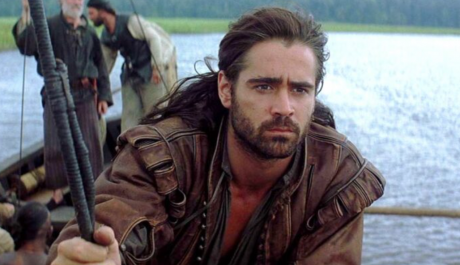
The New World‘s drawn-out, epilogue-like final act is, in fact, an example of abrupt story betrayal and audience abandonment. It should be picked over in filmmaking classes at USC and NYU in years to come as a lesson in what a director looking to survive in the world of commercial filmmaking should never ever do.
A few weeks ago The New World producer Sarah Green told The New York Times that “first and foremost we’ve created a love story.”
This is unmistakably true for the first 100 or so minutes, and in a near-revolutionary sense. The legendary, historically fanciful saga of British explorer John Smith (Colin Farrell) and the teenaged Pocahantas (Q’orianka Kilcher) in early 1660s Virginia feels vital and pulsing and re-imagined as a gentle culture-clash love story…largely non-verbal, visually haunting…primal atmosphere seeping out of every frame.
Green also told the Times, “We’re definitely not doing a historical piece. We try to set it properly…we try to give that background and that feeling, but we focus on the love story.”
As far as the last act is concerned, that’s a distortion. The Farrell-Kilcher love story is totally abandoned (and in a very brusque and alienating way at that) and the film pretty much sticks to the historically accepted story of Pocahantas’ life for the last third — marriage to a wealthy English tobacco grower named John Rolfe (Christian Bale), bearing a child, travelling to England to meet the King and Queen, and an early death. The failure of The New World ending is entirely due to the fact that this final section plays like a postscript.
But during those first two thirds, The New World is a truly rare animal and movie like no other…a feast of intuitive wow-level naturalism that feels as fresh and vitally alive as newly-sprouted flora. This is the forest primeval, all right…the native Americans (“naturals”) and English settlers eyeballing each other amid the murmuring pines and hemlocks and low-lying marshlands, and then prodding, spearing, shooting and finally accepting each other in an evolving, step-by-step cultural passion play.
I’ve respected Terrence Malick as a genius all of my filmgoing life. I knew that before but I was reminded once again when I sat down with this film in late November. And I’m truly glad to live in a world that gives up a Malick film every five or six years.
But he’s so embedded in his own head that he can’t deliver a halfway satisfying commercial movie. I don’t mean formulaic. I mean a film that simply satisfies like his two best films, Badlands and Days of Heaven, did in ’73 and ’78, respectively.
I was going to say Malick is a “compositional” genius rather than an overall genius, but I have to repeat that the first 100 minutes of The New World were, for me, truly exquisite. Exquisite in the way that profound visual art always is. The film is heart-stoppingly beautiful at times. The acting is all about eyes and faces and intimations…hardly anyone says anything, and most of the dialogue arrives in the form of internal narration. The only person who speaks from the diaphragm in complete sentences with any clarity is costar Christopher Plummer. Everyone else and every plot turn is conveyed in mutters, whispers and meditative voice-overs. You get what’s happening bit by bit but Malick refuses to spell anything out in connect-the-dots terms.
And yet the feeling of cosmic connectivity in this film is a real pore-opener. Call it a symphony of naturalism — a feeling that you’re really and truly there with the moisture and the mud on your feet…the grime and hard work and smell of the leaves and the soil…the worshipping of nature’s magnificence and terror. It really and truly is Virginia in the 1600s coming off the screen and sinking into your eco-system.
[I’ll post the second half tomorrow morning.]