Evil Empire

Studios owned by super-sized corporations haven’t been in the business of making real movies in a dog’s age. Not with any consistency, for sure. We are living in an era of mass devolution, and pitiless world-market realities demand that studios create and sell the hell out of renewable brands and franchises that the least educated, least sophisticated people in the world can groove to with having to think twice.
And yet somehow and in various hard-to-figure ways, studios like Warner Bros,, Universal, Dreamamount, Disney, New Line and 20th Century Fox along with their indie-mentality “dependent” production-distribution arms (Warner Independent, Picturehouse, Miramax, Focus Features, Paramount Vantage, Fox Searchlight) manage every now and then to crank out or at least acquire films that are about something besides an untrammelled interest in making money — movies with an alert mind or a cool attitude or a delicious funny bone or a soul even.

There’s one big studio, however, with a different attitude than the others, a studio that has a “dependent” arm that’s into toney films (Sony Pictures Classics) but also one into genre material (i.e., a euphemism for mostly second-tier junk), and led by people who occasionally get lucky with a quality film in the way that a stopped clock will tell the right time twice a day.

You know who I’m talking about…of course you do. I’m talking about the studio that gave us over the last few months the agreeably made, somewhat satisfying The Pursuit of Happyness, the sad and soulful Mike Binder movie Reign Over Me, and Casino Royale, the best James Bond movie since Goldfinger, and which single-handedly gave a new lease on life to the oldest franchise around. Three films to be proud of, by gum. But the rest…my God, the rest.

When I’m on my death bed I will look back upon how Sony Studios product befouled my dreams and sucked my soul dry from May ’06 to May ’07. I will think back to the twin horrors of the ’06 Cannes Film Festival — The DaVinci Code and Marie-Antoinette. I will remember my inability to laugh (all I managed were a few guffaws and one or two titters) as I sat through Talladega Nights, and how Adam Sandler‘s Click got steadily weaker and thinner after the first act. I’ll remember that horrible feeling of being trapped in an old leather storage trunk with All The King’s Men, and how rancid and putrid so much of Running With Scissors felt, and how infuriated Stranger Than Fiction made me feel. And Nic Cage‘s Ghost Rider, and the contemptible Perfect Stranger and Are We Done Yet?, and the mere thought of all those Joe Roth/Revolution films…don’t start.

And the very possibly wondrous and soul-levitating Spider-Man 3, of course. How do I know Sam Raimi‘s film isn’t a riveting, heart-stopping, spiritually stimulating film on any number of levels? I don’t know this at all, of course, because, as many readers have pointed out, I haven’t seen it and the tone and attitude of the first two films means nothing…nothing at all.

(I probably won’t see it until May 4th, by the way. Sony distribution execs are extra angry that I ran and rah-rahed Todd McCarthy‘s Variety pan and did the same thing with Kim MastersRadar piece about the alleged $350 million production budget, and are determined not to show me Spider-Man 3 before it opens.)

I’m fine with missing freebie screenings (especially of Sony product), but I wonder if anyone’s fine with the lack of sophistication and seasoning and adult attitude that’s coming off the Sony lot these days, and…I don’t know, the overall shallowness and the relentless determination to angle their movies at the mouth-breathers. All I know is, there are reasons to occasionally smile or at least feel respect when it comes to movies made by the other guys (not often but now and then), but Sony product seems to give me a headache on a far more frequent basis. They seem to be following a kind of corporate-think, crank-it-out, bottom-line stinko mental- ity, and I really and truly don’t think it’s unfair or even unkind to call them the most corporate-minded of all the studios.

And I’m wondering why. What factors have led to this? Why is it that the other studios seem to somehow churn out smart, likable, above-average movies aimed at non-idiots with a bit more frequency than Sony? Or do I have it wrong? It doesn’t seem so to me, but one of the great things about a reader talk-back section is that you gain all kinds of different perspectives and insights. It’s not such a crazy or cranky idea that one studio among all the others might have more of a lowball, gorilla-friendly, brand-dependent attitude than the others. And I’m not even saying that this studio is absolutely and positively Sony. But it sure feels that way these days.

And all the money that Sony has made and will make is beside the point. Movies are fundamentally about dreams, awe, warm hearts, spiritual connections, hopes, longings, wonderment, God…all that good stuff. And I can’t think of any entertainment entity in any medium that has shared and spread around smaller approximations of these things than Sony.

Tribeca and Rosenthal

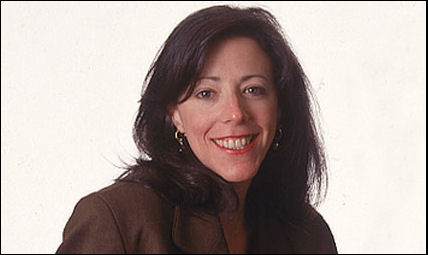
The Tribeca Film Festival acquired an unsavory rep when IndieWire broke that story about ticket prices being raised by 50%. That was three and a half weeks ago. Today, finally, the money issue was addressed by festival co-founder Jane Rosenthal in an interview with the Hollywood Reporter‘s Gregg Goldstein. And the explanation is basically that she and her partners have been saddled with rising costs and have personally been losing money on the festival, and they had to alleviate this.

Rosenthal says the festival loses about $1 million annually, and that she, her co-founder husband Craig Hatkoff and partner Robert De Niro have had to personally cover this deficit.

“No official figures are available on how much the festival costs, earns or loses because, since its second year, Tribeca has been a private, for-profit organization run under the umbrella of the private, for-profit Tribeca Enterprises,” writes Goldstein, “which was founded by Hatkoff, Rosenthal and De Niro in 2003.

“A Tribeca insider does claim that for the past few years, the cost of staging each fest has increased to about $13 million (20% of which is ponied up by the festival’s founding sponsor, American Express), and the event has been running a $1 million annual deficit — which comes right out of Rosenthal’s, Hatkoff’s and De Niro’s pockets.

“Hatkoff says that Tribeca now costs three to four times what it did when it was initially conceived in 2002 as a five-day event that hosted some 150,000 attendees. By last year, it had ballooned to a 13-day event and more than tripled in attendance. And yet they festival has, according to the aboe arithmetic, been bringing in $12 million in revenue to its $13 million in expenses.

“The rationale for a bigger scale is that there are fixed costs inherent in running it no matter how large we are,” Hatkoff tells Goldstein. “It’s Economics 101. Not having it grow will just exacerbate the cost structure. It’s not about making money for the festival.”

“Still, this year’s 50% jump in most ticket prices has caused grumbling in some quarters. Rosenthal defends this by saying she is saddled with having to retrofit theatres and bring in high-cost talent and pony up for pricey hotel rooms.

“When we have to retrofit theaters with digital projection and fly more filmmakers in with fewer hotel rooms available than ever before, we have to pay for it,” she says. “We don’t get city and state funding the way (the Toronto International Film Festival), (the Sundance Film Festival) and (the Festival de Cannes) do. I don’t even get any substantial funding for free events. Without that, I had to raise ticket prices.”

Crisis comedy

I should have mentioned this yesterday, but George Clooney‘s intention to make a dark and dry political comedy out of Rachel Boynton‘s Our Brand Is Crisis is a very good one. The people who loved Wild Hogs will stay away in droves, but if it’s done right Clooney’s adaptation could be a great metaphor piece about Americans trying to export its own culture and values — i.e., American political values by way of spin, focus groups, compassionate lying and image-massaging — into other cultures and making things much worse in the process.

Boynton’s doc is anything but “funny” — it’s a dry piece of verite you-are-there analysis — but as soon as I read Pamela McLintock and Adam Dawtrey‘s Variety story about the idea of molding it into a comedy, a light went on. I said to myself, “Yes, this’ll work f it’s written well. It could even be perfect.”

Our Brand Is Crisis is about a political consulting firm called Greenberg Carville Shrum (CGS) being hired to help the 2002 presidential campaign of Bolivian presidential candidate Gonzalo “Goni” Sanchez de Lozada of the MNR Party. He was a cigar-smoking rich guy with his hand out who didn’t get it, but hesmart enough to use the (very expensive) services of CCS. Goni paid the fee and the gang flew down to Bolivia (among them consultant Tad Devine, Jeremy Rosner and James Carville) to do what they could. “Goni “was elected, but then teh countruy’s economy worsened and the people took to the streets and he was finally forced to resign.

Boynton’s doc is about days of GCS Bolivian brainstorming sessions, focus groups, carefully staged TV appearances and whatnot. Some guy on an Amazon response forum called it The War Room, Part II: The Bolivian Years.

Variety reported that Clooney’s Smoke House will produce (with Clooney, Grant Heslov and Nina Wolarsky sharing duties). British writer Peter Straughan will adapt, and Clooney could either director or costar.

Eberty making an appearance

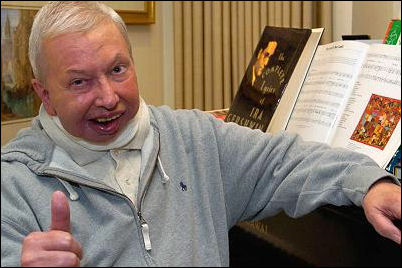
Admitting that he “ain’t a pretty boy no more,” Roger Ebert has announced that he and wife Chaz will appear at the Ninth Annual Overlooked Film Festival (opening tomorow nnight) at the University of Illinois at Urbana. Ebert hasn’t been able to speak for several months due to a tracheostomy (he’s hoping that “another surgery” will remedy this), so he’ll be confining himself to facial and hand gestures, “eye rolling,” written notes and whatnot.

“I have received a lot of advice that I should not attend the festival,” Ebert has written in today’s Chicago Sun Times. “I√ɬ¢√¢‚Äö¬¨√¢‚Äû¬¢m told that paparazzi will take unflattering pictures and that] people will be unkind. Frankly, my dear, I don√ɬ¢√¢‚Äö¬¨√¢‚Äû¬¢t give a damn. As a journalist I can take it as well as dish it out.

“What happened was, cancer of the salivary gland spread to my right lower jaw. A segment of the mandible was removed. Two operations to replace the missing segment were unsuccessful, both leading to unanticipated bleeding. A tracheostomy was necessary so, for the time being, I cannot speak. The doctors now plan an approach that does not involve the risk of unplanned bleeding. If all goes well, my speech will be restored.

“So when I turn up in Urbana, I will be wearing a gauze bandage around my neck, and my mouth will be seen to droop. So it goes.”

There but for the grace of God….

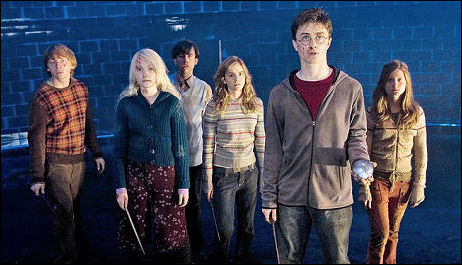
“Harry Potter” Pheonix trailer

It’s an old tune about how the Harry Potter movies have stopped mattering. The zeitgeist-connectivity factor peaked three years ago with Alfonso Cuaron‘s Harry Potter and the Prisoner of Azkaban. Tens of millions have been programmed to pay to see them, of course (picture those school kids marching into that gothic Orwellian factory in Alan Parker‘s Pink Floyd: The Wall), and you can bet this will happen when David YatesHarry Potter and the Order of the Phoenix (Warner Bros., 7.13) arrives.

The trailer looks exciting in the same old flash-cut, ooh-wow way that all trailers for all the expensive CG movies tend to be, but it seems to be selling the same old shite with a slight budding-hormone twist. This time there’s a conventional bald ogre baddie without a nose, Imelda Staunton as a new Hogwarts bureaucrat baddie, and Katie Leung as Cho Chang, Harry’s (Daniel Radcliffe‘s) new love interest.

I wouldn’t go to a free screening of this film with a knife at my back. I wouldn’t watch it if I was on a 15-hour plane trip top Thailand and dying of boredom. Okay, maybe if I’d watch it on the plane if it was being shown in a high-def format, but certainly not on one of those cheap-ass, back-of-the-seat video screens.

Emma Watson (i.e., Hermione) has been my favorite since the series began. She’s now 17 and posing on magazine covers, etc., so why not a little romantic subplot for her also? I wonder why she’s so short though. (Radcliffe is Dustin Hoffman‘s size and he towers over her.) Did they cast these kids based on their genetic predispositions to not grow to anything close to adult-sized height? No matter — Watson’s got the charisma.