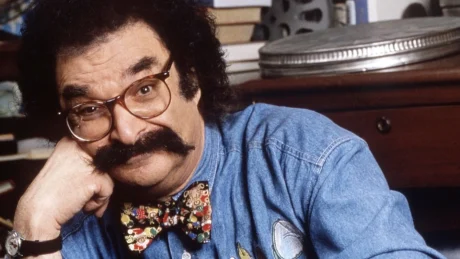
I have mostly agreeable memories of the guy. Always “candid”, cheerful, devotional, politically obliging, and oh, those deliciously groan-worthy puns.
But did this boundlessly jovial fellow ever voice an opinion about a film that was on the renegade side? Did Shalit ever stick his neck out by saying that a film that almost everyone loves isn’t very good? Did he ever champion an unusual or eccentric film that everyone else was ignoring or putting down?
I don’t recall Shalit ever standing alone with an opinion that wasn’t widely shared. I’m not saying his opinions were always safe and chuckly, but they always seemed to be shrouded in general consensus. Am I misremembering? I’m asking.
Shalit was a spirit-lifter first and living-room film critic second…I get that. And his copy was always robust and sophisticated. But, as BobDylan once wrote, sometimes “even the President of the Yoo-nited States has to stand naked.”
Jordan Ruimy asked last night for my five most admired films of 2026. Good effing God.
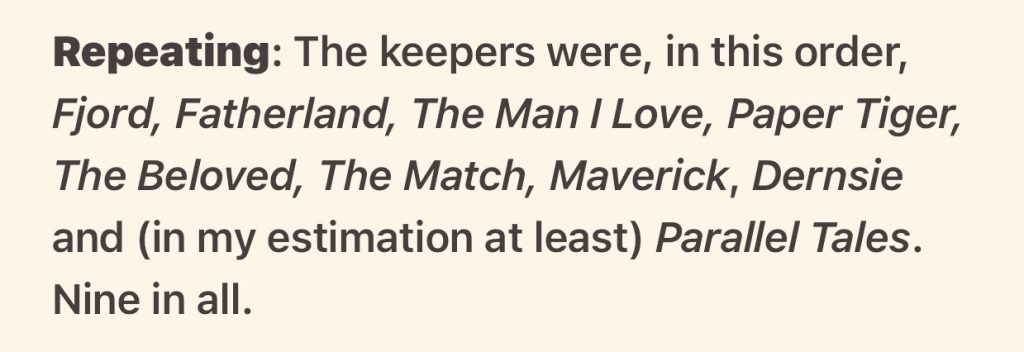
If I’d been allowed to choose from my nine Cannes favorites, I’d be totally fine.
But I could only choose from commercial releases. And that left me with…
Hasan Hadi’s ThePresident’sCake, Francois Ozon’s The Stranger, John Carney’s PowerBallad, Curry Baker’s Obsessionand Daniel Roher’s Tuner.
The more I think back upon ProjectHailMary, which I “respected” but didn’t much care for when it opened last March, the more I spit phlegm upon the memory.
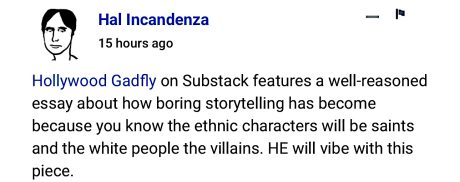
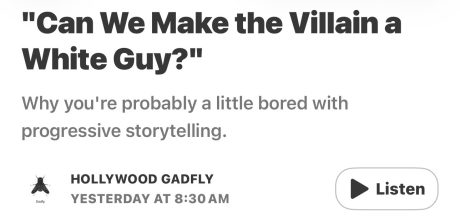
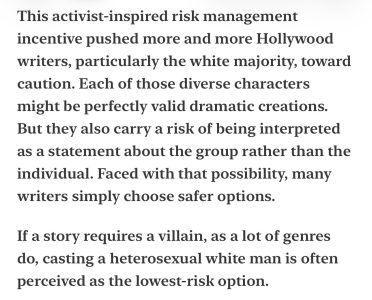
All hail HE’s HalIncandenza for pointing out yesterday’s Hollywood Gadfly Substack piece — an examination of how Hollywood’s identity cautions and concerns, which began to morph into woke Maoism starting in the late teens and certainly by the GeorgeFloyd summer of 2020, has made many dramas boring and predictable.
This is the kind of “this is the truth of things and let the chips fall where they may” article that The New Yorker’s JustinChang, an identity-code enforcer and celebrationist of the strictest order, could and would never write.
Who is Hollywood Gadfly? Perhaps an agent or a production exec, more likely a screenwriter. A discerning guy, obviously. Older and engaged and therefore with some perspective.
SPOILERS AHEAD: The general critical verdict about Steven Sielberg‘s Disclosure Day is somewhere between “pretty good” and “woo-woo good.”
A good guys-vs.-bad guys drama about an underground effort to stop suppressing information about alien visitors, DD is fast-moving, diverting and imaginative as far as it goes. I agree with the “pretty good” consensus, and I’m especially down with the final 35 or 40 minutes, which is all about (surprise!) crescendos and emotional payoffs and (what else?) generous servings of Spielberg-alien-awe face. But I wouldn’t trust the woo-woos.
So let’s not get carrried away. Disclosure Day is fine or even better-than-fine, but aside from one or two high-energy spurts it feels a bit..what words apply?…mid-range or cerebral or subdued or something. It’s never dull but…well, it just never got my blood going. Not really, I mean. Except at the end.
When it comes to lopsided, holy-shit car-chase thrillers, which is what the first 105 minutes of Disclosure Day basically is, HE has one ironclad requirement: the sympathetic hunted guys can’t make any stupid moves. If they screw up in some bullshit, boneheaded way, I tend to get angry and alienated and am soon exhaling loudly in my seat.
Emily Blunt‘s Margaret Fairchild, a TV weather girl based in Kansas City, and her boyfriend, Wyatt Russell‘s Jackson, get chased around by dozens of baddie-waddies in slick black cars (i.e., faceless goons under the command of Colin Firth‘s Noah Scanlon and employed by Wardex Corporation, which is basically about suppression of alien information) but they handle themselves reasonably well.
Blunt does more than that when she becomes a master of suggestion or, if you will, a practitioner of Alec Guinness-styled Jedi mind tricks.
But Josh O’Connor‘s Daniel Kellner, a former Wardex man who’s become devoted to the free and open sharing of alien information and, to that end, is carrying several flash drives that contain 79 years of visual data that proves the existence of alien visitors, screws up in two significant ways.
Kellner is too trusting of his slightly chubby girlfriend, a former nun called Jane (Eve Hewson) who feels that sharing alien info with the general populace will somehow undermine their spirit or diminish the importance of God or some such rubbish. (Only an idiotic God-believer would imagine that His/Her domain doesn’t include the entire universe.) Because Jane sympathizes on some level (subconsciously or otherwise) with the Wardex suppressionists, she winds up betraying Daniel not once but twice.
HE to Daniel: “She’s bad news, bruh! Love is blind but she’s not a realist and you can’t trust her. Cut her loose.”
After Jane’s second betrayal (i.e., alerting the Wardex guys to a remote location where she and Daniel have been hiding out), Josh steals one of the many Wardex cars that are parked near the hideout and drives right toward the others…brilliant!…smashing into this and that auto.
I was shaking my head back and forth and almost moaning with frustration. I really can’t give my support to a fellow who’s too dumb not to drive away from the villains. Then Daniel grabs Turncoat Jane and shoves her into his car. The man is hopeless.
Eventually Spielberg tires of the chase stuff and shifts focus to the big finale, whch includes the metaphorical alien spirit animals…a red cardinal, a fox, an elk (or is it a large-antlered deer?). And then, around the 115- or 120-minute mark, comes the big moment in which Daniel’s flash drives are finally uploaded to the TV station where Margaret does her weather-girling, and before you know it the whole world is wise to the entire alien-visitation portfolio.
And then Fairchild, sitting in an anchor chair, gives a gentle, thoughtful speech to the world about the meaning of what’s been revealed. Her very last line is “listen”, which is a variation on the final line in Howard Hawks’ The Thing (`1951): “Watch the skies”
There’s no question that Blunt does a LOT of strenuous acting in Disclosure Day. She blathers, yelps, convulses, cries out, shudders, shrieks. She really delivers in terms of vigorous “acting.”
Belfast police arrested the victim, a white native, of a three-day-old stabbing while allegedly coddling the Sudanese assailant, at least initially.
This, at least, is the internet legend going around.
Mob violence was triggered after authorities charged Hadi Alodid, a 30-year-old Sudanese man, with attempted murder in the afore-mentioned stabbing attack, prompting calls from anti-immigrant activists for protests amid heightened tensions in the United Kingdom over immigration.
…who scams people and smokes all the time and probably needs a pedicure and perhaps smells funny to boot, not to mention is unable to get it up…okay, he might be able to manage that but keeping it up is another matter.
Aside from advancing the usual “beware of evil cis white males” trope, what the eff is this? Some have called it a creepy thriller, others a kind of comedy.
Directed and written by Georgia Bernstein, Night Nurse pops on 7.10.
“You have to smoke in movies like you don’t give a damn, like you don’t need it, like you don’t care one way or the other if you have any on you, like your Zen-ness is rooted in your soul and not in the way you look when you light up, you desperate asshole.
“Once an actor looks as if he anxiously wants or needs a smoke to stabilize or enhance his currency with an audience, he’s a dead man. Once an actor pulls out a cigarette in order to have something to do during a scene (and you can always spot actors who do this), the man has permanently surrendered his cool. He’s finished, discredited.
“I’ve smoked on and off in my life. For very brief periods, I mean. I truly hate smoking and particularly myself for succumbing from time to time, which has mainly happened when I’ve been in Europe, more particularly during my times at the Cannes Film Festival. There, I’ve admitted it.” — from an 11.30.08 HE post called “Shame“.
Anyone who goes by the name of “Ronnie Dodge” is obviously some kind of slippery con artist. It’s one of those self-satirizing, self-identifying names like R. Crumb‘s “Weasel J. Weisenheimer,” a rodent-like drug dealer. “The last 40 minutes [of Disclosure Day] had me speechless,” Ronnie says. Sure thing!
What is happiness, the myriad blessings of hanging with a granddaughter aside?
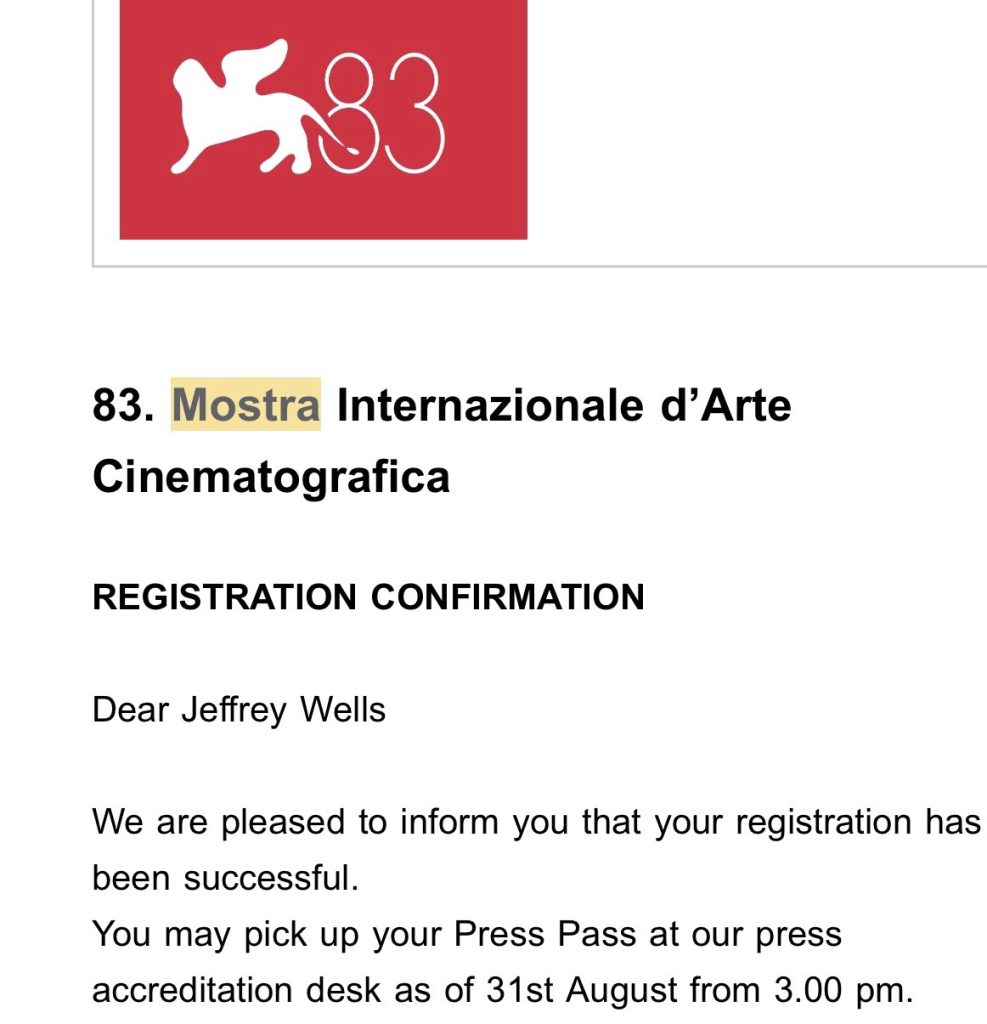
Happiness is an overseas cinematic marathon on the horizon…a demanding, never-enough-sleep adventure in the quietest, friendliest, most serenely seductive, away-from-the-hurly-burly city in the western world.
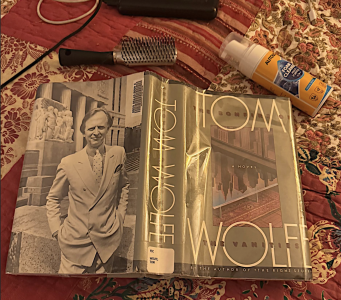
I read Tom Wolfe‘s “The Bonfire of the Vanities” when it first came out in ’87. Loved it, hated the DePalma film. Several weeks ago (mid-April) I borrowed a hardback copy from the Wilton Library, and week aIter week I failed to sit down and read even a small portion of it. Earlier today I happened to read the beginning of an early chapter and it finally put the hook in. I spent most of the day and part of the early evening reading chapter after chapter after chapter. It was all I wanted to do. Such delicious writing, glorious in its wonderful flavor and specificity.
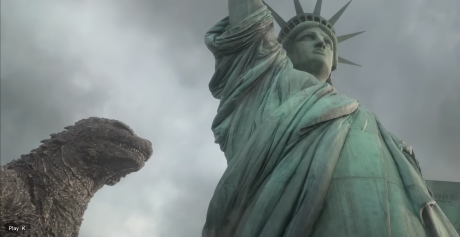
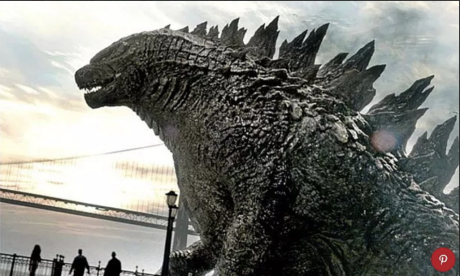
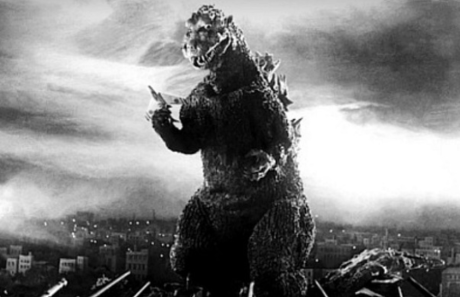
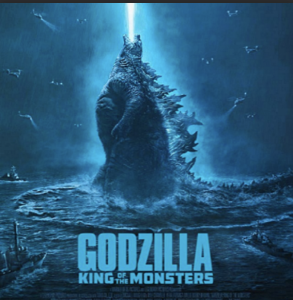
No one really believed the denials from directors Gareth Edwards and Michael Dougherty when they tried to dismiss all those Fatzilla observations that people were sharing all over. Now that Godzilla has slimmed down — he’s clearly not obese in the forthcominmg Godzilla Minus Zero — it’s obvious that Edwards and Dougherty were lying all along….fully exposed as the corporate bullshitters they were from the get-go. Will they ever admit they were shilling for the overweight multitudes? Of course not.