“My Conservative” arrives

C.C. Goldwater, Tani Cohen and Julie Anderson‘s Mr. Conservative: Goldwater on Goldwater has its nationwide debut on HBO tonight (9.18) and will play repeatedly for the next few weeks.

After seeing this 91-minute doc at the L.A. Film Festival last July, I came to realize that former Arizona Senator and 1964 Republican Presidential nominee Barry Goldwater was a man of much greater character than I knew. The film is an engaging, very successful attempt to remind the public who Goldwater really was in terms of core beliefs and personal integrity. The irony is that by today’s standards, and particularly over the last 25 or 30 years of his life, Goldwater sounded a lot more like a liberal than a conservative.
http://www.hbo.com/apps/schedule/ScheduleServlet?ACTION_DETAIL=DETAIL&FOCUS_ID=621717

Newspapers still profitable

“Newspapers are still profitable; the Journal reports that theL.A. Times has an operating profit of 20 percent. But they are under pressure from declining readership and advertising revenue as they face competition from new media sources, such as the internet.” — from a 9.18 CNNMoney story about offers (including an all-cash one from David Geffen) to buy the L.A. Times. That “still profitable” statement is hilarious. Who would have imagined ten years ago that a serious financial news story would feel the need to make this declaration in case readers might infer otherwise?

Ebner on Backstreet Boys

Hollywood Interrupted‘s Mark Ebner taps out a lively piece about Dan “Danno” Hanks and Fred “Mad Dog” Valis, undercover investigators known in the industry as the Backstreet Detectives. This is the beginning of a book, a movie pitch, a TV series pitch…it’s not just this.

Leydon on “Guardian”

According to esteemed Variety critic Joe Leydon, The Guardian (Touchstone, 9.29) is “a shrewdly updated version of classic (and not-so-classic) military-themed pics about grizzled, blunt-spoken vets who transform cocksure hotheads into coolly efficient professionals.” Right away you’re thinking about seeing it — it sounds routine but mildly appealing — but four or five months from now on DVD. “With Kevin Costner well cast as a demanding mentor haunted by past failures, and Ashton Kutcher surprisingly effective as a brash recruit dealing with his own demons, the overlong (139 minutes) but involving drama has obvious cross-generational appeal. Add some exciting rescue-at-sea sequences, and you have the potential for an early fall breakout hit.” Leydon’s distinction is duly noted: he doesn’t say that The Guardian has the makings of a hit, but the potential for one.

“Fire” is about today

For L.A. Times columnist Patrick Goldstein, the Toronto Film Festival movie “that had the most indelible connection to current events was Catch a Fire, the much-praised Phillip Noyce drama set in 1980s-era South Africa.
“When a friend asked what it was about, I told him it was the story of a country so traumatized by its fight against terrorism that it arrests and tortures an innocent, peace-loving man, doing such a good job of infuriating him that when he’s released from prison he becomes the most ardent terrorist of all.
“My pal joked: ‘So, it’s really about today.’ And so it is. The parallels are striking, whether your point of view takes you to the horrors of Abu Ghraib, Israel’s war with Hezbollah or the repressive regimes of Egypt and Iran. As Noyce acknowledges, ‘This is a story that’s set in 1980, but it’s also set in 2006.'”

Clooney “Leatherheads”

No more low-budget arthouse distractions for George Clooney. He’s signed to direct and star in a front-and-center commercial flick called Leatherheads, an alleged romantic comedy about the birth of pro football in the 1920s. There’s only one thing wrong with the packaging, and that’s Rene Zellweger in the lead female role. Guys I know don’t want to see her. She’s always been a talented actress — she was good in Cinderella Man — but nobody in my circle wants to hang with her in the dark for a couple of hours, and I’d be lying if I didn’t admit that my heart sank a bit when I saw her name in this Michael Fleming story.

Matthews on Toronto

Jack Matthews is, I feel, correct in every one of his post-Toronto assessments in this N.Y. Daily News piece except for two: (a) Doug McGrath‘s Infamous, commonly known as the other Truman-Capote- goes-to-Kansas-to-write-In Cold Blood film, is emphatically not better than Bennett Miller‘s Capote, and (b) John Cameron Mitchell‘s Shortbus felt like more of a slog than “a trip.” To me anyway. It’s not that I’m against the graphic filming of one’s sexual tastes and adventures (and those of your friends and hires) and weaving the footage into a form of cultural propaganda; it’s mainly that movies of this sort strike me as boring. No…they are boring.

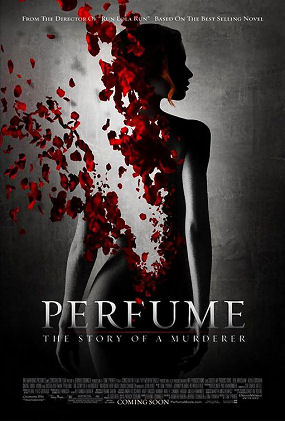
Tykwer’s “Perfume”

Have any German readers of this column seen Tom Tykwer‘s Perfume: The Story of a Murderer? This Berndt Eichinger production, based on Patrick Sueskind’s period best-seller of the mid ’80s, opened in Germany last weekend and did extremely well commercially. Ed Meza‘s Variety story says it “looks like the most successful German film of ’06 after attracting 1.04 million moviegoers and earning $7.3 million in its first four days of release, which amounted to a 53% share of all [German] box-office revenue.”

DreamWorks will open it stateside on 12.27, but I’m getting the idea that its a mezzo-mezzo thing critically. Most German critics panned it, apparently, but not savagely. There are allegedly kinder reviews online but they’re all in German, and so far I have’t spotted any reputable English-language reviews. In the wake of Run Lola Run I would have presumed excellence with Tyker directing, but now I don’t know.

McDonald on Amin

General Idi Amin of Uganda “was the most famous African in history until Nelson Mandela got out of prison,” says Last King of Scotland director Kevin McDonald. “Literally there was no one who was as well known in the West as [Amin], and I think that is because people always found him compelling. There was quite a seductive element to him that made him more dangerous and more terrifying in the end. I think he was a monster, but I think he was a complex monster, and to see him as complex makes not only for more interesting drama. He’s not just straightforward — someone who killed a great deal of people. There was a charm.” — from a Reuters story in Australian’s The Age.

Dargis vs. Klady

N.Y. Times film critic Manohla Dargis has informed me that MCN columnist Len Klady‘s reporting about why her paper has decided to change the way it covers the New York Film Festival — i.e., no more pro forma reviews of films on the day they “open” at the festival, and in their place running a kind of “Times portfolio” with little critical quips inserted — is “wrong” and that she’s asked him to run a correction .
Klady’s error, Dargis says, was in writing that “the exact reasons behind the decision are a bit sketchy, [but] it appears the Times was persuaded by a film industry emissary that a potential blot on a [NYFF entry] was neither good for it or them.” Dargis responded that “our decision to change how we cover the NYFF was not prompted by some unnamed ‘film industry emissary’ and I resent the implication that we would ever change our coverage based on outside pressure.”
So what did prompt the Times decision to forego regular NYFF reviews in favor of what’s being called “portfolio” coverage? Dargis just said the following: “We decided to change how we cover the festival; our new approach will serve our readers better and will allow us to cover the festival as a whole, rather than in piecemeal fashion.”
“We will no longer be writing individual reviews of each feature film in the festival, the exceptions being those films that are opening commercially soon after their festival screenings, including The Queen. In addition to a handful of reviews, we will be publishing other articles, including critic’s notebooks in which we cover
individual films of interest and the program as a whole, much as we do with Sundance and Cannes.”
I don’t know if an “emissary” had anything to do with the Times decision, but NYFF publicist Jeanne Berney did, I’m told, pass along an opinion on this matter. I gather it had something to do with a feeling among distributors that they would be able to better finagle or circumvent negative N.Y. Times reviews if they appeared on the day of a film’s commercial opening rather than the day they show at the NYFF.
“I kept running into people at Toronto who were telling me about this new Times policy,” Klady told me this morning, “and obviously right now there’s a lot of sensitivity about this. I ran into Manohla up there and asked her about [the portfolio approach] and she said, ‘Oh, we’ll be able to inject criticism into these things.'”
(These “things” aren’t technically being called portfolios, by the way. Apparently they don’t have a name. Not yet anyway.)
“The people who may miss out with this new policy,” Klady notes, “are the ones without distributors who are hoping for reviews from the Times to bolster their profile. Question is, are certain films going to avoid the NY Film Festival because of this decision?”