Tribute and Testament

Tribute and Testament

The late Richard Sylbert, one of the most gifted production designers in Hollywood history and a guy I was proud and very delighted to know, wrote a 200-page chronicle about part of his career before passing away in March 2002. Five or six years ago journalist Sylvia Townsend offered to edit what Sylbert had written. That never happened, but a year after he died his widow, Sharmagne Leland-St. John-Sylbert, cut a deal with Townsend to finish what Sylbert had begun and also fill in the missing pieces — i.e., to create a combination biography- autobiography.
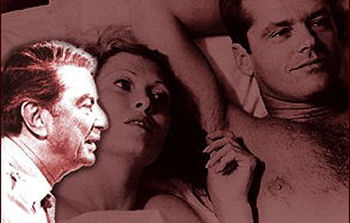
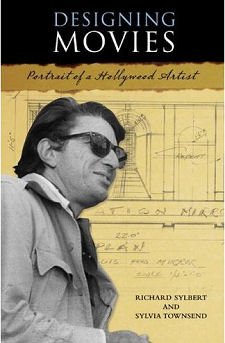
The result is “Designing Movies” Portrait of a Hollywood Artist” (Praeger), a finely written history and an elegant tribute to a great man. But before getting into the substance of it, there’s some mucky-muck about authorship and credit-hogging that needs clearing up.
The front cover tells us that “Designing Movies” was written by Sylbert and Town- send. That’s a completely accurate statement. And yet on the inside front flap it says the authors are these two “with Sharmagne Leland-St.John-Sylbert,” who wrote only an “afterword” chapter. Sylbert’s widow also arranged for an insertion of a brief bio of herself along with Sylbert and Townsend on the inside back flap. Townsend, whom I spoke to Thursday night, told me a lot about Sharmagne Leland-St. John-Sylbert’s maneuvers over the last three years. Suffice that she inserted herself into the interview process to no discernible benefit to the book, and she often generated questionable claims and assertions that were later shot down during fact-checking.
< ?php include ('/home/hollyw9/public_html/wired'); ?>
And yet Sylbert’s widow has elbowed herself into the promotion of this book, and will be the one signing copies at a Book Soup event on Sunday, 10.29 at 4 pm. I gather Townsend will be elsewhere. I hope that this won’t dissuade anyone from dropping by and picking up a copy — it’s a robust and worthwhile read — but arro- gance and egotism of this sort needs to be recognized.
Townsend worked on the book for three years. She edited and added material to 13 chapters that Sylbert had written, covering the beginnings of his career in the 1950s and leading up to his work on The Graduate, Carnal Knowledge and China- town; Townsend wrote another nine (covering, among other films, Shampoo, Reds, The Cotton Club and Dick Tracy) plus an “introduction to Richard Sylbert” chapter. The result is a fascinating ride through the Hollywood glory days of the ”60s, ’70s and early ’80s — a candid, pungent, wonderfully detailed tour.
I don’t mean absolutely candid. Sylbert was a character and as we all know, char- acters have their curiosities. I loved his brilliance, his bluntness, his perceptions — he’d worked with everyone and was a great racounteur. But he was a bit of a bull- shitter, he wasn’t the most serene man in the world, and the ’60s sand ’70s were known for colorful behavior. It’s clear that Townsend has composed a very thorough study of a very complex man, and yet she hasn’t tried to mine the turf of Peter Biskind‘s “Easy Riders, Raging Bulls” — it’s an honest book, but far from a tell-all. But I didn’t read Townsend’s book in search of exotic tales. I wanted to revisit the life of a very gifted fellow, and on this level it fully satisfies.
In the few years that I knew him, I thought of Sylbert as a friend and a great source, and perhaps the greatest teller of Hollywood stories I’d ever been lucky enough to know. Every time we spoke he’d toss off a recollection or two about this or that heavyweight he’d known and worked with over the last 40-odd years, and I’m speaking of every top-ranked talent over the age of 50 who’s ever had a creative impact on this town — Warren Beatty, Robert Towne, Robert Evans, Jack Nicholson, Julie Christie, Dustin Hoffman, John Huston, Elaine May, Francis Coppola, Richard Gere, etc.
Sylbert wasn’t just an intimate witness but a first-class participant in Hollywood’s great creative ferment of the late ’60s to early ’80s. For him, production design was always about more than just dreaming up the look of a film — he was a conceptual collaborator whose input, he always claimed, went far beyond visual apppearance. I know that on a design level alone his creations — which first appeared in Nicholas Ray‘s Wind Across the Everglades (1958) and had their swan song with P.J. Hogan‘s Unconditional Love — were always striking and every so often were wondrous.
Sylbert designed the edgy, sometimes vaguely hallucinatory sets used for John Frankenheimer‘s The Manchurian Candidate (1962), worked with Saul Bass on that legendary title credit sequence for Walk on the Wild Side (also ’62), and imagined the somewhat rickety, constipated interiors of George and Martha’s home in Mike NicholsWho’s Afraid of Virginia Woolf? (’66). He came up with the jungle-like, zebra- and tiger-skinned interiors in Mrs. Robinson’s home in The Graduate (’67), as well as the black-and-white design of Benjamin Braddock’s home in that landmark Nichols comedy.
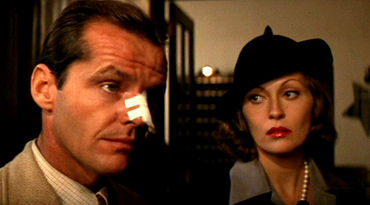
He also designed Rosemary’s Baby (’68), including the before-and-after interiors of the Woodhouse apartment in Roman Polanski’s as well as those wonderfully spooky nightmare visions seen during that demonic seduction sequence. And he did exquisite work for Nichols again on Catch 22 (’70) and Carnal Knowledge (’71), followed by his services on John Huston‘s Fat City and Elaine May’s The Heartbreak Kid (both in ’72). Then came Roman Polanksi‘s Chinatown, which Sylbert enhanced with perhaps the most luscious (but at the same time, somber and moody) re-creation of 1930s art-deco atmosphere ever savored on-screen.
He rendered the 1930s once again in Nichols’ The Fortune, and then late 1960s Beverly Hills in Hal Ashby, Warren Beatty and Robert Towne‘s Shampoo (’74). He did a brilliant job of capturing pre-World War I New York City in Beatty’s Oscar-winning Reds (’81), and won an Oscar nine years later for delivering a physical world of primitive, comic-book proportions in Beatty’s Dick Tracy (’90). He also delivered convincing period milieus for Francis Coppola‘s The Cotton Club (’84) and Lee Tamahori‘s Mulholland Falls (’96).
He also designed P.J. Hogan’s My Best Friend’s Wedding (’97), Brian DePalma‘s Carlito’s Way (’93) and The Bonfire of the Vanities (’90), Robert Towne’s Tequila Sunrise (’88) and Jon Avnet‘s Red Corner (’97). I remember marveling at his re-creation of a portion of Beijing’s inner city for Red Corner, and then listening to him tell me about the nuts and bolts over a breakfast we once shared at Swinger’s Cafe on Beverly Boulevard.
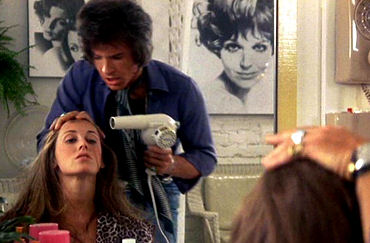
Sylbert won two Art Direction Oscars during his career for his work on Dick Tracy (shared with Rick Simpson) and on Who’s Afraid of Virginia Woolf?. He was also nominated for his work on Reds, The Cotton Club and Chinatown.
On top of all the priceless dish he shared with me over the years (he always picked up the phone, and he never told me he couldn’t help), I’ll always be grateful for his agreeing to drive out to Woodland Hills and speak to a film class I was moderating in ’97. And I’ll never forget how he always wore the same African safari jacket, whatever the occasion. It was a crying shame when he left. I miss him right now. He was an excellent guy to know and have a drink with.
Waxman on “Harsh Times”

Time and again Hollywood types — directors, producers, studios — get into business with oily foreign guys (European or Israeli) who tend to live high and swagger around and smoke cigars. The Hollywooders are always interested because there are always fresh oilies looking to buy their way into the business, and they’ll hook up with almost anyone with a connected rep in order to do so. Elie Samaha, Giancarlo Peretti, Jean-Marie Messier, Bob Yari, Menahem Golan, Yoram Globus, Avi Lerner, etc.
Yari has been doing pretty well for himself lately (The Illusionist is a hit), but sooner or later the matters of oily men always seem to turn sour or go south. Hollywooders who make movies with them always seem to regret it, sooner or later. The latest example of this syndrome has been written about by N.Y. Times reporter Sharon Waxman, and it concerns Harsh Times director-writer David Ayer and his bumpy ride with Phillipe Martinez and his distribution company, Bauer Martinez, which bought rights to Ayer’s film during the ’05 Toronto Film Festival.
Harsh Times will be released on 11.10 by a “reconfigured MGM with scant public awareness, a nest of tense financiers and a handful of abandoned release dates in its wake,” she writes. “Martinez says he still loves the film and has supported it by approving a $15 million marketing campaign and relatively wide, 800-theater release. ‘If I didn’t care about the film, I’d never have put $15 million into the marketing,” Martinez — “an expansive, cigar-smoking Frenchman” — tells Waxman that Ayer “should kiss me every morning for what I do for his movie.”
“Yet Martinez is not actually putting up the $15 million,” Waxman reports. “The money comes from MGM, which had originally expected Bauer Martinez to pay for marketing and delayed its publicity and advertising campaign when the deal stalled over this and other business issues,” and blah, blah. Ayer tells Waxman he got into bed with Martinez with the idea that “we can be neophytes together and reinvent the system.” But the system, Ayer has learned, “is not so easily reinvented. Ayer now says he wants “the warm, loving embrace of the studios. Studios are the way they are for a very good reason.”
The irony is that Harsh Times is no film to avoid. Set in East L.A., it’s a riveting, hard-case melodrama. Christian Bale plays a violent Gulf War veteran looking to find work as a professional right-wing mercenary. Freddy Rodriguez is his irresponsible best friend; Eva Longoria plays Rodriguez’s opposite-number wife. I saw it last March or April…a good while ago. I’ll get into it more next week.

Persistence of Sunshine

Persistence of Sunshine

The last few months have cast Little Miss Sunshine in its proper light. When it opened last July following an ecstatic debut at the Sundance Film Festival six months earlier, nearly everyone called it one of the most original and emotionally grounded family comedies seen in a long while. Quirky and perky, sometimes despairing in tone but intimate and knowing — a movie with smarts and verve and finesse.

Sunshine, of course, has hung in there commercially over the last three months (it’s up to $57-something million domestic) and is now even more broadly regarded as one of the year’s absolute finest. Because, I believe, it’s not a hah-hah comedy as much as a down-to-the-marrow family drama with horse laughs, and because of the quality of the humor. It feels so cleverly configured and well-blended that it doesn’t feel like anyone configured or blended anything.
The lion’s share of the credit for this belongs to three people — screenwriter Michael Arndt and directors Jonathan Dayton and Valerie Faris. I’ve made no secret over the last nine months about being an Arndt fan for reasons that have nothing to do with our having swapped apartments during the summer of ’05. (I sweltered in Brooklyn while he worked with Dayton and Faris during the Sunshine shooting, which was all done within 50 miles of Los Angeles.)
< ?php include ('/home/hollyw9/public_html/wired'); ?>
Arndt has been living in San Francisco and working on a script for Pixar over the last year or so, but he was in town earlier this week and asked if we could talk. His agent has been riding him about sitting down with the right journalists to keep his Sunshine script in play for a Best Original Screenplay nomination. I think it more than speaks for itself but you have to play the game. We met last Tuesday night outside a Coffee Bean on Beverly and Robertson (it was just after the Oliver Stone/World Trade Center shebang at Morton’s) and talked for an hour.
Scene for scene, beat for beat, line for line, the Little Miss Sunshine screenplay is damn near perfect. In Arndt’s own view it deserved a grade of 88 before it was shot, and then the Dayton-Faris collaboration along with the inspired input of the cast kicked it up to a grade of 93 — a solid A. (Only scripts on the level of Some Like It Hot and Tootsie deserve grades in the high 90s, he feels.)

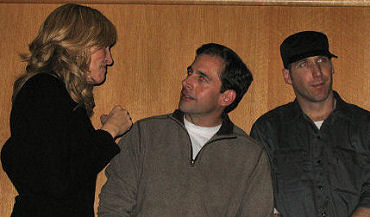
Arndt didn’t want me to take his picture so I didn’t. He feels that “writers should never have their picture taken for the same reason that models should never be interviewed.” But he’s got an appealing, interesting face — there’s a wariness in his eyes, but every now and then something joyful and delighted seeps in — so after some reflection I decided to run the above shot, which was taken at Park City’s Eccles theatre just after the Sunshine‘s debut showing. I’m presuming that he won’t be pissed.
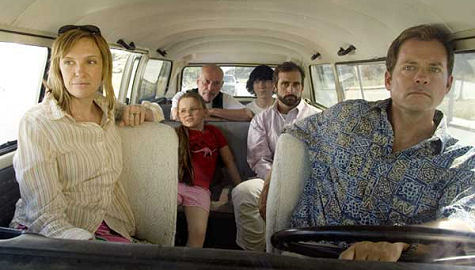
To appreciate this recording you have to know Little Miss Sunshine pretty well, and you have to remember the actors (Abigail Breslin‘s Olive, Greg Kinnear‘s Richard, Paul Dano‘s Dwayne, Alan Arkin‘s grandpa, Toni Collette‘s Sheryl, Steve Carell‘s Frank) and all the stuff they go through.
If you haven’t seen Sunshine, it’s basically about two days or so in the life of the can’t-catch-a-break Hoover clan during a car trip from hell in which they’re taking little Olive to a Little Miss Sunshine beauty pageant in Redondo Beach.
It also helps to know that it took Arndt and Faris and Dayton about five years to get this film off the ground. Why I can’t imagine, but this anecdote in itself reminds me how blind and clueless mainstream Hollywood can often be. What if they’d given up? How many people with scripts as good as this one have grown weary and thrown in the towel after getting turned down for the 27th time?

The Beverly Blvd. traffic was awfully noisy during our talk (trucks, motorcyles, sirens) so I was surprised that our conversation came out as clearly as it did. It lasts about 30 or so minutes, and has some very good stuff on it — trust me.

Oscar beat mosh-pit

To me, the end-of-the-year Oscar beat mosh-pit action is tough and bruising but bracing and a lot of…well, fun. In a perverse sort of way. But to David Poland, it’s becoming more and more of a wallow — craven, degrading, downmarket and heavily caked with brown glop. His latest rant, which I love, sounds like a ringside boxing reporter complaining about the hitting. It’s really good, though. I actually laughed out loud and that’s rare But I need help on one thing. Of all the “controversies [that] will be at a premium,” I’m clueless about ‘Rinko’s vagina.” (He’s referring to Babel costar Rinko Kikuchi.) Anyone?

Par’s Cruise call

At Wednesday’s Tom Freston roast in Manhattan, Paramount Pictures honcho Brad Grey was quoted by Variety‘s Jill Goldsmith and Scott Kirsner about his studio’s shucking-of-Tom-Cruise move that happened two months ago.
Paramount “had considered two options when Cruise’s producing pact came up for renewal,” the story reads. “The first was to ‘reduce the capital we were putting in so dramatically that it wouldn’t have made sense for Tom to keep it,’ Grey said. Such a readjustment ‘would’ve changed the ceiling for all top talent deals.’ The second option was not to reach an agreement. When it became clear, in late August, that the two parties would choose door No. 2, [Viacom chief Sumner] Redstone spilled the beans.”

Thompson on DiCaprio

To get up to speed for her piece about formidable Best Actor contender Leonardo DiCaprio, Hollywood Reporter columnist Anne Thompson persuaded Warner Bros. to let her see Blood Diamond, the hard-hitting Ed Zwick drama set in South Africa that costars DiCaprio, Djimon Honsou and Jennifer Connelly. Thompson treads gingerly in describing the film, but the piece nonetheless contains three “tells.”
One, she calls it “a big expensive drama with a heartfelt political message, just the kind of movie that needs the extra boost of an Oscar campaign.” Two, she says that Warner Bros. “will mount Oscar campaigns for both The Departed” — in which DiCaprio definitively kills as a Boston-mob mole — “[which is] already a commercial success and doesn’t need an Oscar push to attract audiences, and Diamond, which needs all the help it can get.” And three, she says that “if Departed really takes off as a Best Picture contender — and if Diamond doesn’t — then DiCaprio too could be promoted from supporting actor consideration for the Scorsese movie into a best actor aspirant for that movie as well.”
Dicaprio, Thompson proclaims, “is front and center in an anti-hero role” in the Zwick film. “He’s a ruthless South African diamond smuggler who enlists Connellly’s perky journalist to help him find the missing son of Honsou’s South African farmer — as well as his buried giant diamond. Along the way, Connelly and Hounsou’s characters both help DiCaprio’s damaged treasure hunter find his conscience. It’s DiCaprio’s movie all the way, thick Afrikaner accent and all, and Warners is pushing him for a best actor nomination.
“There’s just one problem: The studio’s Departed has become such a hit with critics and audiences that the one movie Scorsese and DiCaprio had no intention of campaigning for has become a serious Oscar contender as well. This leaves the studio scrambling to take care of the needs of all its players.”
DiCaprio, she concludes, “is facing the happy dilemma of handling two possibly Oscar-worthy performances. Warners says it will campaign for DiCaprio in the best actor category for Diamond, a movie whose political agenda he cares about deeply.
“At this point, according to his p.r. rep Ken Sunshine, DiCaprio will join his Departed brothers in the supporting actor category, which will pit him against Nicholson and Damon in a hugely competitive race along with likely contenders Hounsou, Adam Beach (Flags of Our Fathers), Eddie Murphy (Dreamgirls), Jackie Earle Haley (Little Children), James McAvoy (The Last King of Scotland), Michael Sheen (The Queen) and Alan Arkin (Little Miss Sunshine).” (HE says forget Haley and McAvoy.)”

Nicholson is supporting

All that Jack Nicholson-for-Best-Actor-in- TheDeparted jazz? Forget it. Warner Bros., I’m hearing, is off the boat on that one. Delicious as he is, Jack is all flavor and feisty backup in that film, which I’ve felt from the beginning. Oscar prognosticators, take note.