Adrienne Shelly‘s Waitress, a comedy-drama about a pregnant, unhappily married waitress (Keri Russell) falling love with an intriguing stranger, was very nearly invited to show at last September’s Telluride Film Festival, according to what festival honcho Tom Luddy told me this morning. Given Luddy’s liking (or at least respect) for Waitress, the odds seem to indicate that it might be accepted by the ’07 Sundance Film Festival, to which it’s been submitted.

This, obviously is the kind of reception that indie-level director-writers dream of. Obviously something to not only live for but feel pretty good about. On top of which Shelly, 40, was in an apparently happy (or at least content) marriage to a solid, steady direct-mail marketing guy named Andrew Ostroy, and she was the mother of a three year-old daughter named Sophie. Doubly on top of which, I’m told, she had three step-children.
And yet sometime last Wednesday she left her Tribeca loft and made her way over to her West Village apartment, where she kept an office, and hung herself. A story in today’s New York Post said she “was found hanging from a shower rod in the bathtub of [her] apartment by her horrified husband, who cried out, ‘Why? Why?’, cops and witnesses said.”
I called around and talked to a couple of people who knew her pretty well and a couple who’d dealt with her on a business-y basis, and nobody wanted to specu- late why she’d taken her life. Nobody I spoke to would discuss her moods or temp- erament or anything that might have been going on. Nobody ever does in sad situa- tions like this. The “why” always leaks out later on.

“She was a very close friend but not so close in the last year or so,” a friend said. He declined to discuss his feelings about Waitress but they were clearly mixed. He said he attended an ’04 public reading of Waitress “and I gave her some notes, some of which went into the script. By the time I actually saw the film, pretty much every time the joke was over for me. But the reading went over like gangbusters” — there were actually two readings, I was later told — “and Keri Russell is astonish- ing in the film.”
I think I know what it means when someone hems and haws about their reaction to a film but then leaps out of their chair to praise the lead performance in it. I think I do but maybe not. In my book a modified thumbs-up from Luddy tends to signify something of value.
Shelly’s agent Rachel Sheedy (Ally’s sister) of Don Buchwald & Assoc. said the news was particularly mystifyihg because Shelly “had this incredible film that she loved…and she working with this amazing cast. None of it makes any sense at all.”
Shelly was part of “the Hal Hartley gang,” the friend commented. Shelly’s first two starring roles were in Hartley’s The Unbelievable Truth (’89, as Audrey Hugo) and Trust (1990, as Maria Coughlin). Elina Lowensohn, who starred in Hartley’s Flirt and Simple Men, was one of Shelly’s closer friends. The guy who spoke to me said he was thinking of inviting some pals of Shelly’s to drop by on Sunday, which is also when a Shelly tribute may happen, and watch a DVD of Trust.
There was always something slightly gloom-heady about Shelly, but that was also part of her allure. A lot of what she delivered as a filmmaker and a performer seem- ed to be about heartbreak, disappointment and sadness. Which isn’t to say she didn’t have a clever-chuckly side. “Adrienne was one of the funniest people I ever met ,” her friend told me today.
Shelly’s acting career flowered from the late ’80s to late ’90s (from her early 20s to early 30s) and then it began to wind down. She was an early ’90s indie darling. But ever before she began to downshift as performer, she began to develop herself as a filmmaker. Sheely directed and wrote three shorts — The Shadows of Bob and Zelda (’00), Lois Lives a Little (’97), Urban Legend (’94) — and three features — Waitress (’06), I’ll Take You There (’99) and Sudden Manhattan (’97). It’s not like she lacked for drive or ambition.
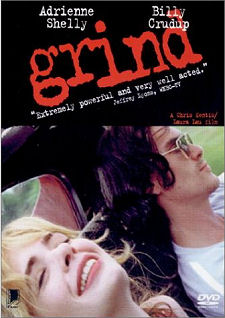
My favorite Shelly performance was in the indie drama Grind, in which she played a somewhat distant housewife married to a blue-collar guy (Paul Schulze) who falls into an affair with her visiting no-account younger brother (Billy Crudup). I actually found her performance a turn-on.
The New York Post story said that “law-enforcement sources said they are inclined to believe Shelly’s death…was a suicide, noting there was no sign of struggle or forced entry in the fourth-floor apartment.”
Sundance ’07 programmers will make start making calls to filmmakers in late November. Obviously it’s their festival to program as they choose, but the want- to-see on Waitress is — let’s be honest — higher now than it was last week. I’m hoping to see it somewhere soon, whatever the venue. This is a very sad story all around.