“Once” is the shit

John Carney‘s Once, which I finally saw last night at 10:40 pm or thereabouts, is the Sundance heart & soul movie everyone’s talking about. And you don’t need to be an NYU film scholar to understand why. A kickaround, no-star Irish musical love story, Once has an ether-like spirit that anyone who’s truly been in love will recognize in a flash.


Once costars Marketa Irglova (l.), Glen Hansard (r.)

It’s about a pair of Dublin-based musicians — a scruffy, red-bearded troubadour (folk-rocker Glen Hansard, best known for his Irish group The Frames) and a young Czech immigrant mom (pianist and singer Marketa Irglova) — falling for each other by learning, singing and playing each other’s songs. That’s it…the all of it. And it’s more than enough.
It’s unique but gently lulling. It’s about struggle and want and uncertainty, but with a kind of easy Dublin glide-along attitude that makes it all go down easy. It’s all about spirit, songs and smiles, lots of guitar strumming, a sprinkling of hurt and sadness and disappointment and– this is atypical — no sex, and not even a glori- ous, Claude Lelouch-style kiss-and-hug at the finale. But it works at the end — it feels whole, together, self-levitated.
Carney’s decision to go with no-name actors (the early plan was for Cillian Murphy to play the troubador or “busker”) was risky; distributors are apparently concerned that Once isn’t commercial enough. That, ladies and gents, is the voice of timidity. Unless I’m crazy Once is going to win the Sundance Audience Award. (I could be wrong, of course, but the current in the Holiday Village theatre where it showed last night was quite palpable.)


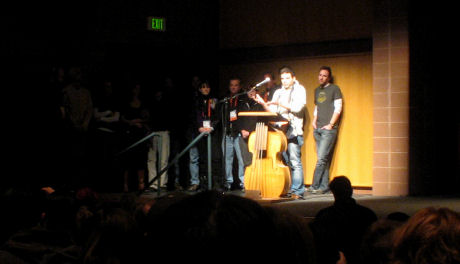
Irglova, Hansard performing after last night’s screening of Once at the Holiday Cinemas — Monday, 1.22.06, 12:25 am

Trust me — there isn’t a woman or a soulful guy out there who won’t respond to Once if they can be persuaded to just watch it. The trick, obviously, is to make that happen, and I admit there may be some resistance. Initially. But once people sit back and let it in (and they’d have to be made of styrofoam for that not to hap- pen), the game will be more or less won. Settled, I mean. I don’t know if Once will make $5 million or $25 million or more or less, but it definitely has the stuff that people go to movies for.
Carney doesn’t give names to Hansard and Irglova’s characters, but it doesn’t matter. He sings songs to Dublin tourists for money while fixing vacuum cleaners for his dad’s shop; she, separated from her Czech husband and raising a small daughter with her mother, is a skilled pianist and singer who sells roses to tourists. And they seem like a match waiting to happen the moment they meet.
Things start off when she tells him she really likes a song he’s been singing, and also that she has a vacuum cleaner that needs fixing. The first big moment happens when he strums and sings one of his tunes in a music shop, and she quickly figures out harmony and piano accompaniment. Their next move is deciding to record an album together, which they manage to pay for (i.e., the studio rental) by finagling a $2000 loan from a bank. They get some street musicians to play accompaniment. The tracks turn out beautifully.


Once director John Carney, Irglova, Hansard during post-screening q & a

But Hansard is still hung up over a girlfriend who dumped him and moved to London, and he suddenly decides to go there also, mainly to pursue his music career but also to possibly rekindle things. And Irglova’s thinking the best thing for her daughter is to try again with her estranged husband. Will things work out between them regardless? Or is the musical connection enough, or even greater than the proverbial emotional and hormonal sparks?
During the post-screening q & a Carney called Once a musical in the tradition of Singin’ in the Rain, Carousel, Brigadoon and the like. It isn’t that, of course — it’s a groundbreaking musical in the vein of A Hard Day’s Night, Cabaret and Dancer in the Dark…a new kind of funky street musical with a fresh idea. A key component is that the film never seems to be pushing all that hard, which can be a huge plus in the right hands.
Hansard and Irglova’s characters obviously love each other for what they have in their hearts plus their ability to say this musically, and we get to absorb all this like flies on the wall. The tension is whether or not they can take things to the proverbial next level. Life is hard, love is harder…but music is all joy.

The sound was fucked and gurgly when the film first began to roll around 10:15, so Carney had it stopped and a team of tech-heads fiddled around and re-threaded the film. It started up again around 10:35 or 10:40 pm. It ran 88 minutes. Then Carney, Hansard and Irglova came up for a q & a, and then the musicians sang a beautiful tune heard a couple of times in the film called “Falling Slowly.”
Hansard and Irglova currently have an album out with all the songs from Once — it’s called “The Swell Season.” An official Once soundtrack CD will presumably be released later this year, concurrent with the theatrical release.
Note: I would have had this piece up this morning if it hadn’t been for the awful technical issue that occured around breakfast time — my apologies to all. And thanks to those who corrected my incorrect spelling of Hansard’s band — The Frames, not the Flames.
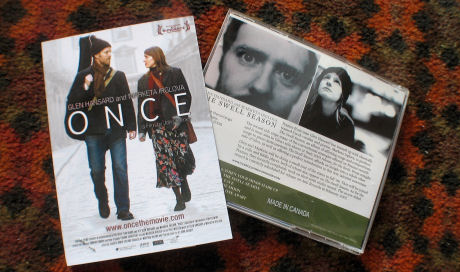

“Swell Season” CD given to me last night by Hansard

Saved!

Hollywood Elsewhere has been out of business all day long due to an incorrectly installed DBD module, which affected my ability to go into Movable Type. The problem started at 8:15 this morning; the subsequent 11 or so hours were absolute hell. The problem was finally solved ten minutes ago by a genius named Chris Tillet. I’m asking that everyone observe a moment of grateful silence for the 2% or 3% of tech support people out there who actually know a thing or two and use their nimble noggins.

“Little Children” in hotels

“A friend who visited Atlanta this past weekend tells me that Little Children was one of the options at her hotel for in-room pay-per-viewing. So I can’t help thinking: No matter how many Oscar nominations the movie may receive on Tuesday, has New Line already written off the movie’s prospects as a theatrical release?” — recent entry on Joe Leydon‘s Moving Picture Blog.

Major LMS Denial

In major denial: “I refuse to believe that Little Miss Sunshine, a movie the world loves but I loathed, is going to get a Best Picture nod.” — Salt Lake Tribune‘s Sean P. Means, in a piece about Tuesday’s Oscar nominations.

Oscar gang

An above-average, all-star Oscar roundtableHelen Mirren, Penelope Cruz, Leonardo DiCaprio, Brad Pitt, Cate Blanchett and Forest Whitaker — by Newsweek‘s Sean Smith and David Ansen, including streaming video clips. From the 1.29.07 issue.

Reeler on Painting Kid

The Reeler‘s Stu VanAirsdale on (deep breath…no, two deep breaths) Amir Bar-Lev‘s My Kid Could Paint That, “already the subject of buying speculation after last week’s TV deal with A&E Indie Films and one of the more eagerly anticipated competition titles among festivalgoers. The anticipation paid off: Bar-Lev’s film is a meta-mix of doc ethics, art politics and family drama, a brilliantly paced mystery tale of a Binghamton, N.Y., four year-old whose abstract paintings develop a lucrative following before its authorship is drawn into question by an increasingly skeptical media…including Bar-Lev himself.”

Defending “Chicago 12

Chicago 10 deliberately eschews context and perspective, the better to simply plunge the viewer into the maelstrom, as if these fires raged last week rather than four decades ago. [Brett] Morgen’s message, however, while implicit, couldn’t be much clearer. In lieu of a “comprehensive,” “dispassionate,” “balanced” portrait of the most explosive instance of American dissidence of the past half-century (at least), he gives us something much more valuable: a call to arms.
“Yes, the movie is blatantly stacked in favor of its hero-agitators, but it’s also impossible to watch Chicago 10 without becoming acutely aware of the vacuum at the center of the current anti-war movement, which has prompted countless marches and demonstrations but has produced no Abbie Hoffmans or Jerry Rubins. And it’s Morgen’s refusal to offer any kind of retrospective take on what we’re seeing – to give his doc the propulsive forward motion of a fictional narrative – that prompts us to make our own disheartening comparisons between past and present.” — from Mike D’Angelo‘s defense of Morgen’s film on Nerve’s Screengrab.com.

Ready to go home

I’ve been through not-so-hot Sundance Film Festivals before, and even the bad ones had their occasional pleasures and surprises. It’s a little bit early to be asking if “this is the worst Sundance ever?” and then saying “yes, maybe”…like David Poland did yesterday. “We’re two days into the festival and the buyers are ready to go home,” he wrote. Let them go home already! There’ll be more room at industry screenings if they leave, right? Am I disappointed I haven’t seen something deeper, stronger, funnier, punchier? Yeah, I am, but there are five days to go, for Chrissake. Give it a rest.

Posey’s “Children”

I despise romantic comedies as a rule, but Zoe CassevetesBroken English is an exception, perhaps because it doesn’t try to be “funny” as much as sardonic and bitterly truthful about what a slog it is out there for no-longer-young women who are “looking for love,” or at least for a relationship that allows for the possibility of something nourishing and genuine.

For what it is and as far as it goes, English is very bright and absorbing, and it contains the most affecting and vulnerable performance of Parker Posey‘s 38-year life. She may seem to be doing the same thing here that she’s done in many films before; the difference is that there’s a bit more sadness in her features, a hint of a crack in her voice at times, and a greater willingness to show her buried child. Her performance is further enhanced by Cassevetes’ tip-top script.
After last night’s 7:30 screening I asked Toronto Globe & Mail critic Liam Lacey what he thought. “Not bad but thin,” he basically replied. I said, “Okay, yes, but the slightness is very smart. I mean, c’mon…have you ever seen a movie about a woman in her 30s looking for the right guy to fall in love with that satisfied your heavy-osity criteria?” He laughed.
The film gets rolling and digs in when Nora (Posey), a Manhattan hotel worker, meets Julian (Melvil Poupaud), a 30ish Parisian who seems soulful and sincere enough. The chemistry seems right, but then he takes off. Should Nora let it go and move on, or fly to Paris and see what happens next? In the hands of another director and with a lesser actress as Nora, a vehicle like Broken English might have been unwatchable. I mean, I usually hate shit like this. I wish that more romantic comedies were this smart and easy to sit through.
Drea de Mateo, Gena Rowlands and especially Justin Theroux provide tasty supporting performances. Theroux, playing a typically egoistic actor, is hilarious. He delivers his lines with just the right jaded aroma, never too broad or buffoony.

Grace is Gone

James C. Strouse‘s Grace is Gone, which I saw last night at 10 pm, is the best film I’ve seen so far at Sundance ’07. It’s a plain and pared down thing, emotionally subtle but very specific and often moving, familiar and understated with a Midwestern voice of its own — a family film about a very American, very here-and-now tragedy.

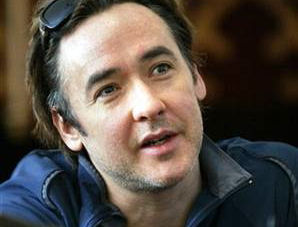
It definitely stands a chance of being remembered at year’s end, certainly for John Cusack‘s deeply touching performance (a major step forward given his career-long inhabiting of hip sardonic wise guys) and possibly in the Best Picture, Direction and Screenplay categories at the ’08 Spirit Awards, and perhaps beyond that. 2007 has barely begun, but Grace has the kind of quiet poignance and gravitas that lingers.
I heard last night that the Paramount Vantage team was circling, but the Hollywood Reporter guys have just broken the news that the Weinstein Co. has picked it up.
Grace is Gone is a rare Sundance film in that it bridges a red state-blue state sensibility. It is basically antiwar (and clearly anti-Bush), but at the same time non-judgmental in its portrait of a patriotic dad (Cusack) who’s barely coping with the news of his wife having just been killed, and particularly how to break the news to his two daughters (one of whom is played by Shelan O’Keefe).
Grace is humanistic and character-driven, but, as Sundance programmer John Cooper has written, the fact that it “can be construed as pro-military guarantees its greatest impact.” It’s a curious case — a movie made by anti-war blues that exudes heartfelt respect and compassion for the patriotic reds. I’m putting it a bit bluntly, but that’s the basic deal.


Grace is Gone director-writer James C. Strouse

There’s a shiftless-brother-of-Cusack character (Alessandro Nivola) who espouses antiwar views, but the film is apolitical in its focus on family grief and confusion. It’s obviously frowning at Cusack’s blind loyalty to the Bush cabal’s handling of the war but it doesn’t get into argumentative particulars or windy rhetoric. I can imagine this film playing in rural Republican/Bubba territory sometime later this year, and mainstream conservative guys and their wives and children coming out of the theatre and going, “Yeah…good film…solemn, truthful.”
Cusack’s Stanley Phillips goes into a kind of stunned tailspin when he hears news that his soldier wife, Grace, has been killed in Iraq. The extent of his meltdown is evident when he decides to hide the news from his daughters, deciding instead to take them on a road trip from their home in Minnesota to a Disney World-type amusement park in Florida.
He obviously needs to spill it sooner or later, but he puts it off and puts it off. His older daughter, 12, senses right away that something’s up but she doesn’t force or confront. Eventually her younger sister also starts to detect a certain vibe in the air. The movie is about the drip-drip-drip of truth seeping in, scene by scene, line by line. It takes its time getting there, but it never bores or drags.

Cusack, who produced along with four or five others, is an adamant anti-Iraq War leftie, and good for that. He feels, obviously, for those military people who’ve been killed so far, and believes that their tragedies shouldn’t be hidden. Cusack has been quoted as saying that the Bush administration’s policy of banning media coverage of America’s war dead as their remains are returned is “one of the most shameful, disgraceful, cowardly political acts that I’ve seen in my lifetime.”
The elegance of Grace is Gone, by contrast, is that it doesn’t “say” anything, but there’s no mistaking what it’s saying.