Cheney at NY Public Library

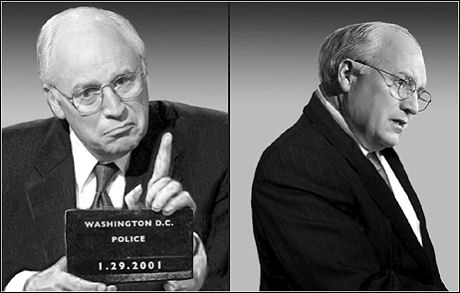
How can a piece of art that portrays Vice President Dick Cheney as a denial-advocate regarding Iraq and Iran intelligence reports be called “politically inflammatory“? Nora Ligorano and Marshall Reese‘s black-and-white prints, now hanging in in a New York Public Library exhibition called “Line Up,” are “mug shot-style diptychs in which a member of the Bush administration appears in profile and face forward, holding a police identification sign and the date on which he or she made a statement of questionable veracity relating to Iraq.” I mean, nobody’s pushing the envelope here.

Raveh on “4 Months” & Oscar situation

Israeli film blogger Yair Raveh, writing on his recently launched English-language version of Cinemascope, shares my concern about the Oscar chances of Cristian Mungiu‘s 4 Months, 3 Weeks and 2 Days. Raveh isn’t just dubious about this winner of the European Film Award for Best Feature and Best Director (plus the Cannes Film Festival’s Palme d’Or last May) not taking the Best Foreign Language Film Oscar. He doesn’t even think it’ll be nominated.

“I predict it will not be one of the five nominated Foreign Language films,” Raveh states. “Not because of the abortion theme, but because [Mungiu’s] filmmaking style is all but indigestible to American viewers.” Academy fuddy-duds, he means.

Raveh says a nomination won’t happen for the same reasons that films by Dardenne brothers or Bruno Dumont have never been nominated. 4 Months is “stark, naturalistic, mirthless and devoid of music. It looks like a documentary or perhaps an improvised piece, and it’s easy to miss the stand-out filmic achievements Mungiu has brilliantly pulled off, starting with the movie’s ironic self-referential title.”

“Two Lane Blacktop”

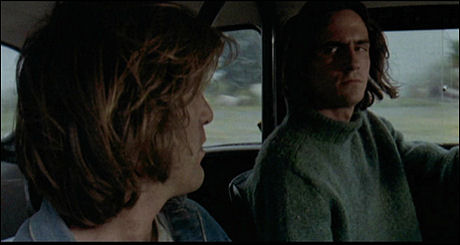
Hearing about tonight’s release party for the Criterion DVD of Monte Hellman‘s Two-Lane Blacktop nearly broke my heart. The party is happening right now at Crustacean in Beverly Hills, and the combination of free seafood and the company of people who know and genuinely care about an obscure 1971 road movie would be delightful.

I saw Two Lane Blacktop eons ago in New York. I don’t have a very vivid recollection, possibly due to some kind of hindrance at the time — fatigue, too much wine, bad mood — that dulled my concentration. It’ll be great to see it again all cleaned up, not to mention the loads of extras. We all know Blacktop has a tremendous lore. James Taylor, minimalism, Warren Oates, “the girl,” Dennis Wilson, the quiet of the lonesome highway.

DVD Beaver’s Gary Tooze has said that watching it “is like stepping back into a very cool era that seems farther away every day with our reliance on technology and lack of interaction with our environment and its inhabitants. This is more than a movie about cars. It says volumes about where we have come and nostalgic remembrances of what we have left behind. ‘Amateurish but in a profound way’ seems appropriate.”

I was told tonight by Boston Herald critic Jim Verniere that there are no — repeat, no — cool DVD stores in Boston. There used to be but no longer. No DVD culture, no wandering the aisles of some nook-and-cranny retailer, no atmosphere. It’s like hearing that all the Boston taverns have closed. A way of life is dying. Verniere orders online. Terrific.

Lastest Buzzmeter picks

The latest Envelope Buzzmeter is out and Juno, a smart and likable comfort-blanket movie, is now in the top five. The problem (and I don’t dislike it — it’s a thoroughly decent domestic dramedy) is that it’s a 7.5 or an 8, at best, and just not in the class of last year’s Fox Searchlight contender, Little Miss Sunshine.

Otherwise, Atonement still leads with No Country for Old Men, American Gangster and The Kite Runner in the 2nd, 3rd and 4th position.

No Country‘s Joel and Ethan Coen are still the leading Best Director contenders with Atonement‘s Joe Wright, American Gangster‘s Ridley Scott and Before the Devil Knows You’re Dead helmer Sidney Lumet running 2nd through 5th.

There Will Be Blood‘s Daniel Day-Lewis is still top dog in the Best Actor category, followed by Gangster‘s Denzel Washington, Sweeney Todd‘s Johnny Depp (a new arrival), Michael Clayton‘s George Clooney — what? — and Atonement‘s James McAvoy.

Stop right there. The 25 Buzzmeter contributors (myself excluded) are telling me that Clooney’s performance, which was perfectly solid and convincing, was stronger and more penetrating than Benicio del Toro‘s in Things We Lost in the Fire? I need to say this politely but are they out of their minds? Del Toro has the spirit, the craft and the under-the-skin honesty of Marlon Brando. Wake up, grow a pair, say what’s really true and stop playing political suck-up games, and I’m saying this with the greatest respect for the smarts and wisdom of everyone concerned.

The Best Actress race is still led by La Vie en Rose‘s Marion Cotilard (my choice), followed by Away From Her‘s Julie Christie, Juno‘s Ellen Page, Atonement‘s Keira Knightley and Enchanted‘s Amy Adams. Honestly, really now — would the Buzzmeter gang be voting for Adams if Enchanted had fizzled at the box-office? It’s a fine, live-wire performance, sure, but it’s pretty much a one-note thing…okay, two notes…an enchanting bit…Carol Burnett as Snow White. Get past it.

In the Best Supporting Actor category, Tommy Lee Jones — the sad-hearted soul of No Country for Old Men — has been edged out by The Assassination of Jesse JamesCasey Affleck. Affleck was awfully good in that film so no complaints. No Country‘s Javier Bardem still leads the pack with Into The Wild‘s Hal Holbrook, Michael Clayton‘s Tom Wilkinson and Charlie Wilson’s War‘s Philip Seymour Hoffman also among the five. Fine by me.

I’m Not There‘s Cate Blanchett still leads the Best Supporting Actress category, as she should. Gone Baby Gone‘s Amy Ryan, Michael Clayton‘s Tilda Swinton, Atonement‘s Saoirse Ronan and American Gangster‘s Ruby Dee also among the top five.

“Drums” shot in Kanab, Utah

Speaking of the just-released Ford at Fox DVD collection, New York‘s “Vulture” writers have, like me, shared a special liking for Drums Along the Mohawk, one reason being that it’s “maybe the only cowboy-and-Indians flick ever set in upstate New York.”

But not shot there, of course. The IMDB says Drums was filmed in and around Kanab, Utah, where “more western movies and television programs have been filmed…than in any other single location outside of Hollywood itself,” according to a website for Nedra’s Cafe in Kanab.

I earlier mistyped the title as Drugs Along the Mohawk. Great title, I thought, so I Googled it. Lo and behold, there was an actual Mohawk Valley drug-dealing operation that was busted in 1999. A 6.9.99 N.Y. Times story reported that police “managed to cripple but not quite destroy the largest cocaine smuggling and selling operation in northern New York State in a series of rapid early morning raids, state and Federal officials said. The raids netted a few prize suspects, including a 24-year-old Mohawk man who, the officials said, ran the drug network from his home here.”

No Hollywood IMAX theatres in Beantown

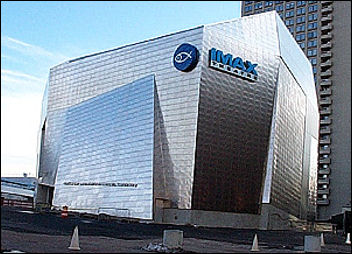
Before arriving in Boston I told my son Dylan we needed to see Beowulf in IMAX 3-D, and he said forget it — Boston’s two IMAX theatres (the Mugar Omni and the Simons IMAX theatre-aquarium) just show docs and travelogues. Hard to believe. Hollywood flicks projected in IMAX (and especially IMAX 3-D) are delivering big-time thrills like nothing else these days, but if city folk want to catch the IMAX-ed Beowulf, I Am Legend later this month or The Dark Knight next summer, they’ll have to hump it out to suburban Natick or Reading.


New England Aquarium IMAX Theatre

Were Cinerama, CinemaScope and Todd A-O ignored by Boston exhibitors when they hit the scene in the 1950s? In any business you have to go with the flow and change with the times, so why don’t Beantown exhibs have at least least one Hollywood-friendly IMAX house? Get with the program and hubba-hubba, guys.

A local critic offered an explanation. Boston, he wrote back, “is a big-league film town with a severe resistance to change, a sense of entitlement from the cultural institutions, and a belief that people don’t go ‘downtown’ to see movies but rather stay in the ‘burbs where they already live.

“I do think we’ll be seeing more and more 3D downtown in the coming years — basically as the Loews Common
installs more digital projection — but the real estate is scarce for a new IMAX build, and perhaps and the Aquarium and Mugar Omni don’t want to sully their mission (or simply may not be able to, for any variety of reasons).

“In general exhibition has fled Boston proper,” he explained. “The only two movie theaters left within city limits are the Common and the Fenway. That’s not counting the arthouses in Brookline and Cambridge, and the multiplexes of various size in the inner suburbs, 10 minutes from downtown. This is a far cry from the not-so-old days when there were dozens of theaters in Boston.”

Insdorf booted from NPR photoplay committee?

Fox 411’s Roger Friedman reported today that Annette Insdorf, the distinguished critic, film scholar and Columbia University film department chief, bas been elbowed out of the National Board of Review’s executive photoplay committee. If true, this move divests the NBR of its only shred of credibility in dispensing end-of-the-year movie awards. The news comes only one day before the NBR will vote and announce its 2007 winners, and, if confirmed, will obviously make the group seem even more tainted that is has been in the past.


Reportedly heave-ho’ed NBR board member Annette Insdorf; NBR honcho Annie Schulhoif; Fox 411 columnist Roger Friedman

As Friedman reports, the National Board of Review “is otherwise composed of dilettantes and senior citizens who pay around $500 a year as members to watch movies and get their pictures taken with celebrities. [The group] is a kind of a laughingstock among movie press people, the studios and even the actors and directors.

“What’s interesting about the NBR is that despite the membership, the executive photoplay committee makes the ultimate decisions about who, and what, will get awards. Most of those decisions are based on the members’ connections to the studios and who they think will show up for their annual awards show and dinner in early January.

“Insdorf was considered the only sane member of the group, and the only one who would advocate based on merit. With her out of the voting, it’s feared that the much maligned president Annie Schulhof will push through a number of winners less deserving than others.

“Members of the executive photoplay committee are kept secret. But I am told that some other members, all Schulhof pals, include unknowns like ancient mariner Keith Edwards (his credits include [productions by] David Merrick and David Susskind) and 74-year-old Amy Greene-Andrews, the ex-wife of considerably deceased minor producer Milton Greene (1957’s The Prince and the Showgirl).”

And yet, as Friedman notes, “With the Writers Guild strike in full force, the NBR could — in a very weird world — wind up being the only awards show for some time. Picket lines could severely damage if not altogether halt other upcoming awards shows such as the Oscars and Golden Globes.”

Ledger’s “Joker” continues the threads

Big-screen psychopaths are a kind of close-knit brotherhood. They seem almost genetically linked in being (a) utterly consumed by a ferocious past, (b) possessing the usual smirky, self-amused personality and (c) their general indifference to common-ground values. I don’t know where villainy can go over the next 10 to 50 years, but I know it’s been in the same place for the previous 50. I’m not saying I’m fatigued with this, but will there ever be a new flavor along these lines?


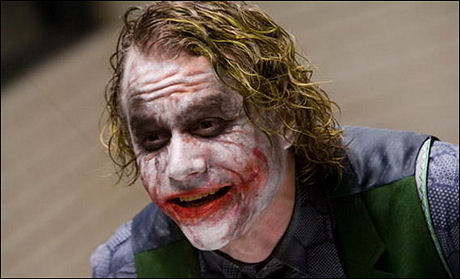
Heath Ledger’s “Joker” in Chris Nolan’s The Dark Knight

Robert Mitchum‘s nutso preacher in Charles Laughton‘s The Night of the Hunter (’55) was an early manifestation, and perhaps the first. Jack Nicholson‘s “Joker” in Tim Burton ‘s Batman was another big gong in this vein. Hannibal Lecter, to some extent. Anton Chigurh, certainly. And now another inhabiting, apparently, is on its way from Heath Ledger‘s “Joker” in Chris Nolan‘s The Dark Knight(7.18.08).

Consider this scene from the opening of Nolan’s upcoming Batman film, which was previewed last Sunday night in the IMAX format in Manhattan, and will be attached to general release prints of I Am Legend (opening 12.14). It’s been described in a 12.3 MTV piece by Josh Horowitz.

William Fichtner, playing a mob-front banker, is about to be dispatched by a masked Ledger at the climax of a bank job: “The criminals in this town used to believe in things,” Fichtner seethes. “Honor. Respect. What do you believe in?” He screams it again, louder: “What do you believe in?”

The mask comes off, and Ledger’s “grinning, scarred face” is revealed at last. “I believe whatever doesn’t kill you simply makes you …” — a pause before the final word — “stranger.”

That line is a little too arch and cocky for Anton Chigurh to have said in No Country for Old Men, but it’s from the same nutter hym book. And I’m wondering again, without implying in any way that Ledger’s performance won’t be a huge kick in the pants, are we stuck with this kind of villain for the rest of our days? Is any actor or director or writer going to come along in five or ten years and do what Mitchum and Laughton did for the era of Davy Crockett, Dwight D. Eisenhower and Bill Haley and the Comets?

Apatow on WGA strike, from Peter Howell

The WGA strike situation “doesn’t look good right now,” producer-director-writer Judd Apatow tells the Toronto Star‘s Peter Howell. “I think if you look at what is being offered by the studios, it doesn’t look like they want it to end. I mean, it’s clear they want this strike to continue.

“It would cost very little money to end the strike and [the producers] are basically trying to create a way of paying people so that when the internet explodes, they’ll wind up paying less than they do now to writers. And I don’t think they’re going to get away with it.”

Now, that‘s a gulf and a half. The writers aren’t satisfied with current status quo arrangements and want more, but the producers, to hear it from the well-positioned Apatow, are not only opposed to this but want to pay writers less, in a future-tense sense, than what they’re currently getting.

“The writers really failed to stand up for themselves with the DVD (in a previous contract dispute) and they feel terrible about it,” Apatow continues, “and enough of them will not give up [meaning that the strike] will have to be resolved in a reasonably fair manner.”

Except that the vast majority of heavyweight producers and studio chiefs stopped believing in “fair” when they were 13 years old. Accepting the basic unfairness and occasional brutality of life and adjusting their game plan accordingly is how they came to be big alphas in the first place. “Fair?,” says Peter O’Toole to Jack Hawkins in Lawrence of Arabia as they discuss the campaign to capture Damascus. “What’s ‘fair’ got to do with it? It’s going to happen.”

Radar’s plastic surgery piece

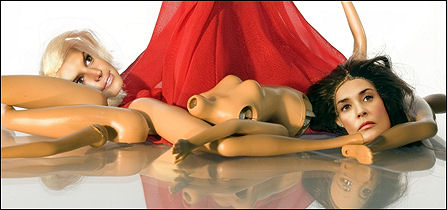
Why do celebs with money to burn continue to willfully disfigure themselves and risk worldwide embarassment due to inelegant or woefully miscalculated plastic surgery? And why do surgeons perform procedures that could very possibly turn clients into laughing stocks and eventually, one presumes, result is a diminishment of their own professional reputations? These are questions that I wanted answered in Dale Hrabi‘s Radar‘s piece about this bizarre industry, and yet they’re barely addressed.

The deep-down truth is that clients probably understand and perhaps even accept the fact that they may wind up looking like carnival freaks, but they’re willing to risk it and, if necessary, live with it because of a deep-down feeling that the metaphor of aging — which they see as a constant biological advertisement for the loss of power and the inevitability of death — is a much worse thing to cope with on a daily basis.

Downside quote: “No one wants to be the next Meg Ryan, whose 2001 misadventures in lip enhancement left America’s erstwhile sweetheart looking like a duck, a lapse in judgment at which Hollywood still shudders. ‘She basically installed a vagina on her face,’ says producer Clifford Streit (American Psycho), adding helpfully, ‘When your lips get that big, your eyes look too small.'”

Upside quote: “There’s so much bad work in L.A., it’s not even worth discussing. But if people see someone famous who’s 50 years old and looks mysteriously phenomenal, that’s when they start leaning in at the parties and whispering, desperately trying to figure it out,” a source tells Hrabi. The latest focus of such awe, the source says, is Michelle Pfeiffer. “After Hairspray and Stardust came out simultaneously, I don’t know anyone who wasn’t saying, ‘How the hell does she look like that?’ Now everyone thinks they can do it, too.’ If only they knew the secret recipe.”

Bellowing

The badness of a movie is directly proportional to a lot of things. Dave Barry once wrote that the more helicopters a film has, the worse it is. (Obvious exception: Apocalypse Now.) I say it’s animal yelling. Not Al Pacino-type shouting or the profane bluster in Glengarry Glen Ross or F. Lee Ermey barking at the “ladies” in Full Metal Jacket, but emphatic groaning, screaming or bellowing of any kind, for any effect. Live Wire, a Pierce Brosnan film that was on earlier today, reminded me of this fact.