“Zodiac” and Fincher

The Zodiac “director’s cut” (out on DVD on 1.8.08) screened the night before last at the Variety screening series at the Arclight. I drove over right after the Sweeney Todd screening and caught the last 45 minutes. I’d seen this cut on a screener sent over a month ago, and yet I felt curiously riveted, glued. I was saying “wow” all over again. This is what great movies do — they refresh their game and deepen and spread out a bit more every time.
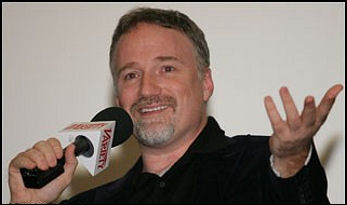

David Fincher at the Arclight — Thursday, 11.29, 10:55 pm

The percentage of Oscar handicappers and Academy apparatchiks who truly get this — who understand that Zodiac is the ultimate Shelby Mustang of ’07, a film so unique and special and unified that even half of the supposed cine-sophisticates don’t quite get the full splendor of it — amounts to a slender slice of the pie. But what a feeling it is to know. I’ve never been so certain of the right-on rootedness of any film in my life. The people who scratch it off their Best Picture lists shall think themselves accurs’d they were not here, and hold their manhoods cheap whiles any speaks that fought with us upon Saint Crispin’s day.

Zodiac director David Fincher, producer Brad Fischer and screenwriter James Vanderbilt sat for a q & a with Variety critic Todd McCarthy after the screening. Fischer had a good quote that I didn’t write down — “This is a newspaper film, not a serial killer film…more in the realm of All The President’s Men” — but no one felt inclined to say what it really is. Maybe it hasn’t struck a deep enough chord because most viewers haven’t been down the road that Jake Gyllenhaal‘s cartoonist character goes down. The quiet madness of an all-consuming obsession. Or maybe a lot of people have and it makes them uncomfortable.
Europeans honors “4 Months”

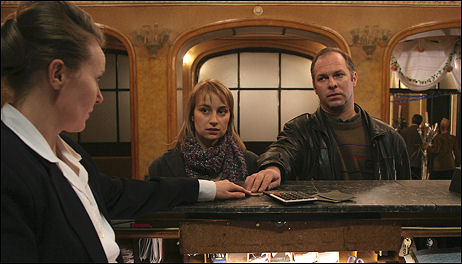
There is lingering irony in Cristian Mungiu‘s 4 Months, 3 Weeks and 2 Days having today won the Best Picture and Best Director trophy at the 20th annual European Film Awards. I’m referring, of course, to the reported “definitely mixed” reactions to the film among an Academy foreign film screening committee that happened a month ago.

A journalist-critic friend told me a little more than two weeks ago that the Roumanian film “may not even make the short list,” that some committee folk had complained it’s “too slow” and that others “didn’t like the fetus on the floor shot” and so on. Some felt otherwise, but there was generally a strongly split reaction.

It’ll almost be thrilling if the naysayers manage to block Mungiu’s Palme d’Or winner from becoming one of the five nominees for Best Foreign-Language Film. They have a reputation to uphold, after all. So what if there’s a slight difference of opinion from other parties, other countries? Isn’t it better to be “full of passionate intensity” (in the William Butler Yeats sense of the term) than to reconsider a position or give ground?

Excellent film preservation piece

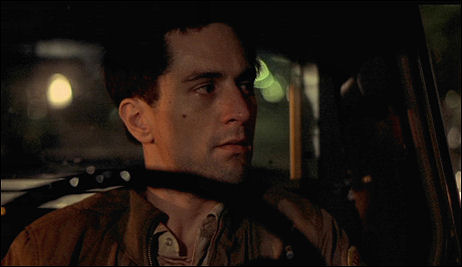
This 11.30 Variety article by Tatiana Siegel (with reporting by Anne Thompson) about the continuing insufficiency on the part of major distributors to adequately preserve their film libraries — including, surprisingly, relatively recent gems like Martin Scorsese‘s Taxi Driver — is one of the most soundly written and reported pieces on this subject ever posted by either Siegel or Thompson or anyone.

“With an eye on the bottom line, studios are reluctant to preserve or restore films for which they have no foreseeable distribution plans,” the article reads. “[And] preservation execs are facing impossible odds. Even though Columbia’s Taxi Driver is stored in Sony’s climate-controlled vault, it’s losing its color (though some critics have placed the blame on the restoration work Scorsese performed in 1996).

“Other vulnerable pics from the era include the seminal dark comedy Harold and Maude, which is in grave condition. Even The Godfather was recently in need of triage. Paramount sent the original camera negative to Warner Bros.’ facilities for color correction and sound remixing, among other restorations. The Francis Ford Coppola movie has been a consistent money-maker since its 1972 bow, on vidcassette, DVD and homevideo. If that movie is in need of repair, what hope is there for lesser-grossing films?

“Many 1970s films are suffering because they were preserved on a form of film called CRI (Color Reversal Intermediate), instead of a negative. ‘That particular form of negative turned out to be unstable and not good enough. A lot of the films had to be redone,” says Roger Mayer, a former MGM honcho who’s now chairman of the National Film Preservation Foundation.”

Memo from Turner

Before the Alabama New South Coalition gave its support today to Illinois Sen. Barack Obama, Perry County commissioner Albert Turner urged the group to support Sen Hillary Clinton for a reason that would have to be described as blunt, at the very least.

An African-American lobbyist and former assistant director of the Alabama Department of Community and Economic Affairs, Turner told the membership that despite his admiration for Obama, “The question you have to put forth to yourself is that whether or not in this racist country a black man named Obama — when we are shooting at Osama — can win the presidency of the United States?” Turner said Clinton is the Democrat most likely to win in November “because of her husband and because of some other things, mainly because she’s white.”

People who’ve sensed Bubba sentiments among the electorate don’t usually put it this way. The last time I heard anything remotely like this was from a Manhattan- based columnist during the Toronto Film Festival. “Go outside the big cities,” he said, and America “is a nation of rubes and crackers. As fair-minded and issue-driven as these voters like to portray themselves with pollsters, the bottom line is that some of them are constitutionally incapable of voting a black man into the White House.

“As far as these voters and Barack Obama are concerned, the columnist suggested, the ’08 race is a kind of a dry-run, getting-used-to-the-idea exercise that may allow for attitudes and conditions in 2012 or 2016 in which a black man (Obama or someone else) might stand a chance….maybe.”

Most of the readership dismissed this when I quoted the columnist in this space two and half months ago. The same pooh-poohers are now obliged to dismiss Albert Turner’s opinion as well. You know who you are. The forum is yours.

Godard & misunderstandings

“Any great modern film which is successful is so because of a misunderstanding.” — from an interview with Jean Luc Godard, Cahiers du Cinema 171, October 1965, from Godard on Godard, translated and edited by Tom Milne, and used as a preface in a Glenn Kenny piece about the ending of No Country for Old Men.

Emily Gould’s lament

“At the end of the day, your ideas in a book have less impact than if you had summed them up in two paragraphs on the most widely read blog at the most-read time of the day, so why do you spend two years on it?” — Emily Gould, the recently-resigned Gawker editor, talking to New York‘s Vanessa Grigoriadis for a 10.14.07 profile of the then-Gawker crew called “Everybody Sucks.” A wise and well written piece…worth 15 minutes of your time.