Boston cab altercation

Throwing a bag of Mexican takeout food at a cab is not what anyone would call a mature or attractive thing to do, but that’s what I did last night after a cab almost hit me as I was crossing Commonwealth Avenue. And I have to be honest and say it felt right for about three or four seconds. Then I felt like an idiot.

I turned to my left and saw a pair of killer headlights screeching towards me. Instead of leaping out of the way I went into a dead-freeze, deer-in-the-headlights mode. The cab stopped — no exaggeration — with less than six inches to spare.

Anyone who’s ever escaped getting hit like this knows that the usual reaction is rage. I think I said something really cool and clever like “what the f— are you doing, asshole?” Their cab driver screamed something back in the same vein. That tore it — he almost kills me and then he yells at me? That’s when I threw the Mexican takeout, which hit the passenger-door window.

The cabbie, offended by the assault, hit the brakes and jumped out, and I went into mock Sideways mode (Thomas Haden Church swinging the club on the golf course) and howled like an animal. The driver jumped back in and drove off. End of dignified altercation.

Looking Back At Death Proof

There’s nothing left to do now except sift through the last eleven and a half months for films to reconsider…maybe. The year is over, it’s settle-down time, screenings have stopped, and Christmas is only seven days away. So how about some lookin’ back, end-of-the-year love for the crazy-brave but titanically miscalculated Grindhouse, the three-hour exploitation double- feature flick that bombed so badly last April it just about sank the Weinstein Co.? It was a wank and a tank, but at least it was about an idea — a conceit — and it stuck to its guns.
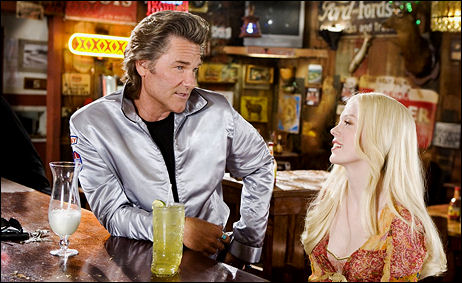

Kurt Russell, Rose McGowan in Quentin Tarantino’s Death Proof

There should at least be a a little retro affection for Death Proof, the Quentin Tarantino segment that delivered some of the tastiest, self-amused dialogue of the year, as well as one of the all-time greatest car-chase sequences…no?
I sat through a good portion of Death Proof the other day. (Not the shorter theatrical version, which is probably gone forever, but the longer, lap-dance version that came out on DVD last September.) There’s an art to making an agreeable waste of time — a film that totally skims the surface and brings absolutely nothing to the table of any consequence, but at the same time one that people half-enjoy because it has some nice moves and (this is essential) is 100% committed to its sense of swagger and is head-over-heels in love with itself because of this.

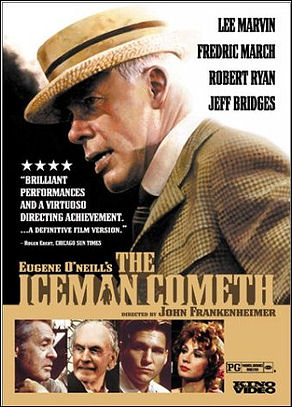
I love, love, love the Suntman Mike dialogue in the barroom in the first half of this thing. Truly, there is something amazing brewing inside Kurt Russell as he peels off line after line in that slow-hand, seductive drawl of his. I said last April that Tarantino should have made a kind of Iceman Cometh out of this character and this setting — it could have been talk- talk-talk for two or even three hours and I, for one, would have eaten it all up. For the first time in his life Tarantino could have delved and dug in. He could have followed his feelings and beliefs and lamentations and just gone for broke. He could have riffed and probed and wondered about every last thing under the sun, and I would have relished it. (Probably.)
But Tarantino and his genre-wallowing partner Robert Rodriguez were committed to their memory-lane concept — making a pair of deliberately cheesey exploitation films that could have played in an urban grindhouse theatre in 1971– and so Death Proof had to leave that Austin bar and head for the hills of California (i.e., that rural winding-road area north of Solvang) and become a dopey but thrilling car-chase movie, which everyone admired for the 100% real, CG-free thrills.
My only beef with this abrupt changeover was that Tarantino totally abandoned his affection for Stuntman Mike by turning him into a raging psycho who moaned and wailed like a nine year-old when things went against him.

What is unquestionable is that by sticking to their Grindhouse concept Tarantino and Rodriguez outsmarted themselves and Harvey Weinstein and most of the ticket-buying Average Joes, who either didn’t get it or decided the idea was too much of a throwaway thing (especially with that three-hour length) and paid to see Disturbia instead.

I suppose I’m just raising a glass to Russell and Stuntman Mike and the movie that Death Proof could have been if Tarantino had had the character and the balls to think beyond doing ’70s genre revisitings and become a real writer and filmmaker, which I thought he might become in the early to mid ’90s before heaving a great sigh and finally realizing he’s too lazy and distracted by this and that to buckle down.

But in spurts and flashes the first half of Death Proof showed again that Tarantino still has the voice and the music. What a shame that he won’t (or can’t) focus and really get down.

“Batman: The Killing Joke”

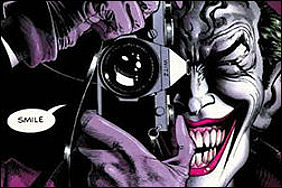
Batman: The Killing Joke is a one-shot superhero comic book written by Alan Moore and drawn by Brian Bolland, published by DC Comics in 1988. Dark Knight director Chris Nolan has said that The Killing Joke [served] as an influence for Heath Ledger‘s Joker character. Ledger stated in an interview that he was given a copy of The Killing Joke as reference for the role.” — from the B:TKJ Wikipedia page.

H.O.V. lanes

Out west we call them carpool or diamond lanes, but here in Boston (and apparently throughout the New England and mid-Atlantic states) they’re called H.O.V. lanes — i.e, lanes for “high-occupancy vehicles.” In other words, people in these parts prefer a dorky acronym over plain English. I was driving into Boston the other day and I didn’t have a clue what H.O.V. meant, but then I read in Glenn Kenny‘s L.A. Times Mike Nichols profile that Charlie Wilson’s War “belongs in the H.O.V lane”…what?

Tapley’s Top Ten of ’07

Variety columnist and In Contention owner Kris Tapley has chosen his top ten films of ’07. I can at least state my strong agreement with the pickings of The Assassination of Jesse James by the Coward Robert Ford (#1), The Bourne Ultimatum (#3), There Will Be Blood (#5), Lake of Fire (#6) and Control (#9). The rest are a bit of a muddle.

BFCA, VH1 on same page/site

The Broadcast Film Critics Association and VH1 have pooled forces, and part of the deal is a VH1 show called “Critics Choice: Best Movies of 2007” which kicked off last Saturday night and will be repeated throughout the month and into January, leading up to the Broadcast Critics Association’s Critics Choice Awards on 1.7.07. The next airings: 12.19 at 8 pm, 12.20 at 11 am, 12.23 at 10 pm and 12.28 at 9 am. Pete Hammond handles some if not most of the on-air schpiel.

Lane on “Sweeney Todd”

“For all the wild swipes of Sweeney’s razor, spattering red on the lens, was there not more threat, and mystery, in the sight of Johnny Depp as Edward Scissorhands — the lost soul who could kill at will but never did?” — from Anthony Lane‘s Sweeney Todd review in the 12.24 New Yorker.
Shouldn’t Lane be tapping out a blog of some kind? Is there a major-league film critic who writes less frequently? No one’s saying that volume rules above all, but reading appetites have become much more voracious over the least five years or so and you just can’t loll around and and bang out two or three elegantly-phrased reviews per month and call it sufficient. Because it isn’t. Not any more.

Kenny on Nichols

I can’t suppress a couple of responses to Glenn Kenny‘s L.A. Times profile of Charlie Wilson’s War director Mike Nichols, which ran yesterday.

Kenny cautions that “one shouldn’t underestimate the Nichols touch” in having made War into a potentially popular “sand” movie, despite Americans having said “no way” to every ’07 film with the slightest whiff of any Middle Eastern elements. Maybe Charlie Wilson’s War will be the exception — it’s certainly entertaining enough. But nobody has a “touch” to have and to hold. Artists are touched by inspiration like lightning — it passes through them, and they are nothing more than lucky conduits when this happens.
The exceptional, long-lasting artists are those with a knack for keeping themselves open to inspiration, or who at least know how to position or trick themselves into the right state of mind so that lightning comes their way more often than not. The fact that creative lightning touched Nichols repeatedly from the days of his Nichols & May routines in the early ’60s until the end of his Phase One career caused by the total crash-and-burn reception to The Fortune, or that he got a version of it back in his Phase Two career with Biloxi Blues, Heartburn, Silkwood, The Birdcage, Primary Colors, Closer and Angels Over America is no indication, much less an assurance, that the lightning was still with him when he shot and edited Charlie Wilson’s War.
Kenny mentions a profile piece by the New Yorker‘s John Lahr in which Nichols “described the waning inspiration that struck him in the years after his steep ascent” and that “he also reveals that in the ’80s he struggled with a Halcion dependency that induced a breakdown.” But Kenny doesn’t acknowledge the extreme unusualness of Nichols’ career in that his Phase One brushstrokes — his signature style as a filmmaker from The Graduate to The Fortune — had totally disappeared when he returned to filmmaking in ’83 with Silkwood. He had literally abandoned his muse of the ’60s and early ’70s and become an entirely different (one could say less distinctive and more accomodating) man.
The late Richard Sylbert, the fabled production designer who worked for Nichols on Who’s Afraid of Virginia Wolff, The Graduate, Carnal Knowledge, The Day of the Dolphin and The Fortune and obviously saw it all first-hand, explained this directorial-personality-change arc a few years ago over a lunch at Swingers.