
Movie Brats of 1967

I checked the entertainment and movies section of today’s New York Post for my piece about how the revolutionary Best Picture lineup of 1967 (the story of which is richly told in Mark Harris‘s just-published Pictures at a Revolution) to no avail.
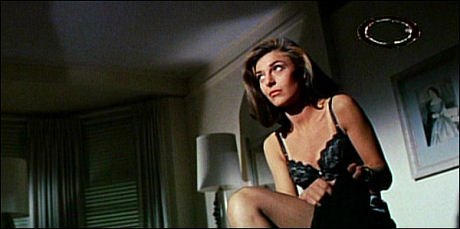
I assumed they’d killed it because it was too dense or thinky or whatever. (I tried to write it like a borough guy but there’s a limit to such contortions.) Then my editor wrote back and said no, it’s in the paper — in the Opinion section.
What was I thinking? A totally reported piece about Hollywood then and now, zero opinion, running on Oscar Sunday with no links in the Movie Section. I guess it wouldn’t have made sense to run it in the Classifieds.
It’s called Year of the Brat with a subhead that reads “In 1967, the Young Turks Took Over Hollywood — And Invented ‘Indie’ Film.” Even if all they accomplished in ’67 — and this was no small potatoes — was to get themselves a solid foothold in a business that would continue to be stodgy and erratic and status-quo-minded in its constant attempts to kowtow to the chumps.
The best quote in the piece comes from Michael Clayton director-writer Tony Gilroy: “All those films and filmmakers [behind edgy 1967 nominees Bonnie and Clyde and The Graduate] were jumping off the cliff. They didn’t know what was happening next.
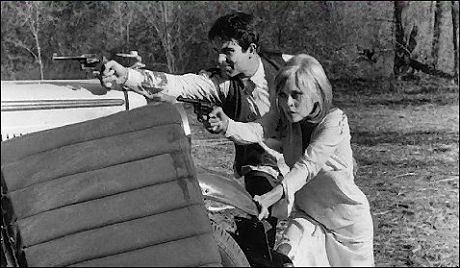
“I think in the last 40 years, it’s become hard to see where the cliff is anymore,” Gilroy states. “There’s been a fundamental shift in what constitutes revolutionary. We’ve been through so much over the years [that] we’ve seen over the abyss. I think movies are less about astronomy today than quantum mechanics. They’re about going in rather than going out.”
On second thought, it’ll be kind of agreeable if Michael Clayton steals the Best Picture Oscar tonight. Quantum mechanics!

Responding to Scott’s Oscar piece

The Academy Awards represent “the self-assessment of a self-interested, self-involved professional clique,” writes N.Y. Times critic A.O. Scott. “It can be argued that, over the past decade or so, this roughly 6,000-member [Academy of Motion Pictures] has become more discerning, more willing to confer its blessings on quasi-independent, medium-budget films instead of the lumbering, middlebrow prestige productions it used to favor.
“Nowadays the main divisions of the studios — Columbia, Paramount, Universal and the rest — specialize in big-ticket entertainment aimed at a global audience. Their art-house subdivisions — the Miramaxes, Searchlights and Vantages — have taken over the business of supplementing cash with cachet.
“Connoisseurs may be satisfied with this arrangement — we can watch the broadcast without superciliousness or slumming — but a showbiz populist might complain that, in honoring the products of the studio specialty divisions, the academy has lost touch with the mass audience.”
Yes, it has — that is exactly what has happened — and thank heaven for that. The tastes and ticket-buyings of Gorilla Nation keep the film industry stable and flush, for the most part, and allow for the funding of the No Country‘s and There Will Be Blood‘s. But in the privacy of one’s home and in the company of trusted friends, there is nothing to do when discussing most of the Gorilla Nation favorites except shake your head and say, “What a bunch of fucking peasants.” And then maybe go outside and spit.
I found this Scott paragraph perplexing,by the way: “The system is not exactly winner-take-all, but it does leave behind a distressingly high number of designated losers, among them some of the most interesting and daring films of the year.
“It should not make a difference that, say, Into the Wild, Starting Out in the Evening and Before the Devil Knows You’re Dead are barely represented in the Oscar sweepstakes. Your list of glaring omissions may be different, but if you’re among the passionate admirers of Lust, Caution or We Own the Night or 3:10 to Yuma, you are similarly stuck savoring the sour grapes of your own good taste.”
With the exception of Before The Devil Knows You’re Dead, each of the above-mentioned films is an unqualified short-faller that has disappointed or offended or bored the pants off the vast majority of the people I know and suss things out with on a regular basis.
Yuma had a stirring and satisfying second act and a fine Russell Crowe performance, but it didn’t begin to approach the time-machine realism and visual majesty of The Assassination of Jesse James by the Coward Robert Ford. (On top of which way too many guys got shot, and I really didn’t like those snow- covered plains being plainly visible just outside of that snow-free town where the final shoot-out occured.)
Starting Out in the Evening had too faint a pulse.
Much of Lust Caution was exquisitely made, but it had a perverse and incomprehensible ending that left most people stranded. Endings matter enormously.
We Own The Night had a great car-chase-in-a-rainstorm, but the rest of it was borough garbage.
And Into the Wild was finally alienating because Emile Hirsch‘s character was too selfish and egoistic.