Rain People

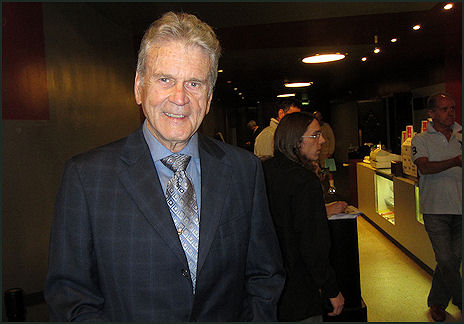
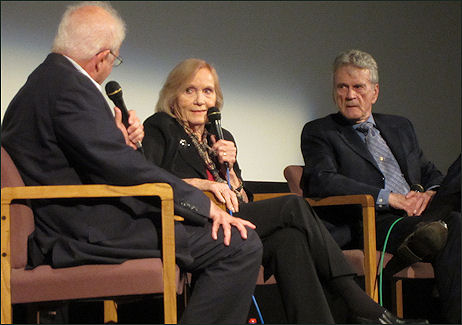
I’d always wanted to see Fred Zinneman‘s A Hatful of Rain on a big wide screen (rather than on a small television set, which is what I saw it on when I was 15) because it’s in black-and-white Scope — my favorite format. So I caught it last night at the Aero, and briefly spoke with star Don Murray (who’s looking very fit and vibrant at age 82) and listened to a q & a with Murray and costar Eva Marie Saint.
Released in 1957 and set mostly in a small lower-Manhattan apartment, A Hatful of Rain is an on-the-nose melodrama about middle-class drug addiction. Murray plays Johnny Pope, a married Korean War veteran in his mid 20s with a heroin habit that keeps him out at all hours. His brother Polo (Anthony Franciosa) has helped him score for months out of misplaced sympathy, and in the process has blown $2500 that had been loaned by their father (Lloyd Nolan), who’s just come up from Florida to visit. And Pope’s wife Celia (Saint) suspects that he’s having an affair, and is in fact relieved when she finally discovers that he hasn’t been unfaithful in a sexual sense.

The main problem I had with A Hatful of Rain (which is a great-sounding title without thinking about what it might mean) is that it’s not actually about drug addiction as much as 1950s middle-class denial — about the inability of Average Joes like Johnny and Polo to own up to shameful situations and deal with them straight-on. The ’50s were about everyone trying to live up to a nice white-bread homogenous ideal, about “everything’s okay” and conforming to the norm and not rocking the boat, and boy, is this movie ever about that!

And so for at least 95 minutes of A Hatful of Rain‘s 109-minute running time, all that happens is denial and lying, denial and lying, and more denial and lying. No habit, no horse, no desperation. “Everything is fine, pop…really.”

The guilt-wracked Murray and Franciosa feel can’t tell Saint or Nolan what’s actually going on despite abundant indications that something’s way off, and it becomes very, very exasperating after an hour of this. You’re muttering to yourself, “C’mon, guys…lying about being a junkie all the time is much, much worse than facing up to it, no matter how ashamed you might be.” And you have to sit through another 35 to 40 minutes of endless dodging and fibbing and covering up before it all comes out in the wash.

And Franciosa is constantly over-acting, and I mean in a way that says, “I am an actor playing a character and I am going to pretend like hell that I’m feeling all the heavy stuff that I’m dealing with because an audience needs to understand and consider all this.” He’s giving it everything he has and then some, and it’s definitely one of the more painful performances I’ve had to sit through in a long while.

It’s partly Zinneman’s fault, of course — he could have told Franciosa to use a little subtlety and economy, but he didn’t. But on-the-nose emoting was par for the course in the 1950s for all but a very few (i.e., Brando, Dean, Clift). Henry Silva plays “mother,” Murray’s drug dealer, and William Hickey plays Silva’s twitchy-scumbag pally or assistant or whatever.

And yet Michael V. Gazzo‘s script, adapted from his B’way play, is reasonably realistic and well-honed for what it is. It has believable dialogue and behavior that seems palatable and recognizable. And it has a clean and decisive ending. (I’m presuming everyone knows that Gazzo played Frankie Pantangeli in The Godfather, Part II.)

But the Aero’s projection, unfortunately, was a little soft. Or the print was a dupe. Either way it looked okay but not all that terrific. I kept saying to myself, “This is going to look so much better when and if it comes out on DVD.”
Elton and Kiki

I realize, of course, that hundreds of thousands of people who don’t know any better make fools of themselves in karaoke bars on a nightly basis, but I can’t understand why intelligent journos who have a clue would degrade themselves in this fashion. “Hey, I have an idea! Let’s all go to a karaoke bar and prove to drunken strangers that we can’t sing or phrase as well as professionals! And are sometimes flat or off-key!” HE rule #39: if you’re not all that good at something, keep it to yourself.


MSN‘s James Rocchi and Cinema Blend‘s Katey Rich.

Read more

Mormon Limit

Manhattan-visiting friend: “Just a reminder to call anyone you know who can help you score tickets to The Book of Mormon. I saw it last night, and it’s the real deal. It’s thrilling, and, yes, irreverent, blasphemous and an equal-opportunity offender. But would you expect anything less from Trey Parker and Matt Stone?

“But what’s amazing is their real love and understanding of musical theatre, and the fact that is has a huge palpitating heart at its center. I don’t remember sitting in a Broadway theatre surrounded by a more thrilled audience (which last night included Sting and Sandra Bullock.)

My response: “I called [a producer friend] and he offered to help me — but only with premium tickets at $260-something a pop. I can’t do that. It’s just a Broadway musical. It’s just two and half hours in a theatre. Plus the irksome and roly-poly Josh Gad, who all but singlehandedly destroyed Love and Other Drugs, is in it…so I’m not completely hearbroken.”

Stockwell In A Box

With today’s release (and concurrent critical savaging) of Cat Run, it’s time to once again lament the saga of John Stockwell — an extremely bright, hip and likable guy who started out as an actor in the ’80s (Top Gun) but really found his footing as a director — first with the entirely decent, well-shaped, movingly performed Crazy/Beautiful (’01) and then Blue Crush, one of the best modestly-proportioned surfer movies I’ve ever seen.

But since then Stockwell has fallen into a trap in which the only films he’s been allowed (or been able) to make are callow thrillers and youth-market programmers — Into The Blue, Turistas, Middle of Nowhere, etc. And now Cat Run, which Time Out‘s Nick Schager calls “a third-generation Tarantino rip-off distinguished only by its equal-opportunity nudity.” Knowing Stockwell as I do (which is to say slightly or somewhat), I believe he’s much better than the material he’s managed to work with over the last eight years. Which is really too bad because life is effin’ short, man.

Tree Turnaround

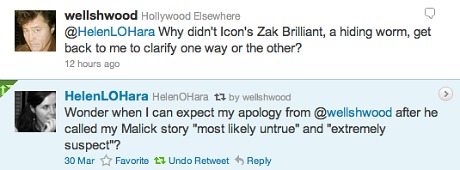
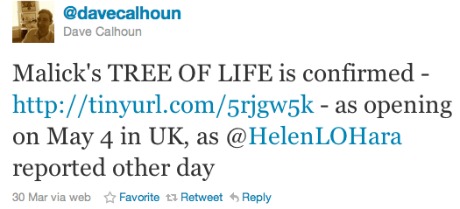
While waiting for last night’s 7:30 pm showing of A Hatful of Rain to begin at the Aero, Empire‘s Helen O’Hara tweeted that I owed her an apology for having written last Monday that her 3.28 story about Britain’s Icon planning to open Terrence Malick‘s The Tree of Life on May 4th, or several days before its expected debut at next month’s Cannes Film Festival, was “probably incorrect.”

Because O’Hara’s story is apparently correct.

Icon’s 5.4 Tree release was confirmed yesterday (or the day before?) on the Film Distributor’s Association list and O’Hara also reconfirmed the story in an update. This despite a distinct possibility that Fox Searchlight will pressure Icon into backing off because a 5.4 release in Great Britain would all but torpedo the Cannes hoo-hah they were (and still are) looking to get from debuting The Tree of Life there.

So I apologize — O’Hara was right and I was led to believe that she “probably” wasn’t. Let the record show that I never said her story was definitely wrong. I wrote that I’d been told it was “most likely untrue” by two Fox Searchlight execs and also that two key sources — Jill Jones, chief of int’l distribution for Summit Entertainment, which holds int’l rights on The Tree of Life, and Zak Brilliant, VP distribution and publicity or Icon Distribution UK — had refused to confirm or deny. I called and emailed both, pleading for assistance. It was like talking to a brick wall.

This morning I wrote Brilliant and Jones again, asking if this is really a set-in-stone plan and if there’s any chance of rescinding, etc.

A 3.31 analysis of the situation by The Playlist‘s Oliver Lyttleton says Icon’s decision “comes at the cost of screwing over their fellow distributors — a Cannes premiere seems to have been key to Fox Searchlight’s strategy for the film, and, should the date stick, they’ve now got less than two months to rejig their campaign. There’s no doubt that the studio would have been furious when they heard the news — in fact, considering their initial denial, they may have found out about it through Empire’s story, rather than being notified by Icon, and initially disbelieved it.

“Does this mean that Brits will be able to head to their local Cineworld on May 4th and buy a ticket for The Tree of Life? Possibly not. In fact, probably not. Summit International, who acted as the sales agent for the film, has major relationships with both Icon and the Cannes Film Festival, and if Icon’s hand gets forced, it’s likely to be by Summit.”

What happened, says Lyttleton, was “a case of the right hand not talking to the left hand. If one studio is releasing a film worldwide, then the timing of its release can be perfectly synchronized, but for an independently produced project like The Tree of Life, which will be released by dozens of different distributors worldwide, it doesn’t work in the same way. Once a final print has been delivered, generally speaking, only good faith and mutual interest keep the companies in sync.

“Whether they were seeking publicity by being the first territory to release the picture, or simply decided it was the most effective date for the film, Icon genuinely picked the May 4th date, and as of the moment of writing, intends to release it then.

“A British opening doesn’t rule the film out of Cannes — last year’s out-of-competition opening film, Robin Hood, started screening for the public in the U.K. on the morning of its bow on the Croisette, while Pedro Almodovar’s Broken Embraces was in competition in 2009, despite going on general release in Spain two months earlier. But it’s almost certain that Icon will have more to lose, reputation-wise, if they stick to their guns, and they’ll likely defer to Fox Searchlight.”

Here’s my guess: (a) It is widely presumed that The Tree of Life is no one’s idea of a popcorn film and may in fact be a blatantly uncommercial property (who knows?), and given this (b) Icon decided they’d get more of an opening-week bang out of a Sean Penn-and-Brad Pitt-with-dinosaurs movie with limited critical response (i.e., with only British critics weighing in). Rightly or wrongly, they came to believe that a significant percentage of Cannes Film Festival journalists will trash it, and that this international chorus will obviously generate negative online buzz so why not open it before this happens?

Timing

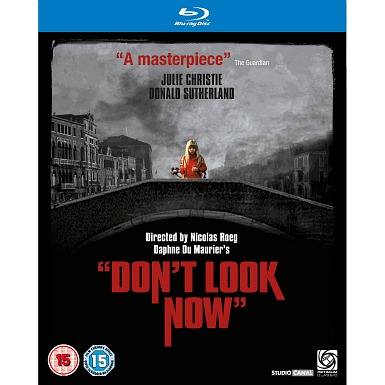
With the recent dispute between Donald Sutherland and Peter Bart over the filming of that legendary Don’t Look Now sex scene (which Bart has more or less admitted error on by telling The Hollywood Reporter‘s Merle Ginsberg that the scene in question was shot “over four decades ago!”), there’s considerable interest right now in Nicolas Roeg‘s 1973 thriller. Which bodes well for the British Region 2 Bluray that streets on 6.27.11.

Will there be a version for Americans without multi-region Bluray players? Of course not. Or at least not in the foreseeable future.

Shutter Speeds

In a speech given today at CinemaCon, the exhibition industry’s annual convention in Las Vegas, James Cameron has announced he’ll make Avatar 2 and 3 “with a native frame rate of 48 or 64,” which will deliver fluid motion in the vein of Maxivsion (which Roger Ebert has been promoting for years) or Showscan. Cameron will demonstrate various frame-rate samples tomorrow at the Coliseum theater inside Ceasar’s Palace.

MSN’s James Rocchi tweeted as follows: “James Cameron keeps talking about Avatar 2/3. It’s the only time in history the nerd who wants a sequel nobody else does has the power to do so.”

Not Right

$275 is too much for a seat at a Yankee game. It’s not even outdoors on the first or third-base line where you can smell the dirt and grass — it’s an ambassador club box over the right-field bleachers. They used to charge 25 cents for a bleacher seat in Babe Ruth‘s day. I don’t know what prices were like when Roger Maris and Mickey Mantle were slamming homers, but I’ll bet they had some relationship to the price of rice…unlike today.

Rewrite

TheWrap‘s Sharon Waxman has reported that there may have been “significant misinformation” about the shooting death of Hollywood publicist Ronni Chasen last November. Apparently she may have taken three in the arm and two in the back rather than five in the chest…whatever. The feeling here has always been that the official explanation is ridiculous. The late Harold Smith shot Chasen at a Sunset Blvd. stoplight after chasing her along that high-speed avenue on a friggin’ bicycle? It may have happened, but no self-respecting screenwriter would dream up such a scenario for fear of being laughed out of town.

Fincher, Jolie, Cleopatra…?

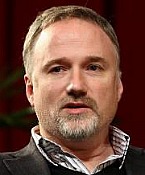
Last Tuesday Deadline‘s Michael Fleming outlined the latest configuration of Sony’s Cleopatra biopic — Angelina Jolie in the lead, David Fincher possibly directing, Scott Rudin producing from a script by Brian Helgeland (but with a new punch-up writer possibly being sought), based on Stacy Schiff‘s Cleopatra: A Life. An inside source says it’s all “conjecture” at this point, but I’m hearing the project may actually come together.

A guy I don’t know much less trust directed me to an IMDB comment posting, allegedly written by someone in the loop, claiming that (a) Fincher is “almost confirmed,” (b) “Filming to begin late in the year (Malta, Cyprus or Egypt),” (c) “The roles of Julius Caesar and Marc Antony to be given to ‘no big stars,'” presumably because the intent is for Jolie to dominate and be central to the proceedings in every conceivable way, (d) “Brad Pitt was never considered for the role of Marc Antony”…THAT WOULD HAVE BEEN TOTALLY RIDICULOUS!, (e) “The film will be a political epic,” and (f) “Expect a fabulous work of make-up…Angelina to appear completely unrecognizable.”

This last bit of possibly imagined information is the most interesting to me. Cleopatra was not a ravishing beauty, by all historical accounts. The idea of Jolie making herself look a wee bit homely with a different nose or something sounds highly intriguing. It worked for Nicole Kidman in The Hours. When’s the last time a world-famous actress significantly altered her looks to portray a head of state? When Bette Davis had her head shaved for The Virgin Queen?

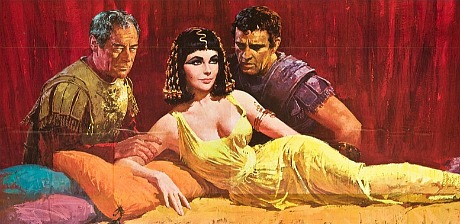
I’ve read about how this would be “the first telling of the Cleopatra story from a woman’s perspective” and that “instead of simply being a seductress, as she was portrayed by Elizabeth Taylor in the 1963 Joseph L. Mankiewicz-directed film, Cleopatra is also a shrewd politician, strategist and warrior, with sexual charisma to spare.”

What? Mankiewicz and Taylor’s Cleopatra wasn’t just some titillating queen who wore heavy mascara. She was written and portrayed as a complex combination — seductress, clever politician, willful negotiator, perceptive reader of character, something of a battle strategist. So we’re going to have to hear a bit more about the new version to be persuaded that it’s going to be a markedly different thing than 20th Century Fox’s “monumental mouse,” as critic Judith Crist called it in her review.

Here’s how I put it to a friend this morning:

“I’ve been in denial about Sony/Rudin’s Cleopatra project, and now I’m finally facing it full-on: David Fincher, my hero, might actually direct this? Wow.

“Whatsername’s source book is entirely respectable, and there certainly ought to be room for another take on the Cleopatra saga, etc. But — it might as well be faced and dealt with straight-on — the stink from Joseph L. Mankiewicz’s 1963 turkey, despite Rex Harrison‘s superb performance and other stirring and agreeable aspects, is, 48 years after the fact, still lingering in the air. And so there’s a slight feeling of ‘uh-oh’ or at least ‘oh…really?’ when you hear about a Cleopatra feature.

“Plus I have to wonder how persuadable Jolie, a tabloid queen to millions, can be in a historical context? I’m thinking of my reaction to her as Alexander the Great’s mom in Oliver Stone‘s film. But if they make her look a bit homely, maybe.

“I’m just being honest and open here. Rudin’s project, image- and expectation-wise, has to overcome the stigma of the 1963 film, and that in itself, however unfair, is going to be a bit of an endeavor. And I’m also asking myself how Fincher, a modernist and/or futurist and a digital guy who’s never gone further back in time that early 20th Century New Orleans, is going to find his way into an exotic 2000 year-old culture…the mind reels.

“I’m not slagging this project at all. I’m just being upfront and honest about the associations that people have with the name ‘Cleopatra,’ etc. If anyone can turn the image around, it’s Fincher and Rudin…don’t get me wrong. But the image does need turning around because everyone in the media remembers what a catastrophe the ’63 version was….that’s all I’m saying. Obviously doable. An educating process required.”

Rum and Stoli?

FilmDistrict’s decision to open Bruce Robinson‘s The Rum Diary, an apparently troubled adaptation of the Hunter Thompson book with Johnny Depp in the lead role, on 10.28 is well and good. FilmDistrict co-founder Graham King has said he’s “extremely proud to bring this novel to film and to honor Hunter’s legacy”…hah!

But let’s not forget that the film may be opening tomorrow (3.31) in Moscow, according to a longstanding IMDB listing. And if it is, let’s hope someone is there to review it. I mentioned on 2.5 that I’d love to fly to Moscow for the occasion, but you have to live within certain limits.

Haines Is Gone

In my head, Farley Granger has always been and always will be “Guy Haines,” the anxious, darting-eyed, pinch-mannered tennis player in Alfred Hitchcock‘s Strangers on a Train (’51). The 85 year-old actor, also known for his performance as an anxious, darting-eyed, pinch-mannered gay murder accomplice in Hitchcock’s Rope, passed on 3.27, but for some reason the news is only just breaking now.

Granger copped a long time ago to being openly bisexual or mostly gay or what-have-you.

Here’s an amusing portion from his Wiki bio: “In Rope, Granger and John Dall portrayed two highly intelligent friends who commit a thrill killing simply to prove they can get away with it. The two characters and their former professor, played by Jimmy Stewart, were supposed to be homosexual, and Granger and Dall discussed the subtext of their scenes, but because The Hays Office was keeping close tabs on the project, the final script was so discreet that screenwriter Arthur Laurents remained uncertain of whether Stewart ever realized that his own character was gay.”

Until this moment I myself have never even flirted with the notion that Stewart’s character was supposed to be (or might have been) gay. I don’t think Stewart had it in him to play “gay.” He was too aww-shucksy for that.