
Dylan Speaks Out

28 year-old Dylan Farrow has written a letter to N.Y. Times columnist Nicholas Kristof about what she claims was a sexual assault by Woody Allen in 1992, when she was seven. Kristof has written a column that includes portions of her letter and which offers comments and questions.

No one can be clear about what may have actually happened, but I’m not going there again. Dylan has “come out” because of a special Golden Globe career-tribute award recently given to Allen in absentia. She obviously wants the world to know that Allen is not a right guy. She told Kristof that “when she heard of the Golden Globe award being given to Allen she curled up in a ball on her bed, crying hysterically.” It therefore seems a reasonable assumption that if the Hollywood Foreign Press Association had not given this award to Allen, Dylan would not have broken her silence…right?

Kristof’s access to Dylan was arranged through Mia and Ronan Farrow, with whom he’s friendly. In other words, whatever the final truth of the matter, feelings of rage and vengeance on the part of Mia and Ronan Farrow are why this incident is being re-aired. Dylan may have been violated by Allen 21 years ago, maybe, but the Kristof piece is meant to to cause damage or, if you will, deliver some payback. In the absence of incontrovertible proof, it’s basically a grenade thrown over the wall.
Read more

Russell Does Figure-Eights Around Durling

Legendary steam-of-consciousness surfer and genius director David O. Russell, who is currently Oscar-nominated for American Hustle, was tributed last night at the Santa Barbara Film Festival. Festival director Roger Durling tried to conduct a normal “interview” but Russell wasn’t going for it. In fact he advised the befuddled Durling to loosen up and just let it happen. Interviewers need to understand this. DOR doesn’t answer questions. Well, he does but if I’ve heard him say “I forgot the question” once I’ve heard it 15 or 20 times. All an interviewer needs to do is drop a thought or a memory byte or some fleeting observation into the vast lake of free-associating consciousness and tap-dancing, lightning-reflex improv that is Russell’s grab-bag mind and just….let him rip!


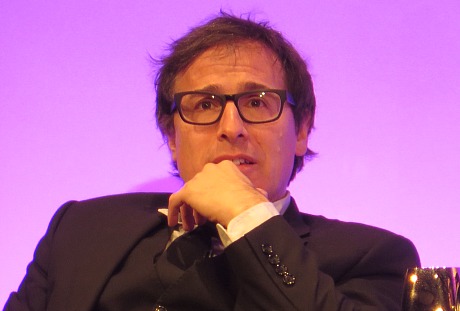
David O. Russell during last night’s tribute interview at Santa Barbara’s Arlington theatre.

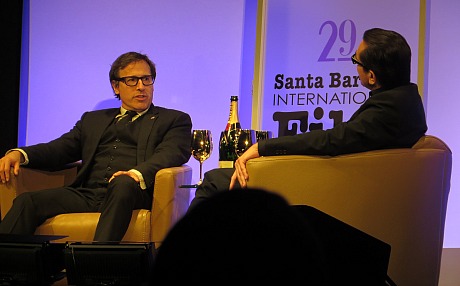
Russell and SBIFF festival director Roger Durling.

And yet if you go on too long (as I feel Durling did last night — the interview lasted two hours or about 30 minutes more than ideal) Russell’s incandescence can burn out. SBIFF interviews are a dance but Russell’s rap is a world-class “act” and it all ended well. And yet there’s a lesson to be learned: Always leave them hungry for more.

Is Russell going to win Best Director for Hustle, having been denied a win for Silver Linings PLaybook and The Fighter? The betting seems to favor Gravity‘s Alfonso Cuaron but who knows? I love Russell. I could listen to his always perceptive but scattershot observations and recollections every day. It doesn’t matter if I don’t feel quite as enthusiastic about Hustle as I did about his previous two films. I’m in for the long haul, and so is DOR. Right now is the best time of his life (and mine). Russell is on a roll, nothing can stop him but eventually something will. It’s inevitable. But Russell has the spirit to keep punching and pitching so he’ll bounce back when that happens — no concerns on that score.

Read more

Under Siege

A smug, semi-beguiling asshole radio personality (Steve Coogan) makes ratings hay out of a hostage/standoff situation after a sacked employee (Colm Meaney) loses it. I’m sensing something moderately clever and subversive as far as it goes. Alan Partridge (formerly titled Alan Partridge: Alpha Papa) earned an 84% Rotten Tomatoes score after it opened theatrically in England last summer and in Australia in the fall. A VOD debut will happen on 2.27 with a U.S. theatrical opening set for 4.4.

Respecting Mr. Schell

Maximilian Schell, the much-honored actor-director with the cultivated European air, died last night in Innsbruck at age 83. My dominant memory will always be his electrifying performance as Hans Rolfe, the clever German attorney who defended Burt Lancaster‘s Ernst Janning in Judgment at Nuremberg (’61), for which he won a Best Actor Oscar. Schell/Rolfe was a blend of crackling intelligence, necessary poise, a burning determination to be heard and a nativist resentment of American occupiers. He didn’t just hold up his end in that Stanley Kramer film — he was a virtuoso, a young actor riding a perfect storm of talent, timing and a first-rate script.

Schell’s other noteworthy performances: the larcenous, tuxedo-wearing mastermind thief in Jules Dassin‘s Topkapi (’65), a hyper and obsessive German officer in The Young Lions (’58), a Holocaust survivor with a hidden idetntity in The Man in The Glass Booth (’75), an anti-Nazi activist in Fred Zinneman‘s Julia (for which he was Oscar nominated and was given the New York Film Critics Circle award for Best Supporting Actor) in 1977, and Tea Leoni‘s estranged father in Deep Impact (’98).

Starting in the late ’60s Schell began to direct, write and costar in several German-produced films of his own devising, almost none of which I saw or even paid attention to. But the Oscar-nominated Marlene (’84), his documentary about Marlene Dietrich, was a major standout. Schell was forced to creatively adapt to a tough situation when Dietrich changed her mind about appearing in present-tense interview footage. But he managed it well and won a NYFCC award for Best Documentary.

The Austrian-born Schell was quite the handsome continental smoothie during the ’60s, ’70s and ’80s. But at some point during the ’90s his eyes changed, his voice became deeper and more guttural, and he grew a beard. In one of the oddest transformations in motion picture history (particularly for a good-looking guy who began as a German-styled Montgomery Clift by way of Cary Grant), Schell more or less became a variation of Akim Tamiroff. This, at least, is how he seemed to me in Little Odessa (’94) and particularly in Deep Impact. That 1998 disaster fick was mostly ludicrous, but the “oh, Daddy” scene on the beach between Schell and Leoni was moderately affecting.

Read more