Robe, Mitre, Scepter

Fernando MeirellesThe Two Popes is an interesting, mildly appealing two-hander as far as it goes. I had serious trouble with the refrigator temps as I watched, but I probably would have felt…well, somewhere between faintly underwhelmed and respectfully attentive even under the best of conditions.

It’s a wise, intelligent, non-preachy examination of conservative vs progressive mindsets (focused on an imagined, drawn-out discussion between Anthony Hopkins‘ Pope Benedict and Jonathan Pryce‘s Pope Francis a few years back) in a rapidly convulsing world, and I could tell from the get-go that Anthony McCarten‘s script is choicely phrased and nicely honed. But I couldn’t feel much arousal. I sat, listened and pondered, but nothing ignited. Well, not much.

Possibly on some level because I’ve never felt the slightest rapport with the Catholic church, and because for the last 20 or 30 years I’ve thought of it in Spotlight terms, for the most part.

I love that Pope Francis (formerly or fundamentally Cardinal Jorge Bergoglio of Argentina) is a humanist and a humanitarian with simple tastes, and I was delighted when he jerked his hand away when Donald Trump tried to initiate a touchy-flicky thing a couple of years ago. And I’m certainly down with any film in which two senior religious heavyweights discuss the Beatles, “Eleanor Rigby” and Abbey Road, etc.

But it just didn’t seem to amount to that much. For me. Maybe because I’m a lapsed Episcopalian from way back, or maybe because I’ve always considered myself, spiritually speaking, to be an LSD mystic by way of the Bhagavad Gita.

No disrespect to Meirelles, Pryce and Hopkins and the other principals. I just didn’t feel it. Please don’t let this stop you if you’re inclined to give it a shot when it starts streaming on Netflix. It’s fine. Just because a film is good, sturdy and respectable doesn’t mean you’re obliged to sing hosannahs.
Read more

“Aeronauts” Ain’t For Me

My first impression of Tom Harper‘s The Aeronauts (Amazon, 12.6.19) was one of dismay and disappointment. Why, I asked myself, is Telluride screening an implausible, broad-brush fantasy adventure, based on an actual 19th Century hot-air balloon feat but nonetheless fictionalized to showcase the bravery of an imagined female lead…why is Telluride screening this for serious cineastes when it was obviously made for the family crowd?

Everything about The Aeronauts seems tailored to the lowest-common-denominator ADD demo. Every line and scene is aimed at the peanut gallery. Every potential risk and thrill element (almost falling out of the passenger basket, climbing up the side of a balloon in frigid weather) struck me as cartoonishly crude and exaggerated. The recreations of early 1860s London felt about as genuinely atmospheric as the depictions of mid 1930s London in Mary Poppins Returns, which is to say “pass the crackerjack.” It all feels like a movie — a show for the shmoes.

The Aeronauts is, however, based on a historic 1862 balloon voyage by James Glaisher (played by Eddie Redmayne) and Henry Coxwell.

Departing from Wolverhampton in England’s West Midlands district, the team broke the world flight altitude record that day by reaching about 11,887 meters, or 38,999 feet. Glaisher blacked out somewhere around 29,000 feet. The cold caused Coxwell to lose all sensation in his hands, but he nonetheless managed to pull the balloon’s valve cord with his teeth before losing consciousness. The balloon landed safely in Ludlow, about 34 miles southwest of Wolverhampton.

Harper’s film, co-written with Jack Thorne, sticks to the basic story but jettisons Coxwell for a fictionalized female balloonist, Amelia Wren (Felicity Jones). Except Wren isn’t that fictionalized as she’s based on two 19th Century adventurers — French aeronaut Sophie Blanchard and the British-born Margaret Graham.

Wren’s relationship with late husband Pierre (an Aeronauts backstory) is chiefly based on Sophie Blanchard’s flights with husband Jean-Pierre Blanchard, while Pierre’s death is inspired by that of Thomas Harris on 5.25.24.

I hadn’t done much research before seeing The Aeronauts, but since the greatest perils that befall the voyage are thin air and frigid temps, the viewer naturally wonders why the balloonists decide to ascend six or seven miles into the heavens. They had to know they’d be venturing into harm’s way.

Read more

Climate Change

I’ve just come out of what may have been the most uncomfortable screening of my entire theatrical moviegoing life.

I’m not talking about the film I saw — Fernando MeirellesThe Two Popes, an engagingly thoughtful, well-written, occasionally comedic relationship drama about Pope Benedict XVI (Anthony Hopkins) and Pope Francis (Jonathan Pryce). I’m talking about the arctic frigidaire climate inside Telluride’s Galaxy theatre.

The house was filled with warm bodies, but I was all but unable to focus on the film because I was trembling and hugging myself to death. I was half watching the Popes while my other half couldn’t stop dreaming about pleasuring myself with a winter coat and scarf, or a goose down quilt. I’m sorry but that’s what happened.

“Marriage Story” Power Chords

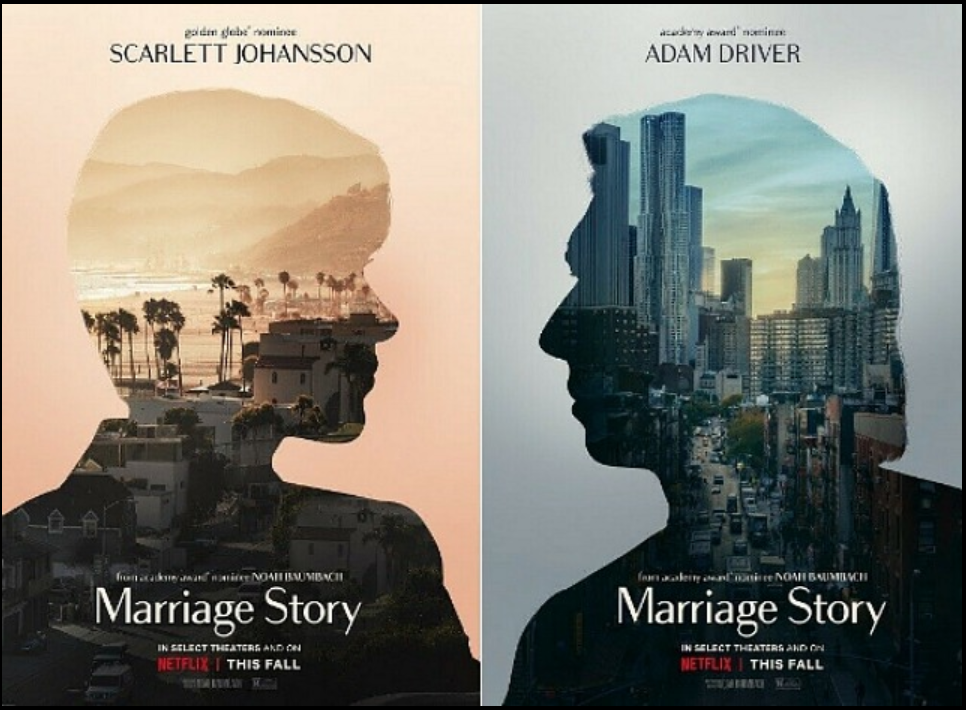
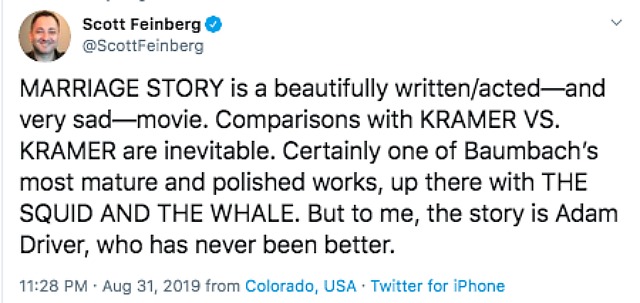
I finally caught Noah Baumbach‘s Marriage Story Saturday evening. With all the buzz I was more or less expecting the moon, I suppose, but I wasn’t disappointed. It didn’t quite melt me down like Kramer vs. Kramer did 40 years ago, but it sure softened me up. Which it to say I felt “met” on adult terra firma, and within a fully recognizable realm.

It’s more Ingmar Bergman than Robert Benton-esque. But sensibly so. Like all fine, steady, smart films that open between October and December, Marriage Story delivers the goods in a way that seems to fundamentally apply. It’s “one of those.” And I didn’t think of it as Black Widow vs. Kylo Ren. Well, if their defenses were considerably lessened.

I felt vaguely unsure where it was going or what it was up to a couple of times, but I mainly felt like I was in good, safe hands — gripped, touched, respectful, comfortable (because it never goes crazy or overly dark, it never breaks the trust) and always recognizing the truth of what’s on the plate.

Marriage Story is easily Baumbach’s best film, above and beyond The Squid and the Whale, and surely contains the best, most fully felt, deep-from-within performances that Adam Driver and Scarlet Johansson have given thus far. It’ll be really, really difficult for them to top this.

Best Picture nom, Best Director/Original Screenplay noms (Baumbach), Best Actor and Actress (Driver, ScarJo) and maybe a Best Supporting Actress nom for Laura Dern because of a single, third-act rant she delivers about society’s unfair attitudes toward women in terms of idealized “male gaze” expectations, and probably a nomination for composer Randy Newman.

The costar performances are just right — Azhy Robertson as Henry, Alan Alda and Ray Liotta as attorneys with radically different styes, Merritt Wever, Julie Hagerty, et. al.

It’s an honestly felt, emotionally complex (and sometimes convulsive) marital-downswirl drama, but with a rather middle (moneyed) class attitude…acrimony tempered by sensible sensibilities. Fundamentally decent people with the usual issues and shortcomings, but nobody’s a raving lunatic Nobody throws up or gets busted in some lewd, embarassing infidelity or throws a frying pan or drives a car off a bridge or runs naked into a traffic jam.

Driver and ScarJo are the married, Brooklyn-residing Charlie and Nicole, the latter a successful theatre director and the former his star performer who feels overshadowed by Charlie’s egocentric attitudes and looking to possibly re-launch her acting career in Los Angeles with a promising TV series.

Read more