Day: August 13, 2021
Clooney’s “Tender Bar”
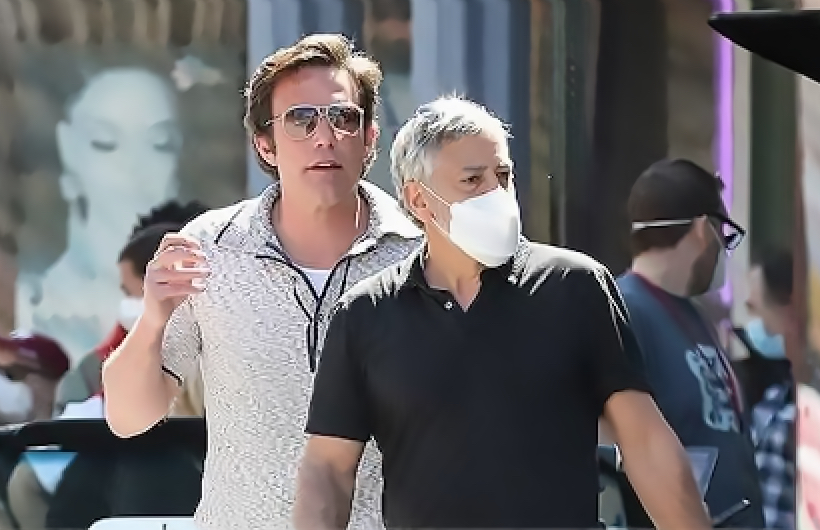
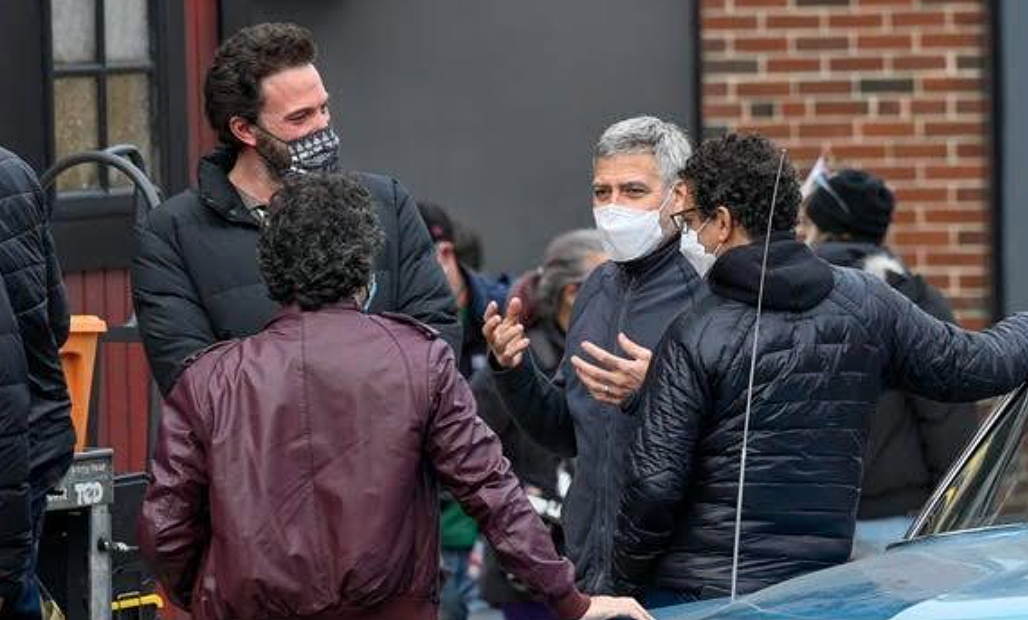
George Clooney‘s The Tender Bar (Amazon), a boozy proletariat community relationship flick (Manhasset) with a father-son, male-role-model current, will presumably begin streaming sometime in the mid-to-late fall season. Ben Affleck, Tye Sheridan, Chris Lloyd and Lily Rabe topline.
I’ll never touch another drop for the rest of my life, but every now and then (and I mean rarely) I’ll say to myself “I kind of miss that warm, boozy, half-in-the-bag camaraderie…stroll into a bar, bend the elbow, get a buzz-on,” etc. But not that much.
Review excerpt of same–titled book: “A Pulitzer-Prize winning writer for the Los Angeles Times, J.R. Moehringer” — played by Sheridan in the film — “grew up fatherless in pub-heavy Manhasset, New York, in a ramshackle house crammed with cousins and ruled by an eccentric, unkind grandfather (Chris Lloyd).
“Desperate for a paternal figure, he turns to his Uncle Charlie (Affleck), and subsequently, Uncle Charlie’s place of employment — a bar called Dickens that soon takes center stage.
Publishers Weekly: “You needn’t be a writer to appreciate the romance of the corner tavern or, for that matter, of the local dive in a suburban strip mall.
“But perhaps it does take a writer to explain the appeal of these places that ought to offend us on any number of levels…[such as] what would we do without them, and what would we do without the companionship of fellow pilgrims whose journey through life requires the assistance of a drop or two?
“More than anything else, Moehringer’s book is a homage to the culture of the local pub. That’s where young J.R. seeks out the companionship of male role models in place of his absent father, where he receives an education that has served him well in his career and where, inevitably, he looks for love, bemoans its absence and mourns its loss.
“Moehringer grew up in Manhasset, a place, he writes, that ‘believed in booze.’ At a young age, he became a regular — not a drinker, of course, for he was far too young. But while still tender of years, he was introduced to the culture, to the companionship and — yes — to the romance of it all.
“‘Everyone has a holy place, a refuge, where their heart is purer, their mind clearer, where they feel close to God or love or truth or whatever it is they happen to worship. For young J.R., that place was a gin mill on Plandome Road where his Uncle Charlie was a bartender and a patron.
“The Tender Bar‘s emotional climax comes after its native son has found success as a journalist for the Los Angeles Times. On September 11, 2001, almost 50 souls who lived and loved in Moehringer’s home town of Manhasset were killed in the terrorist attack on the World Trade Center. One was a bartender we’ve met along the way. Another was one of the author’s cousins.
“Moehringer’s lovely evocation of an ordinary place filled with ordinary people gives dignity and meaning to those lost lives, and to his own.”
When Tatum Was The Guy
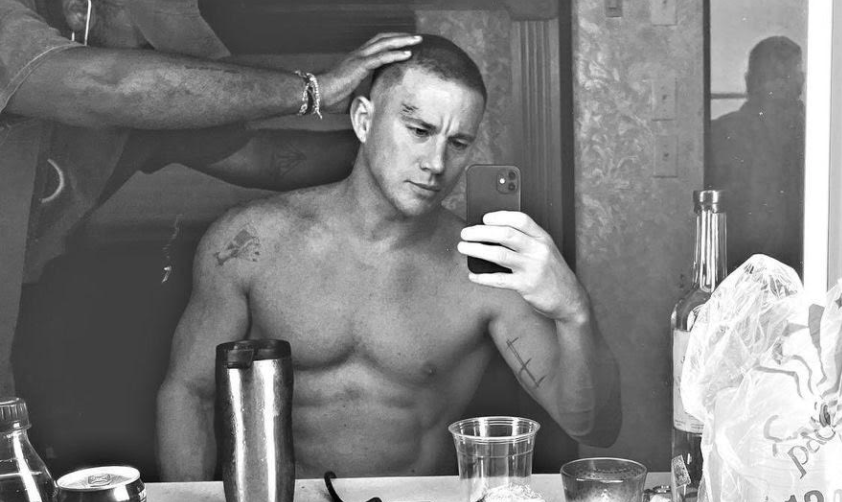
The other day HE commenter Manwe Sulimo asked what had happened to Channing Tatum. The 41-year-old actor hasn’t been in a noteworthy live-action film since Logan Lucky, which opened on 8.18.17.
Four years of flatlining is a long time. It would be one thing if Tatum had been out of circulation due to working on some big, classy prestige project. But his recent credits indicate more of an interest in popcorn realms.
Tatum has been delving into directing and producing over the last three or four. On 2.18.22 Dog (UA Releasing), a comedy that Tatum co-directed (along with Reid Carolin), produced and starred in, will open in some capacity.
Two months after that Tatum will be costarring with Sandra Bullock in The Lost City of D, a “cutthroat jungle adventure” from co-directors Aaron and Adam Nee. Tatum and Carolin are also producers on Spaceman, a sci-fi drama with Adam Sandler, Carey Mulligan and Paul Dano.
The present-tense bottom line is that Tatum apparently sees himself more as a behind-the-cameras creative than a leading-man actor. Cue career review assessments. For my money Tatum’s two best roles were in Steven Soderbergh‘s Haywire (’11) and Magic Mike (’12).
“Field” Finale Rewrite
There are two generally understood concepts of heaven. Concept #1 focuses on material-world stuff…pleasure, happiness, fulfillment, great sex, neck rubs, bags of money, great Italian food. Concept #2 is about a bullshit fairy tale after-realm that religious leaders have been selling to their parishioners for centuries, as in “be good and go to heaven.”
I’ve always said that if there’s a heaven, it certainly doesn’t work on a merit or virtuous behavior system. Upon dying everyone becomes Keir Dullea‘s space fetus at the end of 2001: A Space Odyssey, or nobody does.
At the very end of Field of Dreams, a conversation between Ray Kinsella (Kevin Costner) and the ghost of his dad, John (Dwier Brown), skirts both realms. And what John says is self-contradictory. Here’s how the scene plays:
Ray: “You played a good game.
Dad: “Thank you. (beat, beat) It’s so beautiful here. For me…for me, it’s like a dream come true. (beat) Can I ask you something?”
Slightly agog, Ray nods.
Dad: “Is this…is this heaven?”
Ray: “It’s Iowa.”
Dad: “Iowa?”
Ray: “Yeah.
Dad: “Coulda sworn it was heaven.”
Dad picks up catcher’s glove, Ray walks over…
Ray: “Is there a heaven?”
Dad: “Oh, yeah. It’s the place dreams come true.”
So let’s break this down, shall we?
John is an emissary from some kind of mystical, post-mortal realm (i.e., the same in which 2001‘s Dave Bowman resides, so to speak), and so he asks his son if the cornfield baseball diamond upon which they’re standing is heaven. Because the joy of playing baseball has so lifted and purified his spirits, John is suddenly wondering if this blissful feeling of cosmic radiance is a renewable thing on some level. John believes that Ray’s baseball diamond might be the ultimate OHM place to be.
Ray quietly tells him no, it’s not — that they’re just in Iowa. In response to which John, obviously uncertain which realm is up, replies that he “coulda sworn it was heaven.” In other words, for a dead guy John doesn’t know very much. He has an idea that Ray’s baseball diamond might be the epicenter of God’s perfect universe, but he’s not sure. He was just passing along a thought, a notion.
And then Ray, having been told in so many words that John isn’t exactly a fountain of all-knowing mystical knowledge of the wonders of the universe, and having just heard that John is as fascinated and mystified about where he is (not to mention who or what he is) as anyone else…knowing all this Ray asks John for some very basic dead-guy info: “Is there a heaven?”
And then John immediately switches gears. He is suddenly no longer the uncertain and questioning ghost, no longer the mystical dream-dweller. And so he tells Ray, “Oh, yeah”….as in “oh, son, relax your weary head because of course there’s a heaven…trust me, there is!”
And then he steps down off the cosmic pedestal and reverts to concept #1 as described above — heaven is not only real, he assures, but “the place [where] dreams come true.”
Repeating for clarity: Ghost John doesn’t have clue #1 about what heaven is or even what it might be, and so he asks his mortal son, an agnostic who only knows for certain what the material realm is, if he’s somehow arrived at the perfect cosmic place. But when Ray asks John if heaven is something pulsing and genuine, John does a 180 and tells Ray that, being a dead guy and all, that he’s absolutely certain that heaven is something with definable conditions and perimeters.
Surely Everyone Understands
…that last night’s Field of Dreams game in Dyersville, Iowa. was NOT played on the modest-sized, cornfield-flanked diamond that sits next to Ray Kinsella‘s (Kevin Costner‘s) Iowa farmhouse — built for the 1989 cult film, and which still stands and thrives today as a tourist attraction.
Last night’s game was played at a nearby (500 feet away) baseball field called the MLB at Field of Dreams, also cornfield-flanked but with stadium seating for 8000 people, according to both Fox Sports and The Sporting News.
#/media/File:MLB_at_Field_of_Dreams_(aerial_view).jpg)
In a pre-game press conference, Costner called Field of Dreams “the perfect little movie…the climax, rather than a big car chase, was ‘do you wanna have a catch?'”
Due respect but not quite. Field of Dreams was and is “a perfect little movie,” agreed, but it didn’t end with a father (Dwier Brown‘s John Kinsella) and son playing catch. If it HAD ended with the catch, Field wouldn’t be half the legendary perennial it’s become.
Field of Dreams ends, in fact, with a nighttime helicopter shot of a long stream of cars, lined up on a nearby road leading up to the Costner farmhouse. That shot of…what, 200 cars waiting to see the field and bask in those Shoeless Joe Burt Lancaster vibes…THAT’s what sold the film.
Without that line of cars, without that irrefutable evidence of what people want and need and long for in their lives, the film would’ve basically been a nice pipe dream.
Friendo: “To each his own, but every time Costner says ‘hey, dad, wanna have a catch?’, that chokes me up. That’s the film for me. The line of cars is just icing on the cake.”
HE to Friendo: “I never had a catch with my dad so it doesn’t get me as much. And in a broader sense sentiment doesn’t travel — it doesn’t expand or deepen. It always diminishes over time. Just ask John Ford and Steven Spielberg and the directors of The Bishop’s Wife and A Guy Named Joe. The only sentimental ending that never fails to get me is the Warren Beatty-Julie Christie ending of Heaven Can Wait, and for the worst of reasons.”
Friendo to HE: “It’s A Wonderful Life.”