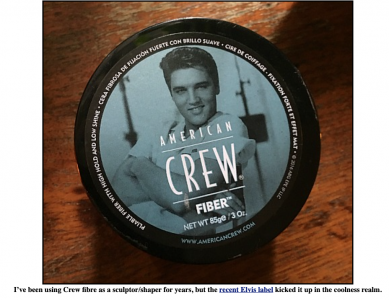
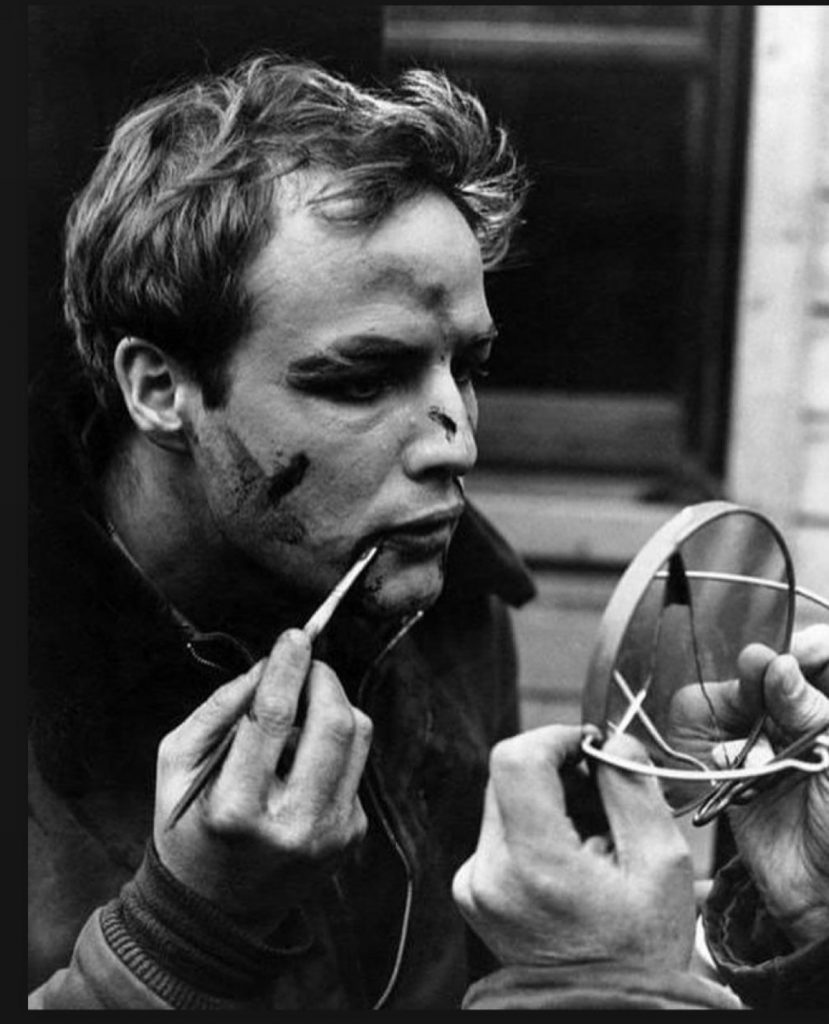
As far as it goes, HE approves of Austin Butler‘s performance as Elvis Presley in Baz Luhrmann‘s hyper homina-homina biopic.
On 5.26.22 I wrote that Butler “does a good workmanlike job in the title role. He apparently gave everything he had. As Owen Gleiberman has written, Butler looks less like Elvis than the young John Travolta mixed with Jason Priestley. But he worked it hard. Respect.”
Yesterday HE commenter Eddie Ginley, an incessant troublemaker, asked readers to remember “when Wells sounded the drum beats against Butler’s casting?…now the praise for his performance is the one unifying factor in all reviews….What happened? How did Wells get this so terribly wrong?”
HE response: “I got nothing wrong. Don’t lie, don’t fabricate. I had been profoundly unimpresssed with Butler’s Tex Watson in Once Upon a Time in Hollywood, and reacted accordingly to his Elvis casting, partly because he doesn’t genetically resemble the Real McCoy. DON’T LIE.”
Ginley responded by quoting from an HE piece about the Elvis casting process: “Four contenders had recently screen-tested for the Presley role in Luhrmann‘s biopic about the relationship between the iconic rock star and Colonel Tom Parker (Tom Hanks), and it was my view that three of them — Ansel Elgort, Miles Teller and Harry Styles — weren’t right. My judgment was that 28 year-old Austin Butler (The Dead Don’t Die, the grubby and psychotic Tex Watson in Quentin Tarantino’s Once Upon a Time In Hollywood) seemed “the most interesting possibility among the four.'”
HE response: “What did I basically say? That Butler seemed less problematic than Elgort, Teller (too old) or Styles. That doesn’t mean Butler (John Travolta meets Jason Priestley) was a perfect choice, and I had made it quite clear that his Tex Watson was, to me, a creepy poseur. I hated the way he said ‘I’m the devil, and I’m here to do the devil’s bidness!’ [not a typo]
“Whenever a thoughtful person calls this or that creative choice ‘interesting,’ that almost ALWAYS means they have a slight issue with it. ‘Interesting’ is a close relation of ‘impressive.’ It’s a dodge word that smart people use when they don’t want to share their actual opinion.”
Jon Stewart gonna Jon Stewart and and more power, but something snapped when I watched “The Problem With White People,” and things haven’t been the same since. A little more than a month ago Stewart was tributed at the Kennedy Center with the 23rd annual Mark Twain Prize for American Humor, and I really couldn’t get into it, man…sorry.
When I think of Stewart now, I think he could maybe sorta kinda go fuck himself…no offense.
A little more than three months ago my admiration for and approval of Stewart stopped dead in its tracks. To repeat, Stewart’s “The Problem with White People“, which aired on his Apple talk show on 3.25.22, is what did it.
On 3.30 I shared my skepticism and revulsion at what this one-sided woke indoctrination seminar was pushing, and particularly the dismissal of Andrew Sullivan‘s opinions by Stewart and another of his guests, the odious Lisa Bond of Race2Dinner…it was so enraging. I wanted to throw something at my computer screen, although I dismissed that instinct a millisecond later because it was only 15 inches in front of my face and what was I going to throw anyway? A sliced tomato? The juice would get into the guts of my Macbook Pro and then I’d really be in trouble.
Stewart and Bond were basically parroting woke talking points, to wit: (a) all disparity equals discrimination, (b) meritocracy is merely a systematic smokescreen for white dominance, (c) the low marriage rate among African Americans is the fault of whites, (d) almost all American sub-systems or social standards are guises for white power, (e) the whole societal system in which we work and live is gamed in favor of whites, and therefore (f) white people have a duty to cleanse and overhaul these systems in order to alleviate the stain and the shame of institutional racism.
I’ve responded to these talking points with three significant HE posts about The 1619 Project, which is pretty much the historical cradle for wokester theology in the realm of American racism. The best of them was “What’s Your 1619 Beef?“, posted on 7.30.20. Here’s an excerpt:
“Slavery has always been an ignominious chapter in the first 245 years of US history (1619 to 1865) and racism has stained aspects of the culture ever since, but to assert that slavery and racism (which other cultures have shamefully allowed and profited by over the centuries) are THE central and fundamental definers of the immense American experience strikes me as a bridge too far.
“Many factors drove the expansion and gradual strengthening & shaping of this country, and particularly the spirit and character of it — immigration, the industrial revolution and the cruel exploitations and excesses of the wealthy elites, the delusion of religion, anti-Native American racism and genocide, breadbasket farming, Abraham Lincoln, Frederick C. Douglas, the vast networks of railroads, selfishness & self-interest, factories, construction, the two world wars of the 20th Century, scientific innovation, native musical forms including jazz, blues (obviously African-American art forms) and rock, American literature, theatre and Hollywood movies, sweat shops, 20th Century urban architecture, Frank Lloyd Wright, major-league baseball, Babe Ruth & Lou Gehrig, family-based communities and the Protestant work ethic, fashion, gardening, native cuisine and the influences of European, Mexican, Asian and African cultures, hot dogs, the shipping industry, hard work and innovation, the garment industry, John Steinbeck, George Gershwin, Paul Robeson, Louis Armstrong, JFK, MLK, Stanley Kubrick, Chet Baker, John Coltrane, Marilyn Monroe, Amelia Earhart, Malcom X, Taylor Swift, Charlie Parker, Elizabeth Warren, Katharine Hepburn, Aretha Franklin, Jean Arthur, Eleanor Roosevelt, Carol Lombard, Shirley Chisholm, Marlon Brando, Woody Allen, barber shops & manual lawnmowers, the auto industry, prohibition & gangsters, the Great Depression and the anti-Communism and anti-Socialism that eventually sprang from that, status-quo-challenging comedians like Richard Pryor, Lenny Bruce and Steve Allen (“schmock schmock!”), popular music (Chuck Berry, Little Richard, Elvis Presley, Frank Sinatra and the Beatles), TV, great American universities, great historians, great journalism (including the National Lampoon and Spy magazine), beat poetry, hippies, the anti-Vietnam War movement, pot and psychedelia, cocaine, quaaludes and Studio 54, 20th & 21st Century tech innovations, gay culture, comic books, stage musicals, Steve Jobs, etc.
The enthusiastically received Elvis is in its third day of national release (if you count the Thursday previews), and it’s time for some reactions from HE regulars.
Kindly, bending-over-backwards, vaguely worded assessments (“It’s not perfect but I love Presley’s pop-chart hits, and there’s no understanding the movie without letting those songs into your soul-stream”) are not welcome. Please lay it out straight.
I’ve barely written about Elvis myself, except for that 5.26 post-screening riff that I tapped out in Cannes after catching Baz Luhrmann‘s film in the Salles Agnes Varda.
We all knew it was coming, and yet somehow it feels a lot worse now that it’s official.
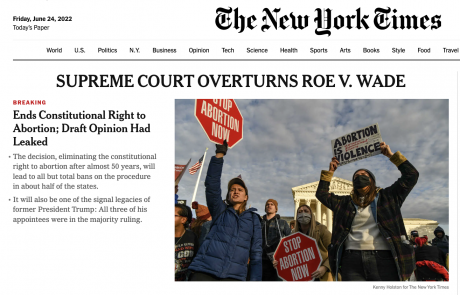
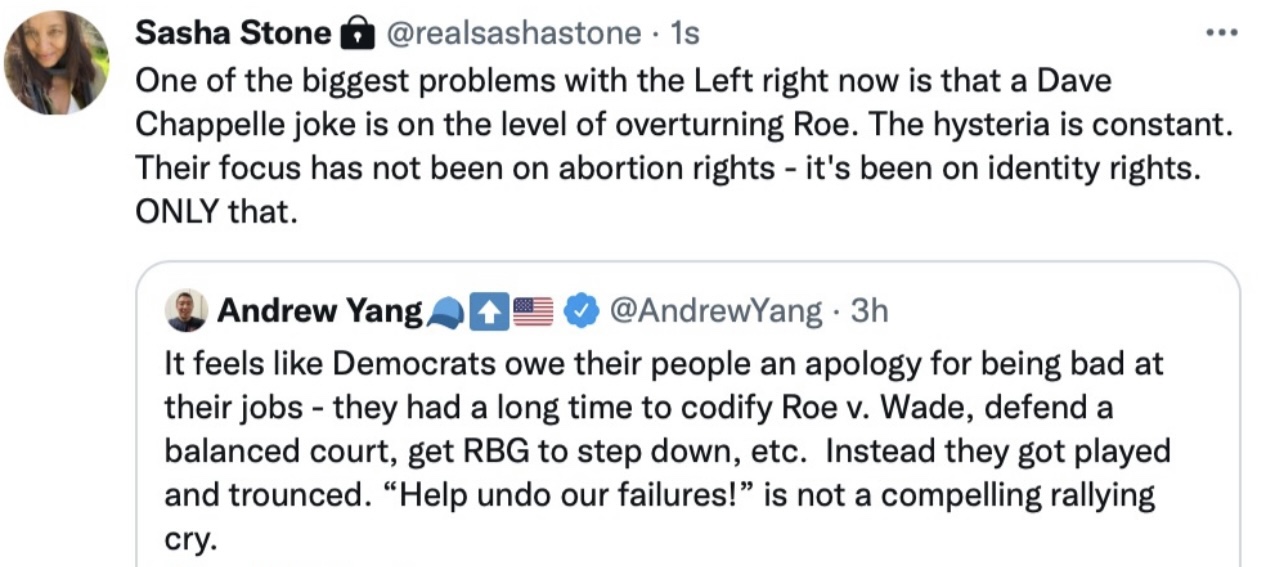
The overturning of Roe v. Wade is a scourge — a cruel, hideous imposition upon all women, right now and for the foreseeable future. Don’t even talk about what will happen in bumblefuck territories over the coming weeks, months and possibly years — removing the right of women (poor women especially) to choose their own biological fates and futures is draconian, deplorable and fairly close to medieval.
I’ve been thinking about this decision for most of the day, and particularly during my journey back from Berkshires. The likely real-world impact is sinking into my head in stages, and the air seems to get a bit colder each time.
As emotionally conflicted as I am about mid-to-late-term abortion (I went through a Jack Nicholson-like change of heart** when the news of Sutton’s arrival was shared), the right of a woman to choose one way or the other is absolute.
I’m certainly consumed with loathing for the six Supreme Court justices who struck down this fair, necessary and former law of the land, and especially the three Trumpies — Justices Neil Gorsuch, Brett Kavanaugh and Amy Coney Barrett, all of whom blatantly misrepresented their views on Roe during their confirmation hearings and concurrent discussions with legislators.
Putting it mildly, Lawrence O’Donnell’s reaction [above] to the trashing of Roe v. Wade closely reflects my own, and almost certainly the reactions of at least two-thirds if not three-quarters of the country.
Key quote: “The current Supreme Court is not a product of democracy. It is a product of minority rule…a product of the corruption of constitutional processes by Senate Republicans, who refused to even allow for a vote on President Obama‘s final choice for a Supreme Court justice” — i.e., Attorney General Merrick Garland, who has so far shown himself to be a wimp in the matter of a possible federal prosecution of Donald Trump.
“The Republican justices on the Supreme Court share a dangerous Trumpian characteristic — they are incapable of embarassment.”
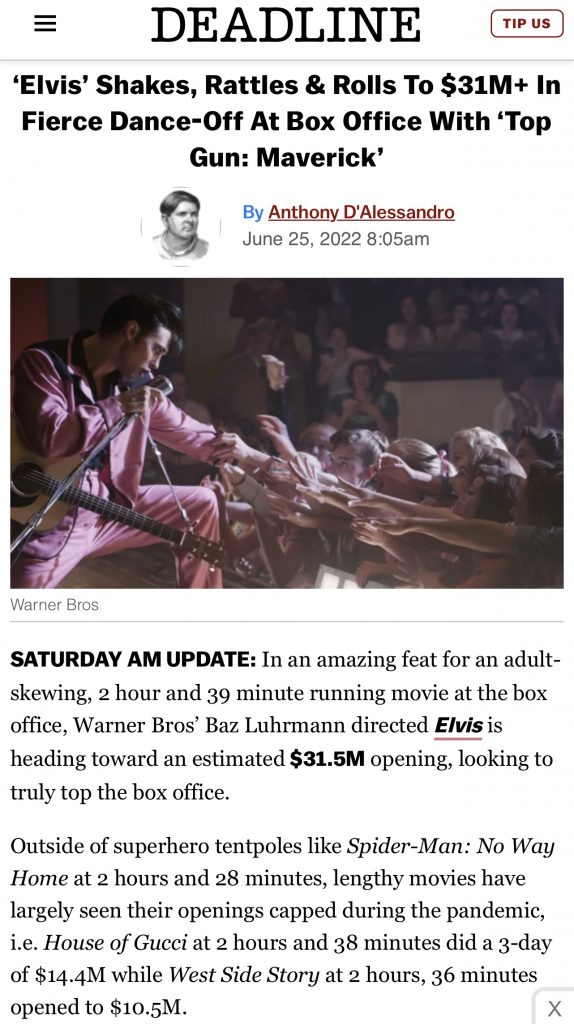
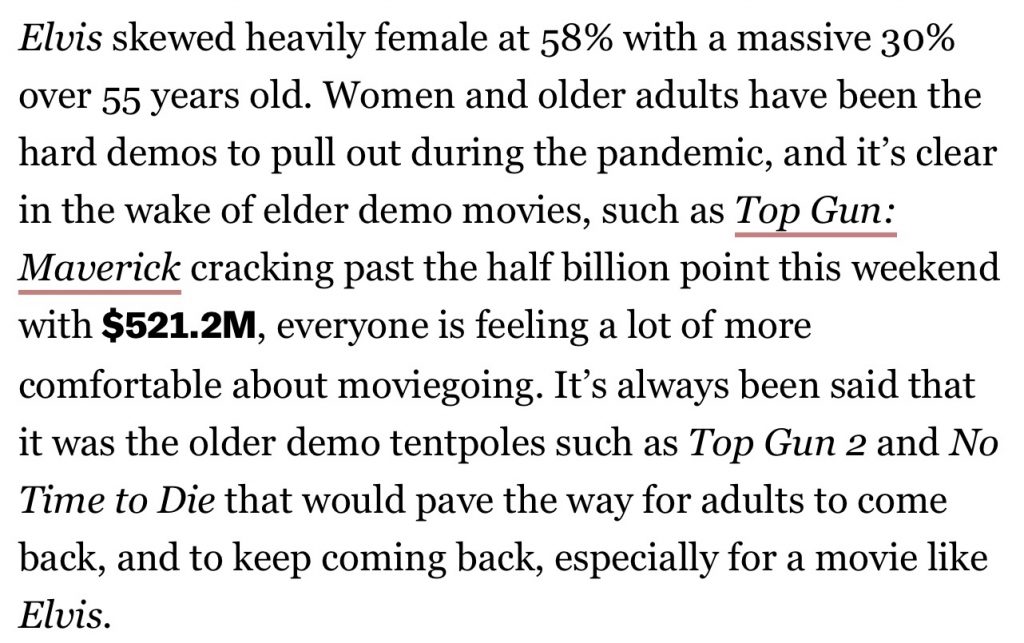
Despite a chorus of “uh-oh’s” from industry wise guys, Baz Luhrmann’s Elvis is not — repeat, not — a box-office shortfaller. It’s not Top Gun: Maverick but for a longish ADD biopic aimed at oldsters, it’s doing fairly well with a projected weekend tally of $31 million and change.
The second weekend, of course, will tell the real tale. But until then.,.
“We all know what a haunted house looks like: Victorian, Gothic. The Addams Family pile, the Bates residence in Psycho. Mansard roofs, looming gables, bullseye windows, porches, verandas.
“The renowned art historian Sarah Burns of Indiana University has made an exhaustive study of how this late 19th century style became ‘the prime sinister locus’ of American culture, chiefly gathered in the marvellous essay Better for ‘Haunts: Victorian Houses and the Modern Imagination.’
“Late-Victorian architecture was anathematised in the 1920s as a way of passing moral judgement on the tawdriness and excess of the Gilded Age. This was, in turn, a way of condemning the flashiness and superficial opulence of the pre-Crash 1920s.
“When artists such as Edward Hopper and Charles Burchfield painted houses as empty and sinister, they were indirectly passing judgement on the corruption of the day.” — from “It’s Coming From Inside the House,” an Architects Journal articles by Will Miles, 8.21.15.
Video taken this morning inside Mount Washington House in Hillsdale, New York.
Every two or three years I’ll re-watch Alexander Payne‘s Sideways, mainly to savor Paul Giamatti‘s exquisite performance as morose Miles, a failed novelist and wine aficionado who falls in love during a week-long hiatus in Santa Barbara wine country.
So I re-watched it again last night, and there’s absolutely no question that Giamatti’s conflicted and deflated fellow wasn’t just the best lead male performance of ’04, but possibly the 21st Century’s finest and certainly one of the most penetrating of the last 70 or 75 years.
In my mind Miles Raymond is right up there with Willy Loman as one of filmdom’s most poignant expressions of middle-aged ennui, only funnier and only flecked with a tragic arc as opposed to being defined by one.
Sideways was appropriately nominated for Best Picture Oscar that year, competing against The Aviator, Million Dollar Baby, Finding Neverland and Ray. But Giamatti wasn’t even nominated for Best Actor. He won SAG’s 2004 Best Actor award, but the Best Actor nominees turned out to be Jamie Foxx (Ray — the ultimate victor), Don Cheadle (Hotel Rwanda), Johnny Depp (Finding Neverland), Leonardo DiCaprio (The Aviator) and Clint Eastwood (Million Dollar Baby).
Due respect to Cheadle and director Terry George, but 17 and 1/2 years later I can’t recall a single scene from Hotel Rwanda. All I can remember is that everyone (myself included) said it was worthy.
Nor can I recall a single vivid scene from Finding Neverland….not one. In The Aviator, DiCaprio’s Howard Hughes struck me as overly strained and actor-ish — he was 15 times better in The Wolf of Wall Street.
The thinking in early ’05 was that Giamatti didn’t “work the room” hard enough. Jamie Foxx charmed the pants off of each and every Academy member he met that season, but Giamatti, like Miles himself, was a bit too sullen and withdrawn.
But what a joke it was and still is that the Academy basically said, “Yes, we recognize that Giamatti gave a great, half-funny and half-sad performance, but we just couldn’t nominate him…don’t ask us why…okay, we didn’t nominate him because we’re too shallow.”
Straight from the shoulder and no bullshit: Is there anyone in the HE community who feels strongly about seeing or not seeing Baz Luhrmann’s Elvis this weekend?
If it’s a must-see, what’s the main factor driving that notion? And if it’s a meh, why do you feel that way?
You may have heard that Elvis underperformed last night and that it may finish the weekend with less than $20 million, which may translate into a third or even (God forbid) a fourth-place showing.
I’ll tell you what I’m feeling, and that’s a pre-West Side Story vibe because (a) 40-and-younger types don’t care that much about E.P., (b) the numbers will depend on whatever ticket-buying enthusiasm may happen among GenX and more particularly boomers, and don’t forget that (c) Elvis’s core fan base (those in their tweener and teen years when he first ignited) are older boomers plus the baby-bust generation.
I really and truly hope that Elvis (which I was half-okay with after seeing it in Cannes) does better than West Side Story. I don’t want to see it tank.
As much as I dislike the act of abortion and as queasy as I feel about abortions at 23 or 24 weeks, the right of women to choose whether to have a baby or not mustbeabsolute. It should not be rescinded. Their bodies, theircall.
Today is a black day for women everywhere, and a black day in American history. I’m very, very sorry.
Posted on 12.1.21: “I’ve mentioned before that something happened inside me several months ago, back when Jett and Cait‘s daughter, the recently born Sutton, was growing inside Cait. Suddenly the idea of terminating a fetus’s life was no longer an abstraction. I was especially disturbed by the idea of terminating a fetus at 24 weeks, which suddenly seemed wrong on some primal level. The Roe v. Wade law stipulated 24 weeks because that’s the point at which fetuses become viable, yes, but why so long into the pregnancy? Why not 18 or 20 weeks?”
Jack Nicholson to Rolling Stone in 1984: “I’m very contra my constituency in terms of abortion because I’mpositivelyagainstit. I don’t have the right to any other view. My only emotion is gratitude, literally, for my life. I’m pro-choice but against abortion because I’m an illegitimate child myself and it would be hypocritical to take any other position.”
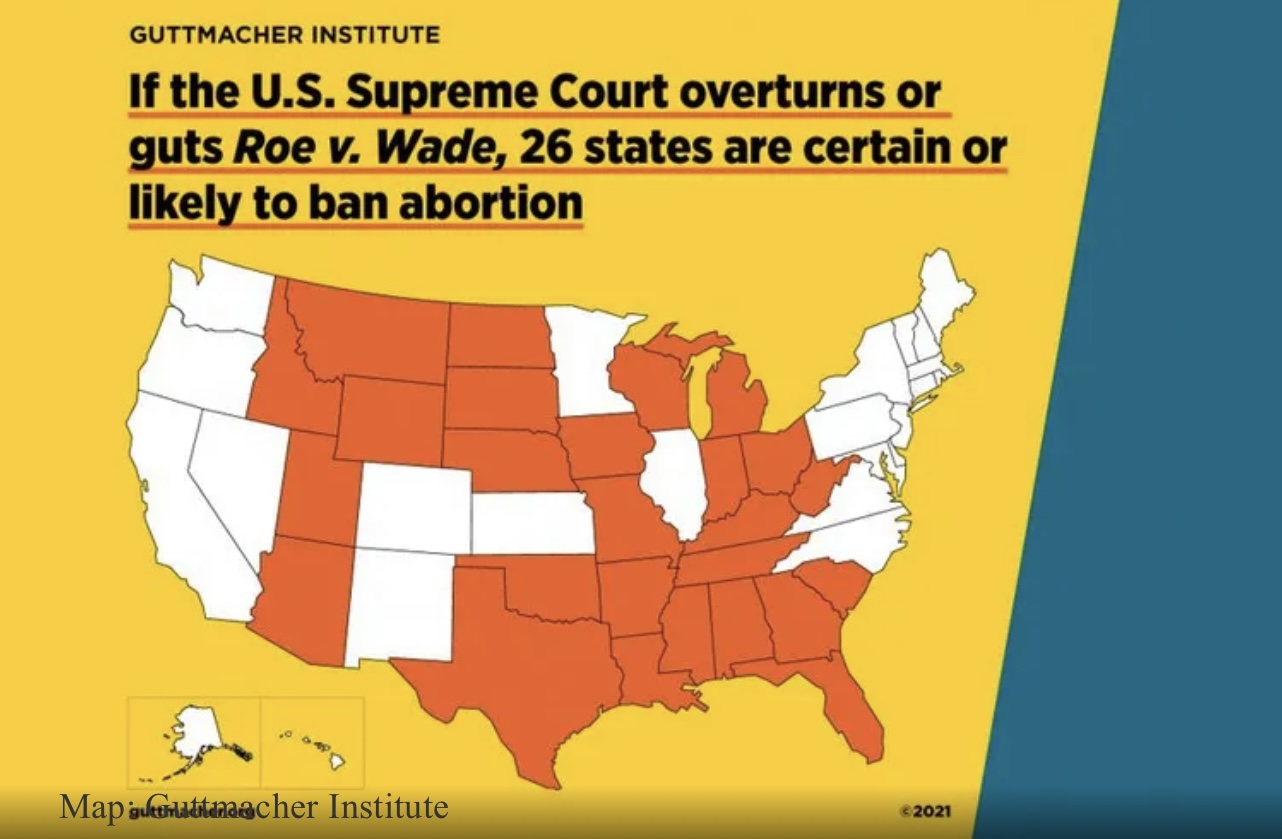
Bill Maher: “The current abortion divide between the states ‘makes me think about the Civil War…pre-Civil War. Because we seem to be going toward this place in America where we’re gonna be two countries. One where you’re a free woman, and another in which it’s a Dred Scott situation.
“When you look at some of the things that are being proposed in some of these [red] states. I mean, Louisiana says flat-out that [abortion] is homicide. When you drive from L.A. to Nevada…on one side of the border you’re a free person and on the other side you’re a criminal. You can fly across the country and gain and lose your reproductive rights 20 times.”