Son of Tuscan Fence Buzz

[Initially posted on 5.30.17] Tatiana and I are staying in a stone cottage on a wine farm called Azienda Agricola Caparsa (47 Via Caparsa), near Radda in Chianti. (Luca Guadagnino says there are so many English who live or rent in this region that some call it “Chiantishire.”)

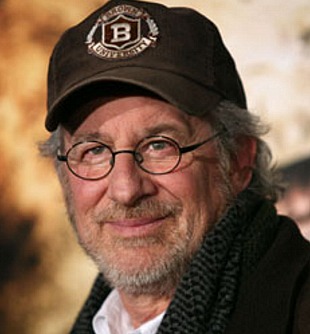
The owner, Paolo Cianferoni, is a dead ringer for Steven Spielberg if you take away the beard, and de-age Spielberg by ten years.

Paolo told me yesterday that original Sideways author Rex Pickett stayed here some years back. So between Pickett, Spielberg and myself the place has a definite Hollywood aroma.


Paolo’s electric bolt fence is more or less dead center in this photo. You can’t see it all that clearly, I realize, but does that matter? It’s there, okay? I’m telling you.

I told Paolo that Tatiana and I were planning to hike over to Radda in Chianti, and so he pointed to a shortcut path through his vineyard. He then pointed to a metal gate at the top of a far-off incline. The gate was electrified, he said, to keep out deer and whatnot, but I just needed to open it carefully and watch where I step.

So we got to the gate and I delicately opened it — no shock. Thinking I was in the clear, I stepped through and, being a bit sweaty and breath-starved, missed the fact that a thick, coiled, half-camoflauged wire was lying in the dirt three or four inches from the gate. My ankles touched it and a split second later I was James Cagney at the end of Angels With Dirty Faces. My body convulsed. I felt as if my kidneys had been punched by a guy with brass knuckles. The electric current was mild (i.e., high enough to dissuade animals without killing them), but it definitely rocked my attitude.

For a while there I felt like (a) a huge dumbass.  I actually still feel this way.


(l.) Caparsa vineyard owner Paolo Cinaferoni; (r.) Steven Spielberg.
 

Lansbury’s McCarthy-esque Commie

Patty Duke won the Best Supporting Actress Oscar for 1962, but who even watches Arthur Penn‘s The Miracle Worker these days? But everyone knows Angela Lansbury‘s performance in The Manchurian Candidate, Duke’s chief rival that year.

She played Eleanor Iselin, the scheming wife of a rightwing, Joseph McCarthy-like senator who’s actually a tool of the Chinese-Russian Communists, and one of the most deliciously evil villains to grace the screen in the 20th Century.

Lansbury should have won the prize. It’s hard to find a hardcore movie fan today who doesn’t relish her performance. Eleanor Iselin is not only demonic but neurotic (braying voice, temper issues, vindictive), and each of her lines are layered with just the right amount of darkly comic icing. Plus she conveys a hint of sexual rapport with (and even lust for) her brainwashed son, Raymond Shaw (Laurence Harvey).

Ms. Lansbury died today at age 96, just five days short of her 97th birthday.

Read more

“Amsterdam” Loss Pegged At Nearly $100M

From Anthony D’Alessandro’s “Amsterdam Stands To Lose Nearly $100 Million”, posted this afternoon on Deadline: “Fully financed by New Regency, Amsterdam cost a reported $80M to produce, that being the pic’s most piercing nail in its coffin. What should have been an awards-season play with its originality was quickly sandbagged by critics at 34% on Rotten Tomatoes. Even by pre-pandemic standards, this 1930s-set comedy was expensive, so how did this come to be? Based on a projected global gross of $35M, an estimated $70M global P&A spend — which I’m told is the bare minimum for a big pic like this — backstopped by Regency, Amsterdam after all home ancillaries will lose around $100M ($97M to be exact).”

Again, all I can say is that I’m sorry.

Is Murray Actually Toast?

Yesterday’s Bill Murray news almost felt like an obituary. Per Eriq Gardner’s Puck report, the 72 year-old legend not only misbehaved on the Being Mortal set (i.e., straddled and mask-kissed a ‘much younger’female production staffer) but agreed to cough up $100K and change to make the issue go away.

In today’s woke-serpent world, this may mean that Murray is finished, at least for the time being. Unfair as this sounds, he’s suddenly the new Frank Langella…a soft predator who may or may not be an insurance problem because he can’t be trusted to play by the current rules. Too old to be saved or converted.

I don’t know how much of this “Murray is finished” talk is smoke and how much is mirrors, but it feels like such a shame that the mob wants him tossed…the latest name to be placed on the hit list. Maybe his alleged banishment isn’t permanent and he can slip back into film or streaming roles after a couple of years.

Friendo: “The fact that the media and entertainment industries want to assassinate Murray for doing…what’s the word? Oh, yes…next to NOTHING is most certainly a shame. Not to mention terrifying. Cancel culture is an addiction.”

Let’s pretend that Murray got hit by a truck yesterday and that it’s time for an obit. If I had an hour to grind one out I would insist that the most glorious year of Murray’s life happened in 1993, when he delivered his two greatest performances — a sardonic Chicago loan shark named Frank “The Money Store” Milo in John McNaughton and Richard Price‘s Mad Dog and Glory, and a sardonic TV weatherman in Harold Ramis‘s Groundhog Day. Murray was around 42 when he shot both.

Murray”s third-best performance happened five years later in Wes Anderson‘s Rushmore, in which he played Herman Blume, a wealthy Houston businessman (also sardonic) who falls in love with a grade-school teacher (Olivia Williams), and in so doing ignites a feud with a 15 year-old romantic rival, Max Fischer (Jason Schwartzman).

Some thoughts about Milo, which I posted three years ago:

Mad Dog and Glory is about a curiously touching friendship between Milo and Robert De Niro‘s Wayne — a timid, lonely Chicago cop who specializes in forensics and crime-scene photographs. Milo is a Chicago mob guy who becomes a big brother and ‘friend’ of Wayne’s after the latter saves his life.

“Milo is a lot like Murray in many ways, just not internally. He’s angry and doesn’t really like himself or his friends or his life. He wants to be somewhere else. He’s seeing a therapist to try and deal with the hostility, and he performs a stand-up comedy routine at a place called the Comic-Kaze Club, which he owns. But he doesn’t want to lose the gangster life either.

“Frank and Wayne’s connection begins when Wayne — joshingly called “‘Mad Dog’ by his cop pals — saves Frank’s life during a grocery store holdup by calming down a jittery holdup man and sending him away without bloodshed.

Read more

Likely Best Picture Winner?

It broke my heart when I learned that Martin McDonagh‘s The Banshees of Inisherin (Searchlight, 10.21) wouldn’t be screening at Telluride ’22. I knew it would be at least pretty good, and I couldn’t figure why Telluride hadn’t grabbed it. Probably some Venice Film Festival bullshit.

Over the last couple of weeks I’ve been hearing it’s a lot more than “pretty good”, and that it might even be a Fabelmans conqueror. And now that I’m hearing that a fair number of critics believe that Banshees might actually win the Best Picture Oscar, my heart is still broken as I won’t see it until 10.20, or the day before it opens.

Critic friendo #1: “I’m hearing that the movie that’s going to win Best Picture is the Martin McDonagh film. I’ve just heard it here and there. People adore this film.” Critic friendo #2: “Don’t miss Banshees…it’s A-plus. It made me realize how (1) filmmakers in America don’t really know how to tell good stories because they all want to write their own scripts and they’re not great writers. And (2) I’d forgotten how powerful a great story can actually be, and why they matter so much. McDonagh is such a great fucking writer.”

Critic friendo #2 response to Best Picture buzz: “I have to agree with that. Also Best Original Screenplay.”

Read more

Will Joe & Jane Resist “Women Talking”?

The new Women Talking trailer tells you it’s a quality-level thing for smart women…grim, somber, articulate, muted palette, lotsa dialogue. I can only tell you that as much as I recognized the pedigree and respected the aims of Sarah Polley’s film (UA Releasing, 12.2), I looked at my watch at least seven or eight times.

Posted on 9.9.22: Step outside the woke-critic realm and there’s a sizable body of opinion (or so I determined after speaking with Telluride viewers) that Sarah Polley‘s Women Talking is a static, dialogue-driven #MeToo chamber piece that could be fairly described as a “tough sit.”

Based on Miriam Toews’ 2018 novel, which is “loosely based on real-life events that occurred in 2011 at the Manitoba Colony in Bolivia,” Women Talking is about several women dealing with corrosive sexual trauma.

Set within an isolated American Mennonite community, Women Talking focuses on a nocturnal, seemingly dusk-to-dawn discussion inside a barn, and focuses on eight or so women debating whether to leave their community to escape the brutality of several men who have repeatedly drugged and raped them.

Fortified by several first-rate performances (most notably from Jessie Buckley, Rooney Mara and Claire Foy) and currently enjoying a 92% and 90% approval ratings on Rotten Tomatoes and Metacritic, respectively, the post-Telluride narrative is that Women Talking will probably be Best Picture-nominated and will certainly be in the running for a SAG Best Ensemble prize.

The other narrative is that this counted-on support for Women Talking will be largely emotional (particularly driven by the overturning of Roe v. Wade) and certainly political.

As I wrote in a 9.5 piece called “Telluride Hive Mind,” “The elite Telluride critic community feels it has no choice but to worship Polley‘s film…politically speaking there’s no upside to not praising it.”

I added that Women Talking is “sturdy and nicely handled as far as it goes, but sitting through it felt confining and interminable. For me, it was almost totally about waiting for it to end.”

The indisputably brave, lone-wolfish Kyle Smith of The Wall Street Journal: “Critically acclaimed as an oblique commentary on the #MeToo moment, it’s an example of a prestige film that is more focused on point-scoring than coherence.”

A sentence in Jordan Ruimy’s mostly negative Toronto assessment, however, gave me pause: “There were women sobbing all around me during the press & industry screening of Sarah Polley’s Women Talking, so I assume the film will work with a large contingent of people. But it fell flat for me.”

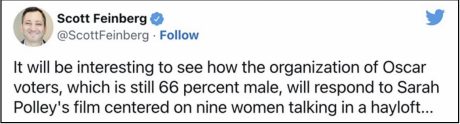
Roe v. Wade plus Toronto “sobbing” means Women Talking isn’t going away and will command repeated salutations in award-season assessment articles between now and early ’23 (the Oscar telecast happens on 3.12.23). The bottom line is that, as THR‘s Scott Feinberg suggested during Telluride, a significant percentage of Academy and guild members will probably be less than enthused.

This won’t stop the wokester cabal, of course. They will push for Women Talking with the same fervor they used to (unsuccessfully) take down Green Book, and which some of them will use to diminish Sam Mendes‘ immensely affecting Empire of Light, which will absolutely be Best Picture-nominated…trust me.