Honest Reactions, Please

In a 10.11 interview with A.V. Club‘s William Hughes, legendary horror helmer John Carpenter allows readers see the proverbial man behind the curtain, and that man, it turns out, is a lot more into video games than keeping up with must-see films.

And therefore — here’s a real forehead-smacker — Carpenter doesn’t even know what elevated horror is, for heaven’s sake.

C’mon, bruh…being 74 (which is oldish but not that old) doesn’t give you license to just live in your own little world and ignore the here-and-now. You have to watch what other directors are doing, and maybe let some of what they’re doing and saying…maybe let a little bit of that in.

Hughes: Shifting gears slightly: Are you familiar with the phrase ‘elevated horror’?

Carpenter: I don’t know what that means. I mean, I can guess what it means, but I don’t really know.

Hughes: People usually use it to refer to A24’s movies…horror that’s very heavy on the metaphorical. Hereditary, Midsommar, movies like that.

Carpenter: I have no idea what you’re talking about.
Things Were Different Then

Will you listen to this Pauline Kael interview with Woody Allen, which happened in early 1974? They’re mainly talking about Sleeper (12.17.73), Allen’s most recent film at the time, and Kael is offering sincere praise here and there but she’s also telling Allen, politely, what she feels is lacking in his films or about aspects of his films that don’t quite work for her

Does Allen stiffen or bristle or get a tad defensive? No, he’s totally fine with this (or pretending to be fine with it), half-agreeing or breaking into a discussion of some point she’s made or just listening.

Can you imagine any big-time critic or columnist conducting such an interview with a major filmmaker today? Saying nice things but also sharing discreet criticisms from time to time? It would never, ever happen.

Allen later told Roger Ebert that he admired Kael, but that during their interview “she had everything but judgment.”

Repeating: “Woman King” Is Dishonest History

Everyone presumably understands by now that Gina Prince-Bythewood‘s The Woman King lies about the slave-trading history of Dahomey and particularly that of the Agojie, the all-female warrior unit that protected Dahomey during the 18th and 19th Centuries.

Here’s the concise truth of it, laid out in an 10.5 Project Syndicate essay titled “Women, Life, Freedom and the Left.” The author is Slovenian philosopher and scholar Slavoj Žižek:

The Woman King is an historical epic about the Agojie, an all-female warrior unit that protected the West African kingdom of Dahomey from the seventeenth to the nineteenth centuries.

“It stars Viola Davis as the fictional General Nanisca. She is subordinated only to King Ghezo (John Boyega), a real-life figure who ruled Dahomey from 1818 to 1859, and who engaged in the Atlantic slave trade until the end of his reign.

“In the film, the Agojie’s enemies include slave traders led by the fictional Santo Ferreira (Hero Fiennes Tiffin), a character loosely inspired by Francisco Félix de Sousa, a Brazilian slave trader who actually helped Ghezo gain power.

“Dahomey was a kingdom that conquered other African states and sold their people into the slave trade. While Nanisca is depicted protesting to King Ghezio against the slave trade, the real Agojie served him.

The Woman King thus promotes a form of feminism favored by the Western liberal middle class.

“Like today’s #MeToo feminists, the Amazon warriors from Dahomey will ruthlessly condemn all forms of binary logic, patriarchy, and traces of racism in everyday language; but they will be very careful not to disturb the deeper forms of exploitation that underpin modern global capitalism and the persistence of racism.

“This stance involves downplaying two basic facts about slavery. First, white slave traders barely had to set foot on African soil, because privileged Africans (like the kingdom of Dahomey) furnished them with an ample supply of fresh slaves.”

For Me, Fetterman’s Stroke Issue Is Nothingburger

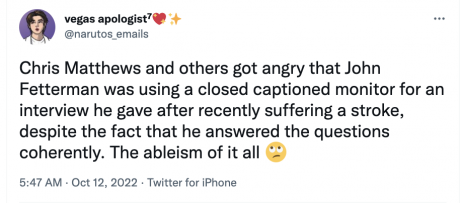
I don’t see John Fetterman‘s stroke issue (i.e., using closed-captioning) as a campaign problem, although obviously it’s become one. Recent Pennsylvania Senate race polls had Fetterman, the Democratic candidate, ahead but now he’s neck-and-neck with the Republican candidate, Mehmet Oz. I tend to see Fetterman’s temporary disability (which I presume is temporary) as a character-building thing, or somewhat analogous to FDR’s disability. I think it’s cruel to attack Fetterman over a medical issue. The idea of Oz winning is appalling.

Murray’s Great Gift

Damn few actors have the innate ability to make this kind of dialogue — “Put down the magazine before you hurt yourself…okay, Harold?” — land as well. This plus a just-right expression of world-weary “God help me.” Bill Murray owns this attitude. He coined it. If you insist on beating him with birch branches along with a time-out, fine. We all understand that paying just over $100K to the Being Mortal production assistant was just for openers, and that the real punishment starts now. But don’t excommunicate him. He’s Bill Murray, for chrissake. He understands everything, has been everywhere, carries the whole equation in his head, etc.

LAFCA Going Gender Neutral

“I guess we have to ask ‘what is the point of any of this?” Because activists are imposing their ideology on nearly every corner of the industry, making film awards — and films in general — something other than what their original purpose has always been. And honestly, what are these awards going to be but a ceremony inside of a devout religion?” — Awards Daily‘s Sasha Stone, posted on 8.23.22.

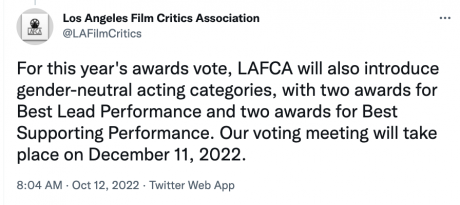
10.12.22: Wokesters within the Los Angeles Film Critics Association have decided to follow the lead of the Spirit and Gotham Awards by abandoning gender-based acting awards.

When the LAFCA foodies vote in December they’ll hand out two Best Lead Performance trophies (either gender or gender-neutral) and two awards for Best Supporting Performance (ditto).

LAFCA motive #1 is to emphasize how different L.A. wokester culture is from tens of millions of Joe and Jane Popcorn movie lovers in every corner of the nation, who don’t give a shit about any of this.

LAFCA motive #2: “Non-woke film fans may love the idea of gender-based acting categories for now, but we are leading the way to a bold and brave new realm…henceforth we are living in a gender-neutral world, whether you like it or not. Wake up and woke up and join us…it’s a joyful revolution!”

Here’s a portion of my reaction to the Spirit Award announcement, which I posted six or seven weeks ago -/ obviously the same deal.

“I will say this straight and clear and true: If the Academy decides to go gender-neutral with the Oscar acting awards, the eclipse will be total and absolute, and I mean beyond the level of anything dreamt of by Michelangelo Antonioni …culturally and aesthetically, the Oscars will have slit their own throats.

“Which award-giving org will succumb next to glorious trans fluidity-slash-equality? If the gender-neutral advocates within BAFTA, the Academy, the Golden Globes, the Critics Choice and the guilds…if they manage to eliminate gender-based acting awards, Average Joes and Janes will simply walk away and stay away…they will raise their fists and voices and say “stop this insanity, stop this bullshit…men are men and women are women and they generate different moods and expressions and ways of living and processing the ups and downs of living…stop this bullshit and come down to earth.”

Read more

Wonderful Economy

Visual economy is always a great thing, but it can be dazzling when a single shot (or a brief sequence) portrays a character’s basic attitude.

There’s a moment near the beginning of Louis Malle‘s Damage (’92), a masterful drama about an obsessive, self-destructive affair between a British politician (Jeremy Irons) and his son’s fiance (Juliette Binoche), that exhibits this.

Irons walks into his tres elegant, two-story home in Hampstead Heath at the end of the day and tells his wife (Miranda Richardson) about a meeting with the Prime Minister. The maid is fixing dinner, he’s feeling smug and successful and all is generally well. He makes himself a drink and strolls into the nearly living room. He take a sip and looks around, and the expression on his face says everything — unfulfilled, unchallenged, drained.

Malle doesn’t dwell on Irons’ face. He shows it to us for maybe three or four seconds, and then fade to black. It tells us all we need to know.

Can anyone think of other films and other moments in which something essential or fundamental about a character is explained in a single brief shot?