Bury My Heart at Wounded Carlyle

Every so often I reflect on what the accumulation of time does to some people, and what it’s done in particular to…well, friends and family, of course, but hotshots I’ve run into over the years and especially the occasional supernovas. I began thinking about Jack Nicholson a couple of days ago. William Faulkner‘s concept of eternity will always apply (“the past is never dead…it’s not even past”), but the more it sinks in the more the present seems to concurrently intensify.

Things change, of course. and some weather the storm better than others. Luckier, healthier, better genes.

The general rule is that you can “party” like a madman in your teens and 20s and maybe even into your early 30s, but you have to behave more sensibly and turn that activity down (or better yet embrace sobriety) when you hit 40 or thereabouts. You really do. If you don’t, you’ll probably have to pay the piper when you get old. Some who were famous and flush and relatively young during the great cocaine binge era of the ’70s and early ’80s can tell you about that piper. Not all but some.

Speaking of which you have to admire how Martin Scorsese (who will celebrate his 80th birthday on 11.17) is by all accounts still lucid and wise and charging along like a 47 year old, or a decent facsimile of same.

Feel free to ignore the following if you’ve re-read it too many times…

It was mid January of 1982, and I, representing the N.Y. Post, was interviewing Mr. Nicholson at the Hotel Carlyle. I’d been told that my time slot was, believe it or not, about an hour. The subject was Tony Richardson‘s The Border (Universal, 2.12.83). I arrived at the Nicholson suite on the 23rd floor around 10:30 or 10:45 am. I was greeted by publicist Bobby Zarem in the foyer. Nicholson was seated about 25 or 30 feet away, down the hall and around the corner but within earshot.

“How are ya, Jeff?” Zarem asked with his usual urgent energy. Manhattan had been going through a long frigid spell and it seemed especially icy and and windy that morning. I was wearing a gray leather jacket that wasn’t nearly warm enough, so the first reply that came to mind was “oh, cold as usual.” A split second later I heard Nicholson doing an imitation of me, saying “cold as usual.”

Our discussion was all over the map, and I was trying to keep things cool and steady. But deep down I was saying to myself “wow, this is really happening.” I didn’t know if I was coming or going, but at some point I asked Jack for his reaction to a tartly written review of The Border by Time‘s Richard Corliss. Jack hadn’t read it so I showed it to him. The review began as follows:

“When, early in The Border, Nicholson muses about how, back in California, ‘I liked feeding those ducks,’ one’s first reaction is: ‘Feeding them what? Strychnine?’ Nicholson’s voice, with the silky menace of an FM disc jockey in the eighth circle of hell, has always suggested that nothing in the catalogue of experience is outrageous enough to change his inflection. Even when he goes shambly and manic (Goin’ South, The Shining), Nicholson’s voice and those tilde eyebrows give the impression…” and blah blah.

Nicholson chuckled faintly when he read it, and then went into a minor tirade about how he was “mad” that he’d convinced the public he was a murderer, and about being stuck in that box. This image disappeared the following year, of course, after he played Garret Breedlove, the randy ex-astronaut, in James L. BrooksTerms of Endearment.

Earlier or later I had shared a view (my own) of Nicholson’s performance in The Shining. The idea was that aspects of his Jack Torrance performance seemed, to me and others I knew, to be self-referential or, if you will, a kind of inside joke between Jack and his fan base. Nicholson disputed this. He wasn’t rude but his response was basically who was I, a mere journalist, to assume I had an inside view of things? He was relaxed and droll about it, but his point was that he was “inside” and I wasn’t.

Like a lot of X-factor guys, Nicholson has a habit of jumping the track in terms of conversational threads. We got to talking about cold-weather jackets and he mentioned he was planning to head downtown later to buy himself a nice warm one. “What are you looking for?”, I asked, meaning goose down, motorcycle jacket, Brooks Brothers or whatever. And Nicholson answered, “I don’t know. I haven’t known for quite some time.”

The most poignant moment was when he began sipping a Miller High Life about 15 or 20 minutes into our chat, and my deciding to drink one also as a gesture of solidarity.
Scared for Fetterman Last Night

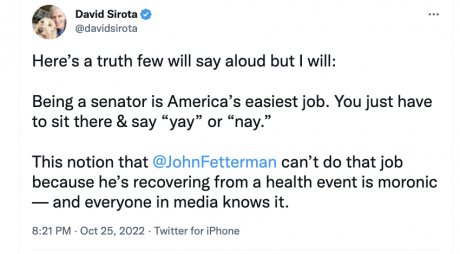
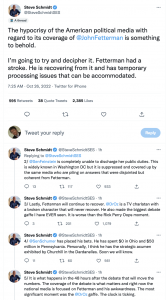
I was terrified that Pennsylvania’s Democratic candidate for the U.S. Senate would make some sort of grammatical mistake or lose his train of thought or something. He stumbled once or twice but he did…well, okay. (Except for the fracking answer.) Anyone who would vote against John Fetterman because he isn’t fully recovered from his stroke has no heart or compassion for those who’ve had to cope with a serious but temnporary medical condition. Fetterman is a soul man and a much better human being than Mehmet Oz, who said last night that he would support Trump in the ’24 election if nominated.

We Go Back Decades

I first interviewed Drew Barrymore in the summer of 1982, when she was seven. It was for an Us magazine cover story about E.T., The Extra-Terrestrial. I ran into her again in ’99 at that Sunset Marquis bar (Bar 1200) — she and Luke Wilson were parked at a table, and I sat down for a chat.

The Drew Barrymore Show has been happening since 9.14.20. I like the red-yellow-green flag game, and I enjoyed this session in particular because Stewart strikes me as a no-bullshit type who has her own opinions and holds her ground when challenged or prodded.

Unlike Barrymore, I should add. During a 5.17.21 interview with Dylan Farrow and during a discussion of Allen v. Farrow, Barrymore threw Woody Allen under the bus. In ’96 Allen cast Barrymore in Everyone Says I Love You, the second best film she made in her life.

Read more

Unforgettable Ending, Made No Sense

I’m not talking about Jack Nicholson‘s Bobby Dupea abandoning Karen Black‘s Rayette Dipesto at a gas station in rural Washington. This I understand. Dupea comes from an eccentric musical family and, despite his job history as an oil worker, regards himself as an intellectual rebel artist. He’d rather slit his throat than submit to a conventional middle-class Bakersfield life as Rayette’s husband (and perhaps as a father to their unborn child). And so, like a chickenshit junior high-school nihilist, he decides to escape.

That part adds up. Dupea is a tragic figure who’s running away from himself…hell, from everything. I was almost like that in my early 20s.

What I don’t get is why Bobby leaves his brown suede jacket hanging in the gas station bathroom. He’s heading into “colder than hell” weather without protection from the elements? That’s crazy. And how much money could he possibly have in his wallet? It all fits except leaving the jacket in the bathroom.

HE’s McGrath Blockage

I said yesterday that I don’t like the look of The Son‘s Zen McGrath, the 20-year-old Australian actor who plays the son of Hugh Jackman and the grandson of Anthony Hopkins in Florian Zeller’s upcoming film (Sony Pictures Classics. 11.25.22).

Baobob dylan to HE: “So you hate McGrath before you’ve even seen the movie? Or you hate the actor because he’s…acting?”

HE to Babobob dylan: “I took an instant dislike to the guy, and tough shit if you don’t like that.”

Bobby Peru: “When will you grow out of this juvenile bullshit and give films and characters fair shakes?”

HE to Peru: “You’ve never experienced an instant no-thanks to anyone in your life, simply because of how they look or because of some vibe they were putting out? No stranger has ever glanced at you and given you a dirty look? Peter Ustinov once said that Charles Laughton felt this way toward Laurence Olivier. It happens. It’s called instant animal dislike.

“There was a moment when I was 19 or 20 when I walked into a bar in rural New York State, and there was a guy sitting at the bar who was giving me a look that said “fuck you.” I hadn’t done or said a thing and he was almost ready to take a poke at me.

“Why should I have to make an extra effort to get to know Zen McGrath and discover things about his character that I might find acceptable or tolerable or likable? I’m not about to work with the guy at an office or on a movie — he’s a character in a film, and if he doesn’t rub me the right way (which is to say at least in a neutrally inoffensive way) that’s on him, not me. I’m just a face in the crowd. A face and a voice.

“There used to be actors who were hired and worked a lot by playing villains or shifty shitheads BECAUSE they rubbed or struck you as bad news. One look at these guys and you just KNEW they were trouble. That’s why Hollywood hired them time and again. Guys like Neville Brand, say. Every so often a bad or ornery guy would graduate into playing a good guy — Humphrey Bogart and Lee Marvin come to mind.

“Does McGrath have the potential to graduate in this fashion? Maybe…who knows? I wish him well in a general sense, but I really don’t like the vibe he’s putting out in The Son. And I don’t have to apologize to you or anyone else if I feel this way.

“There have been many, many actors in the past who hit it fairly big & even became movie stars because audiences instantly liked or trusted them or at least felt a certain familial kinship. McGrath is not part of this fraternity. In The Son he has a face that says “I am a sullen, scowling, pissed-off malcontent, and I’m going to turn this movie down a dark alley. If at all possible I’m going to infect you with the poison in my soul, and you are going to know what it feels like to be miserable and self-loathing…I’m going to bring you down, man.”

“I don’t care if McGrath’s character was blown off or rejected by Hugh Jackman’s character when young. That was a cruel and hurtful thing for Jackman to have done to the poor kid, agreed, but some people are narcissist shitheads, or they just aren’t cut out to be good or decent fathers. My dad was clever and witty and a hard worker in the office and amusing at parties, and a decent, honest, stand-up fellow character-wise. But he was also brusque and gruff and moody and dismissive when it came to me. I didn’t feel all that loved or supported by the guy (not to mention the alcoholic personality toxicity) but life is sometimes like that. You have to somehow make do and roll with the punches.

Read more

“The Son” Blisters

Friendo who’s seen Florian Zeller’s The Son (Sony Pictures Classics, 11.25): “So we face madness in this film, right in the eye. It’s like watching a burning house implode. And it’s harder to look away than to stare. Mesmerizing.

Hugh Jackman is a man with everything — a beautiful, much younger second wife (Vanessa Kirby), a gorgeous new baby boy, a fabulous job, beautiful home, money in the bank. So what’s wrong with this picture? Laura Dern as the first wife — dumped for her younger replacement. And the teenage son (Zen McGrath) who was abandoned like a cold leftover.

“Hugh seems eager to help with his first son’s dark, mute depression at being the starter child left behind, but it’s not until we see Hugh with his own father — Anthony Hopkins in a perfectly chilling single scene — do we understand that the self-serving seed of pure narcissism was sown in Hugh long ago. And that those seeds have already taken root in his first born and will not be torn out without collateral damage.

“I applaud Florian’s bravery in showing what divorce does to children — not a popular topic for your classic self centered American adults. It also takes you a minute to realize that Jackman’s character is a self-centered ass because he seems so (superficially) well intentioned.

“But when you meet his serpent of a father (Hopkin), you realize how screwed up they all are and how this pathological myopia is passed down through the generations. The Hopkins-Jackman scene is short but deadly.

“And it’s hard not to like Jackman because he’s such an affable movie star, while we’re supposed to feel for the kid, who’s kind of a weird anti-social nerd.”

HE comment: I haven’t seen The Son but I already hate McGrath…fuck that guy.

Gothams Spit On Joe & Jane Popcorn

The 2022 Gotham Award nominations popped today. I’m sorry but I don’t think anyone outside of New York or Los Angeles cares about these damn indie awards.

They’ll be presented at Cipriani Wall Street on Monday, 11.28.

The non-gender acting categories are a drag, and the only film nominated for Best Feature that has any real precision or power is Todd Field‘s Tar.

Friendo: “It’s a best-of-the-year list for coastal elitists who hate the average moviegoer.”

The Gothams couldn’t be bothered to nominate James Gray‘s Armageddon Time for best feature — bad call.

Ten outstanding gender-free lead performance noms and…do I understand only one winner will be chosen? This is ridiculous. Tar‘s Cate Blanchett will probably take it, but that means The Whale‘s Brendan Fraser (also nominated) can’t win, which seems a shame. Not to mention Everything Everywhere All At Once‘s Michelle Yeoh.

Eight nominations for outstanding gender-free supporting performance, and the only one that got to me was Nina Hoss‘s performance as Cate Blanchett‘s neglected wife in Tar.

The Gotham committee actually nominated Mark Rylance‘s performance as a suburban cannibal oddball in Bones and All? C’mon!

No Love for “Endearment”

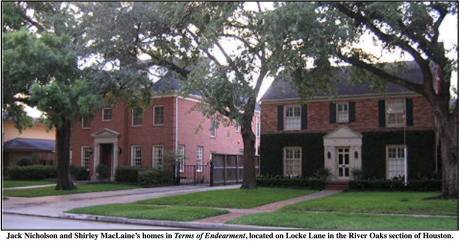
Way back in ’84 (38 years ago) hotshot movie guy Lewis Beale wrote a piece for L.A. Times “Calendar” about his loathing for James L. BrooksTerms of Endearment (’83). The piece isn’t accessible online, Beale explained, but it boiled down to the following:

1. Aurora Greenway (Shirley MacLaine) was a horrible (read: headstrong, egoistic) person who treats her daughter Emma (Debra Winger) dismissively or otherwise like dirt, and only becomes involved in Emma’s life when she’s dying of cancer, and because of this we’re supposed to like her because she’s Somebody’s Mother.

2. The film covers 30 years and takes place in three cities, but has no sense of time and place. At all. [HE to Beale: It primarily takes place in Houston and in a mid-sized university town in Nebraska. The New York visit is brief and basically doesn’t count.]

3. Emma whines all the time, then Brooks puts her in a New York restaurant with three or four bitchy career women to make her look good and them bad. [HE to Beale: Emma whines when her husband Flap (Jeff Daniels) starts cheating on her. She doesn’t whine at all when she gets cancer.]

4. Cancer is to the 1980s what consumption was to the Victorians — the province of hacks. [HE to Beale: Cancer happens to unlucky younger people. It’s not common, but it happens.]

5. Sloppy pacing, sitcom structures, characters introduced for no reason (Danny DeVito‘s), etc.

Beale also mentioned that two of America’s foremost critics, Pauline Kael and Andrew Sarris, also hated the film.

The piece got tons of negative mail. Beale’s editor Irv Letofsky loved the piece, and the negative reaction.

HE comment: The movie is saved by Jack Nicholson‘s Garrett Breedlove. Without him Terms would have been unbearable.

4.27.06 article fr5om Houston during my last visit there (and probably my last): “There are good people all over this town but with the exception of a visit Wednesday night to River Oaks, where the really rich folks live and where the oak trees are huge and the grass is moist and fragrant, Houston seemed less than abundant with down-home charm. And if you’ve been to New York or Paris or London or Rome, it feels lacking in cultural refinement.

“To me, it’s an arid corporate hee-haw town. Not enough sidewalks. Cavernous malls. Lots of middle-aged guys with monster beer bellies. Expensive cars tearing around like they’re in the Monte Carlo Grand Prix, and all those revolting glass-and-steel towers. Not enough trees. Women with vaguely predatory vibes and long jaws. And the strip clubs — strip clubs! — as prominent and well located as the better restaurants, music stores and markets…nothing covert about them.

Cherry Kutac told me before I came that Houston is like L.A. but without the soul, and I think that just about nails it.

“Early tomorrow morning I’m going down to the courthouse where the Enron trial is happening. And then I’ll drive by St. John’s, the private school where Wes Anderson shot Rushmore, and maybe visit MacLaine’s Terms of Endearment home.”

Need A Little Help

Without being specific, I’m having trouble with a recently opened drama and I need some assistance from the HE community.

Let’s say we have an older musician (in his late 60s or early 70s) suddenly deciding to do away with all the banality and boredom in his life and devote himself more seriously to the playing of folk music. He knows he only has another decade or two left and wants to make the most of it, and the way to do that is to devote himself entirely to fiddle-playing and, during the quiet moments, hanging with other musicians.

Life is short and getting shorter by the day, he’s finally realized, and he ain’t wastin’ time no more.

But a pesky old friend doesn’t like the new devotion, and won’t stop trying to engage the musician in friendly small talk. The musician becomes more and more angry about the friend’s obstinacy, and finally, to make a point that cannot and absolutely will not be ignored or denied, the musician decides to mutilate himself in order to get through to the obstinate friend…”leave me the feck alone for the rest of my life.”

The irony, of course, is that this mutilation destroys the ability of the musician to play music.

Recap: Enough with the small talk because I intend to completely devote myself to fiddle-playing, and if you don’t stop trying to talk to me I’m going to fecking fix it so I can’t play the fiddle any more….that‘ll show ya!

Can someone please explain how this tale makes even a tiny lick of sense?

Do Paranoid Films Have To Be Thrillers?

A friend recently said that he found the faint but distinct current of paranoia in Tar to be the film’s most arresting aspect.

I zeroed in on this during my last viewing of Todd Field’s film, and now I agree — once the paranoid stuff begins to manifest, it becomes stronger and stronger until Lydia Tar’s downfall.

My favorite definition of paranoia is one attributed to Willam S. Burroughs — “knowing all the facts.” But what exactly defines paranoia in films?

Most of us would say it’s a vague but persuasive feeling that something undefined but threatening is approaching or waiting around the corner. This feeling gathers strength as the film progresses, but the superior paranoid films hold off at the climax…the prickly vibes linger after the payoff.

I never really thought about paranoid currents in movies until reading about Alan Pakula‘s paranoid trilogy — Klute, The Parallax View and All The President’s Men. I’m actually not so sure about Pakula’s journalism docudrama but the first two are paranoid masterpieces.

In my book the most striking or penetrating paranoid films are, in fact, thrillers — The Conversation, Rosemary’s Baby, The Witch, It Follows, The Innocents, Taxi Driver, Three Days of the Condor, Repulsion, Cutter’s Way.

What films (if any) feel paranoid without conforming the usual scheme of thrillers?

Commendable Fiennes Again Defends Rowling

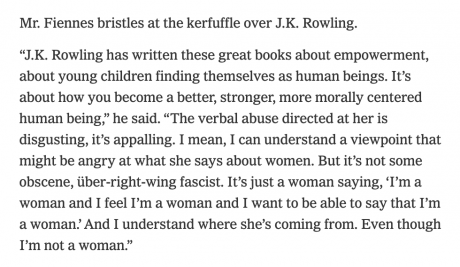
In a 10.22 N.Y. Times interview, “Ralph Fiennes, Master of Monsters,” the 59 year-old star of David Hare‘s Straight Line Crazy has, to his immense credit, once again defended J.K. Rowling in the face of trans hate:

For the record, Fiennes said roughly the same thing to Telegraph theatre critic Dominic Cavendish on 3.17.21.

“I can’t understand the vitriol directed at [Rowling]. I can understand the heat of an argument, but I find this age of accusation and the need to condemn irrational. I find the level of hatred that people express about views that differ from theirs, and the violence of language towards others, disturbing.”

Here are HE’s choices for Fiennes 11 greatest performances, be they lead or supporting…if your performances ring true, the amount of screen time matters not:’

1. Monsieur Guystave H. in The Grand Budapest Hotel. Fiennes has a classic line about graceful aging and adjusting one’s appetites. Gustave is telling Tony Revolori‘s Zero Moustafa, a Grand Budapest hotel bellboy, that he Biblically “knew” Tilda Swinton’s recently deceased Madame D. Noting that she was “great in the sack,” Fiennes explains that “in your youth it’s all fine filet but as you get older you have to settle for the cheaper cuts.” Or words to that effect.**

2. Amon Goth in Schindler’s List — a performance that spoke for itself from the get-go. I interviewed Fiennes in the fall of ’93 for a regular Sunday column I did for the N.Y. Daily News — the piece called “The Reich Stuff.”

3. Harry Hawkes in Luca Guadagnino‘s A Bigger Splash. For the “Emotional Rescue” scene alone.

4;. Charles Van Doren in Quiz Show.

5. Laurence Laurentz in Hail Caesar!

6. Heathcliff in Emily Brontë’s Wuthering Heights.

7. Dennis “Spider” Cleg in David Cronenberg‘s Spider.

8. Count László de Almássy in The English Patient (though I find his performance a bit labored, a bit of a slog).

9. Coriolanus in Coriolanus.

10. Maurice Bendrix in The End of the Affair.

11. Justin Quayle in The Constant Gardener.

I have to add that I’ve always half-admired Fiennes for that 2007 seven-mile-high episode aboard Quantas Airlines. Only good-looking movie stars get away with this kind of thing, and I had to chuckle with I first read about it. Fiennes had most of his hair back then and his natural good looks were still untouched my middle-aged crease, and Quantas steward Lisa Robertson had loved him in The English Patient so he was in like Flynn.

** That’s generally true if you’re not married, but for the middle six months of 2013 I was utterly blessed by a relationship with an exquisite, marbled, grass-fed filet mignon, to go with the metaphor. God smiled, and I will never forget His generosity. Despite the woundings at the end I caught an amazing break.