“A Pompous and Idiotic Fiction”

The fact that Vincente Minnelli‘s The Four Horsemsn of the Apocalypse (’62) hasn’t been remastered for HD streaming or issued on Bluray — that should tell you something.

Bosley Crowther’s N.Y. Times review, published on 3.10.62, is also instructive. Crowther’s verdict ends with the following sentence: “The less attention paid to this picture, the better for the simple dignity of the human race.”

The rest of the review is pretty good also: “As different from Rudolph Valentino as Glenn Ford depressingly is — and, believe us, it’s more than just the difference between a guy who did the tango and one who does not — there is that much (and more) between the impressiveness of the filmed The 4 Horsemen of the Apocalypse, in which Valentino leaped to fame, and the one with Mr. Ford as its hero, which dragged its great sluggish bulk into Loew’s State yesterday.

“In the first place, this latest film endeavor to bear the name of Vicente Blasco Ibáñez‘ popular novel of World War I has no more resemblance to the novel — or, indeed, to the 1921 Rudolf Valentino film — than may be found in the similarity of names of characters and in a couple of cut-ins of ghostly horsemen riding in clouds of surging smoke across the screen.

“This one tells a slow and vapid story of a colorless Argentine sport (Glenn Ford), caught with his father, mother and sister in Occupied Paris during World War II, who takes up with the wife of a French journalist and, finally, when down to his last dress suit, joins the Resistance movement and carries messages in folded magazines. It is a pompous and idiotic fiction, and it is staged by Vincente Minnelli in an incredibly fustian ‘Hollywood’ style.

“Although some of it smacks of actual Paris and the country regions of France, most of it reeks of the sound stages and the painted sets of a Metro-Goldwyn-Mayer studio These, on wide screen in color and lighted like a musical show, convey no more illusion of actuality than did Snow White and the Seven Dwarfs.

“The second thing is the way it is played — or isn’t played — by a cast of the most non-Argentine and non-French seeming people you’ve ever seen. Mr. Ford as the gay hidalgo from the pampas who hits the boulevards wearing a gray fedora, black gloves and swinging an ebony cane is about as convincingly Argentine and possessed of urbanity as a high-school football coach from Kansas who has never been out of the state. And in his romantic scenes with Ingrid Thulin, who plays the wayward wife, he is aggressively flat and solemn. In short, he is just plain dull.

“Miss Thulin is beautiful and graceful, in her svelte Scandinavian way, but she is made to act a very shallow woman — and her voice and lip movements do not match. Charles Boyer is drab as the father who had been living in Argentina since his youth and still talks with such a thick French accent that all the other Frenchmen sound like hicks alongside him. Yvette Mimieux plays Mr. Ford’s young sister who gets in with a Paris student crowd that swings into the Resistance movement with all the fervor and frenzy of high-school rooters at a football game. Paul Henreid as the journalist whose wife deceives him and Paul Lukas as the Germanic uncle of Mr. Ford who becomes a top Nazi general in the Occupation dutifully go along. The less said of Karl Boehm as a Germanic cousin and Lee J. Cobb as the Argentine grandfather whose anti-Hitler sentiments in 1938 are as fiery as those of a Jewish character in Exodus, the better for all concerned.”

You might presume that dismissive reactions like Canby’s helped to diminish Ford’s career, as he soon after stopped appearing in grade-A productions. And yet on 4.13.62, only a month after Apocalypse opened, one of Ford’s best films ever, Blake EdwardsExperiment in Terror, premiered to excellent reviews and better-than-decent business. Ford’s performance as an emotionally somber San Francisco detective was one of his best ever.
Read more

HE Puzzle-Gamed By “Knock At The Cabin”

Last night I finally saw M. Night Shyamalan’s Knock At The Cabin. It’s more of a mystifying situational conceit than what most of us would call a movie or even a campfire tale. It’s based on Paul Tremblay‘s “The Cabin At The End of The World,” which I haven’t read. But the screenplay, co-authored by Shyamalan, Steve Desmond and Michael Sherman, feels like a surreal dream (i.e., arresting impressions minus a compelling narrative) that was never developed into the kind of thing that most films need — i.e., a story that coheres.

Is it okay to defy conventional storytelling logic in order to create a conceptual horror film version of a Luis Bunuel film (i.e., a kind of Exterminating Angel set in a woodsy cabin)? Yeah, you can do that, sure. But guys like me don’t have to like it, much less recommend it to their readers.

There’s a fanciful notion here — i.e., a couple of guys being asked to sacrifice one of their lives in order to stop a worldwide apocalypse — and I’m telling you it doesn’t pay off or hang together. Not even a little bit. I realize I’m obliged to at least consider it as Bunuel-influenced but my gut still wants to call it precious bullshit.

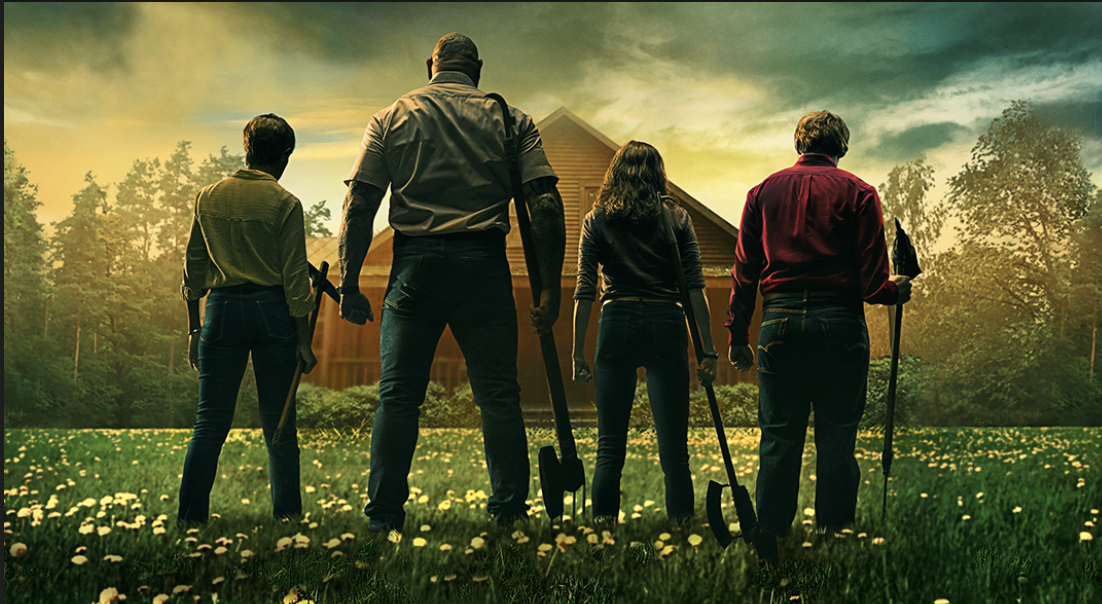
And how, by the way, does a gay couple’s experience with homophobia from all sides….how does this connect with a global apocalypse or, for that matter, an invading foursome (Tankbod Ripplehead, Nikki Amuka-Bird, Abby Quinn, Rupert Grint) who are described near the end as the Four Horsemen of the Apocalypse?

Which reminds me: Has anyone even thought of, much less seen, Vincent Minnelli‘s The Four Horsemen of the Aoocalypse (’62)? A MGM release that ran 153 nminutes, it costarred Glenn Ford, Ingrid Thulin (they exchanged fluids off-screen), Charles Boyer, Lee J. Cobb, Paul Lukas and Yvette Mimieux. I’ve never seen it, but I presume it was problematic

Boiled down, Knock At The Cabin is just a single-location “who dies and who lives?” thing, fortified or ornamented with a series of spooky end-of-the-world panoramas.

The best performance by far comes from Kristen Cui, who plays the adopted daughter of Jonathan Groff and Ben Aldridge‘s married couple.

Speaking as a serious fan of Groff (especially his starring performance in Mindhunter, which is only five or six years old), I was horrified to notice that he’s losing that young-guy physique and is becoming a bit stocky…no! What’s next — he grows a beard, puts on another 10 or 15 pounds and becomes a bear?

After Cabin ended I bolted upright, walked out to the lobby and immediately read the Wikipedia synopsis to see if I’d missed anything. I hadn’t. There’s a term for a movie like this — burn.

Why is it called Knock At The Cabin? Why isn’t it called A Knock At A Cabin? Why isn’t it called Tankbod Has An Axe?

Read more

Yesterday A Guy Said…

“We’re supposed to hate Jaws now?” He was responding to “Did These Chinatown Viewers Understand?” And I replied by summarizing Peter Biskind’s “Easy Riders, Raging Bulls” as follows:

The huge primal successes of Jaws (6.20.75) and Star Wars (5.20.77) slowly bland-ified the moody, anti-establishment ‘70s thing that had permeated Hollywood…the New Experimental Anti-Conventional Hollywood Party Era that began with Bonnie and Clyde, The Graduate and The President’s Analyst (all released in ‘67).

Steven Spielberg and George Lucas, the directing maestros behind Jaws and Star Wars, pretty much killed the cool kidz party by injecting (a) a win-really-big greed jackpot virus into the Hollywood bloodstream and (b) a strain of thematic infantilization into movies in general.

These guys didn’t didn’t suck the creative oxygen out of the room deliberately or maliciously, but the massive success of their historic blockbusters gradually introduced the idea of “high concept” and suppressed the commercial intrigue factor among industry folk and audiences alike for adult movies like Night Moves, The Conversation, The Outfit, The French Connection, Z, Easy Rider, Mean Streets, Rosemary’s Baby, Raging Bull, Scarecrow, Get Carter, The Day of the Jackal, Dog Day Afternoon, Godfather I & II, That’ll Be The Day, Stardust, Sunday Bloody Sunday, Chinatown, The Hospital, Network, Prince of the City, The Ruling Class, Quadrophenia, The Last American Hero, Performance, Don’t Look Now, etc.

Is “Misogynoir” An Actual Thing?

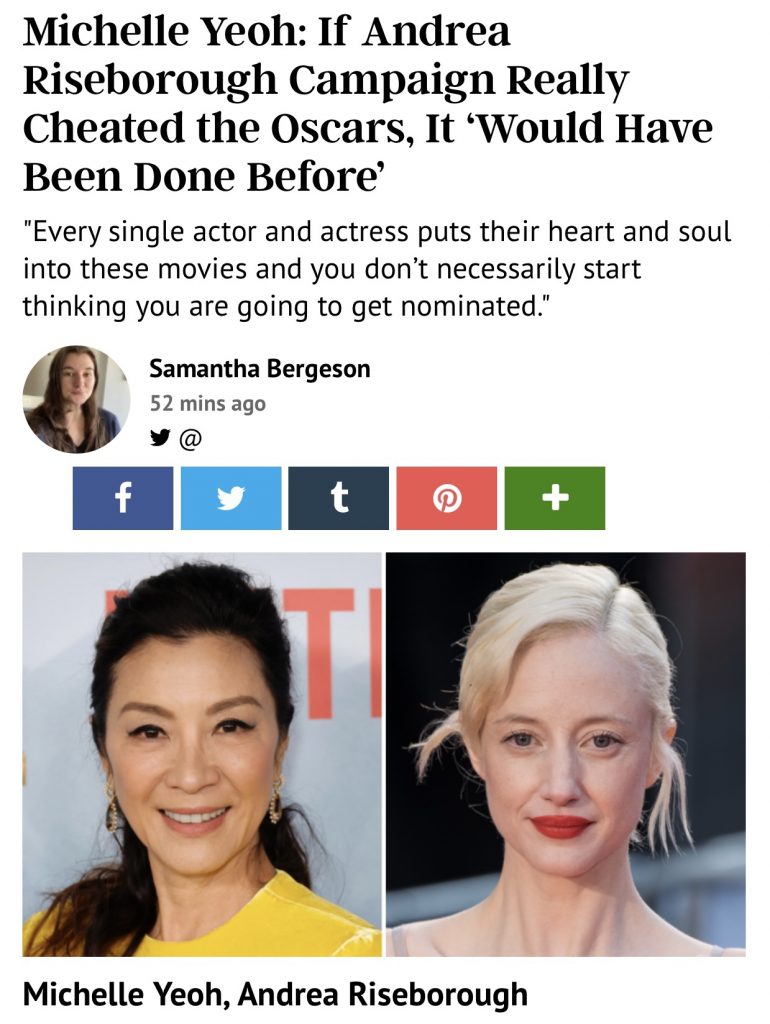
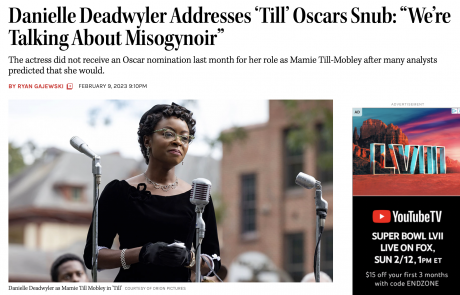
During a brief interview on Kermode & Mayo’s Take, Till star Danielle Deadwyler said she agreed with Chinonye Chukwu, her director, that Till was shafted by the Academy due to “unabashed misogyny towards Black women.”

She also blamed the lack of nominations on “people who perhaps chose not to see the film. We’re talking about misogynoir. It comes in all kinds of ways. Whether it’s direct or indirect, it impacts who we are.”

Deadwyler: “The question is more intent on people who are living in whiteness, white people’s assessment of what the spaces they are privileged by are doing.”

Do actresses like Deadwyler and directors like Chukwu and Gina Prince-Blythwood have anything in their quiver besides guilt-tripping over white oblviousness?

Friendo Who’s Had It Up To Here With All This Sore Loser Stuff: “I’m so sick of this shit and so is everyone else. The problem is the media — all these woke cheerleaders. They have seriously damaged the discourse.”

HE to FWHIUTHWATSLS: “Of course, without a doubt…Deadwyler and her supporters firmly believe that Andrea Riseborough did it. But I have to admit that ‘misogynoir’ is a catchy-sounding term.”

FWHIUTHWATSLS: “The truth the media won’t say is [that] Deadwyler wasn’t THAT good in the movie. She was good, but the limitations of the movie didn’t allow her to be great.

HE to FWHIUTHWATSLS: “Her big Mamie Till scene was the emotional meltdown moment when she shudders and faints and rolls her eyes upward into her forehead.”

FWHIUTHWATSLS: “She was fine, but I found something a tad studied about her emotionalism. The whole movie was too studied. It was okay, but in a way it blew a great subject.”

Diller: Oscar Game Is Over, Needs To Shrink

BARRY DILLER: “Look, the woke thing swung too far. The beginning process of it, which is, we should be more aware and more sensitive, is rational and reasonable. But when you take it to the extremes that the woke community has taken it…that pendulum swung all the way up and to the side of the socket. And it’s now starting to come back.

“And part of its starting to come back is that there’s been opposition to it. Yes, it is a lot from the hard right, but it’s also from just ordinary, normal-thinking folk who say, ‘well, gee, that’s ridiculous.’ You know, it’s ridiculous to shut off speech because one person out of two thousand…it will be too sensitive for that person to hear that. I think that it’s just like many things, it just went too far.

Earlier in the conversation…

DILLER: “And then along comes the pandemic, and that increases the shift because people stay home more, etc., etc. So there are more subscriptions, etc. The entire movie business crashes because there’s no movie theaters, because people can’t go to the theaters. And that whole infrastructure of– the hegemony, let’s call it, of Hollywood, which had ruled for 75, 80 years, it only took three or four years for it to totally disappear. Totally disappear in the sense that it’s over. There is no hegemony anymore of those, let’s call it those major motion picture companies. It’s truly finished. It is never coming back.”

HOOVER: Is there a reform formula for the Oscars?

DILLER: “No — they are no longer a national audience worth its candle because that audience is really no longer interested.”

HOOVER: They’re not interested in the awards and the showmanship of the awards?

DILLER: “They’re not interested in the whole process of it. Just, by the way, the awards don’t reflect their interests either. It used to be that there was congruence between the movies that people went to see and the awards that were given to those movies that were most popular. Not that they were the most necessarily or the least artistic or whatever, but there was a real correlation between popular movies and the giving of blessings on those movies and the people in them. But that disappeared a while ago, and the awards went to movies that nobody watched, nobody went to see. And then no one went to see anything because the pandemic came. So the whole house has kind of collapsed upon itself. And what I think is, is that the awards ceremony should be for the industry and not for consumers. And that would change everything.”

HE to Diller: The Oscar audience has shrunk big-time, but a voice is telling me that it will hang on at the level it is now. It won’t drop any further.

Selznick Gets The Shaft

For the last eight years Gone With The Wind, one of the most financially successful Hollywood epics of all time as well as a moving parable about survival in hard times, has been on the liberal shit list — officially shunned, regretted and derided by film festivals, the Academy’s Apology Museum, HBO Max, etc. All to placate the African-American community and their more-than-justified resentment of the film’s antiquated racial attitudes.

If I were African American I too would flinch at certain scenes in this 1939 release, but here’s the thing: the main focus of GWTW isn’t slavery or the Civil War — it’s actually a parable about the deprivations of the Great Depression, and it’s really about necessary gumption and determination when the chips are down.

Plus the second half of Part One is indisputably great, and the baby shouldn’t be thrown out with the bathwater.

And yet David O. Selznick‘s classic has been jettisoned by its own home-video distributor — Warner Bros. Home Entertainment (WBHE) — in an upcoming Bluray box set.

Ten years ago Gone With The Wind was good to go when Warner Home Video issued a Best of Warner Bros. 100 Film Collection DVD box set, which was priced at $352.91. It was a prime collection of classic Warner Bros. films along with a few choice titles that WHV had long held licensing rights to — GWTW, Mutiny on the Bounty (’35, not ’62), The Best Years of Our Lives, North by Northwest, Ben-Hur.

Now a new restricted version of the same basic package is coming out in April, and Gone With The Wind is MIA.

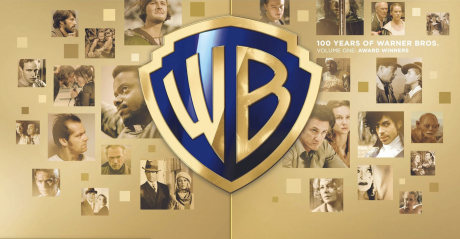
The new Warner Bros. One Hundredth Anniversary Blu-ray Box Sets are broken up into four 25-film collections ($149 each) according to genres — (1) Award Winners, (2) Comedies, Dramas and Musicals, (3) Fantasy, Action and Adventure and (4) Thrillers, Sci-Fi and Horror.

The package is basically aimed at chumps, not serious collectors. None of the Blurays are 4K, and North by Northwest is also missing.

Read more

Sneider-Rocha on Black Sore Losers, Don Murphy, etc.

In the latest episode of The Hot Mic (recorded on 2.9), the incisive Jeff Sneider and the blustery, gravel-voiced, Seth Rogen-aspiring John Rocha discuss anti-Black racism in the industry and particularly the sore-loser attitudes of Gina Prince-Bythewood, Danielle Deadwyler, Till dierctor Chinonye Chukwu and the Woman King allies (3:02).

They also discuss the Jeff Sneider-vs.-Don Murphy thing (39:45).

Rocha sounds to me like an insufferably woke accusational shrieker. Like he’s stuck in 2019 or ’20. Everyone’s sick of this schtick, and in a year or two wokesters (“white people are hopelessly bad!”) will be searching for tall grass. God….he sounds like a male gurgly “White Fragility” author Robin DiAngelo. Plus Rocha completely ignores the ELEPHANT IN THE “WOMAN KING” ROOM, which is that the African nation of Dahomey was a slave-trading nation….he ignores it!! And so does Sneider!

And what about proportionality? What does Rocha want, half of all nominees to be African American? The US population is 13% African American. What’s the percentage of African Americanas in the film/TV industry? An ASU study says that “recent studies show that Black actors comprise 12.9% of leading roles in cable-scripted shows (proportionately reflecting the overall Black population of 13.4%). The numbers behind the scenes aren’t as encouraging, though. Only 6% of the writers, directors and producers of U.S.-produced films are Black.”

Looking For More Riseborough Energy

But I’m not feeling or finding it, and I’m unhappy about this. I was dreaming about a fresh fix when I allowed myself to believe that a 2.15 Andrea Riseborough appearance at the Santa Barbara Film Festival was all but inevitable. But then, according to popular theory, Danielle Deadwyler’s reps put the kibbosh on that. I guess the DD juice is over. I should just accept it.

HE Politely Takes Issue

Magic Mike’s Last Dance director Steven Soderbergh to Rolling Stone‘s Marlow Stern (as transcribed by Jordan Ruimy): “This year’s [Oscar telecast] is going to be very telling. You cannot this year say, ‘Well, they didn’t nominate any popular movies!’ You cannot say that. So, we’ll find out if that’s really the issue or if it’s a deeper philosophical problem, which is the fact that movies don’t occupy the same cultural real estate that they used to. They just don’t.

“I’m sure that [streaming] is part of it. In cultural terms, they don’t matter in the same way that they did twenty years ago. As a result, especially for younger viewers, it’s not as compelling as it once was. They’re going to learn a lot this year. We all will.”

HE to Soderbergh: “We will learn nothing except what we already know, which is that the Woke Awards Mafia (which includes a small army of suck-up journalists) are still nominating films that support their myopic worldview, which leans heavily toward identity politics.

With the exception of Top Gun: Maverick, the ten 2022 Best Picture nominees simply aren’t that good…really. Nine of them failed to pass HE’s Howard Hawks test (2.8). It was just a mildly shitty year because of an army of mildly shitty people pulling the strings.

The actual best films of the year were (a) Empire of Light, (b) Close, which A24 decided not to open domestically until this month, (c) Happening (Best women’s-abortion-rights flick since Four Months, Three Weeks, Two Days; (d) Vengeance; (e) She Said; (f) Emily The Criminal; Top Gun: Maverick; (g) Tar (despite the many irritations); (h) Ron Howard’s Thirteen Lives; (i) James Cameron’s Avatar: The Way of Water; and (j) James Gray‘s Armageddon Time