HE to Stahelski: If you were even half-thinking about making a fifth Wick film, why the hell did you kill him at the close of the present installment? He’s dead and buried, man. If you bring finality, you need to respect finality. Simple.
There’s one way I’ll accept a fifth. Make it a stripped-down, bare-bones, less-is-more prequel. Reverse the engine and renounce the ridiculous over-the-topness of the current model. True, a certain percentage of the style junkies who love John Wick 4 will feel betrayed — “hey, where’s the absurdity?” To which I say, “Fuck ’em if they can’t take a joke.”
One of my all-time favorite guitar solos is from Robby Krieger on “You’re Lost, Little Girl,” and so what…right? I love the simplicity of it. Clean tones, nothing flashy, nice finish. 1:42 to 1:56. The shorter, the better.
It’s great that Mitchell is singing and playing guitar and sounding pretty good, particularly in the wake of having suffered a brain aneurysm in late March of 2015. She was in fairly bad shape after that tragedy, but she’s recovered (or at least is recovering) to a significant degree, and praise be to God for this.
The key question to me is “is Joni still smoking?” Because that’s almost certainly what helped to bring about her aneurysm. She initially lost her ability to speak and walk, and still needs a little help getting around as we speak.
I was so concerned about Mitchell’s well-being in the wake of the aneurysm that I once hand-delivered an admonishing fan letter to her Spanish home in Bel Air. I insisted I was one of her biggest fans and begged her to think about vaping instead of sticking with tobacco.
Mitchell may have decided that life isn’t worth living without the pleasure of unfiltered cigarettes, but maybe not. She once said in an interview that she began smoking at age 9 or 10 or something. At a certain point the body just can’t take the nicotine and the toxins and complications will manifest.
It’s wonderful, in any event, that Mitchell has regained (or is in the process of regaining) her singing and guitar-playing abilities. She’ll turn 80 on 11.7.23.
Posted on 3.31.15: I attended a short, smallish concert that Mitchell gave at Studio 54 in October ’82 to promote “Wild Things Run Fast.” The crowd was not huge, maybe 150 or so, and I was standing fairly close and pretty much dead center. No female artist has ever touched me like Mitchell**, and I was quite excited about being this close to her.
I was beaming, starry-eyed and staring at her like the most self-abasing suck-up fan you could imagine, and during the first song her eyes locked onto mine and I swear to God we began to kind of half-stare at each other. (Some performers do this, deciding to sing for this or that special person in the crowd.) Her eyes danced around from time to time but she kept coming back to me, and I remember thinking, “Okay, she senses that I love her and she probably likes my looks so I guess I’m her special fanboy or something for the next few minutes.”
Mitchell was dressed in a white pants suit and some kind of colorful scarf, and she sang and played really well, and I remember she had a little bit of a sexy tummy thing going on. Sorry but that had a portion of my attention along with the songs and “being there” and a feeling that I’d remember this moment for decades to come.
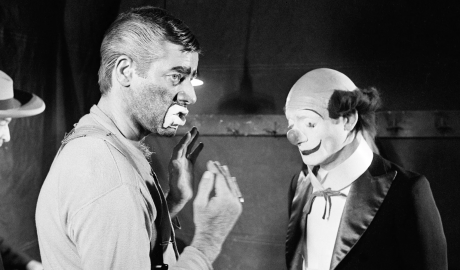
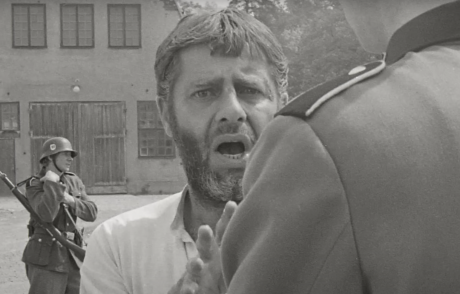
On 8.5.15 L.A. Times staffer Noah Biermanreported that Jerry Lewis had donated a copy of The Day The Clown Cried, an unfinished 1972 holocaust drama that Lewis had directed, written and starred in, to the Library of Congress.
It was stipulated, however, that the film couldn’t be screened “for at least ten years,” and only then with the permission of the Lewis estate. (Lewis passed on 8.20.17 at age 91.)
On 10.14.15 (or two months after the Bierman piece) I was informed by Mike Mashon, head of the Moving Image section on the LoC campus, that the embargo on TDTCC would be in place “for ten years,” and would therefore extend until 2025.
Although the LoC apparently intends to eventually screen The Day The Clown Cried at its Audio Visual Conservation campus in Culpeper, Virginia, curator Rob Stone has stated the LoC does not have a complete print of the film.
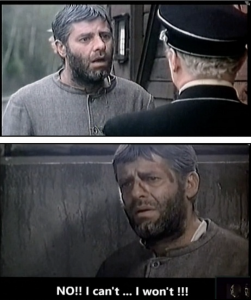
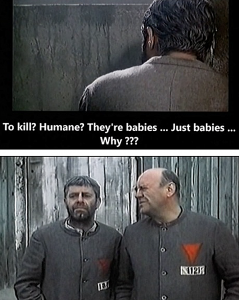
Posted on 6.15.16: I’m hardly an authority when it comes to Jerry Lewis‘s never-seen The Day The Clown Cried (’72), but to my knowledge an assembly of scenes from the finished film has never been shown to anyone.
This morning a friend passed along a 31-minute Vimeo file (posted two months ago but yanked on Thursday morning…sorry) that provides the first real taste of Clown, or at least the first I’ve ever sat through.
And you know what? I don’t see what’s so godawful about it.
Okay, the scheme is manipulative bordering on the grotesque — Lewis as a German-Jewish clown in a Nazi concentration camp who’s ordered in the final act to amuse a group of children being sent to the “showers” — but that elephant aside it didn’t strike me as all that agonizing or offensive. Really. Lewis’s performance seems more or less restrained as far as the writing allows, and the story unfolds in a series of steps that seem reasonably logical. The supporting perfs and period milieu seem decent enough.
When everyone finally sees The Day The Clown Cried in 2024 (or ’25) the verdict may be that it’s not a mediocre, miscalculated effort (or that it is…who knows?), but I didn’t smell a catastrophe as I watched this whatever-you-want-to-call-it. Plus it costars HE’s own Harriet Andersson.
Please accept my deepest, saddest and most heartfelt condolence over the passing of Ryuichi Sakamoto, with whom I had the honor of briefly speaking at a Golden Globes party eight or nine years ago.
Sakamoto’s musical compositions for Merry Christmas, Mr, Lawrence, The Revenant, The Last Emperor, High Heels, Little Buddha, Love Is the Devil and Babel are now and forever truly wonderful.
Sakamoto played the sexually conflicted Captain Yonoi in Merry Christmas, Mr Lawrence (’83), as well as a supporting role in The Last Emperor (’87).
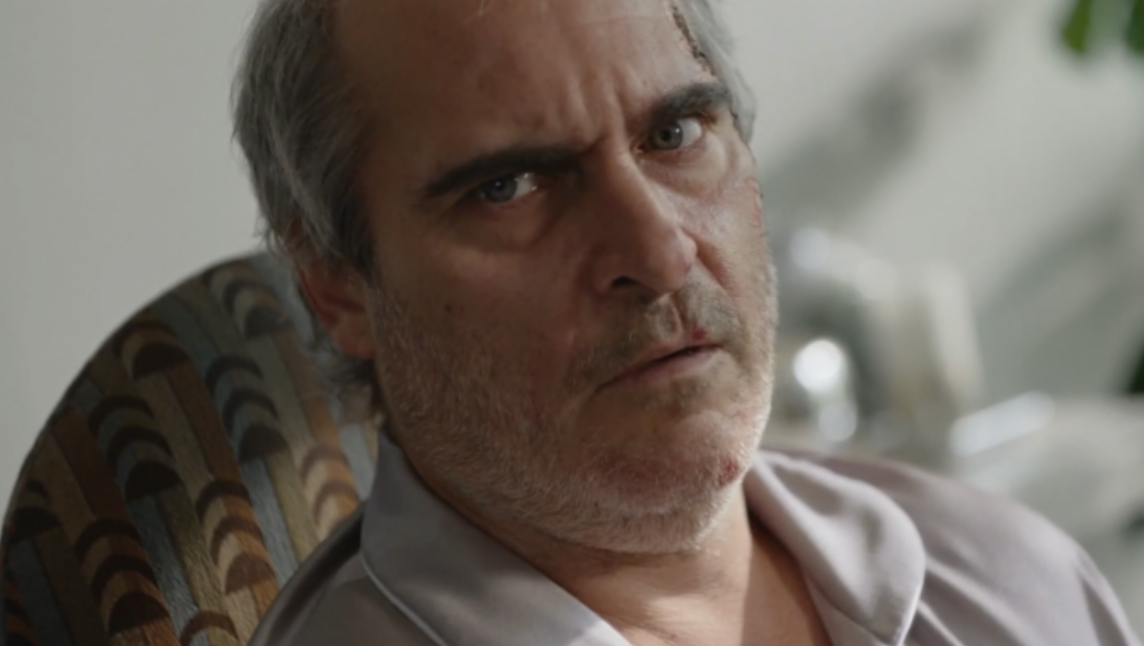
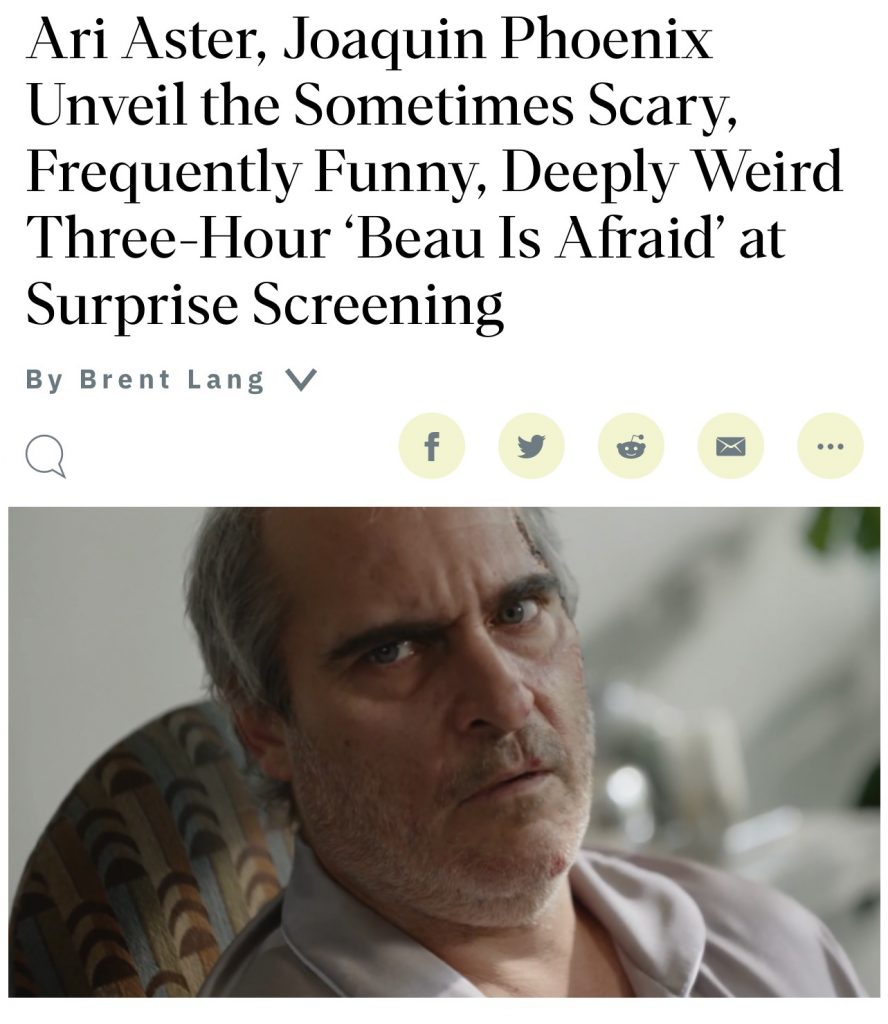
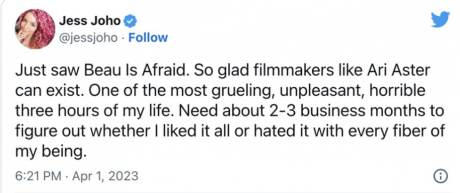
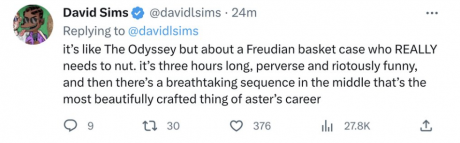
Ari Aster’s BeauIsAfraid (A24, 4.21) was previewed yesterday (Saturday, 4.1) to a paying audience at Brooklyn’s Alamo Draft House (445 Albee Square, Brooklyn, NY 11201), and Variety’s Brent Lang was apparently theretoendureit.
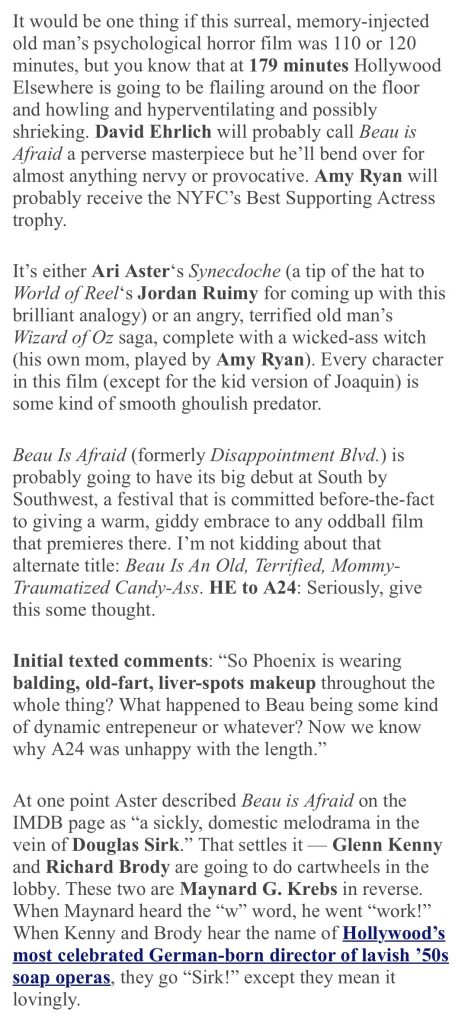
Presuming that the synopsis is legit, Aster’s 179-minute “horror comedy” (set to open in select IMAX theaters on 4.14 before opening wider on 4.21) is apparently some kind of grotesque, audience–punishingfantasia — a surreal acid trip version of a 21st Century AliceinWonderland-meets-Homer’s TheOdyssey, except with a bloated, gray-haired, “twitchy and over-medicated” Phoenix in the Alice role — and not for the faint of heart.
A few excerpts from Lang’sarticle, which was filed late Saturday afternoon:
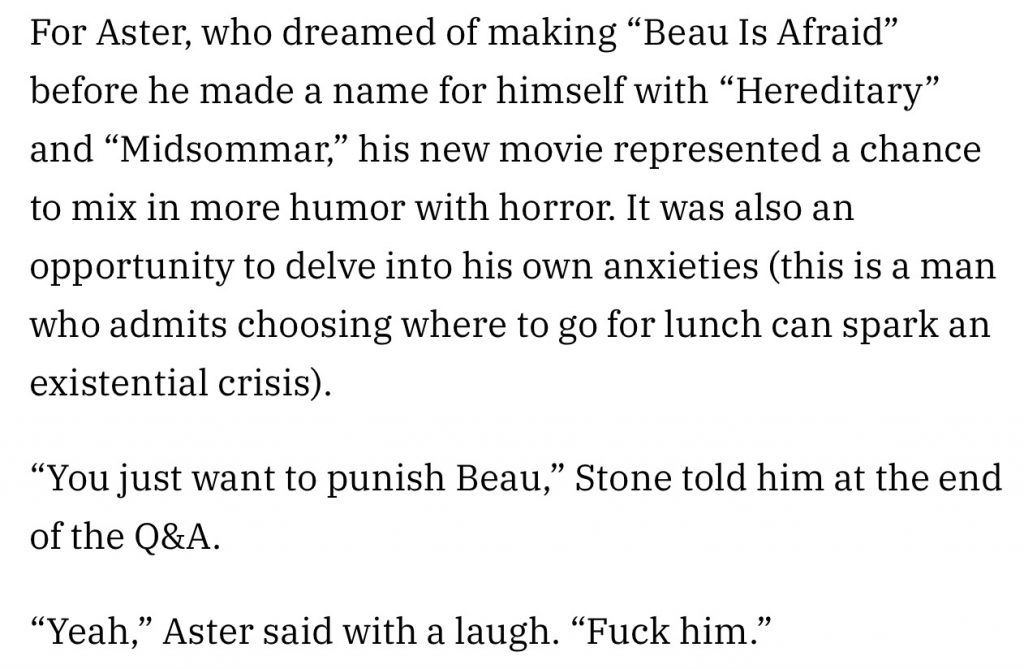
(1) Q&A moderator Emma Stone to Aster following the screening: “Are you okay, man?”
(2) The film features a paint-drinking, antagonistic teenaged protagonist (Kylie Rogers), an animated sequence, a “recurring gag involving Phoenix’sdistendedtesticles”, and “a sex scene with [the mid 50ish] Parker Posey that may rank among the wackiest ever committed to film.”
(3) “The [Draft House] crowd seemed to love it, although thegeneralpublicmayhaveatoughertime” with this “bladder–testingepic.”
(4) Aster comment during the Stone Q&A: “I want [the audience] to go through [Phoenix’s] guts and comeoutofhisbutt.”
(5) The black-garbed Phoenix attended the screening but chose not to participate in the Q&A.
It needs to be said that a film that ends with a great final shot does not necessarily deliver a big twist or surprise (Planet of the Apes) or provide a satisfying, soothing feeling of emotional closure (i.e., Wes Anderson‘s Rushmore).
Truly great endings, rather, are ones that hold and fascinate because of an unexpected (and yet perfectly on-target) feeling of irony. Anything with a certain focus or visual strategy that takes you a little bit by surprise. Content, of course, but primarily style, panache, decisiveness.
The very last shot of The Godfather (i.e., the door closing upon Diane Keaton as she contemplates her future with Al Pacino) is one of the greatest of all time.
Keir Dullea‘s star child gazing down at the earth at the close of 2001: A Space Odyssey, for sure.** The closing shot of Carol Reed‘s The Third Man is a deservedly admired classic. The final image in North by Northwest (i.e., Cary Grant‘s penis train roaring into Eva Marie Saint‘s vagina tunnel) is brilliant. In Kubrick’s The Killing, that shot of the cops approaching a distraught Sterling Hayden as they emerge from an airline terminal is a knockout.
The last shot of Brokeback Mountain (“Jack, I swear”) is excellent. Ditto Fight Club (i.e., collapsing buildings), Cabaret (i.e., a Nazi armband spotted in the crowd), and that lingering closeup of Timothee Chalamet at the end of Call Me By Your Name. The final shot of Michelangelo Antonioni‘s Blow-Up (David Hemmings vaporizes) is a keeper; ditto the bravura ending of The Passenger.
Which others?
** The exploding nuclear weapons at the end of Dr. Strangelove don’t count because they’re a montage, not a single shot.
Quentin Tarantino, 60, has said that The Movie Critic will be his last directing effort because he doesn’t want to succumb to a gradual decline period, which tends to happen, he believes, when directors get into their 60s. Yes, Alfred Hitchcock went into a slow decline after The Birds (Marnie is abundant proof of that) and Stanley Kubrick had arguably begun to lose his edge (certainly compared to the filmmaker he was in the ’60s, ’70s and ’80s) when he made Eyes Wide Shut. But otherwise there are several holes in QT’s analysis.
Clint Eastwood was still cooking with good gas when he made 2008’s Gran Torino at age 77 or thereabouts. John Huston was the same age (77 or thereabouts) when he hit a grand slam with Prizzi’s Honor (’85). There’s no indication that 80-year-old Martin Scorsese is currently off his game, or that he was slippin’ when he made The Irishman (’19). In his early 80s Sidney Lumet delivered a career-crowning one-two punch with Find Me Guilty (’06) and Before The Devil Knows You’re Dead (’07). Woody Allen‘s last three exceptional films — Match Point (’05), Vicky Cristina Barcelona (’08) and Midnight in Paris (’11) — were made when he was 69, 72 and 75.
[Originally posted on 12.9.21] There’s a famous bit in The Empire Strikes Back (’80) when the Millennium Falcon won’t turn over and so Han Solo twice slams a console with his fist and wham…it’s working again.
There’s a scene in The Bridge on the River Kwai (’57) when William Holden angrily kicks a non-functioning two-way radio, and suddenly it’s working again.
There’s a scene in The Hot Rock (’72) in which a police precinct captain (William Redfield) is told by a subordinate that a phone isn’t working, and he asks “well, did you jiggle it? Did you…you know, fiddle around with it?”
There’s a scene in The Longest Day (’62) where Capt. Colin Maud (Kenneth More) walks up to a stalled vehicle during the D-Day invasion and says, “My old grandmother used to say, ‘Anything mechanical, give it a good bash.'” He hits the vehicle and it starts right up.
And don’t forget that moment in Armageddon (’98) when Peter Stormare said “this is how we fix things in Russia!” and then whacked an engine with a wrench.
In 2010 my last and final Windows laptop (I had more or less become a Mac person two years earlier) stopped working in some fashion — it was acting all gummy and sluggish — and so I decided to bitch-slap it a couple of times. Instead of suddenly springing to life, the laptop more or less died. Violence, I realized with a start, was not the answer. Times and technology had changed.
I resolved at that moment never to try and William Holden or Harrison Ford or Peter Stormare or Kenneth More or William Redfield my way out of a technical problem again.
Sharon Acker, the actress who, at 30, portrayed Lynne Walker, the moody, vacantly unfaithful wife of Lee Marvin’s lead character in John Boorman‘s Point Blank (’67), has passed at age 87.
Lynne (the sister of Angie Dickinson‘s Chris) was the best role Acker ever had. Her single best moment was when she sat on a couch and explained to Marvin what had happened, why she “couldn’t make it” with him, why she betrayed him with John Vernon‘s Mal Reese, etc.
THRreports that Acker died March 16 (15 days ago) in a retirement home in her native Toronto.
New Hampshire Gov. Chris Sununu made a reasonably good impression last night on Real Time with Bill Maher. Only 48 years old and obviously sane and plain-spoken and given to joking and smiling, he would be a much more appealing alternative to Joe Biden than Orange Plague, who might be able to win the Republican nomination but can’t possibly win.
Sununu said last night he would support Trump if he becomes the Republican nominee, but that was only to placate the rural morons.