I Don’t Want Biden To Die

Because I really don’t want Kamala Harris to take over. Really. I’m a center-lefty (i.e., a centrist with a classic liberal history before the scourge of wokeism) but I’d honestly feel better about Nikki Haley. She’s a better candidate now than Harris was in ‘19 and early ‘20.

“That’s the one thing that Democrats and Republicans have in common — they’re both waiting for their [likeliest Presidential] candidates to die.” — Bill Maher monologue, 11.10.23.

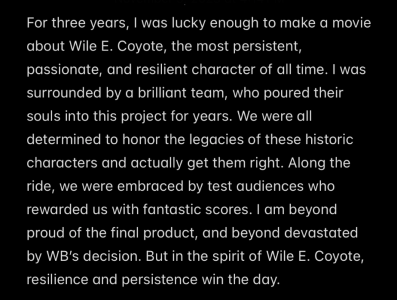
Farewell, “Coyote vs. Acme”…For Now

Yesterday Warner Bros.s David Zaslav shelved the finished and ready-to-go Coyote vs. Acme — no theatrical or MAX release. From this act of brutality WB derived an estimated $30M writedown, with Coyote vs. Acme having cost $70 million.

Another Portrait of Hitchcock’s Pervy Inner Life

I was lucky with the ladies for a fairly long stretch, from the mid ’70s until the late 20-teens. My hound-dog period ended precisely in June of ’17, when Tatiana and I tied the knot.

Before that moment I was mostly just fortunate. Either women find you attractive or they don’t. You can’t talk them into anything they don’t want to do — they hold the cards and control all the traffic lights.

I was a celibate, low-self-esteem nerd in my teens, but after hitting my early 20s I was blessed with dozens of glorious green lights for many subsequent decades. (I was faithfully married between ’87 and ’91.)

In this respect Alfred Hitchcock was one of the unlucky ones. He was obviously quite brilliant, wealthy and powerful during his directing heyday (mid 1920s to mid 1960s), but women found him ugly and Uriah Heepish, and despite his obvious interest and heated libido he never got anywhere.

When he entered his early 20s he should have just said “aahh, fuck it…God has both gifted and cursed me, and I’m just not going to score…women find me grotesque and that’s that.”

Alas, Hitch kept expressing himself in sexual ways throughout most of his life. Indirectly (mostly through surrogates) but creatively and forcefully.

For many decades the standard narrative about Hitchcock has been that he was more than a bit of a misogynistcruel, pervy, sexually frustrated.

This view was launched almost exactly 40 years ago by Donald Spoto‘s “The Dark Side of Genius” (’83). It certainly got the ball rolling.

Roughly 29 years later Spoto served as script consultant for Julian Jarrold‘s The Girl (2012), an HBO/BBC flick based on Spoto’s Hitchcock books (the other two were “The Art of Alfred Hitchcock” and “Spellbound by Beauty”). Hitch and his Birds/Marnie victim Tippi Hedren were played by Toby Jones and Sienna Miller. (Not a good film.)

In the fall of 2016 came “Tippi: A Memoir”, in which Hedren passed along first-hand accounts of Hitchcock sexually assaulting and generally pressuring and tormenting her…”I’m giving you a career…how about some reciprocity?”

On 6.21.18 noted critic David Thomson posted a London Review of Books essay about Hitchcock‘s notoriously perverse (and arguably misogynist) Vertigo. The piece questioned whether Vertigo was an acceptable fit in the #MeToo era. Given Hitchcock’s creepy attitudes toward women on-screen (and his behavior toward Hedren in the early ’60s), Thomson doubted that Vertigo would be #1 again when Sight & Sound critics voted in 2022.

Thomson turned out to be right. In an act of seeming woke ballot-stuffing, Chantal Akerman‘s Jeanne Dielman became the new S&S champion.

Now comes another Hitchcock study, one that basically says that he greatly enhanced the careers of several blonde actresses even though he was a fascinating creep — Laurence Leamer‘s “Hitchcock’s Blondes.”

Yesterday The Atlantic posted a mostly negative review by Matthew Specktor, titled “The Baffling Cruelty of Alfred Hitchcock.” Here are excerpts:

“Despite a title that may come off as objectifying, Leamer’s book is in many ways empathic and thoughtful, and he seems ready to train a generous eye on these actresses, to extract them from Hitchcock’s shadow without shoving the director under the wheels of his own limousine.

“The Hitchcock depicted in these pages is lonely and remote, yet also controlling and often vicious, at once fearful of and fixated upon sex, a devoted caregiver to his wife during her later years and, as Leamer is not the first to speculate, possibly undiagnosed with Asperger’s syndrome.

“The intention here is not so much to redraw our understanding of Hitchcock as it is to shift the emphasis altogether: to provide a new picture, or rather a series of pictures, of the actresses whose lives and careers are too often viewed in relation to the director’s.

“The problem is, Leamer doesn’t quite bring enough to the table. He doesn’t have much in the way of new information, and however nobly he strives to foreground the women in Hitchcock’s orbit, the book comes to life only when the director emerges from the wings to reclaim the stage. Leamer’s attention to the details of the actresses’ erotic lives can also give off a whiff of misogyny.

Read more

Best Supporting Actor Passions

HE salutes FYC’s Scott Mantz for sticking his passionate neck out and predicting that Blackberry‘s Glenn Howertion will might snag a Best Supporting Actor nomination.

Perri Nemiroff is also a Howerton supporter….respect.

Unfortunately Jeff Sneider doesn’t show the same level of conviction and cojones — he only has Howerton as his tenth-favorite choice. Why? Not because Howerton’s performance as former BlackBerry honcho Jim Balsillie isn’t excellent, but because BlackBerry “is such a small film” and blah-dee-blah. What Sneider is saying is that the frugal-minded IFC Films isn’t spending any money to push Howerton…that’s what he really means.

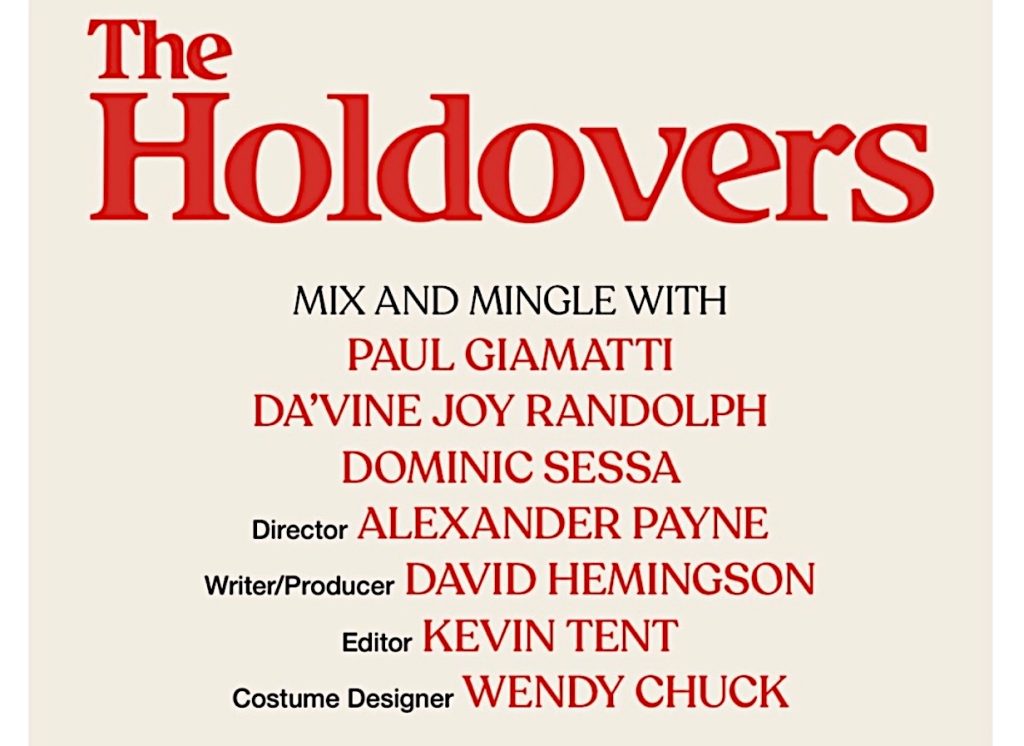
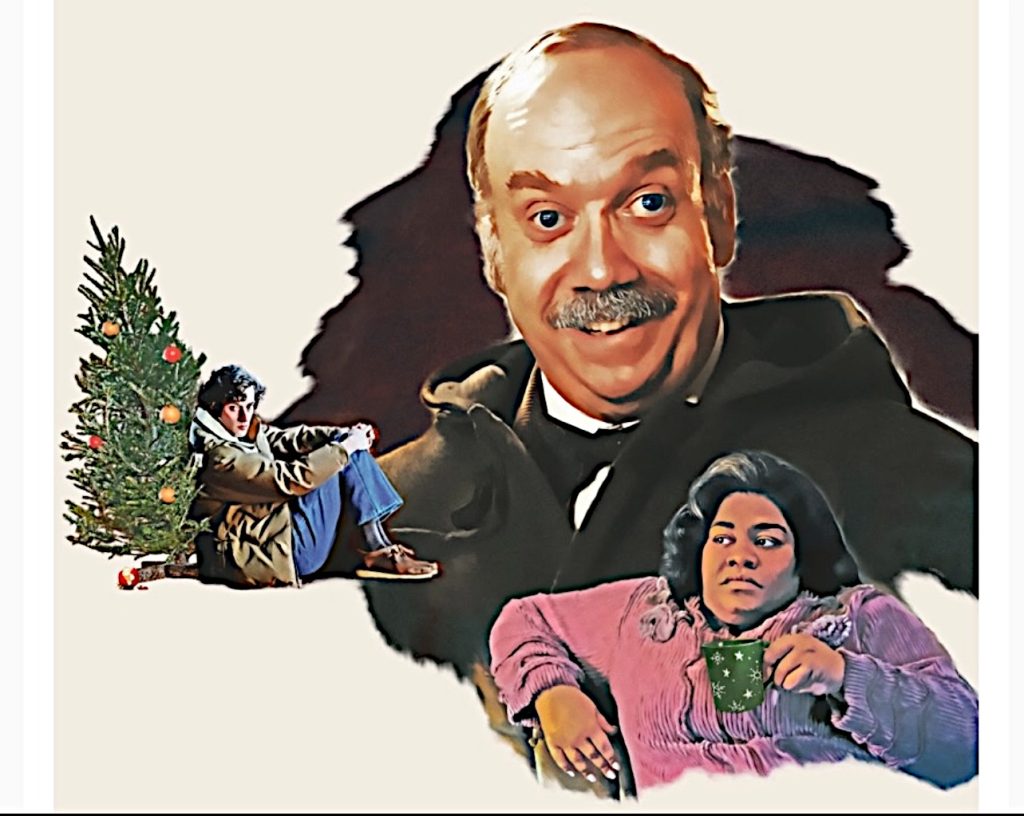
My second favorite Best Supporting Actor contender is Dominic Sessa in The Holdovers. A great debut performance. Can’t be denied.

I wasn’t especially knocked out by Robert Downey, Jr.‘s performance as the slimy, weasel-like Lewis Strauss. He’s fine but I really don’t get the jumping-up-and-down. Barbie‘s Ryan Gosling is appealing as Ken, but it’s a broad, self-mocking, look=at-what-a-clueless-child-I-am showboat performance. Robert De Niro is dullsville in Killers of the Flower Moon. I haven’t seen American Fiction so I have no opinion on Sterling K. Brown. Mark Ruffalo‘s selfish, self-lampooning shithead in Poor Things is a meh.

Charles Melton‘s performance in May December isn’t happening…forget it.

Read more

Fatzilla In Your Living Room

It’s been nine and a half years since Gareth EdwardsFatzilla reboot, and to this day the vast majority of critics and commentators are still refusing to even mention the fact that Godzilla began as a relatively svelte fire-breathing dinosaur back in the early 50s, and that he gained weight as a gesture to an increasingly obese American population that manifested in the 21st Century.

When Godzilla premiered in May 2014, Edwards, something of a beef-bod himself, either denied it or pretended that the obsese Godzilla thing was an invention…a purely subjective observation that smacked of fatphobia or, if you will, an anti-body-positivity mindset.

Will voices in the entertainment culture ever admit the obvious? Will crusty old conservative Kurt Russell toss off an obesity joke or two in Monarch: Legacy of Monsters (Apple + streaming, 11.17). He would if he was producing or co-writing, but he isn’t so he won’t.

Posted on 5.27.19: I don’t care if my repeated mentions about Godzilla having become a total fat-ass sound obsessive, but why do I seem to be the only critic-columnist on the planet earth who’s even mentioning this obvious fact?

Five years ago Japanese film enthusiasts were fat-shaming Godzilla, and for good reason. Compared to the original Toho Godzilla of 1954, Gareth Edwards’ super-reptile was definitely Raymond Burr in the mid ’60s. But the new Godzilla is flat-out obese — a kaiju Orson Welles. And no one, it seems, wants to even take note of this. Not even in passing. Not even as a joke.

The reason (and I’m not kidding) is that critics and think-piece writers have sensed that the monster’s expanding belt size is a subliminal gesture of kinship and comfort to the obese community, which of course reps a significant portion of the moviegoing public, and no film writer wants to be accused of fat-shaming. Because in today’s p.c. environment a fat-shamer is indistinguishable from a racist or a homophobe.

I’m no shamer, but I am saying “is anyone besides myself going to look this thing in the eye or what?” All I’m doing is saying (a) “look at him” and (b) “why do you think that is?”

You can bet that if the new Godzilla had ignored the 2014 precedent and reverted to the relatively lean-and-mean physique of the 1954 Toho version, reviewers would be mentioning this left and right. Because they’d have nothing to fear for saying “wow, Godzilla’s been working out…he’s back in shape!” Because that wouldn’t be…well, I guess it would be received at fat-shaming in some corners.

When Using The Word ‘Fat’ was Permissible,” posted on 6.19.07.