If I Was Costner, I’d Probably Throw In The Towel

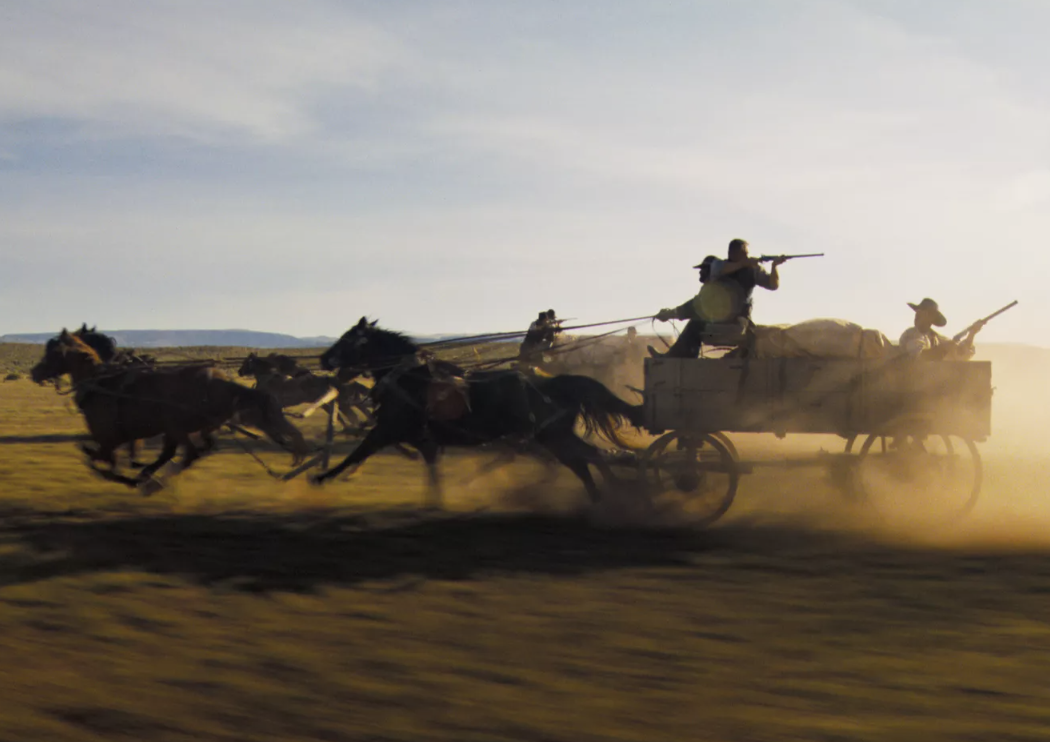
Unless Part Two of Kevin Costner‘s Horizon (Warner Bros., 8.16) somehow improves upon the sluggish initial installment and delivers something that feels whole and alluring and thematically fulfilling, he should probably forget about Parts 3 and 4.

If, God forbid, the next chapter makes the same kind of mistakes that Chapter One did — if it kinda moseys around and half-assedly hopscotches and fritters away story tension — the wisest course (and I’m saying this from the core of my heart) will be to cut bait and let it go.

Because no one will want to even think about the last two installments, much less pay to see them.

Let’s face it — a second Horizon wipeout is certainly possible. If audiences blow it off…well, I’ll be sorry again. I want the opposite to happen, of course, but there’s an odd whiff in the air.

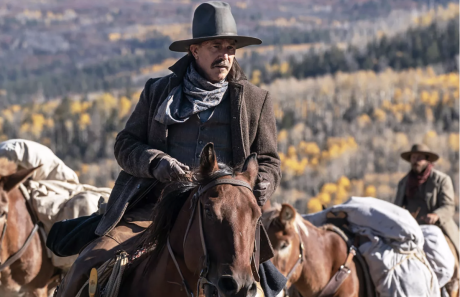
It really and truly breaks my heart to say this. I love Costner as a man of character, consequence and sincerity, and I truly worship some of the films he’s directed and starred in. Open Range especially.

So I really hope to God that Chapter Two brings the magic, in which case no one will be happier than myself.

Before I saw Chapter One in Cannes I wanted it to play like Open Range: Westward Ho The Wagons. Alas…

No 2024 film has bummed me out worse than Horizon, Chapter One did. If on my way out of the Salle Agnes Varda a friend had offered a couple of snorts of Vietnamese heroin, I would have followed him right into the bathroom.
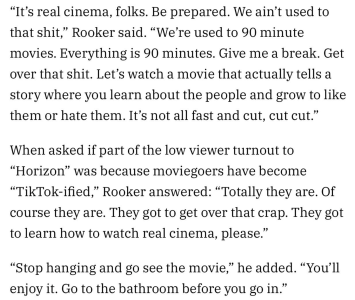
And by the way, Horizon costar Michael Rooker doesn’t seem to understand what happened with this unfortunate effort.

One, “real cinema” in the classic western mode, especially when you’re talking about three effing hours, is about delivering a solid, well-strategized, self-contained story with emotional currents. It needs to deliver a beginning, a middle and hopefully a bull’s-eye ending. Horizon Chapter One doesn’t do that. It just plants seeds by introducing characters along with the beginnings of six or seven story lines. In so doing it refuses to deliver a movie for anyone looking to enjoy a serious, nutritional, stand-alone meal right then and there.

Two, Rooker’s statement that Horizon‘s opener “tells a story where you learn about the people and grow to like them or hate them”…that doesn’t happen either. Again, it’s too all-over-the-place, too meandering, too unconcerned with classic narrative strategy.

Three, big movies these days are not about Tik-Tok sensibilities. They’re not about 90 minutes and out. They’re about running times of 130 to 150 minutes and people like me glancing at our watches three or four times before it’s half over.

Think of the huge, sprawling, emotional story that Red River told, and it did so in 133 minutes

No good movie is too long, and no bad movie is too short.
Truly Rotten People

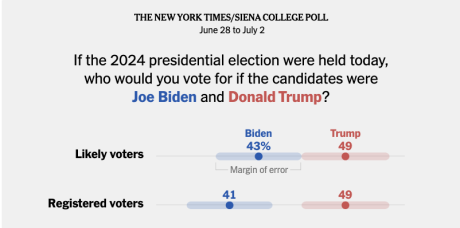
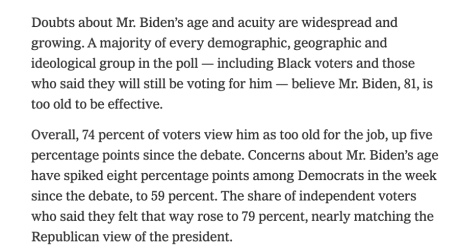
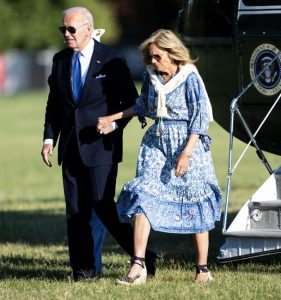
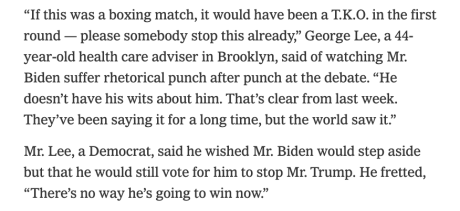
The Bidens, I mean. Lady MacBiden, Hunter Biden (what is this derelict doing in White House meetings? shoring up the old man?) and great-grandpa…deranged, egoistic, sickening.

Over the last six days I’ve gone from “Joe is obviously too old and is almost certainly going to ensure Trump’s victory” (i.e., last Thursday afternoon) to “I wouldn’t be all that upset if he suffers a stroke or better yet dies…he’s a drooling, croaking, reality-denying fiend who cares only for himself” (i.e., right now).

Really Nice Ride

To my great surprise and delight, Christy Hall‘s Daddio, which I was remiss in not seeing during last year’s Telluride Film Festival, is a truly first-rate two-hander — a pure-dialogue, character-revealing, heart-to-heart talkfest that knows what it’s doing and ends sublimely.

Yes, it all happens inside a Yellow Cab on a long nocturnal trek from JFK airport to midtown Manhattan. It may not sound like much, I realize, because it’s just talk, but it holds you with ease and humanity and really effing pays off…sticks the landing with assurance.

I wasn’t exactly astonished by the quality of the lead performances from Sean Penn (driver) and Dakota Johnson (passenger), as they have the whole film to themselves and are both formidable, ace-level talents (Penn especially), but I was definitely taken aback by the quality of Hall’s dialogue and how she magically maintains a sense of story tension start to finish, even though there’s no “story” and it’s all about dodging, contemplating, confessing and looking within.

In my mind Daddio is right up there with Steven Knight‘s Locke (’13) — this century’s other great dialogue-driven, “guy driving on a nighttime highway while discussing fundamental issues” movie.

This may sound like excessive hyperbole, but I honestly feel that Daddio is in the same two-hander ballpark as Joseph L. Manchiewicz‘s Sleuth , Louise Malle‘s My Dinner with Andre, and Richard Linklater‘s Before Sunrise. I’m not saying it’s “better” than any of these three, but it delivers the same kind of step-by-step character cards.

Intially and quite naturally, Johnson’s unnamed protagonist (“Girlie”) holds her cards close to her chest, at least as far as Penn’s cabbie is concerned. But Hall shows us several text messages Girlie hae been getting from her highly hormonal boyfriend. To me he sounds like a real jerk — adolescent, eager-beaver (he actually sends her a dick pic), insensitive.

Penn’s “Clark” is an occasionally blunt (i.e., flirting with coarse) borough guy, and yet also sly, gentle and highly perceptive. Straight-up, decent, not an asshole. And a bit of an amateur shrink, or at least imbued with the observational powers of a seasoned Manhattan detective.

I’m not going to divulge what’s revealed or admitted to, but I can affirm that Daddio unfolds and hangs on in just the right way.

The conversation starts off casually and amusingly, but then a bad traffic accident happens, the traffic slows to a stop and we gradually understand that Johnson’s “Girlie” was up to while visiting her lesbo half-sister in the Oklahoma panhandle. The sister’s girlfriend sounds, by the way, like a Lily Gladstone type.

We get to absorb some melancholy situational truths about Clark and his two past wives and the (presumably modest) Queens house he lives in, etc. And yet the film primarily turns on Girlie’s relationship with the dick-pic sender, and this, trust me, takes on a greater weight as the film moves along.

On top of which Daddio is only 101 minutes long…congratulations for the discipline! And hats off to Hall, a very sharp, 40-year-old rookie.

Fathers and Sons

My gut impression is that Ariel Vromen and Sascha Penn‘s 1992, a dual father-son action drama occuring at the beginning of the Rodney King riots, is a smart, gripping, tautly-plotted film.

I can’t find any reviews and we obviously can’t trust trailers, but this feels like a goodie.

Plus it has a 96-minute running time — an astonishing fact given the general current tendency of many films running over two hours, if not closer to 150 minutes.

I would be remiss not to at least consider the racial-ethnic angle here. Correct me if I’m wrong, but it’s my understanding that 1992 is primarily focused upon Tyrese Gibson and Christopher A’mmanuel‘s characters (good guys), and secondarily upon Ray Liotta and Scott Eastwood‘s characters (thieves)…right? The trailer certainly suggests this.

Question #1: Aren’t white filmmakers presumed by wokester critics to lack authority in stories about Black characters? Question #2: I’m therefore wondering if 1992 having been directed by a white Israeli guy (Vromen), and written by a white guy (Penn) might result in problematic reviews. Question #3: Am I wrong in believing there have long been currents of anti-Semitic attitudes in the Black community, and especially since Israel invaded Gaza hard and heavy following the 10.7 atrocities? Question #4: It’s also my impression that wokesters are generally anti-Israel (i.e., ”Queers for Palestine”).

So this film, which looks pretty damn good, will probably be ignored or perhaps even dismissed by significant sectors of the progressive critic community. If a black dude had directed it…different story.

Boilerplate: In 1992, Mercer (Tyrese Gibson) is desperately trying to rebuild his life and his relationship with his son (Christopher A’mmanuel) amidst the turbulent 1992 LA uprising following the Rodney King verdict. Across town, another father and son (Ray Liotta and Scott Eastwood) put their own strained relationship to the test as they plot a dangerous heist to steal catalytic converters, which contain valuable platinum, from the factory where Mercer works.

“As tensions rise in Los Angeles and chaos erupts, both families reach their boiling points when they collide in this tense crime-thriller.”

“Not That We Loved Biden Less…

“But that we loved our country and especially protecting our democracy from the whims of an authoritarian sociopath more.” — James Mason‘s Brutus in Joseph L. Mankiewicz‘s Julius Caesar (’53).

Olbermann: “I am suggesting that the events of the last 24 hours” — particularly Puck’s Peter Hamby reporting that a confidential OpenLabs “polling memo” spells a electoral disaster for Biden — “may have made Joe Biden’s withdrawal from the ticket inevitable.

“This in turns makes tangible the second half of what might happen next, [which is the very real possibility] that this seemingly dire outcome [might in fact be] far better than it seems.

“If the President were to [accept] the idea that he has to retire from the ticket, it is not a great leap from that point to realizing the extraordinary value of attaching the title of incumbent to Kamala Harris‘s name….of [Joe] retiring from the Presidency, and letting Kamala become, as Lincoln said, clothed in immense power well before the election.

“It is inarguable that if you [believe] Joe will not be up to the responsibilities of the Oval Office days or weeks or months from now…if that’s true he’s probably also not up to the duties of the office right now.

“His retirement from the Presidency would not, I think, be seen as a defeat nor the result oF unseemly desperate pressure. It would be an ennobling act that would resonate in this country.

“To be a President who leaves the office that he has spent his [whole] life trying to reach, solely to ensure that Trump is [kept from taking beastly power]…would enshrine Joe Biden, I believe, among the immortal presidents. Selfless, historic, admirable.”

Read more