De-Grained “Oz” Deliverance

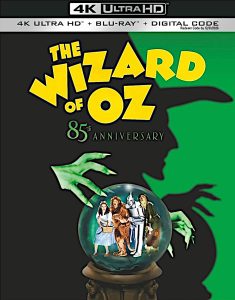
15 years ago WHE released a 70th anniversary Bluray of The Wizard of Oz (‘39) — a sharper and more vibrantly colorful version than anyone had seen up to that point, but also grainy as hell.

You could see Judy Garland’ freckles but she and costars seemed to be literally choking to death, their lungs swamped with God knows how many billions of digital Egyptian mosquitoes.

I was afraid to sound like a rube or a philistine so I lied in my review and said the grainstorm effect wasn’t a problem.

But it was, of course. The inherent mosquitoes were always in the negative but they weren’t detectable when Oz was first released into cinemas in ’39 and again in ‘54. Alas, the Bluray process made them stand out all the more.

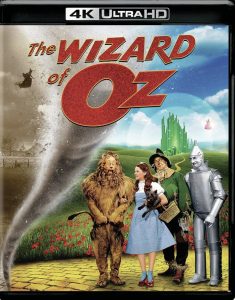
Ten years later (September 2019) a significantly de-grained 4K Bluray version (80th anniversary) was released, but the ‘09 version looked and felt so oppressively grainy that I had lost interest by that point. I despise prominent grain.

But I’ve just received the ‘19 version and have discovered that it’s far less mosquitoed. I ordered it last weekend and am pleased to confirm that it’s the most attractive and least problematic of all the versions.

Okay, so my pleasurable discovery is five years late in arriving. So what?

The recently released 85th anniversary 4K steelbook Bluray deals the exact same visual cards.
More Oz Grain”, posted on 9.19.09:

This morning I heard from and then spoke to restoration guru Robert Harris (The Godfather, Lawrence of Arabia, Vertigo, Spartacus) about my 9.18 reaction to the forthcoming Wizard of Oz Bluray — i.e, “much sharper and more vivid, bursting with color, splendorific,” etc.

Harris admires the disc as much as I do and probably more so. He’s fine with the grain. Accepting, I mean. But he didn’t disagree with my observation about it being “somewhat grainier,” and conceded that the film now looks different than the one that 1939 audiences saw.
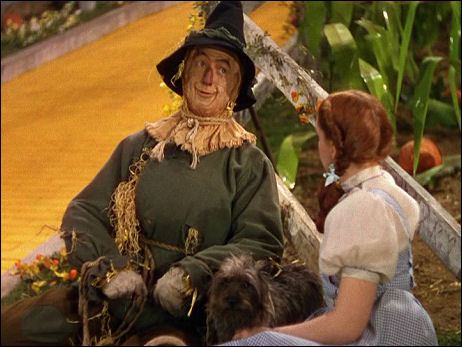
The new Wizard is an example of “a basic Blu-ray trade-off,” I wrote. “The grain that is in the negative is brought out in a way that catches your eye like never before. It’s not a problem, but there’s no ignoring it. I’m not putting the grainy aspect down, per se. I fully respect the decision of Warner Home Video technicians not to overly scrub or digitally tweak or Patton-ize the original 1939 elements.

But I am saying that Dorothy Gale, Auntie Em, Uncle Henry and the three farm hands are now covered in billions of micro-mosquitoes…a smothering deluge I hadn’t been as aware of in years past.”

Harris wrote that “viewers in 1939, 1954 and beyond never saw the grain in Technicolor films because the process did not reproduce it. Between the optics of the era, the optical printing process toward the creation of printing matrices, the metal dye imbibition system, the mordant in use at the time, as well as imperfect registration, which was covered by the overall softness…Technicolor films had a wonderful, almost grain-free, velvety look, which is nothing like the new Bluray.

“There are many ways to skin a cat. The new Wizard of Oz Bluray, which faithfully reproduces the grain structure of the original negatives (with the exception of the opening reel, which is from a dupe source), is one of them.

“Leaving the original grain structure in was a technical decision. WHV technicians have delivered an excellent piece of work, but the Oz Blu-ray has a pronounced grain that wasn’t there when audiences first saw the film. The image is now very sharp, albeit with the original grain structure. But trying to eliminate the grain can lead to a very tenuous situation at best, as each shot must be worked over to make certain that problems do not arise.”
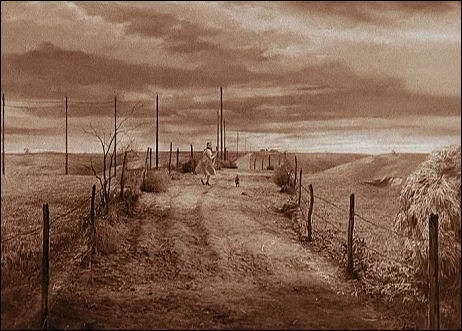
We then spoke on the phone and Harris re-explained:

“There are many ways to reduce grain,” he said. “Either you throw the film out of focus, which is what most people do, and then you sharpen it slightly and raise the contrast. Or you send it to Lowry Digital, which is the only shop in town which has the ability to reduce grain without losing resolution.

“The people who made The Wizard of Oz 70 years ago knew what would show up and what wouldn’t,” he pointed out. “The final result was a beautiful, velvety, slightly soft-focus print with good contrast to it, and it looked gorgeous on screen.

“But if you take the original negattve and then show it to the public [as WHV has with its new Bluray], you’re going to see the original grain structure that the original audiences never saw. But if you remove it…if you remove the grain and you hold the resolution then you’re going to see the wigs and make-up, sets, costume details… all the other problems.

“The other way —- the Lowry way — is to remove the grain, increase the resolution and then put back in a slight level of grain to make it look like film. But one has to acknowledge that whomever is leading the project is going to have to carefully examine every shot in the film to make very certain that they aren’t opening the proverbial Pandora’s box, and creating problems that were never there before.

“Warner Home Video did nothing wrong. They did a great job within their criteria, and I don’t have a problem with it. God knows if you lessen any grain on an older film in any primitve way, you’re really asking for trouble. Like Fox got into trouble with the overly scrubbed-down Blurays of Patton and The Longest Day.
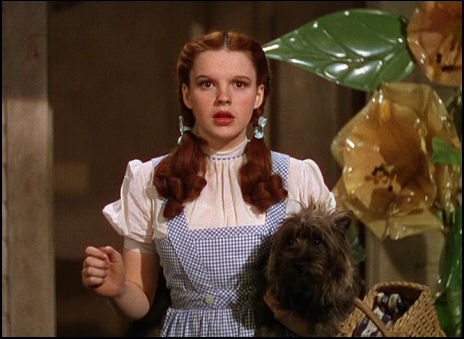
“And if you take all the grain out, as the Lowry people can, it’s like you’re watching the actors through a very clean window. But with older films, like Michael Curtiz‘s Robin Hood, removing too much grain can make some of the armor looks like painted cardboard, and then you’re seeing things that were never meant to be seen.”

Harris suggested at the end of our conversation that I might want to slightly turn down the sharpness level on my 42-inch plasma. I said I might. But then I thought about this later on and reminded myself that I adore the sharpness level, and that pretty much every Blu-lray I’ve watched on it looks fantastic so why should I futz around with it just so The Wizard of Oz looks less grainy?

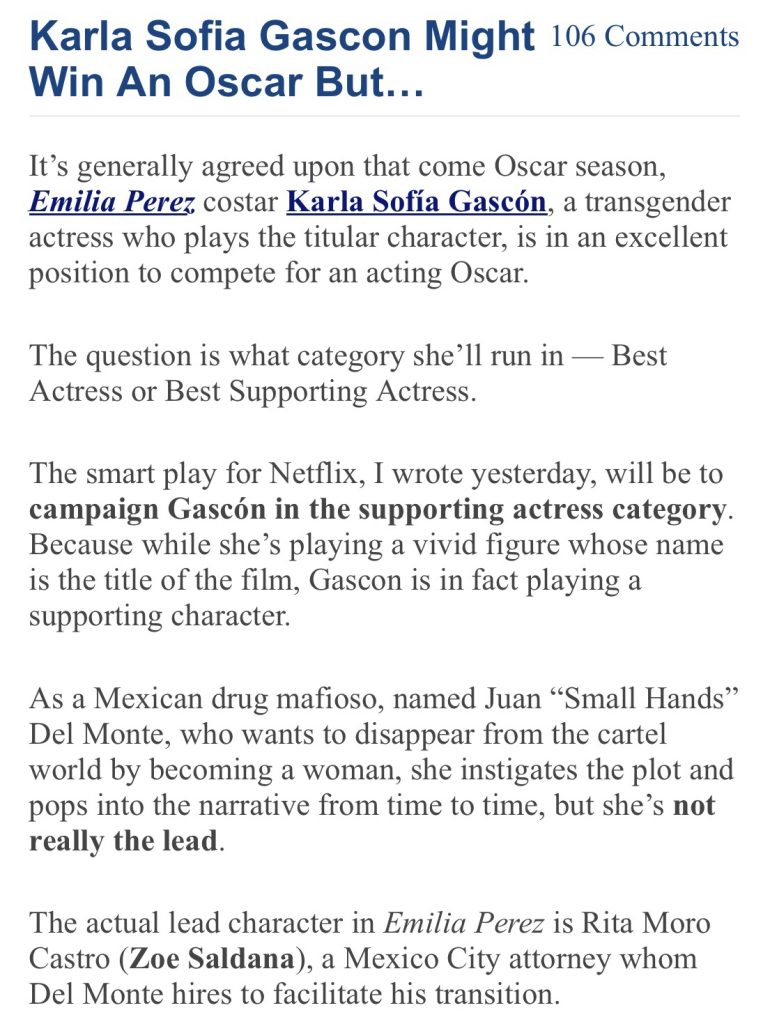
Poland Has Bravely Stated That Karla Sofia Gascon Doesn’t Play “Emilia Perez” Lead

…and in so doing has probably alienated the Netflix marketing honchos who are seemingly invested in selling the idea that the 52-year-old Gascon is a major Best Actress contender.

Not only do Lisa Taback and Kyle Buchanan apparently disagree with Poland, but the entire community of whoo-whoo trans celebrationists are almost certainly enraged by this admission, and are possibly up in arms.

HE truly respects Poland for defiantly posting the truth about Gascon and the film’s real lead, played by Zoe Saldana.

In THB #595: Emilia Perez, Poland declares that Saldana’s Rita Moro Castro, a Mexico City attorney (Poland calls her a “functionary”) whom Gascon hires to help facilitate his/her gender transition and organize his/her disappearance, “happens to be the lead of the film…the only absolute truth-teller…the only one who knows pretty much everything.”

The bottom line is that any award-season columnist who disputes the validity of Gascon’s Best Actress campaign has more or less slit his or her throat as far as a Netflix Emilia Perez ad buy is concerned.

I said the same thing in a 6.19 post, to wit:

Netflix marketers can still change their minds by pushing Gascon for a Best Supporting Actress Oscar, which she would obviously and absolutely win hands down, just as Killers of the Flower Moon’s Lily Gladstone would have easily won if she had decided to campaign in supporting rather than lead.

I’m presuming that running a Gladstone-styled identity campaign by way of a reality-denying Best Actress assertion is what Gascon and Netflix have in mind.

Winning isn’t the point — the idea is to game the system in order to validate and celebrate the identity of the contender (i.e., the first trans actress to mount a game-changing bid for a Best Actress Oscar).

If James Carville was a woke-minded Netflix marketing consultant, his Emilia Perez slogan would be “it ain’t the performance, stupid…it’s the woke-trans bounce of it all.”

Read more

Will Ya Look At This Guy?

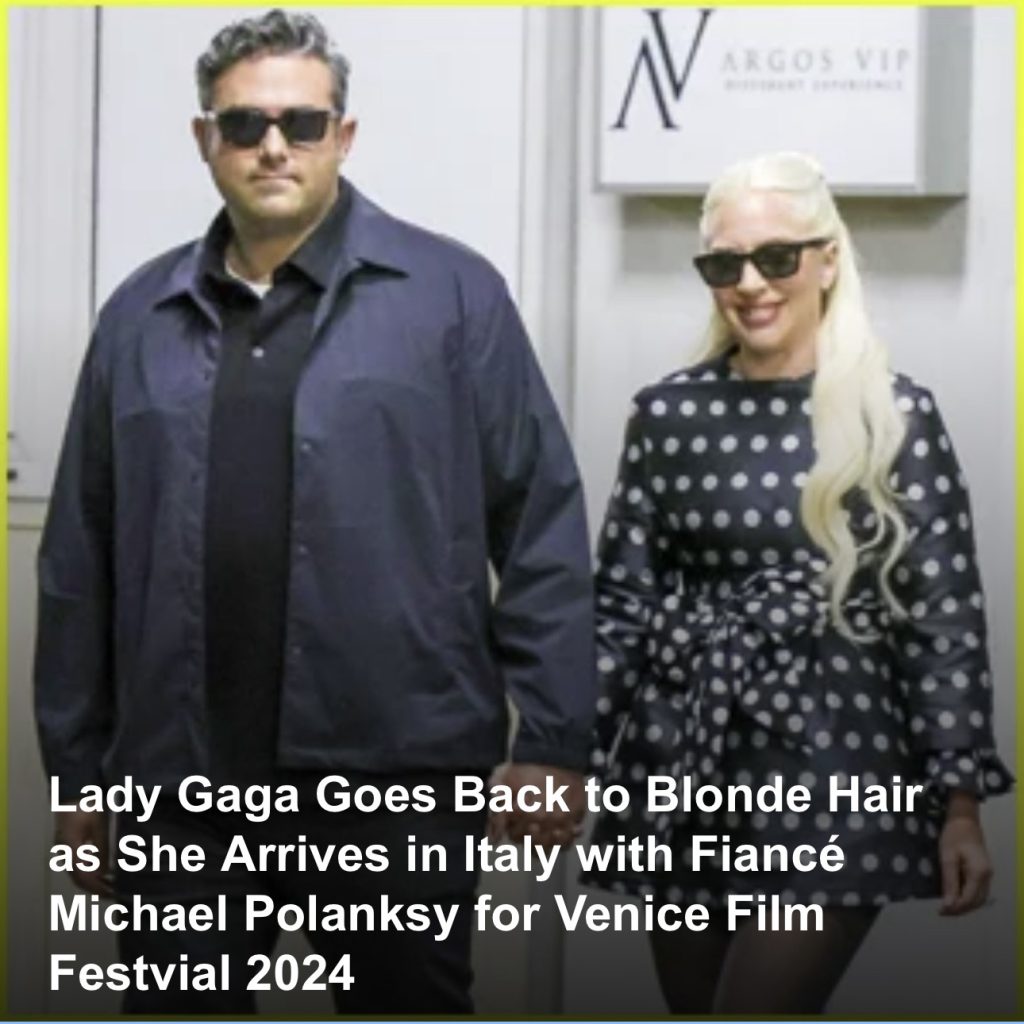
Lady Gaga, an X-factor art God and super-celeb by any yardstick, presumably has the pick of the litter when it comes to boyfriends, and yet for the last four years she’s been with swarthy, barrel-chested rich dude and Sean Parker bro Michael Polansky. And now she’s engaged to the guy.

This is the best she can do? Look at that L.L. Bean shirt-and-jacket combo he’s wearing — he looks like an unshaven, beer-bellied New Jersey dad hanging out in a hardware store or some guy coaching a high-school football team or, like, the co-owner of a Cranford, New Jersey bowling alley.

HE to Polansky: If you hook up with an ultra-glammy musician you’re expected to “get with the program” to some extent…to at least half-adopt her style and embrace her aesthetic attitude and, you know, join the cool kidz team.

I’m sorry but Polansky’s chowderhead beefalo Mall of America outfit obviously doesn’t make it.

Owen Isn’t Much Of A Fan Either

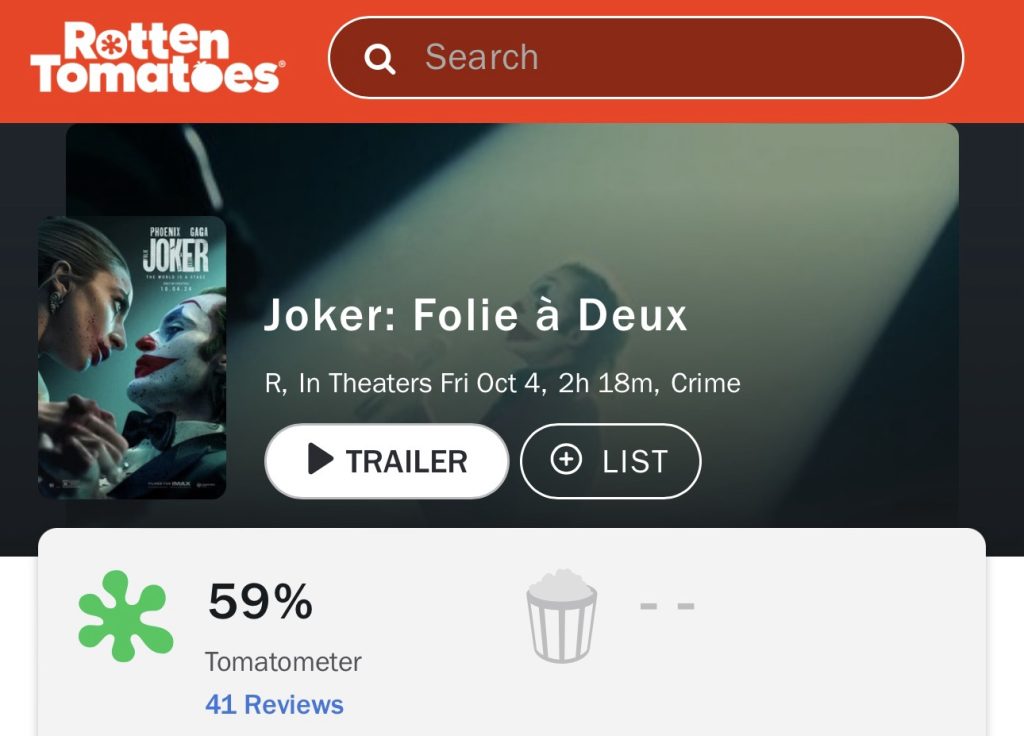
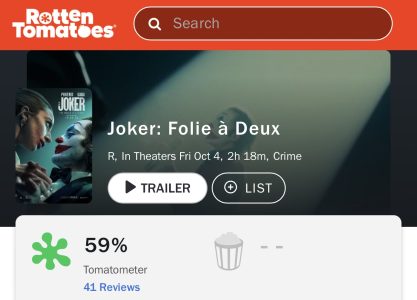
From Owen Gleiberman’s Variety review of Joker: Folie a Deux, which appeared just after 1 pm eastern today:

“I should mention that not enough happens in Folie a Deux. The movie is two hours and 18 minutes long, and here’s the entire plot:

“Arthur (Joaquin Phoenix) is wasting away in Arkham State Hospital. He meets Lee (Lady Gaga), who devotes herself to him. He goes on trial, and the is-he-a-dual-personality-or-just-a-criminal debate unfolds. A verdict is reached. A fateful bomb explodes. The end.

“As a critic, I’ve experienced my share of debates, but I have never understood the morally judgmental quality that hung over the criticisms of Joker. That the film invited us to have a deep identification with a twisted sociopath wasn’t, in my book, a weakness; it was a strength. The movie was, among other things, an allegory of the Trump era, but it’s almost as if the critics were saying, ‘We don’t like the movie because Arthur is a nasty incel who leads an uprising just like Trump!’

“To me, the criticisms of Joker were sort of comparable to a studio executive giving notes that basically said, ‘Raging Bull‘s Jake LaMotta isn’t likable enough.’

“Did the critics, with Joker, turn into cautious executive scolds? In my opinion, they did. But the upshot is that Todd Phillips, making what I think is a huge mistake, listened to them.

Joker: Folie à Deux may be ambitious and superficially outrageous, but at heart it’s an overly cautious sequel. Phillips has made a movie in which Arthur really is just poor Arthur; he does nothing wrong and isn’t going to threaten anyone’s moral sensibilities. In fact, he actually blows the only good thing that ever happened to him — winning the love of Lee’s Harley Quinn — because he denies the Joker in himself. He’s now just a singing-and-dancing puppet clown living in his imagination.

“Is that entertainment? Audiences, I suspect, will still turn out in droves to see Folie à Deux. But when it comes to bold mainstream filmmaking, it’s the scolds who are having the last laugh.”

Paola Camacho on “Joker 2” — Stans Will Hate “Pussy-Whipped” Arthur Fleck

Consider Paola Camacho‘s 9.4.24 Venice Film Festival review of Todd PhillipsJoker: Folie a Deux (Warner Bros., 10.4), pasted below.

Pay particular attention to (a) her passage about the power dynamic behind Joaquin Phoenix‘s Arthur Fleck and Lady Gaga‘s Harley Quinn having been “switched completely in a way we’ve never seen,” not to mention (b) Paola’s statement that “for lack of a better phrase, the Arthur / Joker character [in this film] is pussy-whipped.”

Paola #2: “Anyone who loved the first Joker will hate this one, and anyone who was critical of the first one will love this one. I, for one, love both. They are two entirey different [films].”

Paola #3: “The hard stans will inevitably tear this film apart” because it doesn’t do that ecoectrd Arthur/Joker incel-madman thing.

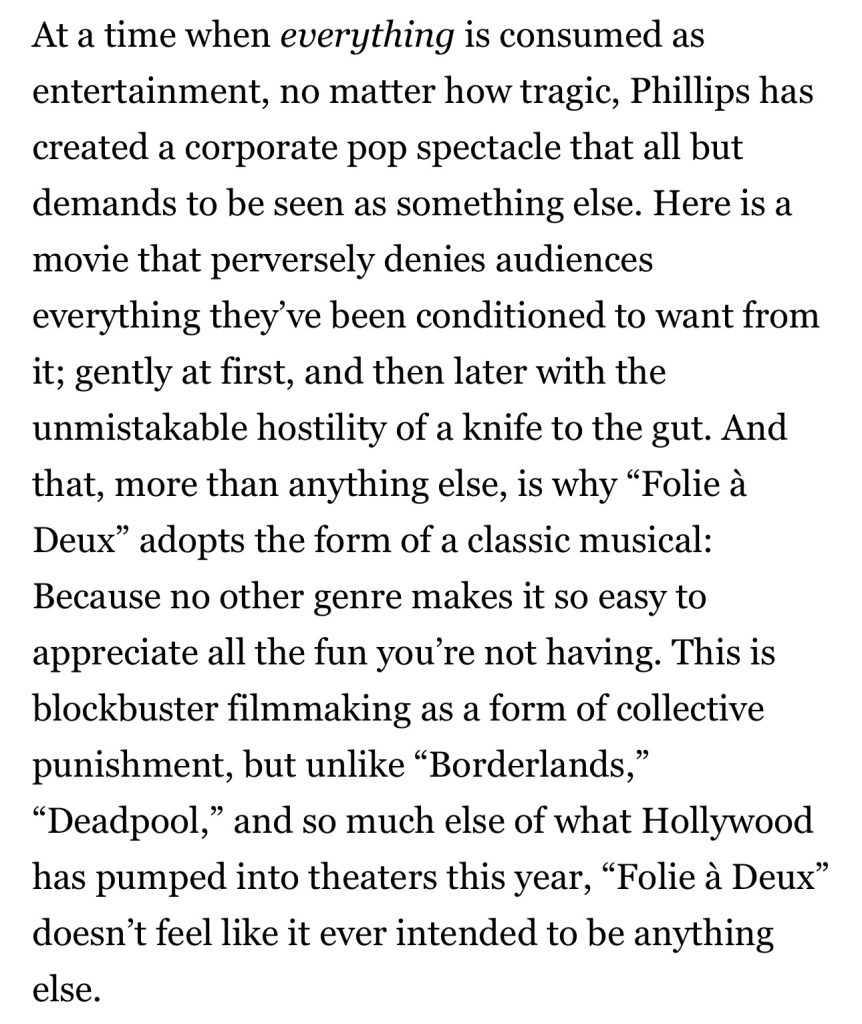
Here’s her entire review:

Clayton Again Raises Eyebrows

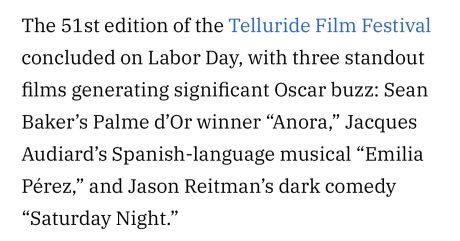
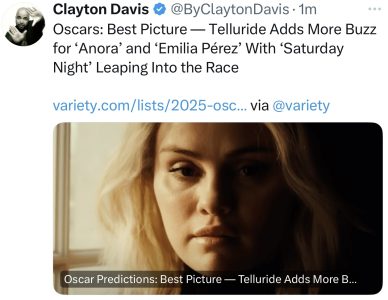
Within the past 24 hours Variety’s Clayton Davis, the well-known, DEI-brand columnist who’s always keeping close tabs…a day ago Clayton wrote (and then tweeted) that the three biggest Oscar contenders to ignite at the 2024 Telluride Film Festival were (1) Sean Baker’s Anora (true), (2) Jacques Audiard‘s Emilia Perez (also true) and (3) Jason Reitman’s Saturday Night (probably not outside of the writing, Best Supporting Actress and production design categories).

The forehead-slapper isn’t what Clayton chose but what he omitted —- Edward Berger’s Conclave, easily the most highly favored 2024 Best Picture Oscar contender as we speak…no question, hands down.

And yet Clayton declined to mention it in his Telluride triumvirate piece. I know that ignoring Conclave at this stage of the game is total wackadoo. There must be a Clayton reason that makes sense. Some slight or resentment, some political consideration.

I suspect it’s not the “too many white guys” complaint because Lucian Msamati, a British-Tanzanian actor of color, plays a senior supporting character, Cardinal Adeyemi, plus there’s a very woke-friendly plot revelation that puts a certain kick into the narrative.

Beautiful Descriptive Passage

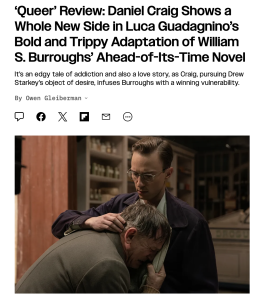
From Owen Gleiberman‘s Venice Film Festival review of Luca Guadagnino‘s Queer:

Daniel Craig, shifting about a dozen gears from James Bond, doesn’t make the mistake of impersonating the older William Burroughs who became a punk icon in the ’80s: the dry voice, the beady-eyed stare of hostility. Craig gives us a pinch of that glowering Burroughs DNA, but the trick of his performance, which is bold and funny and alive, is that he’s playing the younger Burroughs (at the time, the author was around 40), before he’d passed through the looking glass of cultivated insanity to write his visionary novel of American chaos, ‘Naked Lunch.’

“This is Burroughs before he got famous, when he was just…a man, pursuing what his instincts told him to. Craig makes him a nasty, witty literary dog laced with vulnerability. Pounding back shots of tequila, spitting out winding assertions like ‘Your generation has never learned the pleasures that a tutored palate confers on a magnificent few,’ he’s a troublemaker, an abrasive soul. But he is also, deep in that bitter heart of his, a romantic. He tries to maintain power in every situation, but as soon as he meets Eugene, we see that the desire for love has supreme power over him.”

Sluggish Alamo Lazybones

When I began driving north from Albuquerque last Wednesday afternoon, the left-front tire on my Alamo rental car (a black Hyundai Elantra) had a weak tire pressure reading. I was pressed for time so I just drove on. But on my journey back to Albuquerque, which began yesterday in the mid afternoon, the tire pressure was down to 19. And then 15 and 14, and then 10 and 9. I stopped twice to inject compressed air (in the Colorado towns of Rico and Dolores) but the pressure stayed low.

I called an Alamo rep to report the problem. She suggested that I drive to Durango La Plata airport and exchange my Elantra for another car. There was one chubby 20something woman manning the desk for not just Alamo but also National and Enterprise, and after serving several just-arrived customers for an hour she told me there were no available cars to exchange.

By the time I arrived in Farmington the tire pressure was near zero. Call it flat. It took several infuriating, late-night calls with a variety of undereducated Alamo 20somethings with a minimal command of English to finally arrange for a tow-truck guy to drop by the Journey Inn motel and change the tire. (It didn’t happen until this morning.) Except they wanted me to pay $75 for the service.

HE: “It’s your car and your flat tire, and you want me to pay the local tow-truck guy?”

The guy removed the empty tire and replaced it with one of those baby tires…fine. Except the baby tire has a glued-on warning that says in bold letters that I shouldn’t drive faster than 50 mph or 80 kph.

HE to tow-truck guy: “So I can’t drive to Albuquerque with this thing?” Tow-truck guy: “I wouldn’t.”

I guess the only responsible thing is to buy a decent tire somewhere in Farmington and have it put on and then work out the expenses with Alamo back at Albuquerque Sunport. But before I do this I want assurances from the Alamo guys that they’ll deduct this cost from my six-day rental fee of $377. Excerpt I’ve called them five times this morning and they won’t pick up, and I can’t leave a voicemail message.

I also hated the way the out-sourced Alamo reps asked me if I’m calling “from a safe location.” One of them actually asked me if I was “feeling safe” at the end of one of the calls. This is a Millennial thing…”are you feeling safe, oh my little squishy weenies?”

HE to Alamo Millennials: “Nobody wants to feel threatened or uncertain or insecure…nobody wants to be Janet Leigh in that motel room scene in Touch of Evil…but my feelings of safety and assurance have nothing to do with you or your level of barely-there, nodding-out service.”

Vaguely Weird Feelings

Culturally speaking, New Mexico is not what most of us would call a vibrant, aspirational society. It certainly doesn’t feel that way.

Like most places New Mexico is seemingly well developed. It has its rich, elite communities and the exuding of at least a semblance of educated awareness, but generally speaking I’m not feeling much in the way of upscale vibes. I’m sensing a certain current of grunty lowlife attitude…a feeling of resignation.

I’ve been staying at a downmarket motel in Farmington (about three hours north of Albuquerque) and watched a couple of anti-Kamala Harris ads last night…vicious stuff.

Emerson has Harris polling at 52% vs. Trump’s 42%. All I’m saying is that I can really feel the bumblefuck vibe in this corner of the state.

Why Don’t They Just Say It?

In 2001: A Space Odyssey, the mysterious black monolith that suddenly appears before the tribe of lesser “Dawn of Man” apes (i.e., the ones who lost access to the water pond because a tribe of tougher, snarlier apes kicked them out)…the monolith is a cosmic blessing, a civilization-saver…a bringer of deliverance, transcendence, possibility.

Now hear this: the monolith is basically conducting a massive scientific experiment by attempting to spawn intelligence on our planet…it’s a bringer of intelligent initiative and awareness and technological potential…an explorational sentinel sent by aliens of incalculable intelligence, the purpose being to trigger and awaken the lesser apes to evolutionary advancement and put them on the road to eventually becoming intelligent human beings.

In the 21st Century present, the very same monolith (or a close cousin of the one that fiddled with the apes) has been found buried under the surface of the moon. Once sunlight hits it, a piercing radio signal is generated…a signal aimed at the hugely insubstantial gas planet of Jupiter, easily one of the most disappointing planets in our solar system.

Light hitting the no-longer-buried monolith informs the super-intelligent aliens that humans have advanced to a certain noteworthy point in their evolution.

All the HAL vs. Dave and Frank stuff aboard the Discovery is the only plotty part of the film, and was basically generated by Stanley-the-misanthrope…all about how artificial intelligence is just as capable of hubris and ruthlessness and self-destruction as the humans who created it.

The finale is wonderful, of course, and the basic thing that Keir Dullea‘s Dave Bowman seems to know deep down is that the glorious monolith represents damn near everything…it’s the fountain of eternity and the central engine of life…continuity, God, essence, worship, wonder and infinite expansion.