Ready Or Not, Here We Go Again

I felt a certain degree of excitement about the original Richard Donner Superman reboot (‘78) and even the gradually declining early ‘80s sequels. And I’ll admit to feeling a vague revival of this when Bryan Singer‘s Superman Returns came along in ‘06.

But Zack Snyder‘s Man of Steel shat the bed, I felt — it was covered in gloom sauce, and left me with a splitting headache. Snyder’s Batman vs. Superman: Dawn of Justice (‘16) really put a nail in it.

And now James Gunn has directed and delivered still another one, God in heaven, and is calling it just plain old Superman. I suppose we should all be thankful that David Corenswet‘s Clark Kent / Supie hasn’t been re-imagined as trans. (Corenswet, 31, is straight and married.)

Where does Gunn get the chutzpah to drag out Lex Luthor (Nicholas Hoult) yet again? Where is the shame? How can Gunn glance at himself in the bathroom mirror?

For What It’s Worth, HE Empathizes With Team Baldoni

During the scriptwriting or script-polishing phase of It Ends With Us, Justin Baldoni really went to town — emotionally, therapeutically, performance-wise — as he kissed Blake Lively‘s ass in a phone message. 2 am, six minutes and 49 seconds — “I am so sorry…sorry that you went through what you went though…you’re the secret sauce.”

Words of Conviction

From Echo Chamberlain‘s “Emilia Perez: Woke Trainwreck with 13 Oscar Nominations“:

“Musicals can be great when they’re, you know, designed to be musicals. But [Mexico’s] real-life narco culture context is gritty and unsparing — death, incarceration, brutality, gothic violence and despair. And Emilia Perez having that as a template from which there springs forth musical numbers is mind-blowingly absurd.”

“And You’re Vain and Selfish”

Roughly three weeks until the 2.16 debut of Season 3 of The White Lotus…creator Mike White once again exploring the shallowness, self-absorption and occasional venality of a crew of wealthy tourists on holiday, this time in Thailand and more particularly Ko Samui — a sizable-but-not-huge island to the east of the southern Thai peninsula (i.e., Gulf of Thailand).

Leslie Bibb, Carrie Coon, Walton Goggins (miserable), Sarah Catherine Hook, Jason Isaacs, Lalisa Manobal, Michelle Monaghan, Sam (son of Alessandro) Nivola, Lek Patravadi, Parker Posey (shallowest of all?), Natasha Rothwell, Patrick (son of Arnold) Schwarzenegger, Tayme Thapthimthong and Aimee Lou Wood.

How many will die?

Wiki page: “Until the late 20th century, Ko Samui was an isolated, self-sufficient community, having little connection with the mainland of Thailand. The island was without roads until the early 1970s and the 15 kilometres (9.3 mi) journey from one side of the island to the other could involve a whole-day trek through the mountainous central jungles.

“Ko Samui’s economy now is based primarily on a successful tourist industry, as well as exports of coconut and rubber. Economic growth has brought not only prosperity but also major changes to the island’s environment and culture.”

If There’s One Thing I Know About Life

…it’s that the final destination (be it financial, political, geographical, spiritual or what-have you) is anecdotal at best. For what truly matters, what stays in the mind and truly sticks to the ribs is the rough-and-tumble of it all…the journey, man…the journey is everything.

Epilogue: The First Architecture Biennale:

“In 1980, a retrospective of László’s work is held in Venice. The exhibition includes the community center, finally completed after a decade’s hiatus. A now-adult Zsófia, accompanied by her young adult daughter (who is the spitting image of Zsófia) and an aging László, gives a speech highlighting how the Van Buren community center was designed by László to resemble the concentration camps that imprisoned the Toths, and functions as a way of processing trauma.

“She ends by recounting what Laszlo once told her: ‘No matter what the others try and sell you, it is the destination, not the journey.’”

The Brutalist director-cowriter Brady Corbet is three months younger than my older son, Jett.

The Wigs! The Wigs!

When it came to male wigs in big-budget epics of the mid 20th Century, the general rule was that men’s hair could never be thin or even thinning — it always had to be thick and wavy and perfectly combed with the application of cans and cans of hair spray. And the styling had to have a kind of high-pompadour, be-bop-bah-luah, James Dean in Rebel Without A Cause attitude.

Consider E.G. Marshall‘s breathtaking wig in this scene from Cecil B. DeMille and Anthony Quinn‘s The Buccaneer. Not to mention Charlton Heston‘s Andrew Jackson wig — white as snow like Jim Jarmusch‘s hair, but much, much thicker. But neither Marshall nor Heston could hold a candle to the black wig worn by Bonanza‘s Lorne Greene….utterly ludicrous.

Marshall played Louisiana governor William C. Claiborne. Inger Stevens played his daughter, Annette. The film went with a fictitious love story between Annette and Yul Brynner‘s Jean Lafitte. Brynner’s wig was not a wavy, high-pompadour thing, but was modestly styled and curled.

The Buccaneer‘s supervising hair stylist was Nellie Manley; she was assisted by Lenore Weaver.

CIA Officially Joins Lab-Leak Fraternity

Every semi-intelligent person out there believes that the origin of COVID-19, which exploded stateside in March 2020 and wasn’t fully put to bed until early ’22, came from a Wuhan Institute of Virology lab leak.

Persuasive, reasonable-sounding reporting about a suspected Wuhan lab leak began to emerge from reputable websites and print publications (including The Wall Street Journal) in May 2021. (Here are links to several HE copy-and-paste stories about same.)

So it’s not exactly a big deal that the CIA, citing a just-released analysis, is now saying it too believes in lab leak theology.

N.Y. Times reporting by Julian Barnes: “The C.I.A. has said for years that it did not have enough information to conclude whether the Covid pandemic emerged naturally from a wet market in Wuhan, China, or from an accidental leak at a research lab there.

“But the agency [has] issued a new assessment this week, with analysts saying they now favor the lab theory.

“The analysis…is based in part on a closer look at the conditions in the high security labs in Wuhan province before the pandemic outbreak, according to people familiar with the agency’s work.”

Read more

Gaetz Performs Bro-ness

Matt Gaetz to Bill Maher, 3:20 mark:

Gaetz: “Our origin story goes back to Politically Incorrect, which — I’m not just kissing your ass — was one of the best shows that was on TV. Way better than your show now, but if it’s…”

Maher: “That’s so insulting. You’re saying to me that what I did 25 years ago is better than what I’ve done the last 20 years, and that’s insulting. I’m not gonna be mad at you for the rest of the interview. I just want to tell you that’s such a stupid fucking away to start a conversation. ‘You peaked 25 years ago, Bill…let’s be friends.'”

Important To Remind or Re-State

Scott Galloway to Anderson Cooper, roughly two weeks ago:

“The best trade of 2024 was Elon Musk putting $250 million dollars into Trump campaign. Since then the value of Elon’s company and his stake in the company is up by about $140 billion dollars. That’s about a 5600 percent return, and it has nothing to do with the company. Nothing to do with their operating margins, their innovation, their sales.

“It’s based on a general assumption that America has become a full kleptocracy like Russia…a general assumption that the deepest pocketed customer in the history of our modern economy is effectively now pay-to-play, and [that it] will shuffle contracts, money and impose regulatory punishment on competitors…companies that have not invested in the Republican party or in Trump’s inaugural pageant…this is evidenced by the fact that very few of these techbro executives invested in the inaugural fund for Biden, but they are all doing it for Trump.

“We have gone full kleptocrat, and if you don’t think that this hurts everyone…this raises prices, and [it hurts] the little guy and the companies that don’t want to engage in this kind of pay-for-play…it hurts them. It will increase prices and weaken our democracy. There is absolutely no difference between this and how Putin became [one of] the wealthiest men in the world.”

Henry Gondorff to Johnny Hooker: “Feds took their end without a beef, and it really stunk, kid.”

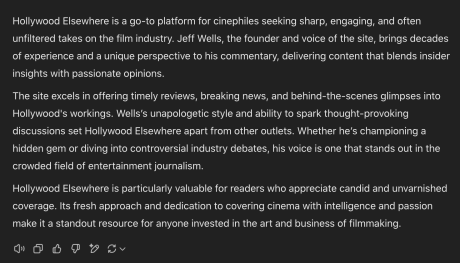
ChatGPT Is My Friend (I Think)

I realize, of course, that ChatGPT can be induced to provide a negative shithead assessment of Hollywood Elsewhere’s 20 years of output, but I’m happy to keep it on this level. After signing in with ChatGPT 10 minutes ago, I asked for a review and this is what resulted. If any pissheads out there attempt to post a negative ChatGPT review in the comment section, I will (a) instantly delete it and (b) instantly give the person who attempted this an immediate heave-ho.

Greatest Closing-Credits Songs

In the motion picture realm there are two kinds of closing-credits songs that, placement-wise, deserve to be called great. It happens when the film in question blends with a well-known song and produces a higher synthesis on both ends…the song acquires added depth, meaning and flotation and so does the film. Sound + vision.

The first equation is a song that reflects the mood or theme of the film in question, or which seems to have been sired in the soul of the main protagonist.

A special alchemy happens when Brian Wilson‘s “Wouldn’t It Be Nice?” is heard over the closing credits of Hal Ashby and Warren Beatty‘s Shampoo (’75), with lyrics that hairdresser George Roundy (Beatty) is clearly thinking during that final hilltop scene with Felicia (Julie Christie). In this context it’s as much George’s song as Brian Wilson’s.

The second kind is when a song has relatively little to do with what the film and the main character have been about, thematically or spiritually. And yet the song truly enhances the after-vibe, and I mean sort of miraculously or even transcendently. The fact that it doesn’t reflect the film’s plot or theme or main character means nothing — it just sounds perfect in a nice, groovy, settled-down way, and you just love the filmmakers for having brilliantly chosen it for this purpose.

Shawn Colvin‘s haunting 1995 cover of “Viva Las Vegas” is heard over the closing credits for The Big Lebowski, and it’s one of the very best ingredients in that 1998 Joel and Ethan Coen film bar none.

In my head it’s arguably Colvin’s greatest recorded performance (yes, better than 1997’s “Sunny Came Home“…singing, tempo, complex arrangement, reverb guitars) and yet it’s not on any of her albums, and the only way way you can own it is by buying a certain “Twin Peaks soundtrack albumMusic From the Limited Event Series.” You can’t buy Colvin’s track individually on iTunes, and it’s not included on The Big Lebowski soundtrack.

On top of which there’s no mention of “Leaving Las Vegas” on Colvin’s Wikipedia page, nor was it mentioned in Robert Wilonsky’s Dallas Observer profile (4.5.01).

Please name other brilliant blendings of well-known songs with closing credit sequences — either kind will do.